
Tag Archives: State

Will Canada add polgygamy and polyamory on top of same-sex marriage?

Here’s an article from the American Spectator. (H/T RuthBlog)

Excerpt:

While the United States is occupied with the federal challenge to California’s Proposition 8, Canada has its own pending marriage case, which is likely headed for the Canadian Supreme Court. Canada, which redefined marriage nationwide to include same-sex couples in 2005, against the backdrop of successful provincial lawsuits against the country’s marriage law, could be moving on to bigger things — literally. Specifically, polygamy and polyamory, as this case invokes the question of whether the government can continue to criminalize multiple-partner marriages. The case itself, initiated by the British Columbia Attorney General under a special provision of that Province’s law, arises in the wake of failed prosecutions of polygamous sect members in British Columbia.

Advocates of polygamy and polyamory seem to have an ally in the Law Commission of Canada, a statutory body of government appointees who propose changes to modernize Canadian law and report to the Justice Ministry. In 2001, the Commission issued a report, Beyond Conjugality: Recognizing and Supporting Close Personal Adult Relationships, that questioned the continuing illegality of consensual polygamy in Canada.

Polyamory is the end-game of proponents of same-sex marriage, but it poses even more problems for children:

If we take seriously the idea that marriage laws have an educative function, polyamory raises red flags. On each of the core functions of marriage — promoting fidelity, providing a tie between children and parents, securing permanence for spouses and their children — polyamory seems particularly harmful. Both traditional polygamy and polyamory promote types of infidelity (though the former is of a more orderly variety), of course, but the chaos of polyamory blurs distinctions of parenthood more significantly than does a setting where a child has an established set of parents and lots of half-siblings. The ethic of “choice” at the root of polyamory does not bode well for permanence either.

As complicated as the day to day existence must be for children in homes with multiple adults acting as “parents,” the breakup of polyamorous relationships would be dramatically more complicated for children. There would be an exponential increase in the possible divisions of a child’s time, of decision-making authority and demands for the child’s loyalty, when the dispute involves three or more people than when only two disputants are involved.

Clearly, when it comes to marriage, the adage “the more the merrier” does not apply.

I should note that research on legalizing polygamy is funded by the government in Canada. The 3 authors of that study are feminists, and like third-wave feminists, they oppose the unequal gender roles inherent in traditional marriage. Studies showing the harm caused by polygamy and polyamory presumably do not receive funding from the government, since those studies would not create domestic-dispute-resolution work for the government’s courts. Traditional marriage is bad for government, because it doesn’t require bigger government agencies, or more social programs. Traditional marriage has to go if government is to continue to expand its power.

At some point, I would expect the government to begin to regard traditional marriages and families with suspicion and distaste.
Stephen Baskerville’s new academic paper on the family

An excellent paper explaining how the breakdown on the family isn’t caused by fathers abandoning their posts. It’s caused by specific government policies. And the conseequence of this crisis is that government size and power increases to deal with the problems.

Here is the PDF.

Excerpt:

Unilateral divorce involves government agents forcibly removing legally innocent people from their homes, seizing their property, and separating them from their children. It inherently abrogates not only the inviolability of marriage but the very concept of private life.

If marriage is not a wholly private affair, as today’s marriage advocates insist, involuntary divorce by its nature requires constant government supervision of family life. Far more than marriage, divorce mobilizes and expands government power. Marriage creates a private household, which may or may not require signing some legal documents. Divorce dissolves a private household, usually with one spouse having done nothing legally wrong. It inevitably involves state functionaries—including police and jails—to enforce the divorce and the post-marriage order. Otherwise, the involuntarily divorced spouse will continue to enjoy the protections and prerogatives of private life: the right to live in the common home, to possess the common property, or—most vexing of all—to parent the common children. These claims must be expunged by force, using the penal system if necessary.

Given that 80 percent of divorces are unilateral, divorce today seldom involves two people simply parting ways.10 Under “nofault” rules divorce often becomes a power grab by one spouse, assisted by people who profit from the ensuing litigation: judges, lawyers, psychotherapists, counselors, mediators, and social workers.

The most serious consequences involve children. The first action in a divorce is typically to separate the children from one parent, usually the father. Even if he is innocent of any legal wrongdoing and did not agree to the divorce, the state seizes his children with no burden of proof to justify its action. The burden of proof (and the financial burden) to demonstrate that they should be returned falls on him.

A legally unimpeachable parent can thus be arrested for associating with his own children without government authorization. He can also be arrested through additional judicial directives that apply to no one but him. He can be arrested for domestic violence or child abuse, even without evidence that he has committed any such acts. He can be arrested for not paying child support, even without proof that he actually owes it. He can even be arrested for not paying an attorney or psychotherapist whom he has not hired. In each case there is no formal charge, no jury, no trial. The parent is simply incarcerated.

And another one:

The growing confrontation between the family and the state reveals that the relationship between personal morality and freedom is more than a cliché. It illustrates the direct connection between the breakdown of traditional morality and tolerance of governmental intrusion and control.

Sacrifice for others begins in the family. The family is where both parents and children learn to love sacrificially, to put others’ needs before their own desires, and to sacrifice for the wellbeing and protection of the whole. If such responsibility does not begin in one’s own home among loved ones, it is not likely to begin at all. People unwilling to sacrifice for their own flesh and blood are not likely do so for the strangers who constitute their fellow citizens and country.

Linda McClain writes that families are “seedbeds of civic virtue” and “have a place in the project of forming persons into capable, responsible, self-governing citizens.”12 For the American founding fathers, argues David Forte, “The bridge from reining in ‘private passions’ to producing a ‘positive passion for the public good’ was the family’s inculcation of public virtue.”13

But we can say more. In the family, children learn to obey and respect authorities other than the state—God, parents, extended family, and others who are not government officials: pastors and priests, teachers, neighbors, coaches, and other figures of civil society. By accepting these authorities, the bonds to which often are reinforced with love, children learn that government is not the sole authority and claim on their allegiance and that it is an institution that can and must be limited.

And another:

When fathers protect and provide for their families, they will resist the state’s efforts to usurp those roles. Under their leadership, families are a force for limiting state power.

The single mother, by contrast, is ordinarily not predisposed to resist the state’s encroachment into her family. On the contrary, she usually demands it. She is our society’s principal claimant on a vast array of state “services” without which she cannot manage her children: services to keep the father away and extract money from him, services to feed and house and clothe the children, to baby-sit them, to educate them, and to control their misbehavior and criminality. As the state usurps the roles of protector and provider and disciplinarian, it becomes husband and father, and it has no incentive to limit its own power. Henceforth the state protects and provides. And the state demands obedience.

And one last one:

Under the divorce regime the authority of fathers and parents generally is fragile, because court orders can readily be obtained to undermine or countermand it. Family wealth—traditionally used by fathers to obtain obedience from children and put limits on government—is increasingly useless for both purposes, because it can be simply confiscated by the court and handed to whomever the court chooses: the wife or children or lawyers or government. Children need not learn responsibility with money, because the government hands it to them unconditionally after confiscating it from their fathers. Differences within the family are settled, not by negotiation or compromise or intervention by relatives or church, but by government orders.

It’s 17 pages of pure goodness. Marriage is better when you understand how subversive it is. Once you get away from the idea that it’s not about you having fun, it’s really quite an enterprise – a way of serving God by being unselfish and loving others.

Ontario man arrested for defending his home with a firearm

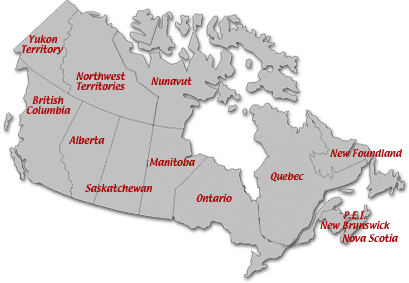
Political Map of Canada

From the Winnipeg Free Press. (H/T ECM)

Excerpt:

A Port Colborne, Ont., man whose home was attacked has ended up facing charges himself.

Niagara Regional Police say a man emerged from his home with a handgun and fired it after several Molotov cocktails were thrown at the home.

Police say three suspects wearing dark clothes got away in a car after the cocktails were thrown early Sunday morning.

There is nothing to suggest any of them were injured when the gun was fired.

By the time police and firefighters arrived, the homeowner had already doused several small fires and damage to the home was minimal.

Ian Thomson, 53, is charged with careless use of a firearm.

The point is that this is yet another step in undermining the traditional roles of men as being protectors and providers and moral leaders in their homes. Men are viewed as being unreliable because the responsible men are being passed over by young unmarried women, and when things don’t work out, they turn to government. It’s another step in the long march to turn men into immature wallets and sperm-donors who have no role in the family at all and just work at menial jobs, drink beer, watch sports, and sit around on the couch, while all-female arrangements (or the government-run day care system) raise the children.

What are the traditional roles for men?

Provider

Every time that the government taxes a man and redistributes his wealth, it removes the need for a man who can provide, and so women don’t have to choose good men to be providers. And that removes the responsibility of making good choices about men from a women. Moreover, if there is no father needed because the government pays for everything, then women don’t get the benefit of having a man to moderate them (which works in reverse, of course), and to help them to raise the children to have moral standards and a sense of accountability. The man gets the authority to do these things by being the primary breadwinner. Democrat dream programs like nationalized day care only marginalize men even more.

Protector

Every time the government passes restrictions on home defense with legally owned firearms, and even worse, on concealed-carry of firearms, it takes away the need for a woman to choose a man who is able and willing to protect his family. If a woman doesn’t have to depend on her husband to protect her (as a last resort), then she doesn’t have to court carefully and choose a man who has protective instincts, no criminal record, and who has a legally-owned firearm and the freedom to use it to defend her and the children. (Note: women should have concealed-carry permits and firearms, too – there is no difference between men and women here, both have to defend the nest and the chicks)

Moral/spiritual leader

Every time the government passes restrictions on smacking, school choice, mandatory sex education, etc., or undermines morality and religion in any other way, it undermines the role of the father as spiritual and moral leader, and makes it less important for a woman to choose a man who will be the spiritual and moral leader in the home. She won’t have to court as carefully, because it’s now the government’s job to educate the children on morality and spirituality. And the government will be there to undermine anything he does tell the kids with public schools, speech codes, etc.

The point of this is to show what happens when men and women vote for bigger and bigger government to provide more and more things. If women have sex with men too early and then develop the view that they are unreliable, then they vote for bigger government for security, then government will take over traditional male responsibilities. Similarly, the worst kind of lazy, cowardly, ignorant men will freely abdicate their obligations to work hard so that they can share with their neighbors and lead families. My point is to show how this can be be sped up or slowed down based on the policies people vote it. If you want men to have a BIGGER role in the family, then get rid of the safety net, cut taxes, and stop the courts and the police from penalizing men for acting like… men. You get the men you vote for. So vote wisely!