
Tag Archives: Spending

NPR planned to hide $5 million donation from radical Muslim group from government

(44 minutes)

Story from the left-wing Washington Post.

Excerpt:

An NPR fundraising executive said her organization would be willing to shield a would-be donor from a government audit by keeping the donor’s name anonymous, according to a series of surreptitiously recorded phone calls released on Thursday by a conservative activist.

Betsy Liley, NPR’s senior director of institutional giving, made the comments to a man posing as a trustee of a fictitious Muslim charity, which the man had said had connections to the Muslim Brotherhood, an Egypt-based group that has suspected ties to terrorists.

Liley’s conversations with the man were captured as part of a sting operation orchestrated by James O’Keefe, who has targeted the ACORN community group and Planned Parenthood with secret recordings.

O’Keefe secretly videotaped Liley’s boss, Ron Schiller, making demeaning comments about conservatives during a luncheon meeting set up to discuss what the NPR managers believed was a potential $5 million contribution. Liley was also at that meeting and briefly comments in the video.

Ron Schiller resigned from NPR on Tuesday for his role in the video scandal. The video’s release also led to the resignation on Wednesday of his boss, NPR chief executive Vivian Schiller.

In a lengthy follow-up phone call with Liley after the lunch, an O’Keefe associate posing as “Ibrahim Kasaam ” of the Muslim Education Action Center (a fictitious entity) expressed concerns that NPR, which receives government funding, would be subject to government audits or would have to disclose the source of its donations.

Liley responded, “If you were concerned about that, you might want to be an anonymous donor and we would certainly, if that was your interest, we would want to shield you from that.”

At another point, Kasaam asked Liley, “It sounded like you’re saying that NPR would be able to shield us from a government audit, is that correct?”

“I think that is the case, especially if you were anonymous, and I can inquire about that,” Liley said. She later informed Kasaam via e-mail that NPR’s management had cleared an anonymous donation from his group.

NPR had previously said, in the wake of the luncheon video, that it had “repeatedly refused” to accept donations from the organization.

NPR put Liley on administrative leave as a result of the video.

And they get millions of dollars of taxpayer money. It’s got to stop.
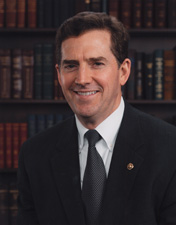
Republicans introduce national right-to-work legislation

Sen. James Demint

From the Hill.

Excerpt:

Eight Republican Senators introduced a bill Tuesday giving workers a choice as to whether to join labor unions, which they argue will boost the nation’s economy and provide an increase in wages.

Sen. Jim DeMint (R-S.C.), introduced the National Right to Work Act to “reduce workplace discrimination by protecting the free choice of individuals to form, join, or assist labor organizations, or to refrain from such activities,” according to a statement.

Seven other Republicans signed onto the effort: Sens. Tom Coburn (Okla.), Orrin Hatch (Utah), Mike Lee (Utah), Rand Paul (Ky.), James Risch (Idaho), Pat Toomey (Pa.) and David Vitter (La.).

“Facing a steady decline in membership, unions have turned to strong-arm political tactics to make forced unionization the default position of every American worker, even if they don’t want it,” Hatch said. “This is simply unacceptable. At the very least, it should be the policy of the U.S. government to ensure that no employee will be forced to join a union in order to get or keep their job.

“Republicans cited a recent poll they said shows that 80 percent of union members support having their policy and that “Right to Work” states outperform “forced-union” states in factors that affect worker well being.

From 2000 to 2008, about 4.7 million Americans moved from forced-union to right to work states and a recent study found that there is “a very strong and highly statistically significant relationship between right-to-work laws and economic growth,” and that from 1977 to 2007, right-to-work states experienced a 23 percent faster growth in per capita income than states with forced unionization.

“To see the negative impacts of forced unionization, look no further than the struggling businesses in states whose laws allow it,” Vitter said. “It can’t be a coincidence that right-to-work states have on balance grown in population over the last 10 years, arguably at the expense of heavy union-favoring states.”

DeMint blamed the problems faced by U.S. automakers on the unions.

“Forced-unionism helped lead to GM and Chrysler’s near bankruptcy and their requests for government bailouts as they struggled to compete in a global marketplace,” he said. “When American businesses suffer because of these anti-worker laws, jobs and investment are driven overseas.”

If you want to attract businesses, then you need to have pro-business laws. That’s where jobs come from – businesses.

Here’s an article about states who are trying to pass these laws to attract more employers.

Excerpt:

Currently 14 states beyond Indiana and Wisconsin are considering legislation that would limit union benefits and/or collective bargaining power. They are: Alaska, Hawaii, Maine, Michigan, Minnesota, Missouri, Montana, New Hampshire, New Mexico, Ohio, Pennsylvania, Virginia, Washington (state) and West Virginia. In any number of these states, supporters have planned or held rallies against the measures. But public support might be less than deep. According to a Rasmussen Poll conducted late last week and released Monday, 48 percent of likely U.S. voters sided with Wisconsin Governor Walker whereas only 38 percent sided with his union opponents; the other 14 percent were undecided. And 50 percent of the respondents favored reducing their home state’s government payroll by one percent a year for 10 years either by reducing the work force or reducing their pay. Only 28 percent opposed such action.

This is how we are going to turn the recession around. Cut off the spending on left-wing special interests – NPR, PBS, ACORN, Planned Parenthood, Unions. They all will have to pay their own way, just like the grown-ups do.

Government handouts make up 35% of all wages

From CNBC.

Excerpt:

Government payouts—including Social Security, Medicare and unemployment insurance—make up more than a third of total wages and salaries of the U.S. population, a record figure that will only increase if action isn’t taken before the majority of Baby Boomers enter retirement.

Even as the economy has recovered, social welfare benefits make up 35 percent of wages and salaries this year, up from 21 percent in 2000 and 10 percent in 1960, according to TrimTabs Investment Research using Bureau of Economic Analysis data.

“The U.S. economy has become alarmingly dependent on government stimulus,” said Madeline Schnapp, director of Macroeconomic Research at TrimTabs, in a note to clients. “Consumption supported by wages and salaries is a much stronger foundation for economic growth than consumption based on social welfare benefits.”

The economist gives the country two stark choices. In order to get welfare back to its pre-recession ratio of 26 percent of pay, “either wages and salaries would have to increase $2.3 trillion, or 35 percent, to $8.8 trillion, or social welfare benefits would have to decline $500 billion, or 23 percent, to $1.7 trillion,” she said.

[…]Social welfare benefits have increased by $514 billion over the last two years, according to TrimTabs figures, in part because of measures implemented to fight the financial crisis. Government spending normally takes on a larger part of the spending pie during economic calamities but how can the country change this make-up with the root of the crisis (housing) still on shaky ground, benchmark interest rates already cut to zero, and a demographic shift that calls for an increase in subsidies?

At the very least, we can take solace in the fact that we’re not quite at the state welfare levels of Europe. In the U.K., social welfare benefits make up 44 percent of wages and salaries, according to TrimTabs’ Schnapp.

You can see a nice graph of welfare spending and another graph of single motherhood in this post at Director Blue. He makes the same point I made about increased welfare spending destroys marriage by reducing the need for men in their traditional roles.