
Tag Archives: Spending Cuts

Ohio Senate passes John Kasich’s pro-life, pro-jobs, pro-child budget

From Life News.

Excerpt:

The Ohio state legislature today passed a state budget which includes multiple pro-life amendments ensuring the state is not involved in abortion funding with taxpayer money.

The state budget, House Bill 153, now advances to pro-life Governor John Kasich. Among other things, the state budget contains Ohio Right to Life amendments that will protect taxpayer dollars from paying for abortion.

The first amendment bans abortions from being performed in public hospitals. The second amendment prohibits abortion coverage in insurance plans of local public employees.

“These two pro-life amendments will ensure that Ohio taxpayer dollars are not funding abortion,” said Mike Gonidakis, executive director of Ohio Right to Life. “It is crystal clear that a vast majority of Ohioans oppose all forms of taxpayer funding of abortion.”

Additional pro-life amendments were also included.  One measure requires the Ohio Department of Health to apply for federal abstinence education grants to reduce the number of unplanned pregnancies. The final pro-life amendment preserves the right of student groups to use and benefit from school funds and facilities, therefore protecting the rights of pro-life groups on college campuses.

“Abstinence education taught by our pro-life educators reduces teen pregnancy. These efforts have resulted in a decrease in teen abortions in Ohio, having a dramatic impact,” Gonidakis said.

“I am pleased that the Ohio House budget bill once again places a priority on abstinence education,” added Valerie Huber, Executive Director for the National Abstinence Education Association.  “Passage of this measure assures that students in Ohio will again receive the benefits of this important risk avoidance message. We appreciate Ohio Right to Life’s support for this measure that returns a state priority on abstinence education in Ohio.”

House Bill 153 will be signed into law on June 30th by pro-life Governor John Kasich, who Ohio Right to Life fully expects to support each of these life-saving measures.

[…]The passage of the budget comes after state House passage of three pro-life bills, including an abortion ban, ban on late-term abortions, and a bill to stop abortion funding in Ohio via the state exchange created under Obamacare. http://www.lifenews.com/2011/06/28/ohio-house-passes-ban-on-abortions-late-term-abortions/

And more from National Review on some of the fiscally conservative provisions in Ohio’s budget.

Excerpt:

For conservatives, it’s a recession-era dream budget. “It balances the budget, preserves our tax cuts, and sets the stage for renewing the ability of Ohio to create jobs,” Ohio governor John Kasich tells National Review Online.

The $55.5 billion budget, which covers the next two fiscal years and fills an $8.6 billion shortfall, cuts $1.4 billion from Medicaid funding, sells five prisons to private operatorsand slashes the money sent to local governments by 25 percent next year and an additional 25 percent in the following year. That last decision has proven to be controversial already, with critics charging that Kasich is passing the deficit problems to local governments, forcing them to raise taxes or severely restrict services. Kasich sees the cuts as an opportunity — and says it would be a “huge mistake” for local government to raise taxes, thus “providing disincentives for companies to locate in their communities.”

[…]On education, over the next two years, Kasich is expanding school choice by quadrupling the numbers of vouchers available and rescinding a statewide cap on charter schools. He is capping higher-education tuition hikes at 3.5 percent, requiring that all university professors teach an extra class, and asking universities to look into ways of offering three-year bachelor’s degrees.

On the jobs front, he’s adamant about the need to forgo tax hikes, even preserving an $800 million tax cut implemented in January. “States with lower levels of taxation have faster economic growth,” Kasich observes. He’s also setting aside $100 million — the profits from the state’s liquor monopoly — to fund JobsOhio, a new initiative dedicated to attracting and retaining businesses in Ohio. With an unemployment rate of 9.2 percent and a loss of over 600,000 jobs in the last decade, Ohio could use the boost.

Both the state house and senate are Republican-controlled, and Kasich is “very optimistic” that the budget will pass. “I’ve told [state lawmakers] that if they have some better policy ideas, that’s fine — but we will not negotiate the numbers. We will have a balanced budget, and we will preserve the tax cut,” he says.

[…]But if the budget succeeds in bringing about an economic resurgence, look for Kasich to reap the benefits. In a piece headlined “Kasich’s beliefs at heart of plan,” Columbus Dispatch writer Joe Hallett commented that the “plan is as much a social budget as a fiscal one, built on ideology as much as practicality,” and said that “Ohio, at least in modern times, has never seen a state budget like [this].”

Kasich is ready to be judged on the results. “Budgets are just a means to an end. They’re not an end in themselves,” he observes. “This budget can set the stage in our state for recovery.”

And the Toledo Blade reports that the Ohio budget should please parents, as well.

Excerpt:

Some 1,100 Ohioans swarmed the grounds of the Statehouse Tuesday to demonstrate support for Gov. John Kasich’s plan to quadruple the number of school vouchers, even as overall aid for public schools is cut.

The governor’s $55.5 billion, two-year budget proposed last week also would lift the cap on the creation of charter schools, which operate with more regulatory freedom than their traditional public K-12 counterparts.

“School choice is not about doing away with public schools,” Lt. Gov. Mary Taylor told the crowd. “It’s about making them better. … Ohio’s future depends on our children being the best and the brightest in the world.”

Mr. Kasich’s spending plan would more than quad- ruple the number of vouchers to 60,000 by 2013 from roughly 14,000 now.

Suzanne Donahue of Toledo sends her 13 and 11-year-old daughters to St. Catherine of Siena School. She’s never received an Ohio EdChoice scholarship, and she’s not sure that her children would qualify under the proposed expansion. But she attended Tuesday’s rally to support that option for other children.

“We pay out of our pockets for it, and I vote for every tax situation that’s on the ballot for the kids because I hate to see the children suffer,” she said. “However, it would be nice to have some of those funds come to my own family. … I believe healthy competition will equal better schools and that better schools will survive.”

[…]The state runs two voucher programs — the statewide Ohio EdChoice Program, which caps the number of scholarships at 14,000, and a smaller, less generous program only for students in Cleveland city schools.

The EdChoice program targets students who attend a school that has been in academic emergency or watch for two out of the last three years. The grants are $4,250 for K-8 students and $5,000 for high school students, or the amount of the participating school’s tuition, whichever is less.

The budget also would lift the cap on how many bricks-and-mortar and on-line charter schools may be sponsored by one organization. The cap was imposed to slow the proliferation of such schools after a number of highly publicized failures. More than 300 charter schools in Ohio serve nearly 88,000 students.

Good news for fiscal and social conservatives. Well done, John Kasich!
Republicans respond to pro-lifers desire to cut UN abortion funding

From Life News.

Excerpt:

Earlier this month, LifeNews.com reported on a public vote House Republicans were taking, seeing input from American voters on which one of three ideas for saving taxpayer dollars was the most attractive and should become the next bill pushed in Congress. With thousands of pro-life advocates encouraged to vote, legislation cutting UNFPA funding won out and will now become the next piece of legislation Republicans will advance.

The vote at the popular YouCut web site makes it so the public will be able to track the progressof the legislation as it moves through the legislative process.

Rep. Renee Ellmers, of North Carolina, will be introducing legislation soon.

“This is going to save American taxpayers $400 million dollars over a 10 year period and it’s just another part of what we’re doing here in Washington to cut wasteful spending that we see happening,” she said in a new video introducing the bill. “And I am very excited to be part of this program and each week we will have more cuts coming forward.”

The legislation would result in cutting the funding President Barack Obama put in place for the UNFPA, an agency that promotes abortion and works hand-in-hand with family planning officials in China enforcing the one-child, forced-abortion policy.

[…]Steve Mosher, the head of the Population Research Institute and the leading campaigner exposing China and the one-child policy, says the UNFPA is the UN population control agency that is complicit in China’s brutal one-child policy, which is carried out through a program of coercive abortion and involuntary sterilization. He hopes the YouCut program receives enough votes to move the pro-life bill forward.

“With just a click of your mouse, you can cut funding to the United Nations Population Fund,’ he said in an email to LifeNews. “Defunding UNFPA could be considered by the House soon, but only if this option gets the most votes on the YouCut website. That’s where you come in. If you think the United States House of Representatives should cut funding to the UNFPA, then vote for that option on the YouCut web site, and urge everyone you know to do the same.”

Pro-life blogger Jill Stanek also encouraged people to vote in it.

“How many times have you been forwarded an email to vote on a meaningless opinion poll?” she asked. “Well, for once, here’s a poll that can really save the lives of preborn children. If you have friends who are solely fiscal conservatives, tell them that at $400 million, this choice will save taxpayers the most money of any of this week’s 3 options.

The YouCut web site talks about the history of UNFPA funding.

“In the 1980s, President Ronald Reagan withheld all U.S. contributions to the United Nations Population Fund (UNFPA) after determining that UNFPA participated in the support and co-management of China’s population control program,” it explains. “Under the Bush administration, the U.S. withheld funds for the UNFPA from America’s annual contributions to the United Nations due to UNFPA’s complicity in China’s one-child policy enforced through coercive abortion and involuntary sterilization, but the Obama administration and the 111th Congress resumed contributions to UNFPA.”

The budget House Republicans wanted sought to terminate UNFPA funding, which stood at $55 million in FY 2010. UNFPA funding was cut by $15 million, to $40 million in the final agreement over FY 2011 spending, but the remainder is sent to the pro-abortion agency.

After Obama restored the funding, Rep. Chris Smith tried to offer an amendment to revert the language back to the original ban on such funding, but House Democrats blocked him from doing so. Then, pro-life Sen. Roger Wicker offered a similar amendment but the Senate defeated it.

Republicans are opposed to funding coerced and sex-selection abortions in China. If Republicans can cut off the money to the United Nations, then maybe the coerced and sex-selection abortions in China will decrease. Regardless of that, we taxpayers can certainly use the money better on our own projects than the government of China can. For example, if I get my money back from the United Nations, I could give it to a crisis pregnancy center. Let me decide – it’s my money. I earned it.

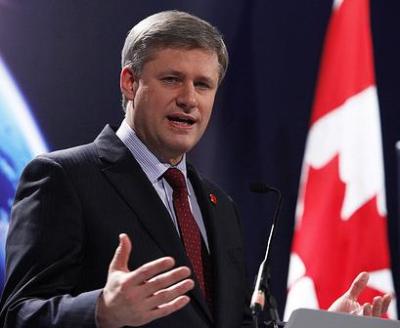
Stephen Harper’s Conservative Party cuts federal spending by 6.2%

Prime Minister Stephen Harper

More news from up north. (H/T Ben)

Excerpt:

Federal government expenditures are set to fall next fiscal year by $16.5-billion, or 6.2%, with big cuts to regional development and environment programs, according to documents tabled Tuesday.

That would leave total expenditures for the 2011-12 year at $250-billion, with the bulk taken up by transfer payments to individuals and governments, and operating costs. Just over $30-billion of that expense is attributed to refinancing Canada’s debt.

The figures, contained in spending estimates provided by the Treasury Board, sees budget increases for departments entrusted with security and law enforcement – such as a 21% boost to jails — but cuts of roughly 20% to Environment Canada, Natural Resources Canada and Agriculture and Agri-Food Canada.

Government is supposed to be concerned with security and law enforcement, not with environmentalist wastefulness.

Here’s Paul Ryan. He would like to cut our budget by 6.2% – and maybe even more.

If Canada is cutting their government waste, then why can’t we?

There are a lot of programs that we could be cutting.

Excerpt:

The federal government could save billions in taxpayer dollars annually by consolidating duplicative government programs, according to a new report.

The newly-released report from the Government Accountability Office “makes us all look like jackasses,” Sen. Tom Coburn (R-Okla.) told reporters Monday night.

The conservative senator said the report — which identifies redundancies in more than 546 individual programs — reveals why the United States is $14 trillion in debt.

“Anybody who says we don’t look like fools up here hasn’t read the report,” he said.

[…]The GAO reviewed 34 areas (among them agriculture, defense and social services) where agencies, offices or initiatives have similar or overlapping objectives. The report also looked at 47 additional cost-saving opportunities related to more general government efficiency. For instance, the report said, “Improved corrosion prevention and control practices could help [the Defense Department] avoid billions in unnecessary costs over time.”

Addressing duplicative efforts on even a single issue could save billions, the report found. For instance, the GAO says the government could save up to $5.7 billion annually by addressing potentially duplicative policies designed to boost domestic ethanol production. Additionally, the Defense Department could save $460 million annually by making broader changes to the governance of its military health care system.

The report finds that there are 15 agencies involved in food safety, 80 programs involved in economic development and more than 100 involved in surface transportation. There are 10 agencies and 82 programs involved in teacher quality, and more than 20 agencies and about 56 programs involved in financial literacy efforts. There are about 2,300 investments across the Defense Department to modernize its business operations.

House Majority Leader Eric Cantor (R-Va.) said today that in order to foster long term economic growth, “we’re going to deal with the pressing issues of regulatory waste in our agencies, as well as long term issues facing our country with entitlement programs.”

This is why we have to stop giving private sector money to government. They don’t earn any money by making things or helping people – they don’t sell anything useful. They just steal money from the productive workers and businesses and then they waste it and run up trillion dollar deficits. This kind of corruption, fraud and waste would not survive in small businesses, and probably not even in big businesses. Business have to be efficient or they go bankrupt. They have to perform or their competitors will have them for lunch. The consumer is king in the private sector.

Related posts