Tag Archives: Socialism

Annual median household income down $4,500 since Democrats won Congress in 2006

Median Household Income Under Obama

The Wall Street Journal reports.

Excerpt:

The recovery that began four years ago has been one of the weakest on record, averaging a little more than 2%. And it has not gained speed. Growth in the fourth quarter of 2012 was 0.4%. It rose to a still anemic 1.8% in the first quarter but most economists are predicting even slower growth in the second quarter.

We hope the predictions of a faster growth in the second half will be right, but the Obama Treasury and Federal Reserve have been predicting for four years that takeoff was just around the corner. Stocks are doing great, and housing prices are rising, but job growth remains lackluster. What has never arrived is the 3%-4% growth spurt during typical expansions.

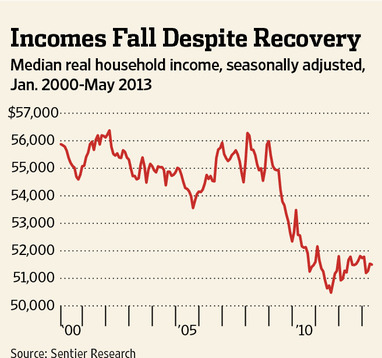
[…]What about the middle class that is the focus of Mr. Obama’s rhetoric? Each month the consultants at Sentier Research crunch the numbers from the Census Bureau’s Current Population Survey and estimate the trend in median annual household income adjusted for inflation. In its May 2013 report, Sentier put the figure at $51,500, essentially unchanged from $51,671 a year earlier.

And that’s the good news. The bad news is that median real household income is $2,718, or 5%, lower than the $54,218 median in June 2009 when the recession officially ended. Median incomes typically fall during recessions. But the striking fact of the Obama economy is that median real household income has fallen even during the recovery.

While the declines have stabilized over the last two years, incomes are still far below the previous peak located by Sentier of $56,280 in January 2008. No wonder Mr. Obama is now turning once again to his familiar political narrative assailing inequality and blaming everyone else for it. He wants to change the subject from the results on his watch.

The core problem has been Mr. Obama’s focus on spreading the wealth rather than creating it. ObamaCare will soon hook more Americans on government subsidies, but its mandates and taxes have hurt job creation, especially at small businesses. Mr. Obama’s record tax increases have grabbed a bigger chunk of affluent incomes, but they created uncertainty for business throughout 2012 and have dampened growth so far this year.

The food stamp and disability rolls have exploded, which reduces inequality but also reduces the incentive to work and rise on the economic ladder. This has contributed to a plunge in the share of Americans who are working—the labor participation rate—to 63.5% in June from 65.7% in June 2009. And don’t forget the Fed’s extraordinary monetary policy, which has done well by the rich who have assets but left the thrifty middle class and retirees earning pennies on their savings.

Mr. Obama would have done far better by the poor, the middle class and the wealthy if he had focused on growing the economy first. The difference between the Obama 2% recovery and the Reagan-Clinton 3%-4% growth rates is rising incomes for nearly everybody.

And remember, thanks to Obamacare, medical insurance premiums have soared over $3,000. We are getting poorer because of Obama’s big government policies.

Whose fault is it?

In the 2006 mid-term elections, the Democrats took over the House and Senate. That was the beginning of the Nancy Pelosi and Harry Reid spending spree. Millions of dollars have been wasted on ineffective government programs, handouts and bailouts. We’ve had trillion dollar deficits for the last four years under Obama, and over 8 trillion added to the national debt since Pelosi/Reid 2007. All that deficit spend does have an effect on economic growth – businesses know that they are going to have to pay it off at some point, either through higher taxes or inflation or both.

Why did Detroit go bankrupt? Who is to blame? Whose fault was it?

This article from Front Page magazine traces the history of the city of Detroit.

Excerpt:

Beginning in 1962, Detroit has endured a steady diet of Democratic mayors and their social welfare agenda. Beginning in 1962, Mayor Jerome Cavanagh ushered in a “Model City” program to a nine-square-mile section of the city. It was based on a Soviet Union-style approach, aimed at rebuilding entire urban areas all at once. The effort was funded by a commuter tax and a new income tax that Cavanagh told residents would be paid by “the rich.” Yet the same central planning that that formed the heart of the Model City program was extended to the people themselves, who eventually resented being told by government how to run their businesses and their lives in exchange for government goodies. Unsurprisingly, the program was a monumental failure.

Then there were the riots. In 1967, police broke up a celebration at a “blind pig.” Blind pigs were after-hours clubs that featured gambling and prostitution and had been part of the traditional black culture in Detroit since Prohibition. The political leadership considered them antithetical to the Model City program. An enraged neighborhood did not. People took to the streets, igniting the worst race riot of the decade. Black-owned business were looted and burned to the ground. Forty people were killed and 5,000 were left homeless. Thus began the “white flight” out of the city center, totaling 140,000 people over an eighteen month period, ensued. The city never recovered.

None of this stopped the progressive agenda from continuing to be implemented. Public employees were given precisely the exorbitant wage and benefits packages that are coming back to haunt the city now. This Democrat-fostered attitude extended to private sector unions, whose equally exorbitant packages, along with efficiency-strangling work rules, made the cost of doing business in the Motor City prohibitive. As a result, much of the car industry that formed the city’s employment backbone left for right-to-work states that provided a far less hostile — and far more affordable — business climate.

As chronicled here, the same progressive-inspired insanity destroyed the Detroit public school system (DPS), which itself stands on the brink of bankruptcy. This tragedy is highlighted by several sad realities. In 2009, DPS students turned in the lowest scores ever recorded in the national math proficiency test over its then-21-year history. The state of Michigan, led by Detroit, has one of the highest black-white achievement gaps in the nation. As of June 12, only 1.8 percent of the system’s students were capable of doing college level work.

Yet by far the most telling indictment of the system is this mind-bending reality: a full 47 percent of city residents are functionally illiterate.

The governor of Michigan Rick Snyder has just come out and said that he will not ask for a bailout from the federal government of Detroit.

Excerpt:

Michigan Gov. Rick Snyder and the bankruptcy specialist he appointed to fix Detroit’s unprecedented financial problems put the blame Sunday squarely on the city and defended their decision to file for Chapter 9.

The Republican governor said Detroit created the problems and stood steadfast behind his decision to file Thursday for bankruptcy, with the city roughly $19 billion in debt.

“This is a tragic, difficult decision, but a right one,” he said. “It’s not about just more money, it’s about accountable government.”

He said corruption and city leaders ignoring warning signs for 60 years contributed to the problems. Among his biggest concerns, Snyder said, is the decline of municipal services for Detroit’s remaining 700,000 residents, including police response times of nearly one hour.

Thank God. Maybe now they will start to elect Republicans for the first time in over 50 years.

Is the root cause of crime poverty or fatherlessness?

If we were really serious about stopping gun crime, then we should go after the root cause of gun crime. So what is that root cause? The answer might surprise you.

Here is Dr. Robert Rector of the Heritage Foundation to explain:

Census data and the Fragile Families survey show that marriage can be extremely effective in reducing child poverty. But the positive effects of married fathers are not limited to income alone. Children raised by married parents have substantially better life outcomes compared to similar children raised in single-parent homes.

When compared to children in intact married homes, children raised by single parents are more likely to have emotional and behavioral problems; be physically abused; smoke, drink, and use drugs; be aggressive; engage in violent, delinquent, and criminal behavior; have poor school performance; be expelled from school; and drop out of high school.[19] Many of these negative outcomes are associated with the higher poverty rates of single mothers. In many cases, however, the improvements in child well-being that are associated with marriage persist even after adjusting for differences in family income. This indicates that the father brings more to his home than just a paycheck.

The effect of married fathers on child outcomes can be quite pronounced. For example, examination of families with the same race and same parental education shows that, when compared to intact married families, children from single-parent homes are:

  • More than twice as likely to be arrested for a juvenile crime;[20]
  • Twice as likely to be treated for emotional and behavioral problems;[21]
  • Roughly twice as likely to be suspended or expelled from school;[22] and
  • A third more likely to drop out before completing high school.[23]

The effects of being raised in a single-parent home continue into adulthood. Comparing families of the same race and similar incomes, children from broken and single-parent homes are three times more likely to end up in jail by the time they reach age 30 than are children raised in intact married families. [24] Compared to girls raised in similar married families, girls from single-parent homes are more than twice as likely to have a child without being married, thereby repeating the negative cycle for another generation.[25]

Finally, the decline of marriage generates poverty in future generations. Children living in single-parent homes are 50 percent more likely to experience poverty as adults when compared to children from intact married homes. This intergenerational poverty effect persists even after adjusting for the original differences in family income and poverty during childhood.[26]

People on the left claim that poverty causes crime, but they don’t look for the root cause of poverty. The root cause of poverty is the decline of marriage, which produces fatherless children. Unfortunately, some people promote the decline of marriage because they do not like the “unequal gender roles” inherent in marriage. So what is the main tool that the anti-marriage people use to increase the number of fatherless children?

Dr. Michael Tanner of the libertarian Cato Institute explains one of the causes of fatherlessness in his testimony to Congress:

Welfare contributes to crime in several ways. First, children from single-parent families are more likely to become involved in criminal activity. According to one study, children raised in single-parent families are one-third more likely to exhibit anti-social behavior.(3) Moreover, O’Neill found that, holding other variables constant, black children from single- parent households are twice as likely to commit crimes as black children from a family where the father is present. Nearly 70 percent of juveniles in state reform institutions come from fatherless homes, as do 43 percent of prison inmates.(4) Research indicates a direct correlation between crime rates and the number of single-parent families in a neighborhood.(5)

As Barbara Dafoe Whitehead noted in her seminal article for The Atlantic Monthly:

The relationship [between single-parent families and crime] is so strong that controlling for family configuration erases the relationship between race and crime and between low income and crime. This conclusion shows up time and again in the literature. The nation’s mayors, as well as police officers, social workers, probation officers, and court officials, consistently point to family break up as the most important source of rising rates of crime.(6)

At the same time, the evidence of a link between the availability of welfare and out-of-wedlock births is overwhelming. There have been 13 major studies of the relationship between the availability of welfare benefits and out-of-wedlock birth. Of these, 11 found a statistically significant correlation. Among the best of these studies is the work done by June O’Neill for the U.S. Department of Health and Human Services. Holding constant a wide range of variables, including income, education, and urban vs. suburban setting, the study found that a 50 percent increase in the value of AFDC and foodstamp payments led to a 43 percent increase in the number of out-of-wedlock births.(7) Likewise, research by Shelley Lundberg and Robert Plotnick of the University of Washington showed that an increase in welfare benefits of $200 per month per family increased the rate of out-of-wedlock births among teenagers by 150 percent.(8)

The same results can be seen from welfare systems in other countries. For example, a recent study of the impact of Canada’s social-welfare system on family structure concluded that “providing additional benefits to single parents encourages births of children to unwed women.”(9)

The poverty that everyone complains about is not the root cause of crime. The poverty is caused by fatherlessness. The fatherlessness is caused by welfare. Fatherlessness is also caused by laws and policies that make it easier for people to divorce, e.g. – no-fault divorce laws. Again, it’s people on the left who push for no-fault divorce laws. So the left is pushing two policies, welfare and no-fault divorce, which cause crime.