Tag Archives: Single-Payer

Stephen Moore: Obama’s failing economy has hit his supporters the hardest

From the Wall Street Journal, a must-read.

Excerpt:

Each month the consultants at Sentier analyze the numbers from the Census Bureau’s Current Population Survey and estimate the trend in median annual household income adjusted for inflation. On Aug. 21, Sentier released “Household Income on the Fourth Anniversary of the Economic Recovery: June 2009 to June 2013.” The finding that grabbed headlines was that real median household income “has fallen by 4.4 percent since the ‘economic recovery’ began in June 2009.” In dollar terms, median household income fell to $52,098 from $54,478, a loss of $2,380.

What was largely overlooked, however, is that those who were most likely to vote for Barack Obama in 2012 were members of demographic groups most likely to have suffered the steepest income declines. Mr. Obama was re-elected with 51% of the vote. Five demographic groups were crucial to his victory: young voters, single women, those with only a high-school diploma or less, blacks and Hispanics. He cleaned up with 60% of the youth vote, 67% of single women, 93% of blacks, 71% of Hispanics, and 64% of those without a high-school diploma, according to exit polls.

According to the Sentier research, households headed by single women, with and without children present, saw their incomes fall by roughly 7%. Those under age 25 experienced an income decline of 9.6%. Black heads of households saw their income tumble by 10.9%, while Hispanic heads-of-households’ income fell 4.5%, slightly more than the national average. The incomes of workers with a high-school diploma or less fell by about 8% (-6.9% for those with less than a high-school diploma and -9.3% for those with only a high-school diploma).

To put that into dollar terms, in the four years between the time the Obama recovery began in June 2009 and June of this year, median black household income fell by just over $4,000, Hispanic households lost $2,000 and female-headed households lost $2,300.

The unemployment numbers show pretty much the same pattern. July’s Bureau of Labor Statistics data (the most recent available) show a national unemployment rate of 7.4%. The highest jobless rates by far are for key components of the Obama voter bloc: blacks (12.6%), Hispanics (9.4%), those with less than a high-school diploma (11%) and teens (23.7%).

This is a stunning reversal of the progress for these groups during the expansions of the 1980s and 1990s, and even through the start of the 2008 recession. Census data reveal that from 1981-2008 the biggest income gains were for black women, 81%; followed by white women, 67%; followed by black men, 31%; and white males at 8%.

[…]Mr. Obama has often contemptuously, and wrongly, branded the quarter-century period of prosperity beginning with the presidency of Ronald Reagan as a “trickle down” era. For many in the groups that Mr. Obama set out to help, a return to the prosperity of that era would be a vast improvement.

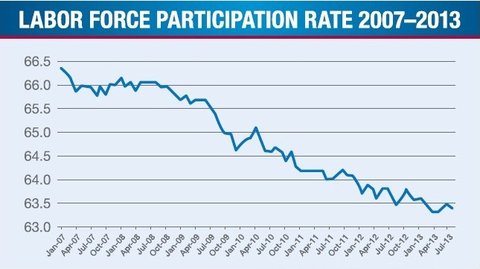
The Census Bureau data on incomes include cash government benefits, such as unemployment insurance, disability payments and the earned-income tax credit (but excludes Medicaid and food stamps). Most of the cash programs have surged in cost during the Obama presidency, yet incomes have still declined for the lowest-income eligible groups. This suggests that wages and salaries from employment have shrunk at an even faster pace than the Census data show. The shrinking paychecks of the past four years are consistent with two unwelcome anomalies of the recovery: a swift decline in labor-force participation to 63.4% from 65.5% during that period and a rise in part-time employment.

What all of this means is that the stimulus-led economic revival that began officially in June 2009—Vice President Joe Biden’s famous “summer of recovery”—has only resulted in lower incomes for at least half of Americans, the very ones who were instrumental in electing Mr. Obama twice.

Guess what? Borrowing trillions from future generations to spend on Democrat-run sham companies like Solyndra doesn’t stimulate the economy. Shocking, I know. And yet that’s what we voted for.

Investors Business Daily explains how the President’s own policies are causing the troubles that his supporters are facing.

Look:

More than 250 employers have cut work hours, jobs or taken other steps to avoid ObamaCare costs, according to a new IBD analysis.

Mind the data have been the refrain from the White House as it downplays anecdotal reports of employers limiting workers to fewer than 30 hours per week.

But the anecdotes are piling high enough that they now constitute a body of data that can help gauge the impact of the Affordable Care Act’s employer mandate.

IBD is introducing ObamaCare Employer Mandate: A List Of Cuts To Work Hours, Jobs — a compilation of employers who have opted to restrict work hours to limit new liability for employee health coverage.

As of Sept. 3, this list has reached 258 — including more than 200 public-sector employers.

Almost all of those employers have cut the hours of part-time workers to below 30 per week — the point at which ObamaCare’s insurance mandate kicks in.

A few have cut payrolls to steer clear of ObamaCare’s 50 full-time-equivalent-worker definition of a large employer subject to employer fines. A few others have reduced staff while contracting with employment services firms to limit their ObamaCare exposure.

The Wall Street Journal explains how health care premiums, which Obama promised to LOWER by $2500, are up $3000.

Excerpt:

Central to ObamaCare are requirements that health insurers (1) accept everyone who applies (guaranteed issue), (2) cannot charge more based on serious medical conditions (modified community rating), and (3) include numerous coverage mandates that force insurance to pay for many often uncovered medical conditions.

[…]We compared the average premiums in states that already have ObamaCare-like provisions in their laws and found that consumers in New Jersey, New York and Vermont already pay well over twice what citizens in many other states pay. Consumers in Maine and Massachusetts aren’t far behind. Those states will likely see a small increase.

By contrast, Arizona, Arkansas, Georgia, Idaho, Iowa, Kentucky, Missouri, Ohio, Oklahoma, Tennessee, Utah, Wyoming and Virginia will likely see the largest increases—somewhere between 65% and 100%. Another 18 states, including Texas and Michigan, could see their rates rise between 35% and 65%.

While ObamaCare won’t take full effect until 2014, health-insurance premiums in the individual market are already rising, and not just because of routine increases in medical costs. Insurers are adjusting premiums now in anticipation of the guaranteed-issue and community-rating mandates starting next year. There are newly imposed mandates, such as the coverage for children up to age 26, and what qualifies as coverage is much more comprehensive and expensive. Consolidation in the hospital system has been accelerated by ObamaCare and its push for Accountable Care Organizations. This means insurers must negotiate in a less competitive hospital market.

Although President Obama repeatedly claimed that health-insurance premiums for a family would be $2,500 lower by the end of his first term, they are actually about $3,000 higher—a spread of about $5,500 per family.

So, every cloud has a silver lining, and the silver lining to this Obama-cloud is that at least the people who voted for socialism are facing the consequences of their own economic illiteracy. I hope they learn. But if they don’t learn now, then they’ll learn when the welfare and entitlements run out. I hope that the people who voted for our American Idol president will take a Thomas Sowell book out of the library and learn something about economics for a change.

UPDATE: From Ian B.: 40,000 Longshoremen (union workers) quit the AFL-CIO union. Socialism hurts employers? It’s all so unexpected! How could reality not match honeyed words and good intentions?
New study finds that many young people won’t purchase Obamacare plans

Dr. David Hogberg of the National Center for Public Policy Research explains how Obamacare affects young people.

Here’s the executive summary:

If the ObamaCare health insurance exchanges are to function properly, it is crucial that a substantial number of people ages 18-34 join them. This age group that is young and relatively healthy must purchase health insurance on the exchanges in order to “cross-subsidize” people who are older and sicker. Without the young and healthy, the exchanges will enter a “death spiral” where only the older and sicker participate and price of insurance premiums will increase precipitously.

This study finds that in 2014 many single people aged 18-34 who do not have children will have a substantial financial incentive to forego insurance on the exchanges and instead pay the individual mandate penalty of $95 or one percent of income. About 3.7 million of those ages 18-34 will be at least $500 better off if they forgo insurance and pay the penalty. More than 3 million will be $1,000 better off if they go the same route. This raises the likelihood that an insufficient number of young and healthy people will participate in the exchanges, thereby leading to a death spiral. 

The design of the plan is to tax younger, healthier people – especially men – in order to obtain the money to pay for heavy users of health care.

To compel the young and healthy to purchase insurance, the architects of ObamaCare included an individual mandate that requires individuals to either buy insurance or pay a penalty. The penalty, which increases over time, is whichever is greater: $95 or one percent of income in 2014, $325 or two percent of income in 2015, and $695 or 2.5 percent of income in 2016 and thereafter.

[…]The gender breakdown of these individuals presents another problem. Women have higher rates of health utilization than men, including more visits to primary-care physicians and greater use of diagnostic tests and emergency care. However, as Table 3 shows, roughly two-thirds of the individuals for whom insurance will cost at least $1,000 more than the fine are men.

Hard to see why any young man would have voted Democrat, and yet many did. Did they know that they were voting for a tax on themselves at a time when many of them are poorly educated by government-run schools, and can’t even find jobs? How can you pay a fine for not having health care when you don’t have a proper education or a proper job?

The net effect of the “community rating” and “guaranteed issue” provisions of Obamacare will be to raise health insurance premiums and force private companies to stop offering plans:

If the exchanges do not attract a sufficient number of people in the 18-34 age demographic, they will eventually enter an insurance “death spiral.” This occurs when the young and healthy drop out of the “insurance pool.” This leads to “adverse selection” in which insurance is only attractive to those who are generally older and sicker. If the insurance pool is comprised largely of people who are older and sicker, then insurance prices will rise to cover their costs. That rate increase causes even more young and healthy people drop their insurance, leaving the pools even older and sicker than before, and so on. Eventually, all but a few insurers will be forced to discontinue their business on the exchanges because they can no longer make a profit. Fewer insurers means less competition, resulting in even higher insurance premiums.

Community rating and guaranteed issue are catalysts for a death spiral. In its strictest form, community rating means that insurers must charge everyone the same premium, regardless of factors such as health status and age. Guaranteed issue means that an insurer must sell a policy to a consumer anytime.

Under ObamaCare, the exchanges use a modified version of both of these regulations. Its form of community rating doesn’t allow insurers to vary rates based on health status. It does allow, however, for modification of premiums if one smokes and to compensate for age (although in a more restricted manner than the market currently does). Regarding guaranteed issue, insurers must sell policies to all comers but (with a few exceptions) only during the annual open enrollment period from October to December.

Both of these rules give young and healthy people big incentives to forgo insurance coverage altogether. Community rating means young people have a reduced incentive to buy insurance since they will pay a premium that is above the market rate. Many who are currently purchasing insurance in the individual market, for example, will see a substantial premium increase if they switch to the exchange.

In a market without guaranteed issue, consumers run the risk of insurers not selling them policies when they get seriously ill. But that risk is largely gone under the exchanges. For instance, a young person who gets a serious illness in June only has to wait until October to sign up for insurance and then wait until January 1 of the next year to receive coverage. Combined, community rating and guaranteed issue give the young and healthy big incentives to forgo insurance until they are sick.

“Community rating” and “guaranteed issue” have actually already been tried at the state level. What happened then?

This:

The late Conrad Meier, then a senior fellow in health care policy for the Heartland Institute, examined what happened when these two regulations were instituted on the state level in his 2005 monograph “Destroying Insurance Markets.” In the early 1990s eight states — Kentucky, Maine, Massachusetts, New Hampshire, New Jersey, New York, Vermont and Washington — imposed community rating and guaranteed issue on their individual insurance markets. The result, according to Meier, was the above-described death spiral.

For example, in 1992 the New Jersey legislature adopted community rating and guaranteed issue rules for its individual insurance market with the passage of the “Individual Health Coverage Program.” The monthly premium for family coverage from Aetna rose from $769 in 1994 to $6,005 in 2005, a whopping increase of 683 percent! Other insurers saw similar increases.

Before the reforms began, there were about 28 insurers covering the New Jersey individual market. By 2007 there were only seven. According to the Census Bureau, the number of people in New Jersey’s individual market fell from about 998,000 in 1994 to 630,000 in 2005, a decline of 37 percent.

It’s pretty clear that Obamacare was designed to replicate this same effect that’s been observed in states at a national level, paving the way for single payer health care. What will Americans think when their healthcare is controlled by the kind of people who run USPS, Amtrak, the Bureau of Motor Vehicles and the IRS? 

What happened to the economy after Democrats won the House and Senate in 2007?

Labor Force Participation Rate from 2007 (Pelosi/Reid) to 2013

Three data points explain what happens when government gets bigger, and job creators get smaller.

First from Investors Business Daily, Obama’s failure to reduce health insurance premiums with his big government takeover of health care.

Excerpt:

The average employer-provided family health insurance premiums have climbed $2,976 since 2009, according to an annual Kaiser Family Foundation survey released this week. They’re up $3,671 compared with the year before President Obama took office. That’s despite Obama’s repeated promises that the health care reform law he championed would cut premiums by $2,500 in his first term.

And while annual premium increases have moderated over the past two years, that’s due to trends in the insurance market largely unrelated to ObamaCare, and trends the law could actually reverse.

The Kaiser survey found that the average family premium this year is $16,351, up 4% over last year, and up 22% since 2009. After adjusting for inflation, premiums climbed an average 3.2% a year in Obama’s first term, higher than the 2.7% average during President Bush’s last four years in office.

During his first campaign for president, Obama repeatedly claimed that his health reform plan would, as he said at a Virginia rally in 2008 “lower premiums by up to $2,500 for a typical family per year.”

Now, let’s take a look the second failure, as reported by the Weekly Standard.

Excerpt:

President Obama likes to talk about income inequality, but what matters far more is the actual income of the typical American.  And how has the typical American household income fared on Obama’s watch?  Well, the economic “recovery” has now spanned an Olympiad, and during that time the typical American household income has not only dropped—it has dropped more than twice as much as it did during the recession.

New estimates derived from the Census Bureau’s Current Population Survey by Sentier Research indicate that the real (inflation-adjusted) median annual household income in America has fallen by 4.4 percent during the “recovery,” after having fallen by 1.8 during the recession.  During the recession, the median American household income fell by $1,002 (from $55,480 to $54,478). During the recovery—that is, from the officially defined end of the recession (in June 2009) to the most recent month for which figures are available (June 2013)—the median American household income has fallen by $2,380 (from $54,478 to $52,098).  So the typical American household is making almost $2,400 less per year (in constant 2013 dollars) than it was four years ago, when the Obama “recovery” began.

Importantly, these income tallies include government payouts such as unemployment compensation and cash welfare. So Obama’s method of funneling ever-more money and power to Washington, and then selectively divvying some of it back out, clearly isn’t working for the typical American family.

And finally, the third example, from the Daily Caller.

Excerpt:

 In 35 states, welfare benefits pay more than a minimum wage job, according to a new study by the libertarian Cato Institute, and in 13 states welfare pays more than $15 per hour.

“One of the single best ways to climb out of poverty is taking a job, but as long as welfare provides a better standard of living than an entry-level job, recipients will continue to choose it over work,” said Michael Tanner, senior policy analyst and co-author of the study.

The study is an updated version of one Tanner put out in 1995 that estimated the full value of welfare benefits packages across the states. The 1995 study found that such tax-free welfare benefits greatly exceeded the poverty level and “their dollar value was greater than the amount of take-home income a worker would receive from an entry-level job.”

Despite efforts to curb welfare spending, many welfare programs and benefits have continued to outpace the income that many workers can receive for working an entry-level job, which disincentivizes work, according to the study.

“The current welfare system provides such a high level of benefits that it acts as a disincentive for work,” reads the study. “Welfare currently pays more than a minimum-wage job in 35 states, even after accounting for the Earned Income Tax Credit, and in 13 states it pays more than $15 per hour.”

According to the study, the federal government funds 126 separate programs designed to support low-income earners. Seventy-two of these programs provide cash or in-kind benefits to recipients. This is on top of additional welfare programs operated by state and local governments.

Welfare recipients in Hawaii get the most benefits, according to Tanner, at $29.13 per hour — or $60,590 pre-tax income annually. However, the state’s minimum wage is only $7.25 per hour, according to the Labor Department. Hawaiians on welfare also earn 167 percent of the median salary in the state, which is only $36,275.

What if a fireman showed up in front of your house on your birthday and claimed that he wanted to put out the candles on your birthday cake because they were a fire hazard? What if he read out a long, passionate, prepared speech about how much he wanted to put out fires? What if he then dumped a bucket of gasoline on your cake? What if your house caught fire and he claimed that you should let him keep throwing gas on the fire to put it out? What if you found out that this person was a lawyer and a community organizer, and knew nothing at all about putting fires out? Obama was not prepared to run the economy, and, as expected, he spent a ton of money without getting the results he said he was going to get. He gave speeches about jobs and poverty and everything he’s done has been to increase unemployment and increase poverty – and now we are $17 trillion dollars in debt. Speeches about achieving objective X during a campaign don’t necessarily translate into achieving objective X. You actually have to know what you are doing in order to achieve objectives, preferably because you’ve done it before in real life.