

Tag Archives: Selfishness

Scott Klusendorf debates an abortion advocate on the Unbelievable radio show

Scott Klusendorf, Life Training Institute

Here are the details:

The abortion debate reared its head again this summer after controversial tweets by Richard Dawkins made the news.

Justin hosts a discussion between Mara Clarke of the Abortion Support Network and Scott Klusendorf of the Life Training Instititute. Mara believes women need to be decide whether to terminate a pregnancy, but Scott says that all depends on whether we are dealing with a human life in the womb.

The MP3 file is here.

My snarky paraphrase of the debate (not exact):

  • Speaker introductions
  • Klusendorf: no justification for abortion is necessary if the unborn are not human
  • Klusendorf: we need to address the issue “what is the unborn?” Are the unborn human?
  • Klusendorf: SLED: size, level of development, environment, degree of dependency
  • Klusendorf: None of these things affect the value of a human being
  • Klusendorf: Even if we don’t KNOW whether the unborn is human
  • Mara: I’m not going to debate when life begins
  • Mara: Women know when life begins by feelings
  • Mara: The moral decision is “whether I can take care of this child?”
  • Brierley: When is an unborn being human?
  • Mara: I refuse to debate that – the real question is whether women want their babies or not
  • Mara: Forced pregnancy is not OK
  • Brierley: Could your justification for abortion (not wanting to care for a child) work through all 9 months?
  • Mara: Late term abortions are rare, so I don’t have to answer that question
  • Mara: Abortion should be OK through all 9 months of pregnancy because women cannot be restricted
  • Mara: Some women are poor, they need to be able to kill expensive babies at any time
  • Klusendorf: although she says she won’t debate the unborn, she does take a position
  • Klusendorf: she assumes the unborn is not human, because she says that insufficient funds is justification for abortion
  • Klusendorf: no one argues that you can kill a two year old because they cost money, because she thinks they are human
  • Klusendorf: she is begging the question by assuming the unborn are not human, but that is the issue we must resolve
  • Klusendorf: I am pro-choice on many other things, e.g. women choosing their own husbands, religion, etc.
  • Klusendorf: Some choices are wrong – Mara might be right, but she needs to make the case for the unborn not being human
  • Brierley: What is your reason for thinking that an unborn child is different from a 2-year old?
  • Mara: An unborn child is not the same as a 2-year old, in my personal opinion
  • Mara: I am not a debater, so I don’t have to provide reasoning for my assertion, I just feel it
  • Mara: Not everybody agrees with Scott, they don’t have to have a rational argument, they just need to feel differently
  • Mara: From my experience, when a woman doesn’t want to be pregnant, then she should be able to not be pregnant
  • Mara: Women shouldn’t be punished with a baby that she doesn’t want, even if she chooses to have recreational sex
  • Brierley: What do you think of women who think the unborn is human and do it anyway?
  • Klusendorf: It’s interesting that they never kill their toddlers for those reasons
  • Klusendorf: I layed out scientific and philosophical reasons for the humanity of the unborn
  • Klusendorf: Her response was “but some people disagree with you”
  • Klusendorf: People disagreed about whether slavery was wrong, or whether women should be able to vote
  • Klusendorf: that doesn’t mean there is no right answer – the right answer depends on the arguments
  • Klusendorf: if absence of agreement makes a view false, then it makes HER pro-choice view false as well
  • Klusendorf: she did make an argument for the unborn child having no rights because of the location
  • Klusendorf: she needs to explain to us why location matters – what about location confers value
  • Mara: I’m not going to let Scott frame my debate for me!!!
  • Mara: women get pregnant and they don’t want their babies! should we put them in jail!!!!
  • Klusendorf: I didn’t just give my opinion, I had science and philosophy, the issue is “what is the unborn?”
  • Mara: philosophical and scientific debates are unimportant, I am an expert in real women’s lives
  • Klusendorf: Which women? Women in the womb or only those outside the womb?
  • Mara: Only those outside the womb
  • Klusendorf: Only those outside the womb?
  • Mara: Women living outside the womb have a right to kill women inside the womb – women have bodily autonomy
  • Klusendorf: then does a pregnant woman with nausea have a right to take a drug for it that will harm her unborn child?
  • Mara: Unborn children are only valuable if they are wanted, unborn children only deserve protection if they are wanted
  • Mara: There are restrictions on abortion – you can’t get an abortion through all nine months in the US
  • Mara: There is a 24-week limit in the UK as well
  • Klusendorf: There are no restrictions on abortion that conflict with “a woman’s health” because Supreme Court said
  • Mara: where are these late term abortion clinics?
  • Klusendorf: (he names two)
  • Mara: that’s not enough!!! we need more! where is there one in Pennsylvania?
  • Klusendorf: well, there used to be Gosnell’s clinic in Pennsylvania, and you could even get an infanticide there….
  • Brierley: What about Dawkins’ view that it is moral to abort Down’s Syndrome babies?
  • Klusendorf: he is ignoring the scientific case and philosophical case for the pro-life
  • Klusendorf: the pro-life view is a true basis for human equality

What I wanted Scott to ask was whether sex-selection abortions were OK with her. Since her reasoning is “if it’s unwanted, it has no rights”, then that would mean sex-selection abortions are just fine. That’s what a UK abortion expert recently argued. It’s always a great idea to show your opponent where their positions really lead. Most of the people you talk about abortion with will not have been exposed to a pro-life case. You can help them to work through the issue.

Are crisis pregnancy centers equipped to discuss the issue of abortion rationally?

I'm Scheming Unborn Baby, and I approve this study
I’m Scheming Unborn Baby, and I approve this message

Consider this article from Stand to Reason, written by Greg Koukl. The title of the article is “The Vanishing Pro-Life Apologist”. Koukl argues that crisis pregnancy centers are less interested in making the case for the right to life of the unborn child, and more interested in giving women who have already chosen life what they need, in terms of material support.

Koukl writes:

The last few years have witnessed a stunning development in the pro-life movement. More and more crisis pregnancy centers (CPCs) refuse to discuss abortion. A new wave of pro-life leaders insist that victory will not be gained in the court of public opinion if the debate centers principally on the morality of abortion.

Paul Swope calls it “a failure to communicate” when right-to-lifers focus primarily on the unborn instead of on the felt needs of women. “The pro-life movement must show that abortion is actually not in a woman’s own self-interest,” he says, “and that the choice of life offers hope and a positive, expanded sense of self.” Reframing the debate in these terms will enable the movement to “regain the moral high ground in the mind of the American public.”

[…]Pro-life feminist Frederica Matthews-Green agrees. “Pro-lifers will not be able to break through this deadlock by stressing the humanity of the unborn….That is a question nobody is asking. But there is a question they are asking. It is, ‘How could we live without it?’ The problem is not moral, but practical.”

Swope and Matthews-Green are not suggesting we frame the debate in terms of the felt needs of women in the narrow context of crisis counseling. It’s certainly appropriate to inform a woman of the physical and psychological consequences of choosing abortion. Rather, they insist the pro-life movement in general must speak less of the unborn and more of the woman in order to break the alleged deadlock.

While it’s true that appealing to self-interest might dissuade some abortion-minded women from killing their babies, it’s hard to image how this could be an effective general strategy. Here’s why: It’s almost always in a woman’s short-term self-interest to abort. This is precisely why the pro-abortion side has been effective. A focus on felt needs favors death, not life.

How can we “regain the moral high ground in the mind of the public,” to use Swope’s words, if we retreat from the moral debate? The whole point of an ethical argument is to give reasons why a woman ought not pursue selfish interests. Felt needs are the problem, not the solution.

This approach completely sabotages the pro-life position. Crisis pregnancy centers do not exist to handle pregnancy. Hospitals and clinics do that. CPCs handle crisis pregnancies, those that are vulnerable to termination by abortion. In a sense, CPCs don’t exist for the woman, but for the child whose life is in danger. The idea is to dissuade women from having abortions precisely because abortion is a moral tragedy. If not, then why oppose it?

What kind of morality does this tactic leave us with? Such a posture implicitly promotes the vice of selfishness instead of the virtue of sacrificial motherhood. Ideas have consequences, and this one may have, as Frank Beckwith observes, “the unfortunate consequence of increasing the number of people who think that unless their needs are pacified they are perfectly justified in performing homicide on the most vulnerable of our population.”

I actually want to go even further than that.

I think that if CPCs refuse to speak up against abortion on on moral grounds, they are doing nothing at all to stem the flow of abortions. Today, men and women are increasingly choosing to have sex when they are not in any kind of committed relationship where a child would be welcome. There are two things we can do to stop this.

First, we can tell them about what abortion really is, and how it is morally wrong to take the life of another person without adequate moral justification. (And selfishness is not moral justification). Second, we can tell them to be more careful about who they choose for relationships, about what the goal of the relationship is (not fun, but marriage), and about making decisions that mature them as a couple so that they are ready to provide for a child. Sex should not be seen as something recreational, and sex partners should not be chosen because of the fun you can have in the moment.

Now if CPCs do not want to tell people that abortion is wrong, and that relationships should be focused on commitment and providing for children, then we will never see fewer abortions. Our job is not to let people in this society think that unless someone else pays the bills, then abortion is OK. Abortion is only OK if the life of the mother is at risk – a very rare scenario. Our job is to educate men and women so that they understand how to have relationships that do not put them in a position where they have to take the life of an unborn child in order to make the lives of the grown-ups more satisfying.

We need to make the the safety of unborn children an issue that people consider when they choose who to have a relationship with, and when to have sex. In particular, women should choose men who value marriage before sex, and who make decisions to ready themselves for the man’s role in marriage. And men should choose women who value chastity and providing above men who offer fun and thrills.

We don’t have enough money to bail everyone out. We have to teach grown-ups moral boundaries, and give them a vision for relationships that is focused on commitment, and therefore safe for unborn children.

Conclusion

So here are my two points about CPCs and pro-life apologetics:

  • crisis pregnancy centers should be committed to defending the right to life of the unborn child in conversations with grown-ups, so that grown-ups police themselves in their relationship and sexual decision-making.
  • crisis pregnancy centers should be working with organizations that use pro-life arguments and evidence to persuade people to value the unborn before the life decision has been made.

And for everyone else, make sure that you’re equipped to explain to others why you think that unborn children deserve full legal protection.

Here’s a good video from Scott Klusendorf to help you do that:

This is an important moral issue, and we can’t be persuasive unless we are equipped with logical arguments and evidence.

Fertility and pregnancy: how long can a woman wait before having a baby?

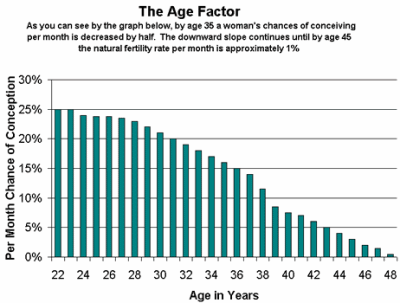
Woman's fertility by age
Woman’s fertility by age

This is from Aeon magazine. The author writes for several ultra-leftist publications, including the New York Times, the Los Angeles Times, Salon and Slate.

She writes:

Many studies show that women are not only woefully ignorant when it comes to fertility, conception and the efficacy of assisted reproductive technologies (ART) – but they overestimate their knowledge about the subject. For instance, a 2011 study in Fertility and Sterility surveyed 3,345 childless women in Canada between the ages of 20 and 50; despite the fact that the women initially assessed their own fertility knowledge as high, the researchers found only half of them answered six of the 16 questions correctly. 72.9 per cent of women thought that: ‘For women over 30, overall health and fitness level is a better indicator of fertility than age.’ (False.) And 90.9 per cent felt that: ‘Prior to menopause, assisted reproductive technologies (such as IVF) can help most women to have a baby using their own eggs.’ (Also false.) Many falsely believed that by not smoking and not being obese they could improve their fertility, rather than the fact that those factors simply negatively affect fertility.

Fertility fog infects cultures and nations worldwide, even those that place more of a premium on reproduction than we do in the West. A global study published for World Fertility Awareness Month in 2006 surveyed 17,500 people (most of childbearing age) from 10 countries in Europe, Africa, the Middle East and South America, revealing very poor knowledge about fertility and the biology of reproduction. Take Israel, a country that puts such a premium on children that they offer free IVF to citizens up to age 45 for their first two children. According to a 2011 study in Human Reproduction, which surveyed 410 undergraduate students, most overestimated a women’s chances of spontaneous pregnancy in all age groups, but particularly after receiving IVF beyond age 40. Only 11 per cent of the students knew that genetic motherhood is unlikely to be achieved from the mid-40s onward, unless using oocytes or egg cells frozen in advance. ‘This can be explained by technological “hype” and favourable media coverage of very late pregnancies,’ the authors concluded.

[…]For a woman over 42, there’s only a 3.9 per cent chance that a live birth will result from an IVF cycle using her own, fresh eggs, according to the American Society of Reproductive Medicine (ASRM). A woman over 44 has just a 1.8 per cent chance of a live birth under the same scenario, according to the US National Center for Chronic Disease Prevention and Health Promotion. Women using fresh donor eggs have about a 56.6 per cent chance of success per round for all ages.

Indeed, according to research from the Fertility Authority in New York, 51 per cent of women aged between 35 and 40 wait a year or more before consulting a specialist, in hopes of conceiving naturally first. ‘It’s ironic, considering that the wait of two years will coincide with diminished fertility,’ the group says.

[…]‘No one talks about fertility,’ said [reproductive endocrinologist Janelle Luk, medical director of Neway Fertility in New York City], who does not believe women are really open to hearing about it. ‘I don’t think women know that there’s a limit: the message is equal, equal, equal. Women say: “We want to go to college, we want to work on our careers, we want to be equal to men.” But our biological clock is not.’

[…]Another way women might even out the fertility playing field is by focussing on the so-called male biological clock. But is there one? Although there have been recent news stories about how advanced age in men (over 40 or 50) increases time to conception and the incidence of autism and schizophrenia, the absolute risk is negligible. ‘When you look at the numbers, you have to separate what the absolute risk and the increased risk is,’ said Natan Bar-Chama, director of male reproductive medicine and surgery at Mount Sinai Medical Center in New York. ‘The absolute risk is still really very small.’

I think if I ever have a daughter, I will be sure to urge her to be skeptical of her emotions and intuitions, to learn how to assess probabilities, to disregard exceptional cases when making plans, to resist the feminism in the culture, to get wisdom from older married women with children instead of young unmarried childless women, to accept that she is not so special that laws and rules don’t apply to her, and to accept that the universe is not malleable according to her needs and desires. I hope my wife will see the value of reining our daughter in before the catastrophes like infertility happen.

Where does the organized opposition to educating young women about fertility facts come from?

‘We feel that women should be able to talk to their ob/gyn about fertility,’ said Sandra Carson, ACOG’s vice president for education. ‘We certainly want to remind women gently that, as they get older, fertility is compromised, but we don’t want to do it in such a way that they feel that it might interfere with their career plans or make them nervous about losing their fertility.’ In other words, there are no guidelines for talking to a woman about her fertility unless she herself brings it up.

All this talk of ‘gentle’ reminders and ‘appropriate’ counselling has a history – a political one. Back in 2001, the ASRM devoted a six-figure sum to a fertility awareness campaign, whose goal was to show the effects of age, obesity, smoking and sexually transmitted diseases on fertility. Surprisingly, the US National Organization for Women (NOW) came out against it. ‘Certainly women are well aware of the so-called biological clock. And I don’t think that we need any more pressure to have kids,’ said Kim Gandy, then president of NOW. In a 2002 op-ed in USA Today, she wrote that NOW ‘commended’ doctors for ‘attempting’ to educate women about their health, but thought they were going about it the wrong way by making women feel ‘anxious about their bodies and guilty about their choices’.

We don’t want women to feel bad, so it’s best to let them follow their hearts. That view is not helpful to women! If we want to help women, we must tell them the truth, and take the consequences.

All this talk about fertility could be accompanied by a discussion of the hard fact that a woman’s attractiveness will decline as she ages. This is a troubling lesson that countless women have had to learn the hard way. When you are young, you stand a much better chance of finding a successful male with good values and who is willing to commit to marriage and parenting. Many women will testify that, as you get older, this convenience deteriorates quickly. The good men will be claimed by the responsible women who don’t waste their youthful years seeking thrills.  Men who are contemplating marriage value a woman’s appearance, fertility, vulnerability and submissiveness to his leadership. Women need to be careful not to embark on a course that will reduce their ability in any of these areas that are important to men, e.g. – careerism, premarital promiscuity, etc.

Related posts