

Tag Archives: Self-Centeredness

Should Christians be motivated by the fear of missing out (FOMO)?

Bible study that hits the spot

My best friend Dina and I recently spent some time talking over some articles that we found on the culture. We specifically talked about what is motivating young people, so I wanted to write something about that.

FOMO: Fear Of Missing Out

Here’s a leftist New York Times article explaining where FOMO comes from:

It’s known as FOMO, or “fear of missing out,” and refers to the blend of anxiety, inadequacy and irritation that can flare up while skimming social media like Facebook, Twitter, Foursquare and Instagram. Billions of Twitter messages, status updates and photographs provide thrilling glimpses of the daily lives and activities of friends, “frenemies,” co-workers and peers.

[…]When we scroll through pictures and status updates, the worry that tugs at the corners of our minds is set off by the fear of regret, according to Dan Ariely, author of “Predictably Irrational” and a professor of psychology and behavioral economics at Duke University. He says we become afraid that we’ve made the wrong decision about how to spend our time.

[…]A friend who works in advertising told me that she felt fine about her life — until she opened Facebook. “Then I’m thinking, ‘I am 28, with three roommates, and oh, it looks like you have a precious baby and a mortgage,’ ” she said. “And then I wanna die.”

It’s like they want to run a race to do fun and exotic things with their peers, and not finish last.

Anyway, I want to begin this post with examples of FOMO behavior I have personally encountered.

FOMO Travel

Dina and I read and discussed this article by Alain de Botton in The European – notice the emphasis on travel and having fun, sophisticated experiences:

We’re continually being bombarded with suggestions about what we might do (go jet skiing, study in Colorado, visit the Maldives or see the Pyramids). We’re always hearing of the amazing things friends have done or are going to do: ‘there was this great bar we all went to …’; ‘she’s getting married in a little country church, then we’re having a picnic…’; ‘the sun was glinting on Sydney Harbour…’ There are endless hints of the allure of life in other places: an article about family-friendly restaurants in Brooklyn, a crime novel set in Trieste, the departure board at the airport with its list of places only a plane trip away: Moscow, Bangkok, Addis Ababa… The modern world makes sure we know at all times just how much we’re missing. It is a culture in which intense and painful doses of FOMO (Fear Of Missing Out) are almost inevitable.

What’s interesting is this – how does FOMO travel affect young, unmarried Christians?

Travel through missions work seems to be the FOMO activity of choice for at least a few young, unmarried Christians. One of my best friends who is married to another of my best friends told me about her missions trip to a European country. I asked her why she did it, since it meant lost savings, lost earnings, lost work experience, etc. (She gave up a year of earnings, and she had a great job in engineering). Her answer was that she did it for the adventure. I have a hard time hearing Jesus say that he was going to do something because he was bored and wanted an adventure. Especially when it’s $30,000 in costs, $60,000 of lost income, and lost work experience – per year. This was before the time of the Internet, though, when missionary work actually made sense. I just don’t think it’s worth spending that kind of money for the impact you make. The people I know who went on missionary trips just wanted to feel spiritual, look spiritual, and have a fun “life experience” vacation. One missionary told me that she was desperate to get away from her boring mid-Western roots.

If you really want to share Christ effectively with people in other countries, then you can start a blog and pay the tiny costs for it out of your earnings from your day job – that’s what I do. I get more people from Europe reading my blog than I could contact in a year of missionary work. I Skype with the people who are interested in Christianity from these countries (Scotland, Northern Ireland, England, Canada, etc.), as well. Meanwhile, I keep working my not-exciting job, so my savings increase, and my resume remains gap-less. This is good stewardship of finances, and self-denial prepares your character for the hard work of marriage and parenting. The Bible says that those who do not work should not eat. And Paul says that he built tents so that no one could accuse him of taking on missionary work for financial gain.

You can tell whether a person is sincere in their missionary intentions by looking at how responsible they’ve been in their decision-making. If a person has gone into debt paying for fun, thrilling activities like skydiving, ziplining, surfing, etc., then it’s FOMO travel. We must look past the spiritual smokescreen, and tell young people to grow up.

After all, if defending God’s honor was the missionary’s main goal, then the real battlefield would be the university.

Bill Craig puts it best:
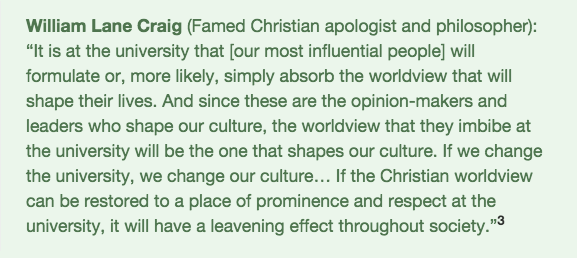
If serving God is your goal, look to the university

There is already a perfectly fine university right next door – no need to fly to Europe to find one! Remember, the university that took your faith away, or maybe the faith of someone you cared about? Yeah, it’s still sitting there in your home town! And it’s still ruining the lives of thousands of young people, by peer-pressuring them into secular, liberal views – and behaviors. It seems to me that it’s better stewardship to stay here and work, then give money to groups like Reasonable Faith. And you can start a blog, teach in church and invite scholars to the local university, too. That costs almost nothing, and it produces better results.

What about Jesus?

Sometimes, it’s a good idea to look beyond the words of the Bible and reflect on the overall message of it at a higher level. When I look in the Bible, I see that Jesus went through a lot of suffering in obedience to God in order to secure the salvation of people who did not even like him. And it’s from this sacrifice on our behalf that his claim on our obedience comes. There are things that I don’t like to do that I do anyway because they work to serve God. Jesus life’s ambition was not to do things that were easy, or that made him happy. Experienced Christians do things that are not fun, because these things are right and because they solve the real problem.

Ryan T. Anderson and Robert P. George reflect on the legalization of same-sex marriage

Gay activist vandalizes pro-marriage sign

Same-sex “marriage” has been the law of the land for 10 years, now. As with the first redefinition of marriage – no-fault divorce – many unexpected problems have arisen. I found an article by two famous social conservative professors in USA Today, where they explain.

Excerpt:

[I]n 2013, [the Supreme Court] struck down the federal definition of marriage as a male-female union in a 5-4 ruling.

[…]Same-sex marriage advocates told the public that they sought only the “freedom to marry.” Same-sex couples were already free to live as they chose, but legal recognition was about the definition of marriage for all of society. It was about affirmation — by the government and everyone else.

It’s unsurprising that once a campaign that used to cry “live and let live” prevailed, it began working to shut down Catholic adoption agencies and harass evangelical bakers and florists. This shows it was never really about “live and let live” — that was a merely tactical stance.

[…]While these were the early effects of redefinition, the more profound consequences will be to marriage itself. Law shapes culture; culture shapes beliefs; beliefs shape action. The law now effectively teaches that mothers and fathers are replaceable, that marriage is simply about consenting adult relationships, of whatever formation the parties happen to prefer. This undermines the truth that children deserve a mother and a father — one of each.

Traditional marriage had the notions of exclusivity and permanence embedded into it. These were seen as necessary to safeguard vulnerable children, who are the natural outcome of natural marriage. But what if you take out the complementary genders, and make marriage about the romantic feelings of adults?

It also undercuts any reasonable justification for marital norms. After all, if marriage is about romantic connection, why require monogamy? There’s nothing magical about the number two, as defenders of “polyamory” point out. If marriage isn’t a conjugal union uniting a man and a woman as one flesh, why should it involve or imply sexual exclusivity? If it isn’t a comprehensive union inherently ordered to childbearing and rearing, why should it be pledged to permanence?

[…]But same-sex marriage is a catalyst for further erosion. Already, we see respectable opinion-makers mainstreaming “throuples,” “ethical nonmonogamy” and “open relationships.”

The progressive elites got rid of natural marriage without even thinking about why marriage was there in the first place. Marriage was traditionally seen as being an exclusive, permanent commitment – and that commitment provided the stability needed for children. Marriage required you to look for a partner who was good at self-control (exclusivity) and commitment (permanence). But when judges decided that marriage was just about two people having romantic feelings, it opened up the door to all of these other “lifestyles”.

I’m just thinking right now about how to stop this. I know that social conservatives are trying to highlight the damage that is being caused by focusing relationships on adult happiness instead of children’s needs and rights. But I still don’t hear any sort of thoughtful presentation of marriage as a commitment enterprise, where two adults suppress their own selfishness in order to make a promise to love and care for this other person. Does anyone see relationships as being a self-sacrificial commitment to another person, and to any children who result? Or are we locked into this view that the goal of relationships is to make my spouse, my children, and everyone else make me feel good and look good?

Bible study: responsibilities and obligations in Philippians 1-4

Bible study that hits the spot

Here are some parts of Philippians that speak to an issue that I think is a problem today for many Christians – self-centeredness.

Philippians 2 talks about the importance of not being self-centered, but instead being focused on the needs of others.

Phil 2:1-8:

2 Therefore if there is any encouragement in Christ, if there is any consolation of love, if there is any fellowship of the Spirit, if any affection and compassion,2 make my joy complete by being of the same mind, maintaining the same love, united in spirit, intent on one purpose. 3 Do nothing from selfishness or empty conceit, but with humility of mind regard one another as more important than yourselves; 4 do not merely look out for your own personal interests, but also for the interests of others. 5 Have this attitude in yourselves which was also in Christ Jesus, 6 who, although He existed in the form of God, did not regard equality with God a thing to be grasped, 7 but emptied Himself, taking the form of a bond-servant, and being made in the likeness of men. 8 Being found in appearance as a man, He humbled Himself by becoming obedient to the point of death, even death on a cross.

And Phil 2:19-23:

19 But I hope in the Lord Jesus to send Timothy to you shortly, so that I also may be encouraged when I learn of your condition. 20 For I have no one else of kindred spirit who will genuinely be concerned for your welfare. 21 For they all seek after their own interests, not those of Christ Jesus. 22 But you know of his proven worth, that he served with me in the furtherance of the gospel like a child serving his father.

Nothing very complicated here, it’s important to look out for the interests of others and to be concerned about their welfare.

I think it’s a good idea to be practical about partnering with people, and instead of just speaking words like “I care” or “I’ll pray for you”, try to find out what needs to be done and do it. Solve the problem with actions. Prayer is important, of course, because so much of what happens to that other person is in God’s hands. You aren’t going to be around all the time, but God is, so talk to him about the other person and what you’re planning to do. But you must also do your part, and do it intelligently and effectively. (The New Testament book of James talks about the need to accompany good wishes with actions that solve the problem)

Also don’t just stand back and give orders while feeling righteous. Many people want to influence others by just quoting the Bible, putting on pious airs, or using mere words. This doesn’t work in any area of the real world. Instead, take a more active approach. Think about the problem that is preventing someone from serving Christ well, and then act to make it easier for the person to do the right thing.

I’ve been able to achieve good success by praying AND performing supportive actions, rather than by issuing commands or prayer alone. For example, I’ve gotten people to transition for useless careers into IT careers, got them to pay off their high-interest debts, got them to switch their majors from something useless to something useful, got them to move on from an abortion or a divorce, got them to not commit suicide, listened to their health problems, helped them pass the GRE or the GMAT or something, got them to take a better job, got them to do a public speaking engagement, taught them how to debate their atheist brother, sponsored a Christian speaker at their university, helped them recover from bad parents, etc. It’s pretty fun to partner with people to further the Kingdom, but if you just leave it at prayer and giving orders, you won’t get the same good results.

All it takes to move from prayer alone to prayer and solutions is to think about other people like a puzzle, and then sacrifice some of your time or your money to build them up. I have a lot of experience doing this, but it’s not something that I learned to do in church. Church doesn’t teach you to be practical about following the Bible intelligently and with your own initiative. It’s set up to favor emotions (singing) and passive listening. To be active, you have to think about the Bible from a higher strategic level. Think about who Jesus is, and then follow his example. Don’t read the Bible in order to just feel happy or sound pious, instead try to make a plan to really DO good. Your goal should be to achieve a result in line with Jesus’ character and goals.

By the way, part of being able to partner with other people to solve problems with actions is being capable yourself. Don’t study stupid things in college. Don’t get into debt. Don’t try to fill your days with fun and thrills. Instead, study hard things, get hard jobs in the private sector, save your money, and learn useful skills. That way, you’ll be able to do more when something more than passive words or feelings is needed. One time, a woman I knew severely hurt her hand at work. She has OCD, and liked to clean the stairs in her house every day. She has a furry cat who drops fur everywhere. So she was lugging this heavy vacuum up and down the stairs every day. And spending a lot of time ironing with an old-fashioned heavy iron, too. So I bought her a hand vacuum and a fancy new iron. With the extra time she saved, she was able to do more reading, public speaking and helping others. Doing Christianity well means making yourself strong, so you can look after others with more than just feelings, piety and prayers.

Philippians is my favorite book of the Bible. And the most important thing about Philippians is that it’s good to be focused on other people, and not on ourselves, and to think of the interests of others, not our own interests. It’s good to get down into the weeds of other people’s problems, and act to self-sacrificially to solve them. Read the book (it’s short) and see if there are not people who you could partner with by helping them solve problems so they can be more effective.