
Tag Archives: Science

Why does God allow so much natural evil from phenomena like earthquakes?

My friend Eric Chabot of Ratio Christi shared this video with me, which features chemist Fazale Rana.

The video runs under 4 minutes:

Basically, there was an atheist who challenged the idea that nature is designed because there are things in nature which cause suffering, like earthquakes and volcanoes.

Now the first thing to note is that atheists commonly think that God’s job is to make humans happy. If he doesn’t make humans feel happy – regardless of their knowledge of him and relationship with him – then he is a big failure. Many atheists think that, it is one of the most common reasons why people become atheists. But of course anyone who reads the Bible and reads the story of Jesus knows that the purpose of life on God’s view is for humans to know him and to be disciples of a suffering Messiah who sacrifices himself in order to obey God the Father.  So that’s the first thing to say – purpose of life not happiness, but knowledge of God and being a disciple of Jesus. This may involve all kinds of suffering, and that’s to be expected.

Second, there is a response to the problem of evil based on the necessity of natural laws. The argument goes that you can’t have genuine morality without a predictable, knowable system of natural laws.

But I want to talk about something different in this post. In the video, Dr. Rana thinks that many of the things that cause suffering in the natural world are actually necessary for life to exist at all. He provides the example of plate tectonics in his video above, and I want to take that one and add to it the example of heavy element production and the stellar lifecycle. These are both from a book called “Rare Earth”, which is written by two non-Christians – Peter Ward and Donald Brownlee, but I’ll link to web sites to make the case.

Plate tectonics.

Here’s an article from Reasons to Believe by Dr. David Rogstad, who has a PhD in physics from Caltech – the top school for experimental science. The article not only goes over the basic plate tectonics to carbonate-silicate cycle connection, but it adds a newer discovery to boot.

Excerpt:

Earthquakes are a byproduct of plate tectonics, a theory in geology developed in recent years for explaining motions near the surface of the Earth. One of the benefits from plate tectonics is that Earth maintains the right levels of carbon dioxide (CO2) in the atmosphere to compensate for the Sun’s increasing luminosity. This is accomplished by what is called the carbonate-silicate cycle. CO2 is removed from the atmosphere through weathering. The weathered products are eventually drawn into the Earth’s interior via plate tectonics. Processes inside the Earth’s interior release the CO2 back into the atmosphere via volcanoes. While all aspects of this mechanism are not yet fully understood, it has been instrumental in providing a stable environment for life on the Earth for billions of years.

New research provides yet another component that appears fine-tuned for life. In a letter in the September 27, 2007 issue of Nature together with a corresponding news release from the University of Bonn, Arno Rohrbach and his colleagues have discussed another mechanism similar to the carbonate-silicate cycle. It also depends on plate tectonics but, in this case, the mechanism controls the amount of oxygen on the surface of the Earth.

Oxygen becomes bound up in various oxides which are then drawn into the Earth’s interior, where various processes result in its being incorporated into an exotic mineral called majorite. The results reported in this letter established that majorite functions as a kind of “reservoir” for oxygen, and when the majorite ascends nearer to the surface of the Earth it breaks down and releases its oxygen. Some of this oxygen also binds with hydrogen released from the interior of the Earth to form water. The authors have referred to the whole process as an “oxygen elevator.”

They go on to say that “without the ‘oxygen elevator’ in its mantle the Earth would probably be a barren planet hostile to life. According to our findings, planets below a certain size hardly have any chance of forming a stable atmosphere with a high water content.”

This research confirms the existence of one more finely tuned mechanism that depends on plate tectonics and contributes to an environment that can support life. It also gives humans one more reason to be appreciative rather than dismayed when we experience an earthquake that breaks some precious possessions beyond repair.

Astronomer Dr. Hugh Ross who has a PhD in Astronomy from the University of Toronto and did a 5-year post-doctoral work at Caltech, adds to this with another discovery.

Excerpt:

In the December 2007 issue of Astrobiology Stanford University geophysicists Norman H. Sleep and Mark D. Zoback note that the higher tectonic activity during Earth’s early history could have played a key role in cycling critically important nutrients and energy sources for life. The production of numerous small faults in the brittle primordial crust released trapped nutrients. Such faults could also release pockets of methane gas and molecular hydrogen. The methane and hydrogen could then provide crucial energy sources for nonphotosynthetic life. Finally, the production of faults could bring water to otherwise arid habitats, such as rocks far below Earth’s surface.

Faulting, generated by active and widespread tectonics, allowed a youthful Earth to support diverse and abundant life. This enhanced diversity and abundance of life quickly transformed Earth’s surface into an environment safe for advanced life. Also, the buildup of biodeposits for the support of human civilization occurred more rapidly due to active tectonics.

The more rapid preparation of Earth for humanity is critical. Without such rapid preparation, humans could not come upon the terrestrial scene before the Sun’s increasing luminosity would make their presence impossible (due to excessive heat).

So that’s the science behind earthquakes. So that’s a brief look at why we need plate tectonics for life, and we just have to buck up and take the earthquakes with it. It’s not God’s job to give us happiness and health. That’s not his plan. People who complain about earthquakes have to show how God could get the life-permitting effects of earthquakes without wrecking his ability to succeed in his plan to make people know him and follow him. But how can an atheist do that? They can’t. I think that people just need to realize that humans are not in charge here and we have to live with that. We have to accept that we didn’t make the universe, and we don’t get to decide what purpose it has. God decides.

On to star formation.

Star formation

Atheists often complain that the universe is too big or too old (which is actually the same thing, since the more time passes, the more it expands). The fact of the matter is that life appeared the earliest it could appear – we needed the universe to be a certain age before it could support life.

Dr. Hugh Ross explains in this article.

Excerpt:

The second parameter of the universe to be measured was its age. For many decades astronomers and others have wondered why, given God exists, He would wait so many billions of years to make life. Why did He not do it right away? The answer is that, given the laws and constants of physics God chose to create, it takes about ten to twelve billion years just to fuse enough heavy elements in the nuclear furnaces of several generations of giant stars to make life chemistry possible.

Life could not happen any earlier in the universe than it did on Earth. Nor could it happen much later. As the universe ages, stars like the sun located in the right part of the galaxy for life (see chapter 15) and in a stable nuclear burning phase become increasingly rare. If the universe were just a few billion years older, such stars would no longer exist.

The Rare Earth book explains the details on p. 40-4:

The trick for getting from helium to the generation of planets, and ultimately to life, was the formation of carbon, the key element for the success of life and for the production of heavy elements in stars. Carbon could not form in the early moments following the Big Bang, because the density of the expanding mass was too low for the necessary collisions to occur. Carbon formation had to await the creation of giant red stars, whose dense interiors are massive enough to allow such collisions. Because stars become red giants only in the last 10% of their lifetimes (when they have used up much of the hydrogen in their cores), there was no carbon in the Universe for hundreds of millions to several billion years after the Big Bang—and hence no life as we know it for that interval of time.

[…]The sequence of element production in the Big Bang and in stars provided not only the elements necessary for the formation of Earth and the other terrestrial planets but also all of the elements critical for life—those actually needed to form living organisms and their habitats.

[…]The processes that occurred during the billions of years of Earth’s “prehistory” when its elements were produced are generally well understood. Elements are produced within stars; some are released back into space and are recycled into and out of generations of new stars. When the sun and its planets formed, they were just a random sampling of this generated and reprocessed material. Nevertheless, it is believed that the “cosmic abundance” mix of the chemical elements—the elemental composition of the sun—is representative of the building material of most stars and planets, with the major variation being the ratio of hydrogen to heavy elements.

[…]Many stars are similar in composition, but there is variation, mainly in the abundance of the heavier Earth-forming elements relative to hydrogen and helium. The sun is in fact somewhat peculiar in that it contains about 25% more heavy elements than typical nearby stars of similar mass. In extremely old stars, the abundance of heavy elements, may be as low as a thousandth of that in the sun. Abundance of heavy elements is roughly correlated with age. As time passed, the heavy-element content of the Universe as a whole increased, so newly formed stars are on the average more “enriched” in heavy elements than older ones.

[…]The matter produced in the Big Bang was enriched in heavier elements by cycling in and out of stars. Like biological entities, stars form, evolve, and die. In the process of their death, stars ultimately become compact objects such as white dwarfs, neutron stars, or even black holes. On their evolutionary paths to these ends, they eject matter back into space, where it is recycled and further enriched in heavy elements. New stars rise from the ashes of the old. This is why we say that each of the individual atoms in Earth and in all of its creatures—including us—has occupied the interior of at least a few different stars.

What he’s saying is that heavy elements are created gradually because of the star formation lifecycle. The first generation of stars are metal-poor. The next generation of stars is better. And so on until we get to stars that can support life by providing a steady, stable amount of energy – as well as other benefits like planets with an atmosphere.  Our planet is 4.5 billion years old, and the universe is about 14 billion years old. Simple life appears about 4 billion years ago on Earth. That means we got life practically immediately, given that we had to develop the heavy elements needed to make a life-supporting star, a life-supporting planet and us. 

UPDATE: Sean from ReligioPolitical Talk pointed out this related post out to me:

Another examples is that hurricanes help to regulate the earths temperature, and cause “sea deserts” to bloom… assisting in many ways earth’s climate:

“Some parts of the ocean are like deserts, because there isn’t enough food for many plants to grow. A hurricane’s high winds stir up the ocean waters and help bring nutrients and phytoplankton to the surface, where they get more sunlight, allowing the plants to bloom,” Babin said. (NASA)

To support the above, via The Columbia Tribune:

….”Most certainly,” says Steve DiMarco, a Texas A&M University oceanography professor who for 16 years has studied the Gulf of Mexico, which has a “dead zone” where oxygen-depleted water can kill marine life.

In early July, most of the Texas-Louisiana shelf from Freeport, Texas, to the Mississippi River Delta was hypoxic – meaning the salt water has lost large amounts of oxygen. Later in July, Hurricane Dolly disrupted the dead zone and re-oxygenated the shallow waters south of Louisiana and the entire shelf off Texas. Oxygen levels started to drop again within days after the storm.

In early August, Hurricane Eduard re-oxygenated the Louisiana shelf, but by mid-August oxygen concentrations dropped to hypoxic levels.

And guess what?

Hurricane Ike re-oxygenated the shelf when it made landfall Sept. 12 in Texas. The latest data collected in October showed oxygen concentrations nearly all at normal levels, DiMarco said….

Now that’s good blogging.
William Lane Craig debates Lawrence Krauss in Melbourne, Australia: Does God Exist?

Here is the video from the third debate from Dr. William Lane Craig’s speaking tour in Australia.

Format:

  • William Lane Craig (15 min)
  • Lawrence Krauss (15 min, but was actually 21:40)
  • Moderated discussion
  • Question and answer

Dr. Graham Oppy, the moderator, is a well-known atheist philosopher. He let Dr. Krauss speak for 21 minutes and 40 seconds, which is why my summary of Krauss is so long.

The video:

Summary

After careful consideration, I decided not to be snarky at all in this summary. What you read below is what happened. There may be some small mistakes, but I will fix those if people tell me about them. I also included some quotes and timestamps for the more striking things that Dr. Krauss said.

The debate itself starts at 4:50 with Dr. Craig’s opening speech. He does use slides to show the structure of his arguments.

Dr. Craig’s opening speech. (4:50)

  1. The kalam cosmological argument:
    • God is the best explanation of the origin of the universe
    • The Borde Guth Vilenkin theorem supports the absolute beginning of the universe
    • Even if our universe is part of a multiverse, the multiverse itself would have to have an absolute beginning
    • Speculative cosmologies try to challenge the Big Bang theory, but none of them – even if true – can establish that the past is eternal
    • Only two types of things could explain the origin of spece, time, matter and energy – either abstract objects or minds
    • Abstract objects do not cause effects, but minds do cause effects (we do it ourselves)
    • A mind is the best explanation for the origin of the universe
  2. The unreasonable effectiveness of mathematics:
    • The underlying structure of nature is mathematical – mathematics is applicable to nature
    • Mathematical objects can either be abstract objects or useful fiction
    • Either way, there is no reason to expect that nature should be linked to abstract objects or fictions
    • But a divine mind that wants humans to understand nature is a better explanation for what we see
  3. The cosmic fine-tuning for the existence of intelligent life
    • There are two kinds of finely-tuned initial conditions: 1) cosmological constants and 2) quantities
    • These constants and quantities have to be set within a narrow range in order to permit intelligent life
    • There are three explanations for this observation: law, chance or design
    • Law is rejected because they are put in at the beginning or matter – they don’t emerge from matter
    • Chance must be rejected, because they odds are just too long unless you appeal to a world-ensemble
    • We do not observe what the world ensemble hypothesis predicts that we should observe
    • Design is the best explanation for finely-tuned constants and quantities
  4. The existence of objective moral values and duties
    • Our experience of morality (values and duties) is that it is objectively real and incumbent on us
    • When someone goes into a classroom and shoots at innocent children, that is objectively wrong
    • On naturalism, moral values and moral duties do not exist – they are conventional and variable by time and place
    • The best explanation for the existence of objective moral values and duties is that God exists
  5. The historicity of the resurrection of Jesus
    • There are three widely-accepted facts that are best explained by the resurrection hypothesis
    • 1) the empty tomb, 2) the post-mortem appearances, 3) the early church’s belief in the resurrection
    • Naturalistic attempts to explain these 3 boilerplate facts fail
    • The best explanation of the 3 minimal facts is that God raised Jesus from the dead
  6. The immediate experience of God
    • Belief in God is a “properly basic” belief – rational even without arguments because of experience of God

Dr. Krauss’ opening speech. (21:12)

Slides: (1234567891011121314)

  1. Religious pluralism I
    • There have been lots of different gods created by people through history
    • We’ve gotten rid of all of them by understanding how the universe works by doing science
    • Religion is just stories, and the stories are inconsistent with how the universe works
  2. Progress of naturalistic science I
    • Newtonian physics refutes the idea that angels push planets around
    • Darwinian evolution refutes design arguments, including the one that Dr. Craig presented (24:10)
    • Biochemistry hasn’t explained how life originated, but we will have the solution soon
    • Physics shows us that matter can be created and destroyed without need a God
    • Physics shows us that universes can be created and destroyed “no problem”
  3. Religious pluralism II
    • Since we have been able to disprove all the gods we’ve invented, why hang on to the last one
    • It’s unlikely that the God that Dr. Craig presented exists, because we disproved all the others he didn’t present
  4. Hiddenness of God
    • There is a complete lack of evidence for the other 999 gods, so how likely is it that the God Dr. Craig presented exists
  5. Religious pluralism III
    • There are inconsistencies between various religions, so therefore there can be no religion that is right
  6. Progress of naturalistic science II
    • Peasants had a very low level of knowledge about the world and they believed in God
    • But our level of knowledge has increased over time, so we shouldn’t believe in God now
    • Peasants thought that the Earth orbited the Sun, but this is now known to be false
    • The Scriptures said that the Earth orbited the Sun, but now we know that’s false from science
  7. Christianity plagiarizes from other religions I
    • There is nothing new or special about Jesus
    • He’s just as unpleasant as all the other gods
    • Everything particular to Jesus occurs in other religions
  8. Catholics are inconsistent about what they believe
    • I’ll bet most Catholics don’t really believe in transubstantiation
    • I’ll bet most Catholics don’t really believe in the virgin birth
  9. The resurrection is copied from many other religions
    • Dionysus, Osiris, etc.
  10. There is no evidence for the resurrection
    • The stories about Jesus were written “decades or hundreds of years after the fact”
    • The stories are inconsistent with each other
    • Dr. Craig tells me that historical Jesus scholars all accept that the resurrection happened
    • That’s like saying that all alien abductions experts agree that alien abductions happened
    • It’s unreasonable to think that the resurrection happened because no one saw it happen
    • I accept that people reported on appearances, but hallucination theory can explain that
  11. The timeline for the creation and incarnation are all wrong
    • The creation, planet formation, hominids, incarnation, etc. all take place in the wrong times
    • If God knew what he was doing, he would done everything at better times to be more efficient
  12. David Hume’s argument against miracles is sound
    • Extraordinary claims require extraordinary evidence – nothing wrong with this argument
    • Miracles are really just coincidences
    • Catholic apparitions at Lourdes disprove the historical argument that Dr. Craig made for the resurrection
  13. God is petty and jealous
    • God shouldn’t demand that we trust him, esteem him and consider his character when we make decisions
    • The atoning death of Jesus for the sins of the world also makes no sense
  14. Belief is based on geography
    • What you believe is clearly correlated with where you are born
    • There is even an Islamic clone of Dr. Craig who “uses the exact same arguments” that he does to prove Islam
    • Belief in God is decreasing in the Internet-accessible world
  15. Science can develop morals without God
    • Reason is able to guide our actions to be moral
    • Morality evolves over time, so there is no objective morality
    • Catholicism teaches things that are immoral
    • Some things are prohibited by biological revulsion, such as incest
    • But if a brother and sister have sex using condoms “is that morally wrong? I can’t say it is frankly” (37:24)
  16. Dr. Craig is irrational
    • “I came here convinced based on my past interactions and his writing that Dr. Craig was a dishonest Charlatan”
    • “Any argument that validates God is reasonable to him”
    • “And any argument against it is not only unreasonable but wrong and worth distorting”
    • “Because it must be wrong – he’s decided the answer in advance”
  17. Dr. Craig is immoral
    • Dr. Craig thinks it is OK for God to command that Canaanite children are killed
    • “So in fact if they were Canaanite children in that schoolroom that he talked about then it would be OK”
    • It’s not reasonable to justify genocide in that way, but Dr. Craig is willing to go to those lengths
  18. The cause of the origin of the space time universe need not be God
    • Dr. Craig says that if there is an explanation for the origin or space, time, matter and energy it must be God
    • But it could just as easily be turtles or Zeus
  19. Dr. Craig misrepresents the Borde Guth Vilenkin theorem
    • Alexander Vilenkin wrote me an e-mail that says that the theorem doesn’t work in all cases
    • “Dr. Craig is so convinced that these arguments must be true that he won’t listen to the fact that they’re not”
  20. Darwinian evolution explains the fine-tuning
    • “Life was fine tuned – we got rid of it with Darwin”
    • Mutation and natural selection explain the cosmic fine-tuning argument that Dr. Craig presented
  21. Suboptimal design disproves the fine-tuning argument
    • “We get back aches” therefore “This argument that [the universe] is fine-tuned for life is nonsense”
  22. William Lane Craig can be proven to exhibit homosexual behavior using logical arguments
    • Look, you can construct arguments that are clearly wrong
    • Premise 1: “All mammals exhibit homosexual behavior”
    • Premise 2: “William Lane Craig is a mammal”
    • Seems to be saying that logical arguments can prove false things “it’s nonsense”
  23. Dr. Craig distorted a podcast that some group made on pain receptors
    • Dr. Craig’s faith is so strong that it causes him to distort what this group said

Discussion: (44:35)

I will not be summarizing everything that was said, just a few main points.

The segment from 52:18 to 57:12 about the Vilenkin e-mail on the BVG theorem is a must-see. Krauss is standing up and gesticulating while Craig is calmly trying to quote a paper by Vilenkin that shows that Krauss is misrepresenting Vilenkin. Krauss constantly interrupts him. After a while, when Craig exposes him as having misrepresented Vilenkin and gets him to admit that all current eternal models of the universe are probably wrong, he quietens down and can’t even look at Craig in the face.

Cosmological argument:

  • Craig: The e-mail says any universe that is expanding, on average, requires a beginning
  • Craig: There are two models – Aguirre & Gratton and Carroll & Chen – where there is a period of contraction before the expansion
  • Craig: The two models are the ones cited in the e-mail that Dr. Krauss showed
  • Craig: In the very paper by Vilenkin that I cited, he says that both of those models don’t work
  • Krauss: (agitated and interrupting) Vilenkin said that they have to make an assumption about entropy that they have no rationale for
  • (as Craig starts to talk Krauss makes an exaggerated, disrespectful gesture and sits down in a huff)
  • Craig: Yes, an unwarranted assumption means that they don’t have EVIDENCE for their theories being correct
  • Krauss: (agitated and interrupting) “All the evidence suggests that the universe had a beginning but WE DON’T KNOW!!!!!!!” (raising his voice)
  • Craig: I’m not saying that we know that the universe had a beginning with certainty
  • Craig: I am saying that the beginning of the universe is more probably true than false based on the evidence we have
  • Craig: And you  agree with me about that – you think the universe had a beginning
  • Krauss: (agitated and interrupting) (Unintelligible)
  • Moderator: One at a time
  • Craig: In your Vilenkin e-mail slide, at the end of the paragraph where the two models are mentioned that Vilenkin specifically shows…
  • (I am guessing that Craig is going to ask why so much of what Vilenkin wrote has been cut out of the e-mail that Krauss showed)
  • Krauss: (agitated and interrupting) Because it was technical…
  • Moderator: Lawrence! Hang on a sec!
  • Craig: He specifically shows that these models are not past eternal, and that they require a beginning just like the others…
  • Krauss: (agitated and interrupting) We can do the math if you want
  • Craig: Now wait. I couldn’t help notice that there on your slide there was a series of ellipsis points indicating missing text…
  • Krauss: (agitated and interrupting) “Yeah, because it was technical!”
  • Craig: “I wonder what you deleted from the original letter”
  • Krauss: (agitated and interrupting) “I just told you!”
  • Craig: “Now wait. Could it have been something like this:  (reads a quote from Vilenkin) ‘You can evade the theorem by postulating that the universe was contracting prior to some time. This sounds as if there is nothing wrong with having contraction prior to expansion. But the problem is that a contracting universe is highly unstable. Small perturbations would cause it to develop all sorts of messy singularities, so it would never make it to the expanding phase.’
  • Craig: “That’s Vilenkin.”
  • Krauss: “In this paper, that’s absolutely right”
  • Krauss: But it’s ok for theories to assume things that we know are wrong – they are still good theories – it’s unknown
  • (Craig turns away and looks through his papers)
  • Craig: “Isn’t it true that the only viable quantum gravity models on order today involve a beginning – have a finite past?”
  • Krauss: “No”
  • Craig: “Well, can you give us one then”
  • Krauss: (talks about a variety of possible eternal models) “In my experience in science, all of them are probably wrong”
  • Krauss: “You know most theories are wrong, which is why, you know, it’s hard”
  • Craig: “Right”

I noticed that a huge number of atheist web sites are taking the Vilenkin quote that Krauss used out of context, like this one and this one. There are probably a lot more of them like that, which I think is interesting. That’s why we have these debates, I guess. To set the record straight about who accuses people of being dishonest, and who is actually dishonest.

Fine-tuning:

  • Krauss tried to argue that he had explained the fine-tuning with the Higgs particle, but Dr. Craig said that only applied to the cosmological constant, not all the other examples of fine-tuning. Krauss said that it wasn’t impressive that this universe permitted life and that “It would have been much more surprising if we evolved in a universe in which we couldn’t live”. Krauss argued the fine-tuning was only for “Life like us”. But Dr. Craig explained that the fine-tuning is what allows us to have the basics of any kind of life, like slow-burning stars, chemical diversity, etc. – things that are required for basic minimal life functions in any living system. Craig said that he was working with the current physical laws of this universe (F = ma, etc.) and that he was looking at what changed if we changed those even slightly. Krauss tried to say that if he changed things like the mass of particles then the strength of forces would change. (But the forces aren’t laws!) Krauss argued that the cosmological constant would be even better for life if it was zero, and Craig said that the life permitting range did include zero, but that the range of life-permitting values was narrow.

Jesus’ existence:

  • Craig reponded to the mystery religions charge, the charge that the evidence for the minimal facts is too late/too weak, the charge that grief visions explained the evidence better, and Hume’s argument against miracles. Craig brought up the early creed from 1 Cor 15:3-7 and explained to Krauss that it was 5 years after the events, and that Jewish standards of oral transmission were strong enough to ensure that the creed was reliable, and most of the eyewitnesses would still have been alive.

Audience Q and A: (1:21:09)

The first topic is the grounding of morality. Krauss agrees that there is no objective morality and no objective moral oughts. He also said that that standards of behavior are arbitrary, and that they change over time and they are adopted for promoting social order. Dr. Craig pressed the point that science itself would collapse without ethical values. It assumes them, but cannot ground them.

The next topic was free will. Krauss is a determinist. Craig asked him how he could reconcile moral responsibility with determinism.

The next topic was the effectiveness of mathematics. Krauss didn’t have an explanation for it and didn’t think it needed one. Then they got into whether the Genesis has been verified by science and whether it is meant to be taken literally.

The next topic was whether philosophy makes any progress. Craig gave the example of verificationism being rejected as too narrow, and self-refuting. Krauss: “I’m going to come to the defense of philosophy for the first time”. Craig: “That’s amazing!” Krauss said that science provides new knowledge. Craig said there were some things that could be known apart from science.

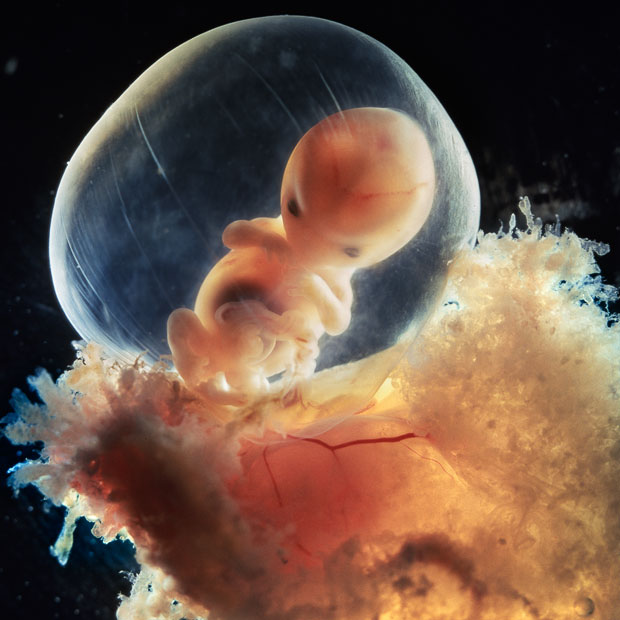
New study finds that unborn babies can recognize spoken words

Scheming unborn baby can hear what you're saying, potty-mouth
Scheming unborn baby can hear what you’re saying, potty-mouth

The study was published in the prestigious peer-reviewed journal Science.

Excerpt:

As a fetus grows inside a mother’s belly, it can hear sounds from the outside world—and can understand them well enough to retain memories of them after birth, according to new research.

It may seem implausible that fetuses can listen to speech within the womb, but the sound-processing parts of their brain become active in the last trimester of pregnancy, and sound carries fairly well through the mother’s abdomen. “If you put your hand over your mouth and speak, that’s very similar to the situation the fetus is in,” says cognitive neuroscientist Eino Partanen of the University of Helsinki. “You can hear the rhythm of speech, rhythm of music, and so on.”

A 1988 study suggested that newborns recognize the theme song from their mother’s favorite soap opera. More recent studies have expanded on the idea of fetal learning, indicating that newborns already familiarized themselves with sounds of their parent’s native language; one showed that American newborns seem to perceive Swedish vowel sounds as unfamiliar, sucking on a high-tech pacifier to hear more of the new sounds. Swedish infants showed the same response to English vowels.

But those studies were based on babies’ behaviors, which can be tricky to test. Partanen and his team decided instead to outfit babies with EEG sensors to look for neural traces of memories from the womb. “Once we learn a sound, if it’s repeated to us often enough, we form a memory of it, which is activated when we hear the sound again,” he explains. This memory speeds up recognition of sounds in the learner’s native language and can be detected as a pattern of brain waves, even in a sleeping baby.

The team gave expectant women a recording to play several times a week during their last few months of pregnancy, which included a made-up word, “tatata,” repeated many times and interspersed with music. Sometimes the middle syllable was varied, with a different pitch or vowel sound. By the time the babies were born, they had heard the made-up word, on average, more than 25,000 times. And when they were tested after birth,these infants’ brains recognized the word and its variations, while infants in a control group did not, Partanen and colleagues report online today in the Proceedings of the National Academy of Sciences.

Babies who had heard the recordings showed the neural signal for recognizing vowel and pitch changes in the pseudoword, and the signal was strongest for the infants whose mothers played the recording most often. They were also better than the control babies at detecting other differences in the syllables, such as vowel length. “This leads us to believe that the fetus can learn much more detailed information than we previously thought,” Partanen says, and that the memory traces are detectable after birth.

“This is a well-respected group and the effects are really convincing,” says Patricia Kuhl, a neuroscientist at the University of Washington in Seattle. Combined with previous work, she says, these results suggest “that language learning begins in the womb.”

More evidence that unborn babies are not just blobs of tissue. Every one is precious, and we need to be more careful with our decisions so that we welcome them into the world and look after them as they grow up. Not just giving them protection and sustenance, but a mother and a father close by, too. That’s what they need.