Tag Archives: Rule of Law

Fiscal and social conservatives unite in new free e-book “Indivisible”

There’s a new book that just came out from the Heritage Foundation, my favorite think tank.

Here’s an excerpt from the introduction by Jay Richards:

To listen to media and political strategists is to get the impression that American public life is a checklist of issues. Some are known as “social” issues (marriage, family) and some are known as “economic” (international trade, wages). There may be some good reasons for this distinction, but when we itemize and divide these topics into two separate categories, we fail to convey the underlying unity of the principles behind the American Experiment in ordered liberty. In reality, the two groups of issues are interdependent. For instance, a free economy cannot long exist in a culture that is hostile to it. The success of free market economic policies depends on important cultural and moral factors such as thrift, delayed gratification, hard work, and respect for the property of others. A virtuous and responsible populace derives, in turn, from strong families, churches, and other civil institutions.

Conversely, economic issues have a strong influence on culture and the institutions of civil society. High taxes, for example, put pressure on families and force parents to spend more time in the workforce, leaving less time to devote to their spouses and children. When government expands spending and control in education, it crowds out parental responsibility; when it expands its role in providing social welfare services, it tends to erode a sense of responsibility among churches and other groups doing good work to help neighbors in need.

The connections are such that the individual issues rarely fit neatly and exclusively into one set or the other. An “economic” issue is rarely exclusively about economics. For instance, poverty in America is often as much a moral and cultural problem as an economic problem. Reducing such poverty depends on civil institutions that inculcate virtue and responsibility as well as policies that promote economic freedom and discourage dependency. Most poverty among children in America is not caused by a lack of jobs but rather by factors such as family breakdown, negligent or absentee parents, substance abuse, or other social pathologies. To consider American poverty in strictly economic terms is to fail to see the full scale of issues involved in this problem.

[…]The following essays are intended as a concise exploration of the link between liberty and human dignity and of the policy issues that tend to cluster around these two themes in American life. This collection brings together a number of well-known social and economic conservatives. To encourage cross-fertilization of their ideas, those known as social conservatives have written on themes normally identified with economic conservatives, and vice versa. The authors highlight economic arguments for issues typically categorized as “social” and social/moral arguments for “economic” issues. Each author focuses on a single topic, briefly summarized below, that is associated with either social or economic conservatives or, in some cases, both.

That’s also one of the main purposes of my blog, to show how fiscal conservatives and social conservatives depend on each other.

Here are the essays and authors:

  • Civil Society: Moral Arguments for Limiting Government – Joseph G. Lehman
  • Rule of Law: Economic Prosperity Requires the Rule of Law – J. Kenneth Blackwell
  • Life: The Cause of Life Can’t be Severed from the Cause of Freedom – Representative Paul Ryan
  • Free Exchange: Morality and Economic Freedom – Jim Daly with Glenn T. Stanton
  • Marriage: The Limited-Government Case for Marriage – Jennifer Roback Morse, Ph.D.
  • Profit: Prophets and Profit – Marvin Olasky, Ph.D.
  • Family: Washington’s War on the Family and Free Enterprise – Stephen Moore
  • Wages: The Value of Wages – Bishop Harry R. Jackson, Jr.
  • Religion:  Why Faith Is a Good Investment – Arthur Brooks, Ph.D., and Robin Currie
  • International Trade: Why Trade Works for Family, Community, and Sovereignty – Ramesh Ponnuru
  • Culture: A Culture of Responsibility – Edwin J. Feulner, Ph.D.
  • Property: Property and the Pursuit of Happiness – Representative Michele Bachmann
  • Environment: Conserving Creation – Tony Perkins
  • Education: A Unified Vision for Education Choice – Randy Hicks

Seeing the names of people paired with these topics just blows my mind. It would be as though William Lane Craig were suddenly to write a book defending free market capitalism or the war on Islamic terrorism. It’s just WEIRD. And you’ll notice that many of the Wintery Knight’s favorite people are in there; Paul Ryan, Michele Bachmann, Jennifer Roback Morse.  I also like Stephen Moore’s writing a lot.

The entire book is available for free as a PDF download, or you can order it from the Heritage Foundation. I ordered 10 copies of everything at the store, because I wanted a bunch to give away to all my friends. I think this is the perfect gift to give someone who doesn’t see the relevance of public policy to Christianity, marriage and parenting. There is no such thing as an informed Christian who is fiscally liberally or socially liberal.

Oh, and by the way: Ryan/Bachmann 2012 for the win!
Indian auto sales surge 71.9% while free trade vaults Chile into the first world

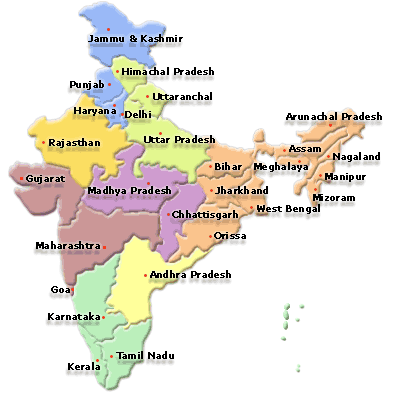
Map of India
Map of India

Before, I wrote about India’s election results and the decision of the ruling Congress Party to drastically cut income taxes. And I also wrote about China’s decision to cut taxes on purchases of new automobiles. So did those tax cuts work out for India and China?

Story from the Associated Press

Excerpt:

China extended its lead over the U.S. as the world’s biggest auto market in November, with production and sales both surpassing 1 million vehicles, and India saw sales jump 71.9-percent.

[…]China’s auto market is sizzling, thanks largely to tax cuts and subsidies aimed at supporting the industry and encouraging use of more fuel-efficient vehicles. The boom has clinched China’s status as the world’s biggest vehicle market due to languishing sales in the U.S.

[…]The surge is also a sign of how the Indian consumer — encouraged by government tax cuts, a big disbursement of back pay for government employees and falling interest rates — is fueling economic growth in Asia’s third-largest economy.

As everyone knows, the Democrats chose to bail out auto companies with taxpayer money and reward people with taxpayer money for destroying fully functional vehicles. And we all know how well that has worked out.

Chile poised to jump from the third world to the first world

Check out this editorial from Investors Business Daily. (podcast here)

Excerpt:

Chile is expected to win entry to OECD’s club of developed countries by Dec. 15 — a great affirmation for a once-poor nation that pulled itself up by trusting markets. One thing that stands out here is free trade.

[…]It’s not like Chile was born lucky. Only 30 years ago, it was an impoverished country with per capita GDP of $1,300. Its distant geography, irresponsible neighbors and tiny population were significant obstacles to investment and growth. And its economy, dominated by labor unions, wasn’t just closed, but sealed tight.

In the Cato Institute’s 1975 Economic Freedom of the World Report it ranked a wretched 71 out of 72 countries evaluated.

Today it’s a different country altogether. Embracing markets has made it one of the most open economies in the world, ranking third on Cato’s index, just behind Hong Kong and Singapore. Per capita GDP has soared to $15,000.

Besides its embrace of free trade, other reforms — including pension privatization, tax cuts, respect for property rights and cutting of red tape helped the country grow not only richer but more democratic, says Cato Institute trade expert Daniel Griswold.

But the main thing, Griswold says, is that the country didn’t shift course. “Chile’s economy is set apart from its neighbors, because they have pursued market policies consistently over a long period,” he said. “Free trade has been a central part of Chile’s success.”

Democrats oppose free trade, and their hostility to free trade angers many other countries in the world.

What does it take for a country to succeed?

I gave my Dad my copy of “Money, Greed and God” by Jay Richards, and although he thought that it started out slow, he’s warmed up to it. He calls me on the phone at least twice a day, and last night he alerted me to this web site, where you can track each countries average citizen’s life span and per-capita GDP over time. My Dad was pretty liberal on economics before, so naturally I’ve been working on him with lots of introductory books on economics. He’s read about a dozen now, and Thomas Sowell is his favorite.

Anyway, my Dad says that this is what a country needs to succeed:

  • free trade with other nations
  • the rule of law
  • low judicial activism
  • low tax rates
  • private property protections
  • currency not threatened by inflation
  • low government spending
  • minimal regulation of commerce

And at that web site, you can track the success of countries like Singapore and Hong Kong, which embrace conservative small government free market fiscal policies, and compare them with countries like Zimbabwe and North Korea, which embrace big government protectionist fiscal policies. Countries fail because they adopt the wrong policies. They succeed when they adopt the right policies. It doesn’t matter how poor they start, if they have the right policies, they grow rich over time.

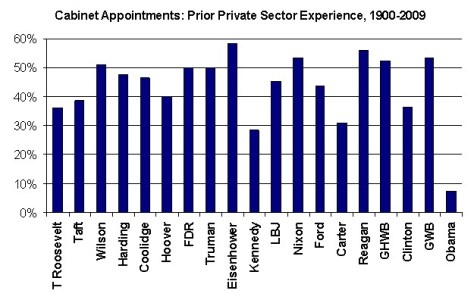
Why are the Democrats so incompetent on economic policy?

Well, it’s because there is almost no one in the Obama socialist regime who has ever run a business or worked in a business. Check out this graphic. (H/T Flopping Aces)

You can read more about the Obama administration’s ignorance of business and economics here in Forbes magazine.

This Reuters article discusses the price of economic ignorance: (H/T Gateway Pundit)

Excerpt:

Hunger is spreading while the number of homeless families is increasing as a result of the recession and other factors, according to a report on Tuesday.

The U.S. Conference of Mayors said cities reported a 26 percent jump in demand for hunger assistance over the past year, the largest average increase since 1991.

Middle-class families as well as the uninsured, elderly, working poor and homeless increasingly looked for help with hunger, which was mainly fueled by unemployment, high housing costs and low wages.

Democrats really don’t know what they are doing. It’s like putting pre-schoolers in charge of Amazon.com. It doesn’t work. Their ivory tower, silver-spoon worldview cannot comprehend real-world, grown-up complexities. So long as the Democrats continue to attack the businesses that employ citizens while redistributing wealth from people who produce to people who vote Democrat, our economic troubles will continue.

Related Cato Institute podcasts

Does the Bible teach communism like Michael Moore seems to think?

Neil Simpson has a wonderful post up analyzing whether Michael Moore is correct to think that Jesus’ teachings in the Bible are opposed to capitalism. My opinion is that Michael Moore is no more a Christian than Barack Obama or Richard Dawkins. In order to be a Christian, you need to accept the teachings of Jesus, and Moore doesn’t. And Neil explains why by referring to Moore’s own blog post.

Neil does a good job of analyzing Moore’s errors, and his incredible hypocrisy, so check it out. But I wanted to highlight a comment from Shalini from the comments to that post.

Shalini wrote:

Socialism discards the concept of ownership… by individuals and I see no passage or verse in NT where Jesus seems so against the concept of individual ownership.

Socialism gradually leads to communism and the very intention of communism is to separate people from God. Heck! If you have a government which says “I will feed you” and promises other pleasures of the world, but it never addresses the spiritual needs of a person, I don’t see God approving of it. The other problem about socialism is that one person works hard and the government/organization takes/steals from him and gives it to someone who works less harder. That results in laziness! So does God approve of laziness? I think God said we will have to work harder all our lives. He didn’t say ‘Some of you will have to work harder and the rest will just have to steal from you.”.

I think the passage she is thinking of might be 2 Thessalonians 3:6-12.

6In the name of the Lord Jesus Christ, we command you, brothers, to keep away from every brother who is idle and does not live according to the teaching you received from us. 7For you yourselves know how you ought to follow our example. We were not idle when we were with you, 8nor did we eat anyone’s food without paying for it. On the contrary, we worked night and day, laboring and toiling so that we would not be a burden to any of you. 9We did this, not because we do not have the right to such help, but in order to make ourselves a model for you to follow. 10For even when we were with you, we gave you this rule: “If a man will not work, he shall not eat.”  11We hear that some among you are idle. They are not busy; they are busybodies. 12Such people we command and urge in the Lord Jesus Christ to settle down and earn the bread they eat.

About 50% of Americans do not pay any income tax, whereas a tiny minority of the most productive people pay the vast majority of all income taxes collected. And yet still the poor clamor for more and more of their neighbors’ wealth! What they should be clamoring for is knowledge of how their neighbor acts in order to be productive and frugal. Or even better, they should be clamoring for a relationship with God through Christ, and not being so focused on acquiring worldly goods at all!

Moore and others on the left think that all religion is about making people happy in this life. So naturally, they are not going to read the Bible to incorporate it as an authority over their decisions – they are functional atheists. They will only use the Bible to trick people into adopting government-controlled wealth redistribution. They just want to feel good about themselves in this life by redistributing other people’s money.

Thomas Sowell calls this “the vision of the anointed”. The elites think they are smarter than you are – that they should decide how much money you earn and how you spend it, so that they can prove how morally superior they are to you by “helping” the “poor” with what they take from you.

Shalini continues:

In the Acts of apostles, there was collection and re-distribution of wealth. But under who’s guidance? The apostles who were God inspired and who did things God would approve of. So there was no problem there. But can we trust the government to do what the apostles did or to do what Jesus would do? A government which approves of all things God loathes? And given the power, who is to say the government wont act as greedy as the CEOs and wall street bankers? At least with a company I have the choice to quit. With the government I will be stuck for life or at least till the next elections. If one is so bent upon making atrocious stereotypes of all rich men why don’t they look at the atrocities done by socialist states? My CEO only had the authority over my intellectual skills. The socialist government would claim authority even over my moral rights.

What Christianity supports is the concept of private individual charity. What Moore supports is government-managed redistribution of wealth from those who produce to those who don’t produce. History has shown in places like Cuba, North Korea, Zimbabwe and Venezuela that this results of trying the communism that Moore seems to advocate results in more poverty, not less. A rising tide lifts all boats – and that is why the poor in capitalist America are richer than the rich in any communist nation.

Further study

To learn more about the relationship between Christianity and capitalism, check out this post (the second half is on capitalism).

Excerpt:

To understand what capitalism is, you can watch this lecture entitled “Money, Greed and God: Why Capitalism is the Solution and Not the Problem” by Jay W. Richards, delivered at the Heritage Foundation think tank, and televised by C-SPAN2.

[…]If you can’t see the Richards video, here is an audio lecture by Jay Richards on the “Myths Christians Believe about Wealth and Poverty“. Also, why not check out this series of 4 sermons by Wayne Grudem on the relationship between Christianity and economics? (a PDF outline is here)

And don’t forget about the course on economics from a Christian perspective taught by Dr. Ron Nash, or Dr. Jennifer Roback Morse’s lecture on basic economics that I wrote about before.

Share