Tag Archives: Roman Catholic

What should a Roman Catholic think about naturalism and evolution?

Charles Pope on the Archdiocese of Washington web site. (H/T Joe Carter on First Things)

Excerpt:

It is common to experience a rather simplistic notion among Catholics that the Theory of Evolution can be reconciled easily with the Biblical accounts and with our faith. Many will say something like this: “I have no problem with God setting things up so that we started as one-celled organisms and slowly evolved into being human beings. God could do this and perhaps the Genesis account is just simplifying evolution and telling us the same thing as what Evolution does.”

There are elements of the truth in this sort of a statement. Surely God could have set things up to evolve and directed the process so that human beings evolved and then, at some time he gave us souls. God could have done that.

The problem with the statement above is less theological than scientific because there is a word in that sentence that is “obnoxious” to evolutionary theory: “God.” The fact is that most Catholics who speak like this over-simplify evolutionary theory and hold a version of it that most Evolutionary Theorists do not hold. They accept the Theory of Evolution uncritically.

Yeah, because what evolutionists mean by “evolution” is that GOD HAD NO DETECTABLE EFFECT ON THE PROCESS. They mean that THE PROCESS OF EVOLUTION OCCURRED ENTIRELY WITHOUT DIVINE INTERVENTION. That’s what evolution means – fully materialistic, fully random, no intelligence needed, emergence of all the diversity of life we see.

Now what this means is that God is excluded as a cause by evolutionary theory. It would be fine if evolutionists (as natural scientists) were either silent on the question of God. Or, perhaps if they simply stated that things may be acted upon by an outside force or intelligence but that is beyond the scope of their discipline. But that is not what is being said by most proponents of evolutionary theory. They are saying that biodiversity results MERELY from natural selection and random (i.e. non intended or non-purposeful) genetic mutations. They are saying that observable effects of biodiversity are wholly caused by something natural, random and without any ultimate goal or plan.

But a Catholic cannot accept all of this. Even if a Catholic wants to accept that things have evolved in some way (whether through macro or microevolution) a Catholic cannot say that this process is simply random, chance, blind, or with no purpose. We believe that God alone created all things, and that he sustains all things. Neither do we confess some sort of “deist” God who merely started things off and then lets them take their own course. Rather, God sustains and carries out every detail.

Joe Carter adds:

In my experience, most people haven’t considered the issue of how the theological and scientific claims can be compatible. For instance, to be a “theistic evolutionist” in the sense that modern scient will accept, requires one to adhere to polygensism (the theory that Adam was not one historical man but, rather, a euphemism for “mankind”). That position, however, is not compatible with the teachings of the Bible, the Church, or of Jesus.

The dividing line between theists and non-theists is as follows: did God act in history in a way that his creative agency and intelligent agency is discernable to us using the objective methods of science? Atheists (and theistic evolutionists) say that God’s creative agency and intelligent (selection/sequencing) agency is neither necessary to explain what we observe in the universe, nor are the effects of agency detectable through science. Theists (and deists) say that God’s creative agency and intelligent agency is necessary in order to explain what we observe in the universe, and these effects of agency are detectable through science.

That is the dividing line. I don’t how I could be much clearer.
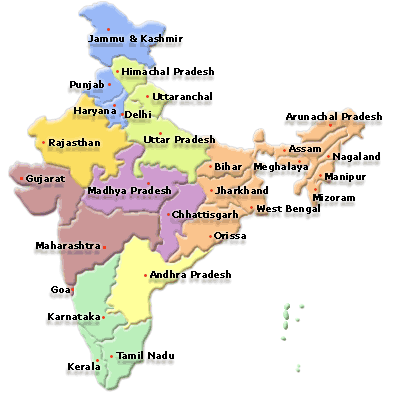
Muslims attack unarmed Christians in India and Turkey

Story from the Hindu.

Excerpt:

Two activists of the Popular Front of India (PFI) were arrested on Monday in connection with the attack on a professor at Muvattupuzha in Ernakulam district. Sources said 12 others, most of them with extremist links, were also taken into custody for interrogation.

Ashraf, 37, of Mundeth, Mekalady, and Jaffar, 28, of Eramaloor, Kothamangalam, were remanded to judicial custody by the Judicial First Class Magistrate Court, Muvattupuzha.

The right palm of T.J. Joseph, 53, professor of Malayalam in the Newman College, Thodupuzha, was chopped off by the assailants on Sunday. He, along with his mother and sister, was returning home from church when a gang of six waylaid his car and attacked him with an axe.

PFI is a Muslim organization. Kerala is not reputed to be a particularly extremist state. I heard that TN and AP are the two best ones. Maybe Shalini can correct me.

And I think the general trend in India is in favor of more religious liberty for Christians. But not so in Turkey.

National Review reports on more violence in Turkey.

Excerpt:

For all the attention Turkey has gotten lately, very few Americans are aware that the Roman Catholic bishop serving as apostolic vicar of Anatolia was stabbed to death and decapitated last month by an assailant shouting, “Allahu Akbar! I have killed the great Satan!”

There are fewer than 60 Catholic priests in all of Turkey, and yet Bishop Luigi Padovese was the fifth of them to be shot or stabbed in the last four years, starting with the murder of Fr. Andrea Santoro in 2006, also by an assailant shouting, “Allahu Akbar!” (An Armenian journalist and three Protestants working at a Christian publishing house — one of them German, the other two Turkish converts — were also killed during this period.)

What’s going on? Why has traditionally secularist Turkey, with its minuscule Christian community (less than 0.2 percent of the population), lately become nearly as dangerous for Christians as neighboring Iraq? And why has this disturbing pattern of events so far escaped notice in the West?

In a nutshell, all these violent acts reflect a popular culture increasingly shaped by Turkish media accounts deliberately promoting hatred of Christians and Jews.

As it happens, Bishop Padovese was murdered on the same day (June 3) that the Wall Street Journal published an eye-opening report on how Turkey’s press and film industry have increasingly blurred the distinction between fact and fantasy, especially since the Islamist Justice and Development Party (AKP) took power in 2002.

“To follow Turkish discourse in recent years has been to follow a national decline into madness.” That’s how Robert L. Pollock, editorial-features editor of the Journal, summed up the trajectory of the daily fare that shapes Turks’ attitudes toward the outside world — and toward non-Muslims in their midst. Indeed, much of what passes for fact in Turkish public discourse would be comical if not for the deadly consequences.

Turkey is really starting to scare me. They’re going the wrong way.

If a Protestant Christian commits suicide, does he still go to Heaven?

ECM is puzzling about things

ECM is actually an extremely intelligent, cultured fellow who reads far more deeply than I do on a wide variety of topics, including philosophy, history and science. He likes to puzzle about difficult questions, and you never know what he will ask from one day to the next.

Today he wanted to know what I thought about Protestants and suicide. In Roman Catholicism, suicide is a mortal sin, so you go straight to Hell since you can’t confess it and do penance for it. [UPDATE: My Catholic commenters say that you might still go to Heaven after some time in Purgatory. However, Protestants don’t believe in Purgatory]. But I didn’t think that that would be the case in Protestantism because we emphasize grace and the sufficiency of Christ’s atonement to cover all sins. But he started to tie me up in knots with his questions, so I just told him to go away.

I still don’t know what the answer is.

Here are the questions:

  • 1) Is suicide a sin in Protestant Christianity?
  • 2) What happens to a Protestant if he commits suicide?
  • 3) How can a Protestant repent of the sin of suicide?
  • 4) Does suicide count as murdering yourself for Protestants?

Please explain to me the right answers in the comments. I really have no idea.

You can also suggest more questions, and I will add them to the list.