Tag Archives: Research

Study finds that attitude of gratitude has many health benefits

From the Harvard Mental Health Newsletter.

Excerpt:

Two psychologists, Dr. Robert A. Emmons of the University of California, Davis, and Dr. Michael E. McCullough of the University of Miami, have done much of the research on gratitude. In one study, they asked all participants to write a few sentences each week, focusing on particular topics.

One group wrote about things they were grateful for that had occurred during the week. A second group wrote about daily irritations or things that had displeased them, and the third wrote about events that had affected them (with no emphasis on them being positive or negative). After 10 weeks, those who wrote about gratitude were more optimistic and felt better about their lives. Surprisingly, they also exercised more and had fewer visits to physicians than those who focused on sources of aggravation.

Another leading researcher in this field, Dr. Martin E. P. Seligman, a psychologist at the University of Pennsylvania, tested the impact of various positive psychology interventions on 411 people, each compared with a control assignment of writing about early memories. When their week’s assignment was to write and personally deliver a letter of gratitude to someone who had never been properly thanked for his or her kindness, participants immediately exhibited a huge increase in happiness scores. This impact was greater than that from any other intervention, with benefits lasting for a month.

Of course, studies such as this one cannot prove cause and effect. But most of the studies published on this topic support an association between gratitude and an individual’s well-being.

Other studies have looked at how gratitude can improve relationships. For example, a study of couples found that individuals who took time to express gratitude for their partner not only felt more positive toward the other person but also felt more comfortable expressing concerns about their relationship.

Managers who remember to say “thank you” to people who work for them may find that those employees feel motivated to work harder. Researchers at the Wharton School at the University of Pennsylvania randomly divided university fund-raisers into two groups. One group made phone calls to solicit alumni donations in the same way they always had. The second group — assigned to work on a different day — received a pep talk from the director of annual giving, who told the fund-raisers she was grateful for their efforts. During the following week, the university employees who heard her message of gratitude made 50% more fund-raising calls than those who did not.

My editor Mary writes: There is a health bonus to thankfulness but health isn’t why we should be thankful. We should be thankful because we are the recipients of many good things and it is appropriate under such circumstances to express gratitude. It is also the overflow of a heart made happy by the generosity of another.

To help us be thankful, here is a famous Thanksgiving day proclamation.

Here it is:

PRESIDENTIAL THANKSGIVING PROCLAMATIONS

1789-1815 : George Washington, John Adams, James Madison

THANKSGIVING DAY 1789

BY THE PRESIDENT OF THE UNITED STATES OF AMERICA – A PROCLAMATION

Whereas it is the duty of all Nations to acknowledge the providence of almighty God, to obey his will, to be grateful for his benefits, and humbly to implore his protection and favor – and Whereas both Houses of Congress have by their joint Committee requested me “to recommend to the People of the United States a day of public thanksgiving and prayer to be observed by acknowledging with grateful hearts the many signal favors of Almighty God, especially by affording them an opportunity peaceably to establish a form of government for their safety and happiness.”

Now therefore I do recommend and assign Thursday the 26th day of November next to be devoted by the People of these States to the service of that great and glorious Being, who is the beneficent Author of all the good that was, that is, or that will be – That we may then all unite in rendering unto him our sincere and humble thanks – for his kind care and protection of the People of this country previous to their becoming a Nation – for the signal and manifold mercies, and the favorable interpositions of his providence, which we experienced in the course and conclusion of the late war –for the great degree of tranquillity, union, and plenty, which we have since enjoyed – for the peaceable and rational manner in which we have been enabled to establish constitutions of government for our safety and happiness, and particularly the national One now lately instituted, for the civil and religious liberty with which we are blessed, and the means we have of acquiring and diffusing useful knowledge; and in general for all the great and various favors which he hath been pleased to confer upon us.

And also that we may then unite in most humbly offering our prayers and supplications to the great Lord and Ruler of Nations and beseech him to pardon our national and other transgressions – to enable us all, whether in public or private stations, to perform our several and relative duties properly and punctually – to render our national government a blessing to all the People, by constantly being a government of wise, just, and constitutional laws, discreetly and faithfully executed and obeyed – to protect and guide all Sovereigns and Nations (especially such as have shewn kindness unto us) and to bless them with good government, peace, and concord – To promote the knowledge and practice of true religion and virtue, and the increase of science among them and Us – and generally to grant unto all mankind such a degree of temporal prosperity as he alone knows to be best.

Given under my hand at the City of New York the third day of October in the year of our Lord 1789.

(signed) G. Washington

That’s from George Washington.

Happy Thanksgiving Day!
Domestic violence rates are higher for homosexual couples than for heterosexual couples

From the left-leaning Atlantic Monthly. (H/T ECM)

Excerpt:

Data on the rates of same-sex partner abuse have only become available in recent years. Even today, many of the statistics and materials on domestic violence put out by organizations like the Center for Disease Control and the Department of Justice still focus exclusively on heterosexual relationships, and specifically heterosexual women. While the CDC does provide some resources on its website for the LGBT population, the vast majority of the information is targeted at women.  Materials provided by the CDC for violence prevention and survivor empowerment prominently feature women in their statistics and photographs.

In 2013, the CDC released the results of a 2010 study on victimization by sexual orientation, and admitted that “little is known about the national prevalence of intimate partner violence, sexual violence, and stalking among lesbian, gay, and bisexual women and men in the United States.” The report found that bisexual women had an overwhelming prevalence of violent partners in their lives: 75 percent had been with a violent partner, as opposed to 46 percent of lesbian women and 43 percent of straight women. For bisexual men, that number was 47 percent. For gay men, it was 40 percent, and 21 percent for straight men.

The most recent statistics available on same-sex intimate partner violence from the National Coalition of Anti-Violence Programs, which focuses on LGBT relationships, reported 21 incidents of intimate partner homicides in the LGBT community, the highest ever. Nearly half of them were gay men and, for the second year in a row, the majority of survivors were people of color—62 percent.

In 2012, NCAVP programs around the country received 2,679 reports of intimate partner violence, a decrease of around 32 percent from 2011. However the report noted that many of the NCAVP’s member organizations were operating at decreased capacity due to limiting the number of cases they were able to take. The report said that excluding data from organizations, there was actually a 29 percent increase in reports of violence from 2011 to 2012.

That article comes from a source with a very clear pro-gay-agenda bias, so let’s take a look at an article from the Family Research Council to balance it out. They rely on mainstream data sources as well, like the CDC, the DOJ, the US Census, etc.

Excerpt:

A study in the Journal of Interpersonal Violence examined conflict and violence in lesbian relationships. The researchers found that 90 percent of the lesbians surveyed had been recipients of one or more acts of verbal aggression from their intimate partners during the year prior to this study, with 31 percent reporting one or more incidents of physical abuse.[69]

In a survey of 1,099 lesbians, the Journal of Social Service Research found that “slightly more than half of the [lesbians] reported that they had been abused by a female lover/partner. The most frequently indicated forms of abuse were verbal/emotional/psychological abuse and combined physical-psychological abuse.”[70]

In their book Men Who Beat the Men Who Love Them: Battered Gay Men and Domestic Violence,D. Island and P. Letellier report that “the incidence of domestic violence among gay men is nearly double that in the heterosexual population.”[71]

[…]Homosexual and lesbian relationships are far more violent than are traditional married households:

The Bureau of Justice Statistics (U.S. Department of Justice) reports that married women in traditional families experience the lowest rate of violence compared with women in other types of relationships.[72]

A report by the Medical Institute for Sexual Health concurred,

It should be noted that most studies of family violence do not differentiate between married and unmarried partner status. Studies that do make these distinctions have found that marriage relationships tend to have the least intimate partner violence when compared to cohabiting or dating relationships.[73]

You can find more data comparing married heterosexuals to same-sex relationships in this FRC paper, which again uses mainstream data sources. Ask yourself: is this a lifestyle that you would recommend to someone you cared about? Is this is a lifestyle that we should celebrate if we are concerned about the good of others? Telling someone not to smoke cigarettes is a good thing. Telling someone not to bicycle without a helmet is a good thing. Telling someone not to get drunk and then drive a car is a good thing. When did we ever get to the point where telling people the facts about the consequences of their choices is considered a bad thing?

By the way, I have to mention this as often as possible, whenever I blog about domestic violence: women commit domestic violence at about the same rate as men.

Rates of domestic violence for men vs women

First of all, let’s see what’s happening with domestic violence rates in the UK, according to the UK government’s own study.

Excerpt:

Data from Home Office statistical bulletins and the British Crime Survey show that men made up about 40% of domestic violence victims each year between 2004-05 and 2008-09, the last year for which figures are available. In 2006-07 men made up 43.4% of all those who had suffered partner abuse in the previous year, which rose to 45.5% in 2007-08 but fell to 37.7% in 2008-09.

Similar or slightly larger numbers of men were subjected to severe force in an incident with their partner, according to the same documents. The figure stood at 48.6% in 2006-07, 48.3% the next year and 37.5% in 2008-09, Home Office statistics show.

Canada numbers:

An estimated 7% of women and 6% of men in a current or previous spousal relationship encountered spousal violence during the five years up to and including 2004, according to a comprehensive new report on family violence.

Sweden numbers:

In two related studies, researchers surveyed 1,400 Swedes about domestic violence and found that 8 to 11 percent of men reported being victims of physical violence at the hands of their spouse in the past year.

The corresponding figure for women was 8 percent.

In lesbian relationships, the rate of domestic violence is extremely high, from 17% to 45%, depending on the study. I do think that men exert a calming influence on women’s emotions, helping them to channel their feelings into words and reasoned arguments. That short-circuits the tendency toward violent outbursts. That’s why I urge men, if they must marry, to practice disagreeing and debating with women before the marriage is actualized. You need to find out what this other person does in a conflict situation before you commit to her for life.

You also see higher rates of violence by mothers against their own children, than with fathers. Mothers are more than twice as likely to abuse children as fathers. Biological fathers are programmed to protect children – it’s the stepfathers and live-in boyfriends who harm children.

Excerpt:

Contrary to public perception, research shows that the most likely physical abuser of a young child will be that child’s mother, not a male in the household, although the mother’s plight often is complicated by her relationship with a cohabiting male. Abusive mothers frequently are isolated, and lack the parental and extended family or peer support that is necessary to maintain their self-esteem and to buffer the stress of raising children.44 Without this support, they often seek care and comfort from their children, treating these children as if they were older than they really are. When children fail to provide this support, the mother can become impatient, angry, and sometimes abusive, even when the child is only a crying infant. Others find any social stimulation from their babies (whether smiling or crying) to be much more irritating than normal mothers do.45 Their abuse in turn adds to their anxiety and feelings of helplessness.46 If the woman is a second-generation or later generation out-of-wedlock mother, or if she is a teenager, she is less likely to know what the appropriate expectations of a young child should be.

[…]The most likely causes of child abuse by a mother, in fact, can be traced to the violence and substance abuse present in the mother’s childhood, followed by the stress and discord in her current household. This is capped by her own victimization,52 and leads to increased illness and a hypersensitivity to the annoyances that children cause.53 In the period between her early experience with abusing parents and her later experiences with an abusing “mate,” the future abusing mother frequently becomes more aggressive and deviant, developing a hostile and rebellious way of acting. She will associate more with men of similar hostility and eventually will “marry” them, becoming an abused spouse herself.54

This is not politically correct to say, but it’s all properly researched and foot-noted – this is the way reality is.

A recent study

Consider this recent study on domestic violence. It surveyed 2,500 students at the University of Florida.

Excerpt:

Women are more likely than men to stalk, attack and psychologically abuse their partners, according to a University of Florida study that finds college women have a new view of the dating scene.

“We’re seeing women in relationships acting differently nowadays than we have in the past,” said Angela Gover, a UF criminologist who led the research. “The nature of criminality has been changing for females, and this change is reflected in intimate relationships as well.”

In a survey of 2,500 students at UF and the University of South Carolina between August and December 2005, more than a quarter (29 percent) reported physically assaulting their dates and 22 percent reported being the victims of attacks during the past year. Thirty-two percent of women reported being the perpetrators of this violence, compared with 24 percent of men. The students took selected liberal arts and sciences courses. Forty percent were men and 60 percent were women, reflecting the gender composition of these classes.

In a separate survey of 1,490 UF students, one quarter (25 percent) said they had been stalked during the past year and 7 percent reported engaging in stalking, of whom a majority (58 percent) were female.

It’s very important to have an understanding of the facts when talking about domestic violence. Trying to be too “nice” instead of telling the truth is exactly the wrong thing to do.

American health care: does it cause poor life-expectancy and high infant mortality?

Probably one of the best health care policy experts writing today is Avik Roy, who writes for Forbes magazine.

Here is his latest column, which I think is useful for helping us all get better at debating health care policy. (H/T Matt from Well Spent Journey)

Excerpt:

It’s one of the most oft-repeated justifications for socialized medicine: Americans spend more money than other developed countries on health care, but don’t live as long. If we would just hop on the European health-care bandwagon, we’d live longer and healthier lives. The only problem is it’s not true.

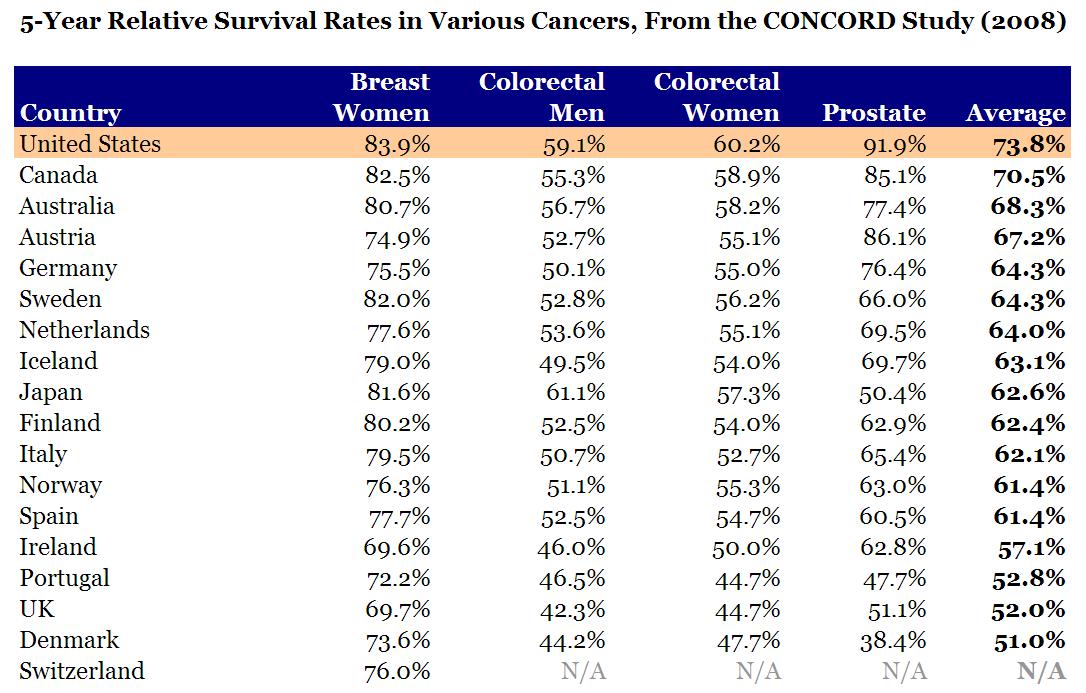
[…]If you really want to measure health outcomes, the best way to do it is at the point of medical intervention. If you have a heart attack, how long do you live in the U.S. vs. another country? If you’re diagnosed with breast cancer? In 2008, a group of investigators conducted a worldwide study of cancer survival rates, called CONCORD. They looked at 5-year survival rates for breast cancer, colon and rectal cancer, and prostate cancer. I compiled their data for the U.S., Canada, Australia, Japan, and western Europe. Guess who came out number one?

Here is the raw data:

Health care outcomes
Health care outcomes by country and type of treatment

Click here to see the larger graph.

So, what explains this?

The article continues:

Another point worth making is that people die for other reasons than health. For example, people die because of car accidents and violent crime. A few years back, Robert Ohsfeldt of Texas A&M and John Schneider of the University of Iowa asked the obvious question: what happens if you remove deaths from fatal injuries from the life expectancy tables? Among the 29 members of the OECD, the U.S. vaults from 19th place to…you guessed it…first. Japan, on the same adjustment, drops from first to ninth.

It’s great that the Japanese eat more sushi than we do, and that they settle their arguments more peaceably. But these things don’t have anything to do with socialized medicine.

Finally, U.S. life-expectancy statistics are skewed by the fact that the U.S. doesn’t have one health-care system, but three: Medicaid, Medicare, and private insurance. (A fourth, the Obamacare exchanges, is supposed to go into effect in 2014.) As I have noted in the past, health outcomes for those on government-sponsored insurance are worse than for those on private insurance.

To my knowledge, no one has attempted to segregate U.S. life-expectancy figures by insurance status. But based on the data we have, it’s highly likely that those on private insurance have the best life expectancy, with Medicare patients in the middle, and the uninsured and Medicaid at the bottom.

I know that my readers who like to dig deep into economics and policy will love the links at the bottom of the article:

For further reading on the topic of life expectancy, here are some recommendations. Harvard economist Greg Mankiw discusses some of the confounding factors with life expectancy statistics, citing this NBER study by June and Dave O’Neill comparing the U.S. and Canada. (Mankiw calls the misuse of U.S. life expectancy stats “schlocky.”) Chicago economist Gary Becker makes note of the CONCORD study in this blog post. In 2009, Sam Preston and Jessica Ho of the University of Pennsylvania published a lengthy analysis of life expectancy statistics, concluding that “the low longevity ranking of the United States is not likely to be a result of a poorly functioning health care system.”

The funniest thing I have found when talking to people from countries with socialized health care systems, like Canada and the UK, is that they are woefully uninformed about American health care. They literally do not know about free emergency room care, which is free for anyone regardless of insurance – including illegal aliens. They do not know about our expensive Medicaid program, which helps people who cannot afford health insurance. And our very very expensive Medicare program, which provides health care to the elderly – including prescription drugs. I get the feeling that foreign critics of American health care are getting their views from amateur documentaries produced by uneducated Hollywood propagandists, or maybe from TV shows on the Comedy Channel. They certainly are not getting their information from peer-reviewed studies by credentialed scholars from top universities, like the ones cited above.

I have literally spoken to Canadians who think that people in the USA without insurance do not get treatment and just die in the streets from stab wounds. They don’t know about the emergency room rule, or about charity care, or about Medicaid and Medicare. There is a lot of ignorance up there – wilful ignorance, in some cases. And keep in mind that the average Canadian household is paying over $11,000 a year for this substandard health care! They are paying more for less, and that’s not surprising since a large chunk of the taxes that are collected for health care go to overpaid unionized bureaucrats. Naturally, when their left-wing politicians need treatment, the first place they go is to the United States, where they pay out of pocket for the better health care. But that doesn’t stop them from denouncing American health care when they are talking to voters.

Higher infant mortality rates?

One of the other common arguments you hear from uninformed people outside the USA is the higher infant mortality rates argument.

Here’s an article by Stanford University professor Scott Atlas to explain why the argument fails.

Excerpt:

Virtually every national and international agency involved in statistical assessments of health status, health care, and economic development uses the infant-mortality rate — the number of infants per 1,000 live births who die before reaching the age of one — as a fundamental indicator. America’s high infant-mortality rate has been repeatedly put forth as evidence “proving” the substandard performance of the U.S. health-care system.

[…]n a 2008 study, Joy Lawn estimated that a full three-fourths of the world’s neonatal deaths are counted only through highly unreliable five-yearly retrospective household surveys, instead of being reported at the time by hospitals and health-care professionals, as in the United States. Moreover, the most premature babies — those with the highest likelihood of dying — are the least likely to be recorded in infant and neonatal mortality statistics in other countries. Compounding that difficulty, in other countries the underreporting is greatest for deaths that occur very soon after birth.

[…]The United States strictly adheres to the WHO definition of live birth (any infant “irrespective of the duration of the pregnancy, which . . . breathes or shows any other evidence of life . . . whether or not the umbilical cord has been cut or the placenta is attached”) and uses a strictly implemented linked birth and infant-death data set. On the contrary, many other nations, including highly developed countries in Western Europe, use far less strict definitions, all of which underreport the live births of more fragile infants who soon die. As a consequence, they falsely report more favorable neonatal- and infant-mortality rates.

[…]Neonatal deaths are mainly associated with prematurity and low birth weight. Therefore the fact that the percentage of preterm births in the U.S. is far higher than that in all other OECD countries — 65 percent higher than in Britain, and more than double the rate in Ireland, Finland, and Greece — further undermines the validity of neonatal-mortality comparisons.

You can listen to a podcast with Dr. Atlas here, from the Library of Economics web site.

If you want to read more about how American health care compares with health care in socialized systems, read this article by Stanford University professor of medicine Dr. Scott Atlas. And you can get his book “In Excellent Health: Setting the Record Straight on America’s Health Care” from Amazon.