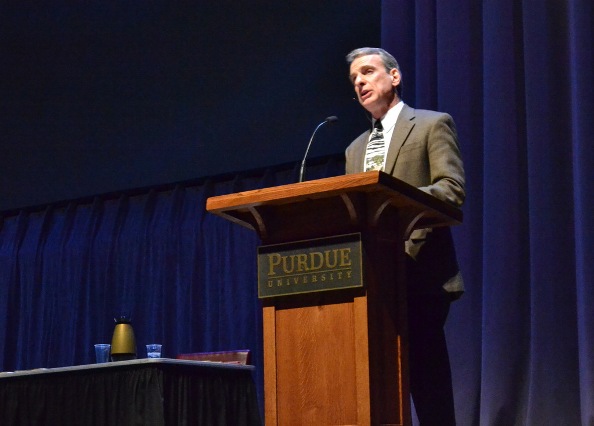
William Lane Craig lecturing to university students
This is an interview of Dr. William Lane Craig before college students at the University of Central Florida. (95 minutes)
Questions from the interviewer: (40 minutes)
What started you on his journey of studying faith and reason?
How would you define the word “faith”?
Are faith and reason compatible? How are they related?
How can reasonable faith help us to avoid the two extremes of superstition and nihilism?
Who makes the best arguments against the Christian faith?
Why are angry atheists like Dawkins and Hitchens more well known than better-informed academic atheists?
Does the Bible require Christians to give the unbeliever reasons for their faith?
How does faith spur Christians to think carefully about the big questions in life?
Should the American church prod churchgoers to develop their minds so they can engage the secular culture?
When talking about Christianity intellectually, is there a risk of neglecting the experience of being a Christian?
Which Christian apologist has shaped your thinking the most?
Which Christian philosopher has shaped your thinking the most?
Does the confidence that comes from apologetics undermine humility and reverence?
If you had to sketch out a 5 minute case for Christianity, what would you present?
Can non-Christians use their reason to arrive at truth?
Are there cases where atheists must affirm irrational things in order to remain atheists?
Can the universe have existed eternal, so that there is no need to explain who created it?
Even if you persuade someone that Christianity is true, does that mean they will live it out?
There is also a long period of questions, many of them hostile, from the audience of students (55 minutes).
Haven’t you said nasty things about some atheists? Aren’t you a meany?
What do you make of the presuppositional approach to apologetics?
Can a person stop being a Christian because of the chances that happen to them as they age?
Why did God wait so long after humans appeared to reveal himself to people through Jesus?
Can a person be saved by faith without have any intellectual assent to truth?
How do you find time for regular things like marriage when you have to study and speak so much?
How would you respond to Zeitgeist and parallels to Christianity in Greek/Roman mythology?
Do Christians have to assume that the Bible is inerrant and inspired in order to evangelize?
If the universe has a beginning, then why doesn’t God have a beginning?
Can you name some philosophical resources on abstract objects, Platonism and nominalism?
How can you know that Christianity more right than other religions?
Should we respond to the problem of evil by saying that our moral notions are different from God’s?
Define the A and B theories of time. Explain how they relate to the kalam cosmological argument.
How can Christians claim that their view is true in the face of so many world religions?
What is the role of emotions in Christian belief and thought?
Can evolution be reconciled with Christian beliefs and the Bible?
When witnessing person-to-person, should you balance apologetics with personal testimony?
Is there a good analogy for the trinity that can help people to understand it? [Note: HE HAS ONE!]
How can Christians reconcile God’s omniscience, God’s sovereignty and human free will?
This is a nice introductory lecture that is sure to get Christians to become interested in apologetics. As you watch or listen to it, imagine what the world would be like if every Christian could answer the questions of skeptical college students and professors like Dr. Craig. What would non-Christians think about Christianity if every Christian had studied these issues like Dr. Craig? Why aren’t we making an effort to study these things so that we can answer these questions?
It is really fun to see him fielding the questions from the skeptical university students. My favorite question was from the physics student who sounds really foreign, (at 1:19:00), then you realize that he is a Christian. I do think that Dr. Craig went a little far in accommodating evolution, but I put that down to the venue, and not wanting to get into a peripheral issue. I’m also surprised that no one asked him why God allows humans to suffer and commit acts of evil.
If you are looking for a good basic book on apologetics, then I would choose “Is God Just a Human Invention?” by Sean McDowell and Jonathan Morrow.
William Lane Craig is Research Professor of Philosophy at Talbot School of Theology in La Mirada, California.
Dr. Craig pursued his undergraduate studies at Wheaton College (B.A. 1971) and graduate studies at Trinity Evangelical Divinity School (M.A. 1974; M.A. 1975), the University of Birmingham (England) (Ph.D. 1977), and the University of Munich (Germany) (D.Theol. 1984). From 1980-86 he taught Philosophy of Religion at Trinity… In 1987 they moved to Brussels, Belgium, where Dr. Craig pursued research at the University of Louvain until assuming his position at Talbot in 1994.
He has authored or edited over thirty books, including The Kalam Cosmological Argument; Assessing the New Testament Evidence for the Historicity of the Resurrection of Jesus; Divine Foreknowledge and Human Freedom; Theism, Atheism and Big Bang Cosmology; and God, Time and Eternity, as well as over a hundred articles in professional journals of philosophy and theology, including The Journal of Philosophy, New Testament Studies, Journal for the Study of the New Testament, American Philosophical Quarterly, Philosophical Studies, Philosophy, and British Journal for Philosophy of Science.
William Lane Craig is, without a doubt, the top living defender of Christianity. He has debated all of the most famous atheists, including Christopher Hitchens, Sam Harris, etc. as well as academic atheists like Quentin Smith, Peter Millican, etc. if you search this blog, you’ll find many debates posted here, sometimes even with snarky summaries.
Dr. Graham Oppy, the moderator, is a well-known atheist philosopher. He let Dr. Krauss speak for 21 minutes and 40 seconds, which is why my summary of Krauss is so long.
The video:
Summary
After careful consideration, I decided not to be snarky at all in this summary. What you read below is what happened. There may be some small mistakes, but I will fix those if people tell me about them. I also included some quotes and timestamps for the more striking things that Dr. Krauss said.
The debate itself starts at 4:50 with Dr. Craig’s opening speech. He does use slides to show the structure of his arguments.
Dr. Craig’s opening speech. (4:50)
The kalam cosmological argument:
God is the best explanation of the origin of the universe
The Borde Guth Vilenkin theorem supports the absolute beginning of the universe
Even if our universe is part of a multiverse, the multiverse itself would have to have an absolute beginning
Speculative cosmologies try to challenge the Big Bang theory, but none of them – even if true – can establish that the past is eternal
Only two types of things could explain the origin of spece, time, matter and energy – either abstract objects or minds
Abstract objects do not cause effects, but minds do cause effects (we do it ourselves)
A mind is the best explanation for the origin of the universe
The unreasonable effectiveness of mathematics:
The underlying structure of nature is mathematical – mathematics is applicable to nature
Mathematical objects can either be abstract objects or useful fiction
Either way, there is no reason to expect that nature should be linked to abstract objects or fictions
But a divine mind that wants humans to understand nature is a better explanation for what we see
The cosmic fine-tuning for the existence of intelligent life
There are two kinds of finely-tuned initial conditions: 1) cosmological constants and 2) quantities
These constants and quantities have to be set within a narrow range in order to permit intelligent life
There are three explanations for this observation: law, chance or design
Law is rejected because they are put in at the beginning or matter – they don’t emerge from matter
Chance must be rejected, because they odds are just too long unless you appeal to a world-ensemble
We do not observe what the world ensemble hypothesis predicts that we should observe
Design is the best explanation for finely-tuned constants and quantities
The existence of objective moral values and duties
Our experience of morality (values and duties) is that it is objectively real and incumbent on us
When someone goes into a classroom and shoots at innocent children, that is objectively wrong
On naturalism, moral values and moral duties do not exist – they are conventional and variable by time and place
The best explanation for the existence of objective moral values and duties is that God exists
The historicity of the resurrection of Jesus
There are three widely-accepted facts that are best explained by the resurrection hypothesis
1) the empty tomb, 2) the post-mortem appearances, 3) the early church’s belief in the resurrection
Naturalistic attempts to explain these 3 boilerplate facts fail
The best explanation of the 3 minimal facts is that God raised Jesus from the dead
The immediate experience of God
Belief in God is a “properly basic” belief – rational even without arguments because of experience of God
Seems to be saying that logical arguments can prove false things “it’s nonsense”
Dr. Craig distorted a podcast that some group made on pain receptors
Dr. Craig’s faith is so strong that it causes him to distort what this group said
Discussion: (44:35)
I will not be summarizing everything that was said, just a few main points.
The segment from 52:18 to 57:12 about the Vilenkin e-mail on the BVG theorem is a must-see. Krauss is standing up and gesticulating while Craig is calmly trying to quote a paper by Vilenkin that shows that Krauss is misrepresenting Vilenkin. Krauss constantly interrupts him. After a while, when Craig exposes him as having misrepresented Vilenkin and gets him to admit that all current eternal models of the universe are probably wrong, he quietens down and can’t even look at Craig in the face.
Cosmological argument:
Craig: The e-mail says any universe that is expanding, on average, requires a beginning
Craig: There are two models – Aguirre & Gratton and Carroll & Chen – where there is a period of contraction before the expansion
Craig: The two models are the ones cited in the e-mail that Dr. Krauss showed
Craig: In the very paper by Vilenkin that I cited, he says that both of those models don’t work
Krauss: (agitated and interrupting) Vilenkin said that they have to make an assumption about entropy that they have no rationale for
(as Craig starts to talk Krauss makes an exaggerated, disrespectful gesture and sits down in a huff)
Craig: Yes, an unwarranted assumption means that they don’t have EVIDENCE for their theories being correct
Krauss: (agitated and interrupting) “All the evidence suggests that the universe had a beginning but WE DON’T KNOW!!!!!!!” (raising his voice)
Craig: I’m not saying that we know that the universe had a beginning with certainty
Craig: I am saying that the beginning of the universe is more probably true than false based on the evidence we have
Craig: And you agree with me about that – you think the universe had a beginning
Krauss: (agitated and interrupting) (Unintelligible)
Moderator: One at a time
Craig: In your Vilenkin e-mail slide, at the end of the paragraph where the two models are mentioned that Vilenkin specifically shows…
(I am guessing that Craig is going to ask why so much of what Vilenkin wrote has been cut out of the e-mail that Krauss showed)
Krauss: (agitated and interrupting) Because it was technical…
Moderator: Lawrence! Hang on a sec!
Craig: He specifically shows that these models are not past eternal, and that they require a beginning just like the others…
Krauss: (agitated and interrupting) We can do the math if you want
Craig: Now wait. I couldn’t help notice that there on your slide there was a series of ellipsis points indicating missing text…
Krauss: (agitated and interrupting) “Yeah, because it was technical!”
Craig: “I wonder what you deleted from the original letter”
Krauss: (agitated and interrupting) “I just told you!”
Craig: “Now wait. Could it have been something like this: (reads a quote from Vilenkin) ‘You can evade the theorem by postulating that the universe was contracting prior to some time. This sounds as if there is nothing wrong with having contraction prior to expansion. But the problem is that a contracting universe is highly unstable. Small perturbations would cause it to develop all sorts of messy singularities, so it would never make it to the expanding phase.’
Craig: “That’s Vilenkin.”
Krauss: “In this paper, that’s absolutely right”
Krauss: But it’s ok for theories to assume things that we know are wrong – they are still good theories – it’s unknown
(Craig turns away and looks through his papers)
Craig: “Isn’t it true that the only viable quantum gravity models on order today involve a beginning – have a finite past?”
Krauss: “No”
Craig: “Well, can you give us one then”
Krauss: (talks about a variety of possible eternal models) “In my experience in science, all of them are probably wrong”
Krauss: “You know most theories are wrong, which is why, you know, it’s hard”
Craig: “Right”
I noticed that a huge number of atheist web sites are taking the Vilenkin quote that Krauss used out of context, like this one and this one. There are probably a lot more of them like that, which I think is interesting. That’s why we have these debates, I guess. To set the record straight about who accuses people of being dishonest, and who is actually dishonest.
Fine-tuning:
Krauss tried to argue that he had explained the fine-tuning with the Higgs particle, but Dr. Craig said that only applied to the cosmological constant, not all the other examples of fine-tuning. Krauss said that it wasn’t impressive that this universe permitted life and that “It would have been much more surprising if we evolved in a universe in which we couldn’t live”. Krauss argued the fine-tuning was only for “Life like us”. But Dr. Craig explained that the fine-tuning is what allows us to have the basics of any kind of life, like slow-burning stars, chemical diversity, etc. – things that are required for basic minimal life functions in any living system. Craig said that he was working with the current physical laws of this universe (F = ma, etc.) and that he was looking at what changed if we changed those even slightly. Krauss tried to say that if he changed things like the mass of particles then the strength of forces would change. (But the forces aren’t laws!) Krauss argued that the cosmological constant would be even better for life if it was zero, and Craig said that the life permitting range did include zero, but that the range of life-permitting values was narrow.
Jesus’ existence:
Craig reponded to the mystery religions charge, the charge that the evidence for the minimal facts is too late/too weak, the charge that grief visions explained the evidence better, and Hume’s argument against miracles. Craig brought up the early creed from 1 Cor 15:3-7 and explained to Krauss that it was 5 years after the events, and that Jewish standards of oral transmission were strong enough to ensure that the creed was reliable, and most of the eyewitnesses would still have been alive.
Audience Q and A: (1:21:09)
The first topic is the grounding of morality. Krauss agrees that there is no objective morality and no objective moral oughts. He also said that that standards of behavior are arbitrary, and that they change over time and they are adopted for promoting social order. Dr. Craig pressed the point that science itself would collapse without ethical values. It assumes them, but cannot ground them.
The next topic was free will. Krauss is a determinist. Craig asked him how he could reconcile moral responsibility with determinism.
The next topic was the effectiveness of mathematics. Krauss didn’t have an explanation for it and didn’t think it needed one. Then they got into whether the Genesis has been verified by science and whether it is meant to be taken literally.
The next topic was whether philosophy makes any progress. Craig gave the example of verificationism being rejected as too narrow, and self-refuting. Krauss: “I’m going to come to the defense of philosophy for the first time”. Craig: “That’s amazing!” Krauss said that science provides new knowledge. Craig said there were some things that could be known apart from science.
What I often see among atheists is this tendency to set up expectations of how God would have acted and then complain that he doesn’t met those expectations. I don’t think that this is a good way to argue against a religion, because it’s subjective. God isn’t obligated to comport with atheist expectations. A much better way of evaluating religions is to test the claims each makes against evidence.
So in this post, I wanted to show how a reasonable person can evaluate and reject different worldviews using evidence.
Falsifying a religion using science
Consider this argument:
Hindu cosmology teaches that the universe cycles between creation and destruction, through infinite time.
The closest cosmological model conforming to Hindu Scriptures is the eternally “oscillating” model of the universe.
The “oscillating” model requires that the universe exist eternally into the past.
Notice how the oscillating model is falsified by mathematics and experimental evidence. Remarkable, when you remember how the public schools would play Carl Sagan videos which promoted this no-Creator model of the universe.
The absolute origin of the universe out of nothing is also incompatible with atheism, Buddhism, Mormonism, etc. because they also require an eternally existing universe.
Atheism in particular is incompatible with the universe “coming into being”, because that would be a supernatural cause – a cause that created the natural world. According to the Secular Humanist Manifesto, atheism is committed to an eternally existing universe, (See the first item: “Religious humanists regard the universe as self-existing and not created.”). If something non-material brought all existing matter into being, that would be a supernatural cause, and atheists deny that anything supernatural exists. The standard Big Bang theory requires that all the matter in the universe come into being out of nothing.
Falsifying a religion using history
Consider this argument:
To be a Muslim, you must believe that the Koran is without error.
The Koran claims that Jesus did not die on a cross. (Qur’an, 4: 157-158)
“Jesus’ death as a consequence of crucifixion is indisputable.” Gert Lüdemann
“That he was crucified is as sure as anything historical can ever be.” J.D. Crossan
“The passion of Jesus is part of history.” Geza Vermes
Jesus’ death by crucifixion is “historically certain”. Pinchas Lapide
“The single most solid fact about Jesus’ life is his death: he was executed by the Roman prefect Pilate, on or around Passover, in the manner Rome reserved particularly for political insurrectionists, namely, crucifixion.” Paula Fredriksen
“The support for the mode of his death, its agents, and perhaps its co-agents, is overwhelming: Jesus faced a trial before his death, was condemned, and was executed by crucifixion.” L.T. Johnson
“One of the most certain facts of history is that Jesus was crucified on orders of the Roman prefect of Judea, Ponitus Pilate.” Bart Ehrman
That’s 7 famous historians: 3 atheists, 3 Jews and 1 moderate Catholic. The atheists, Ludemann, Crossan and Ehrman, have all debated against the resurrection of Jesus with William Lane Craig. Johnson is the moderate Catholic, the rest are Jewish historians. The Koran was written in the 7th century. That is why no professional historian accepts the Koran as more authoritative than the many earlier Christian and non-Christian sources for the crucifixion story. Many of the sources for the crucifixion are dated to the 1st century. It’s not faith. It’s history.
I have seen debates with Muslim scholars, and I have never once heard them cite a non-Muslim historian to the effect that Jesus was not crucified. To my knowledge, there is no (non-Muslim) historian who denies the crucifixion of Jesus in his published work.
Can Christianity be falsified by science or history?
Yes. If you prove that the universe is eternal than would falsify the Bible’s claim that God created the universe out of nothing. That would be a scientific disproof. If you could find the body of Jesus still inside a tomb, that would falsify the Bible’s claim about a resurrection. That would be a historical disproof. The nice thing about Christianity is that we make lots of testable claims. When someone claims to be a Christian, it’s a good thing if they can show how they arrived at that conclusion. Being able to square God’s existence with science, and Jesus’ resurrection with history are two crucial steps to showing the reasonableness of Christianity.



 WINTERY KNIGHT