Tag Archives: Relationships

Study: couples that delay sexual activity experience higher quality relationships

Relationship stability, quality, communication, satisfaction

From Family Studies, news about TWO new studies.

Excerpt: (links removed)

[T]wo recently published studies call into question the validity of testing sexual chemistry early in dating.

My colleagues and I published the first study a few years ago in the American Psychological Association’s Journal of Family Psychology. This study involved a national sample of 2,035 married individuals who participated in the popular online couple assessment survey called “RELATE.” We found that the longer a dating couple waits to have sex, the better their relationship is after marriage. In fact, couples who wait until marriage to have sex report higher relationship satisfaction (20% higher), better communication patterns (12% better), less consideration of divorce (22% lower), and better sexual quality (15% better) than those who started having sex early in their dating (see Figure 2). For couples in between—those that became sexually involved later in their dating, but prior to marriage—the benefits were about half as strong.

[…]These patterns were statistically significant even when controlling for a variety of other variables such as respondents’ number of prior sexual partners, education levels, religiosity, and relationship length.

The second study, by Sharon Sassler and her colleagues at Cornell University, also found that rapid sexual involvement has adverse long-term implications for relationship quality. Using data from the Marital and Relationship Survey, which provides information on nearly 600 low- to moderate-income couples living with minor children, their study examined the tempo of sexual intimacy and subsequent relationship quality in a sample of married and cohabiting men and women. Their analyses also suggest that delaying sexual involvement is associated with higher relationship quality across several dimensions.

They discovered that the negative association between sexual timing and relationship quality is largely driven by a link between early sex and cohabitation. Specifically, sexual involvement early in a romantic relationship is associated with an increased likelihood of moving more quickly into living together, which in turn is associated with lower relationship quality. This finding supports Norval Glenn’s hypothesis that sexual involvement may lead to unhealthy emotional entanglements that make ending a bad relationship difficult. As Sassler and her colleagues concluded, “Adequate time is required for romantic relationships to develop in a healthy way. In contrast, relationships that move too quickly, without adequate discussion of the goals and long-term desires of each partner, may be insufficiently committed and therefore result in relationship distress, especially if one partner is more committed than the other” (p. 710).

The rest of the post talks about two reasons why this works: improved partner selection and prioritizing communication and commitment. Improved partner selection occurs because you haven’t committed too much too soon (sexually) and you have time to let things play out to see if you really fit with the other person. And if you take sex off the table, then you have to use other means in order to build emotional intimacy – communication, service, support, etc.

That’s two studies, and there’s a third. Dina sent me this article from the UK Daily Mail about a new study showing the importance of chastity for relationship quality and stability.

Excerpt:

New couples who jump into bed together on the first date do not last as long in relationships as those who wait a new study has revealed.

Using a sample of almost 11,000 unmarried people, Brigham Young University discovered a direct correlation between the length and strength of a partnership and the amount of time they took to have first have sex.

The study showed that those who waited to initiate sexual intimacy were found to have longer and more positive outcomes in their relationships while those who couldn’t help themselves reported that their dalliances struggled to last more than two years.

‘Results suggested that waiting to initiate sexual intimacy in unmarried relationships was generally associated with positive outcomes,’ said the report authored published by the U.S. National Library of Medicine National Institutes of Health.

‘This effect was strongly moderated by relationship length, with individuals who reported early sexual initiation reporting increasingly lower outcomes in relationships of longer than two years.’

The study examined four sexual-timing patterns: Having sex prior to dating, initiating sex on the first date or shortly after, having sex after a few weeks of dating, and sexual abstinence.

Each one of these fields yielded different results in relationship satisfaction, stability and communication in dating situations.

Here’s another recent study that shows that if a woman has more than her husband as a premarital sex partner, her risk of divorce increases.

His findings:

Using nationally representative data from the 1995 National Survey of Family Growth, I estimate the association between intimate premarital relationships (premarital sex and premarital cohabitation) and subsequent marital dissolution. I extend previous research by considering relationship histories pertaining to both premarital sex and premarital cohabitation. I find that premarital sex or premarital cohabitation that is limited to a woman’s husband is not associated with an elevated risk of marital disruption.However, women who have more than one intimate premarital relationship have an increased risk of marital dissolution.

Here’s another study that makes it even more clear.

Findings:

Data from the 1988 US National Survey of Family Growth (NSFG) were utilized to assess the impact of premarital sexual activity on subsequent marital stability. Among white NSFG subjects first married in 1965-85, virgin brides were significantly less to have become separated or divorced (25%) than women who had not been virgins at marriage (35%).

[…]The lower risk of divorce on the part of white women with no premarital sexual experience persisted even after numerous intervening and background variables were controlled.

If you’re going to talk to a young person about sex, it’s a good idea to use these studies to explain what you lose by having sex too early in the relationship. Although they may respond with anecdotes to refute studies, studies are important because they represent LOTS of data points, not just one or two cherry-picked cases. My view on all this is the Bible’s view – no sex before marriage. But when talking to people about this issue, I find it useful to have evidence ready in order to be convincing in every way possible.

Previously, I blogged on studies that showed that the number of premarital sex partners increases unhappiness in the marriage, which raises the risk of divorce. Read and be wise about sexuality!

William Lane Craig offers advice to Christians considering marriage

Marriage and family
Marriage and family

This post is a 3 in one: one lecture, one question and answer, and another lecture – all on different topics.

I got this lecture from the Reasonable Faith web site.

Dr. William Lane Craig is the top living Christian apologist and debater in the world today, and has 2 Masters degrees and 2 Ph.Ds. He also has scores of academic publications including books from Oxford University Press, etc.

The MP3 file is here. (14.5 Mb, about 41 minutes)

The transcript is here.

Topics:

  • the stresses of ministry on marriages
  • the Christian position on divorce
  • balancing marriage with academic pursuits
  • the importance of marrying the right person
  • Dr. Craig’s politically incorrect advice for choosing a spouse
  • Advice for men: Marry someone who believes in you and who supports you in your calling
  • Advice for women: Be the kind of person who can commit to being a helper and supporter
  • Advice for men: Beware of the career woman who will put their career over supporting you in your calling
  • Advice for women: Be careful about marrying if you think that your goals are more important than your husband’s goals
  • Advice: Don’t try to find the right person for you but instead focus on learning about marriage and preparing for marriage
  • Advice: Flee youthful lusts and pursue righteousness, love and peace
  • Advice: God intends for sex to be within the bounds of marriage, so you need to guard yourself against unchastity
  • Advice for men: be careful what images and movies you see with the goal of keeping your chastity
  • Advice: your highest responsibility after your relationship with God is your spouse, and your studies are third
  • Advice: it’s better to drop classes or give up your graduate studies entirely rather than destroy your marriage
  • Advice for women: understand that you have to work at the marriage in order to help your man finish his studies
  • Advice: set aside a period of the day for communicating and bonding with your spouse
  • Advice: cultivate the ability to talk with your spouse on a personal level, and maintain eye contact
  • Advice for men: do not break eye contact with your wife, and also hold her hand when communicating
  • Advice: do not be embarrassed to seek out a marriage counselor, but make it a good counselor
  • Advice:  don’t just be doing stuff for your mate, but also be vulnerable and transparent with your mate
  • How your relationship with your wife helps you with your relationship with God
  • How do you handle the rebellion of children without being overbearing and authoritarian?

There is a period of Q&A at the end. There is another piece of advice that comes out in the Q&A for women: take an interest in your spouse’s work even if you don’t care about it, and ask him about it every day and try to understand it. Go to the man’s workplace and see what he does. Go to his presentations. Get involved in the man’s ministry and help him in practical ways. Another piece of advice is to not paper over the differences – it’s good to argue, because it means that problems are being confronted and worked through. Husbands should have a good male friend to talk to, and wives should have a good female friend to talk to.

I like how Dr. Craig has thought about how to have a successful marriage, how to choose the right woman, and how to love his wife. I like how he calls out men on the chastity thing. I think that chastity is more important for men than for women, because it’s the men who take the lead in choosing and pursuing the right woman for their plan, and their judgment cannot be clouded by the desire for premarital sex.

It’s the man who is accountable for making the marriage count for God, he will never be able to achieve anything if chooses a wife is merely pretty, rather than being a good learner, resourceful, hard-working, organized and effective. She is the one who has to be chief of staff and take care of the details of his plan to lead the family. (In my case, the plan is 1) impact the church with apologetics, 2) impact the university with apologetics, 3) advocate for laws and policies that protect religious liberty, right to life, marriage and family, and 4) raise Children who will remain Christian and have an influence for Christ and his Kingdom). A man can’t choose a woman who is merely attractive and fun-loving – she will never be willing to commit to doing the hard work that will allow the family to achieve anything as a team.

This is important: don’t choose a woman who isn’t willing to help you with your plan to serve God. And don’t choose a woman who is more interested in fun and thrills than learning and working to achieve a goal. If she is not able to commit to tasks and finish what she starts, then she is not for you. That’s what good women do – they are not content to talk about big plans and not achieve then, they are doers. They find ways to get the job done through organization, discipline and self-sacrifice.

Secondly, here is my previous post on Dr. Craig’s advice for married couples, where he gives 5 points of advice for married couples.

Here are the main pieces of advice Dr. Craig gives:

  1. Resolve that there will be no divorce
  2. Delay having children
  3. Confront problems honestly
  4. Seek marital counseling
  5. Take steps to build intimacy in your relationship

And here’s the controversial one (#2):

2. Delay having children. The first years of marriage are difficult enough on their own without introducing the complication of children. Once children come, the wife’s attention is necessarily diverted, and huge stresses come upon you both. Spend the first several years of marriage getting to know each other, working through your issues, having fun together, and enjoying that intimate love relationship between just the two of you. Jan and I waited ten years before having our first child Charity, which allowed me the finish graduate school, get our feet on the ground financially, establish some roots, and enjoy and build our love relationship until we were really ready to take on the responsibilities of parenthood. The qualifier here is that if the wife desperately wants children now, then the husband should accede to her wish to become a mother, rather than withhold that from her. Her verdict should be decisive. But if you both can agree to wait, things will probably be much easier.

Third and finally, here is a previous post on Dr. Craig’s advice for choosing a good spouse, with illustrations from his own marriage.

For example, Bill’s first story about Jan occurs early after their marriage while he is working on his first Masters degree at Trinity:

And it was also at that time that I began to see what an invaluable asset the Lord had given me in Jan. I remember I came home from classes one day, and found her at the kitchen table with all the catalogs and schedules and papers spread out in front of her and she said, “look! I’ve figured out how you can get two Masters degrees at the same time that it would normally take to get one! All you have to do is take overloads every semester, go to all full-time summer school and do all these other things, and you can do two MAs in the time it takes to do one!”

And I thought, whoa! Are you sure you really want to make the commitment it takes to do this kind of thing? And she said, “Yeah! Go for it!” And it was then I began to see that God had given me a very special woman who was my supporter – my cheerleader – and who really believed in me. And as long as she believed in me, that gave me the confidence to dream bigger dreams, and to take on challenges that I had never thought of before.

If you want to hear another Christian husband talk about how his wife supports him, listen to this lecture called “Giants in the Land” with Dr. Walter Bradley. It’s actually my favorite lecture. I also really like his testimony lecture. If you’re looking for guidance, these are some of the people I would recommend.

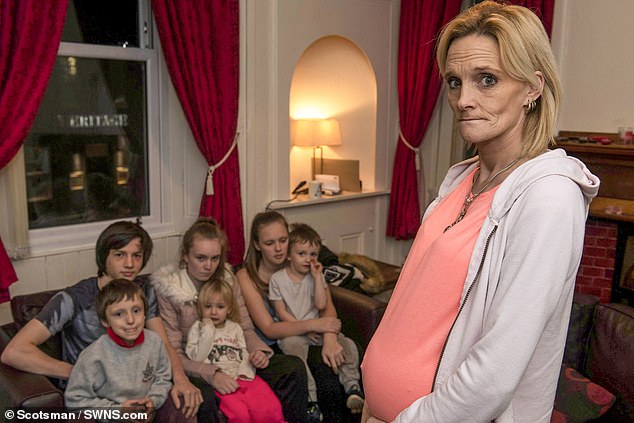
38-year-old single mother of seven, pregnant with twins, demands better government housing

38-year-old single mother with 7 kids, 2 more on the way

I saw this article about an unmarried woman, pregnant with twins, who already has 7 children from a variety of men. She is currently living in a 4-bedroom house paid for by taxpayers. She is angry because the government isn’t giving her enough money to pay for her lifestyle choices.

This article comes from the UK Daily Mail:

A 38-year-old mother-of-seven who is pregnant with twins is begging to be rehoused from her ‘hellish’ four-bedroom council flat which she says isn’t good enough for her.

[…]The single mother said: ‘My relationship with some of my children is at breaking point, we can’t keep living like this.

[…]’I just want to get out of this hell. I’d rather live anywhere else, as long as it is not in here. It has been really tough.

‘I’m feeling down every night and sometimes you just feel like giving up. But I just have to keep going for the sake of the kids.’

She can fix everything that’s gone wrong with a little more taxpayer money. That will make it unnecessary for her to choose men who commit before sex, and let her have the freedom to choose the “best” men for relationships.

More:

After spending a month in various hotels, West Lothian Council found them the flat in Bathgate and they moved in on September 20.

But after moving into her new Bathgate property, Ms Burns complained that the flat did not come with a television…

She wasn’t even provided with a taxpayer-funded telly! How else to people get televisions except from welfare programs?

Anyway, how did this happen? Well, it happens because women are increasingly choosing men who are not willing to marry first, and using premarital sex and cohabitation to land them. Something that the previous generation of married women from 50 years ago would never have done.

The Daily Caller explains:

Unmarried couples are having roughly 40 percent of all births in the U.S., marking a trend that may be detrimental to the upbringing of those children.

For the first time in U.S. history, out-of-wedlock births in America are largely a result of cohabitation, according to the United Nations Population Fund 2018 State of World report released Wednesday. Single mothers had nearly 90 percent of out-of-wedlock births in 1968, but that number decreased to 53 percent in 2017, according to the Pew Research Center.

“Compared to children of married parents, those with cohabiting parents are more likely to experience the breakup of their families, be exposed to ‘complex’ family forms, live in poverty, suffer abuse, and have negative psychological and educational outcomes,” according to the Institute for Family Studies (IFS).

[…]Children with single parents have the highest rates of poverty followed by children living with unmarried, cohabiting parents, the IFS reported.

Between 2006 and 2010, 23 percent of births to married women were unintended while 51 percent of births to unmarried cohabiting women were unintended. That number rose to 67 percent for unmarried women not cohabiting.

Two-thirds of cohabiting parents split up before their child reaches age 12, while only a quarter of married parents divorce, according to an April 2017 Brookings Institution report.

The problem of fatherless children is getting worse. And taxpayers will be on the hook to pay for it – that’s what the story of the 38-year-old woman shows. Productive people have to pay when women are not persuaded to make better decisions about which men to have relationships with, and when to have sex.

My experience

I know three young women who are cohabitating right now. I have had a few conversations with them about what they are studying, what jobs they want to get, and what their plans for the future are.

All three of these women have never married, and are in their early 20s and attractive. Two of them have children. The live-in boyfriends are getting sex without having to commit first. The boyfriends (judging from photos) seem to have been chosen purely for looks. Tall, muscles, beards, tattoos, piercings, etc. Obviously, none of them is a Christian. There just isn’t anything in society telling young women that a Christian worldview matters in a relationship. And none of the men has a STEM degree, a career or savings -they’re too young to have those things to prove their ability to provide. But they’re still co-habitating, and get all the benefits of a wife without having to have proven themselves capable of the responsibilities, expectations and obligations of a husband.

Each of these women is spending the young and attractive period of her life in unstable relationships with men who think of sex as recreational, rather than something that is saved for inside the marriage covenant. If their past relationships fail, they will have a much harder time finding a good man. They will have sexual baggage. They will probably have children from another man. They will have bitterness and mistrust towards men. They will be selfish and unwilling to give to a future husband. The same women who will complain that no one will marry them at age 35 are the ones who could easily have had a marriage-ready man at age 25.