Tag Archives: Regulation

Indian auto sales surge 71.9% while free trade vaults Chile into the first world

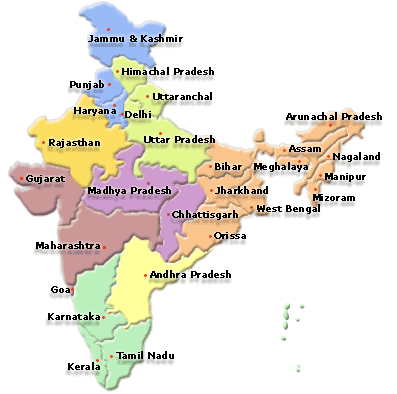
Map of India
Map of India

Before, I wrote about India’s election results and the decision of the ruling Congress Party to drastically cut income taxes. And I also wrote about China’s decision to cut taxes on purchases of new automobiles. So did those tax cuts work out for India and China?

Story from the Associated Press

Excerpt:

China extended its lead over the U.S. as the world’s biggest auto market in November, with production and sales both surpassing 1 million vehicles, and India saw sales jump 71.9-percent.

[…]China’s auto market is sizzling, thanks largely to tax cuts and subsidies aimed at supporting the industry and encouraging use of more fuel-efficient vehicles. The boom has clinched China’s status as the world’s biggest vehicle market due to languishing sales in the U.S.

[…]The surge is also a sign of how the Indian consumer — encouraged by government tax cuts, a big disbursement of back pay for government employees and falling interest rates — is fueling economic growth in Asia’s third-largest economy.

As everyone knows, the Democrats chose to bail out auto companies with taxpayer money and reward people with taxpayer money for destroying fully functional vehicles. And we all know how well that has worked out.

Chile poised to jump from the third world to the first world

Check out this editorial from Investors Business Daily. (podcast here)

Excerpt:

Chile is expected to win entry to OECD’s club of developed countries by Dec. 15 — a great affirmation for a once-poor nation that pulled itself up by trusting markets. One thing that stands out here is free trade.

[…]It’s not like Chile was born lucky. Only 30 years ago, it was an impoverished country with per capita GDP of $1,300. Its distant geography, irresponsible neighbors and tiny population were significant obstacles to investment and growth. And its economy, dominated by labor unions, wasn’t just closed, but sealed tight.

In the Cato Institute’s 1975 Economic Freedom of the World Report it ranked a wretched 71 out of 72 countries evaluated.

Today it’s a different country altogether. Embracing markets has made it one of the most open economies in the world, ranking third on Cato’s index, just behind Hong Kong and Singapore. Per capita GDP has soared to $15,000.

Besides its embrace of free trade, other reforms — including pension privatization, tax cuts, respect for property rights and cutting of red tape helped the country grow not only richer but more democratic, says Cato Institute trade expert Daniel Griswold.

But the main thing, Griswold says, is that the country didn’t shift course. “Chile’s economy is set apart from its neighbors, because they have pursued market policies consistently over a long period,” he said. “Free trade has been a central part of Chile’s success.”

Democrats oppose free trade, and their hostility to free trade angers many other countries in the world.

What does it take for a country to succeed?

I gave my Dad my copy of “Money, Greed and God” by Jay Richards, and although he thought that it started out slow, he’s warmed up to it. He calls me on the phone at least twice a day, and last night he alerted me to this web site, where you can track each countries average citizen’s life span and per-capita GDP over time. My Dad was pretty liberal on economics before, so naturally I’ve been working on him with lots of introductory books on economics. He’s read about a dozen now, and Thomas Sowell is his favorite.

Anyway, my Dad says that this is what a country needs to succeed:

  • free trade with other nations
  • the rule of law
  • low judicial activism
  • low tax rates
  • private property protections
  • currency not threatened by inflation
  • low government spending
  • minimal regulation of commerce

And at that web site, you can track the success of countries like Singapore and Hong Kong, which embrace conservative small government free market fiscal policies, and compare them with countries like Zimbabwe and North Korea, which embrace big government protectionist fiscal policies. Countries fail because they adopt the wrong policies. They succeed when they adopt the right policies. It doesn’t matter how poor they start, if they have the right policies, they grow rich over time.

Why are the Democrats so incompetent on economic policy?

Well, it’s because there is almost no one in the Obama socialist regime who has ever run a business or worked in a business. Check out this graphic. (H/T Flopping Aces)
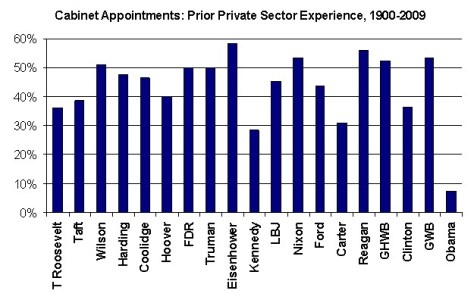
You can read more about the Obama administration’s ignorance of business and economics here in Forbes magazine.

This Reuters article discusses the price of economic ignorance: (H/T Gateway Pundit)

Excerpt:

Hunger is spreading while the number of homeless families is increasing as a result of the recession and other factors, according to a report on Tuesday.

The U.S. Conference of Mayors said cities reported a 26 percent jump in demand for hunger assistance over the past year, the largest average increase since 1991.

Middle-class families as well as the uninsured, elderly, working poor and homeless increasingly looked for help with hunger, which was mainly fueled by unemployment, high housing costs and low wages.

Democrats really don’t know what they are doing. It’s like putting pre-schoolers in charge of Amazon.com. It doesn’t work. Their ivory tower, silver-spoon worldview cannot comprehend real-world, grown-up complexities. So long as the Democrats continue to attack the businesses that employ citizens while redistributing wealth from people who produce to people who vote Democrat, our economic troubles will continue.

Related Cato Institute podcasts

EPA ignores Climategate and declares carbon dioxide a threat to public health

Story from Fox News. (H/T Andrew, ECM)

Excerpt:

In the face of GOP opposition, the EPA on Monday declared greenhouse gases a danger to public health in a move that could pave the way for future regulation.

The administration also waved off concerns about the controversy surrounding leaked e-mails at a British climate research center, with the U.S. envoy to the international climate change conference in Copenhagen dismissing the flap as a “small blip.”

EPA Administrator Lisa Jackson said in a written statement that the finding, which declares carbon dioxide and five other greenhouse gases a threat to public health, marks the start of a U.S. campaign to tackle greenhouse gas emissions.

[…]The meticulously timed announcement comes on the opening day of the Denmark conference, and could boost the administration’s argument that the United States is taking action to combat global warming — though Congress has yet to pass climate legislation.

[…]While administration officials have said they would prefer Congress take action on regulating greenhouse gas emissions, Republicans fear the EPA is prepared to act unilaterally to do so, buoyed by its latest finding. And they question the timing of the announcement.

They could bypass Congress entirely.

My previous story explaining the significance of Climategate is here.

MUST-READ: What does Climategate really prove about global warming?

In my opinion, the most important thing to come out of the e-mail scandal is the source code for the graph generation program.

What does the CRU source code really say?

Here’s the source code for the file “briffa_sep98_e.pro“.

It contains this section of the code which defines an array of adjustments that will be applied to the raw data. The purpose of the adjustments according the programmers own comments (lines that start with ; are comments) is to hide the decline in temperatures, so that the graph will look like a hockey stick. In the words of the programmer, the adjustment is called a “fudge factor” and is “very artificial”.

Here’s the adjustment, called a fudge factor by the programmer:

;****** APPLIES A VERY ARTIFICIAL CORRECTION FOR DECLINE*********
;
yrloc=[1400,findgen(19)*5.+1904]
valadj=[0.,0.,0.,0.,0.,-0.1,-0.25,-0.3,0.,-0.1,0.3,0.8,1.2,1.7,2.5,2.6,2.6,$
2.6,2.6,2.6]*0.75 ; fudge factor

Line 3 creates the 20 subsets from the raw tree ring data, with each subset spanning 5 years. The subsets start in 1904. Line 4 (which wraps to the line 5) creates an array of 20 adjustments that will be applied to the raw data to change the original values. The data is stored in a variable called yrloc and the adjustments are stored in a variable called valadj.

The data is left alone from 1904-1928, adjusted downward from 1929-1943, lowered for 1949-1953 and then raised at the end.

Year
…….. Fudge Factor
1904 0
1909 0
1914 0
1919 0
1924 0
1929 -0.1
1934 -0.25
1939 -0.3
1944 0
1949 -0.1
1954 0.3
1959 0.8
1964 1.2
1969 1.7
1974 2.5
1979 2.6
1984 2.6
1989 2.6
1994 2.6
1999 2.6

And then the adjustment is actually applied to the data here, and stored in a variable called yearlyadj (line 3).

; APPLY ARTIFICIAL CORRECTION
;
yearlyadj=interpol(valadj,yrloc,x)
densall=densall+yearlyadj

The true believers respond

I notice that on Science Blogs, they are claiming that the adjument is never applied because the line that applies it is commented out. But they are using the briffa_sep98_d.pro file, not the briffa_sep98_e.pro file. Someone actually pointed that out to them in the comments, but they haven’t printed a correction.

Here’s a sample comment from the post showing how the global warmists respond:

Apparently similar code appears in another snippet the results of which weren’t commented out, but still, it doesn’t matter.

Well, it certainly doesn’t matter to the mainstream media since they didn’t report the story for two weeks.

Other comments in the source code explain that data is omitted

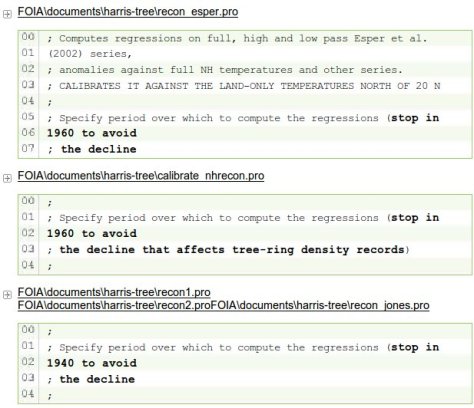
You should also know about comments in the source code like this:

Hide the decline

(Click for larger version)

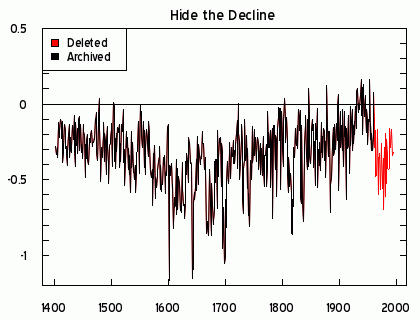
When the missing data is added, the decline appears

Here’s the graph of temperatures with the full data set used.

Hide the decline

There’s the decline they’re trying to hide in red.

Re-considering the hockey stick graph

Take a look at this post from JoNova which re-caps the work of Canadian statistician Steve McIntyre.

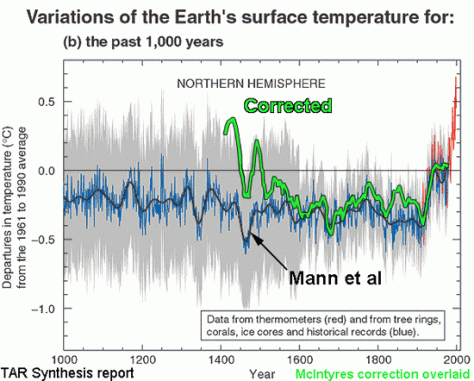
Michael Mann’s hockey-stick graph needed to be corrected:

Jo writes:

In 1995 everyone agreed the world was warmer in medieval times, but CO2 was low then and that didn’t fit with climate models. In 1998, suddenly Michael Mann ignored the other studies and produced a graph that scared the world — tree rings show the “1990’s was the hottest decade for a thousand years”. Now temperatures exactly “fit” the rise in carbon! The IPCC used the graph all over their 2001 report. Government departments copied it. The media told everyone.

But Steven McIntyre was suspicious. He wanted to verify it, yet Mann repeatedly refused to provide his data or methods — normally a basic requirement of any scientific paper. It took legal action to get the information that should have been freely available. Within days McIntyre showed that the statistics were so flawed that you could feed in random data, and still make the same hockey stick shape nine times out of ten. Mann had left out some tree rings he said he’d included.

[…]Astonishingly, Nature refused to publish the correction. It was published elsewhere, and backed up by the Wegman Report, an independent committee of statistical experts.

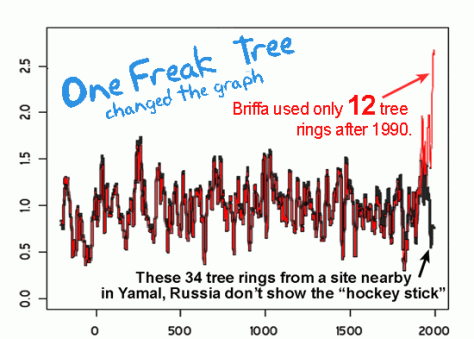
And Keith Briffa’s hockey-stick graph that used cherry-picked data also needed to be corrected:

Jo writes:

In 2009 McIntyre did it again with Briffa’s Hockey Stick. After asking and waiting three years for the data, it took just three days to expose it too as baseless. For nine years Briffa had concealed that he only had 12 trees in the sample from 1990 onwards, and that one freakish tree virtually transformed the graph. When McIntyre graphed another 34 trees from the same region of Russia, there was no Hockey Stick.

The sharp upward swing of the graph was due to one single tree in Yamal.

Skeptical scientists have literally hundreds of samples. Unskeptical scientists have one tree in Yamal, and a few flawed bristlecones…

The CRU e-mails also reveal that CRU “scientists” sought to marginalize and persecute (Expelled?) individuals and scientific journals that disagreed with them. Is that science? Hiding your data and methods, and threatening people who disagree with you. Is that science?

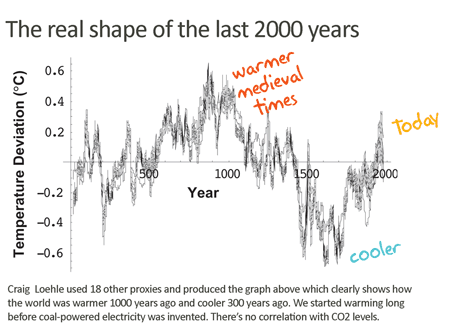
So what does the graph of temperatures really look like?

Here’s what global temperatures have really done over time:

Does this graph show that global warming is man made? Do medieval knights drive around in SUVs too much? Well, if you are getting billions of dollars of taxpayer funding, then maybe they do. Maybe the data that shows that knights don’t drive SUVs is wrong. Maybe the data needs to be adjusted to show that knights DO drive SUVs. Maybe the sample needs to be tailored to prove that global warming is man-made.

Consider Melanie Phillips writing in the UK Spectator.

Melanie cites this e-mail about the Medieval Warming Period from Phil Jones, the director of the now disgraced Climate Research Unit at the University of East Anglia.The Medieval Warming Period is a period during the Middle Ages when the Earth’s temperature was higher than it is today.

Phil Jones writes:

Bottom line – their is no way the MWP (whenever it was) was as warm globally as the last 20 years. There is also no way a whole decade in the LIA period was more than 1 deg C on a global basis cooler than the 1961-90 mean. This is all gut feeling, no science, but years of experience of dealing with global scales and varaibility.

This is the director of the Climate Research Unit at the University of East Anglia. This lab forms the backbone of the the case for global warming alarmism. Is this science? Is this how a scientist is supposed to treat the data?

Follow the money

Billions of dollars in funding are at stake.

Excerpt:

Consider the case of Phil Jones, the director of the CRU and the man at the heart of climategate. According to one of the documents hacked from his center, between 2000 and 2006 Mr. Jones was the recipient (or co-recipient) of some $19 million worth of research grants, a sixfold increase over what he’d been awarded in the 1990s.

Why did the money pour in so quickly? Because the climate alarm kept ringing so loudly: The louder the alarm, the greater the sums. And who better to ring it than people like Mr. Jones, one of its likeliest beneficiaries?

Thus, the European Commission’s most recent appropriation for climate research comes to nearly $3 billion, and that’s not counting funds from the EU’s member governments. In the U.S., the House intends to spend $1.3 billion on NASA’s climate efforts, $400 million on NOAA’s, and another $300 million for the National Science Foundation. The states also have a piece of the action, with California—apparently not feeling bankrupt enough—devoting $600 million to their own climate initiative. In Australia, alarmists have their own Department of Climate Change at their funding disposal.

And all this is only a fraction of the $94 billion that HSBC Bank estimates has been spent globally this year on what it calls “green stimulus”—largely ethanol and other alternative energy schemes—of the kind from which Al Gore and his partners at Kleiner Perkins hope to profit handsomely.

Supply, as we know, creates its own demand. So for every additional billion in government-funded grants (or the tens of millions supplied by foundations like the Pew Charitable Trusts), universities, research institutes, advocacy groups and their various spin-offs and dependents have emerged from the woodwork to receive them.

Popularizers like Al Gore would also benefit if the majority of non-scientists can be convinced that there is global warming, that global warming is man-made, and that government control of individuals and corporations is needed to fix the problem.

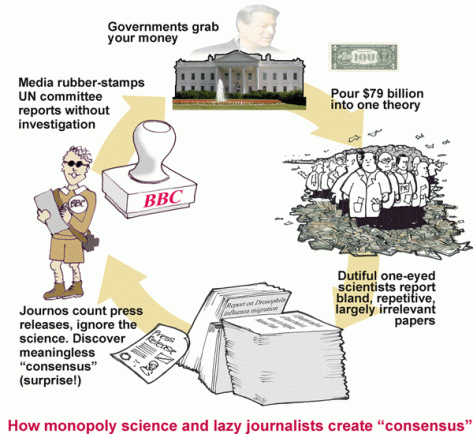
Here’s a simple explanation of how it works:

And the media covers up for them – they are lazy, ignorant of science, and they are overwhelmingly biased in favor of socialism.

Problems in the United States and New Zealand

Note: Christopher Horner of the Competitive Enterprise Institute is suing NASA in order to get them to release their data. And in New Zealand, climate “researchers” have been caught modifying the raw data to show global warming that isn’t there. Take a look at this UK Telegraph article that tells the story so far.

Related posts

Consider Melanie Phillips writing in the UK Spectator.

Melanie cites this e-mail about the Medieval Warming Period from Phil Jones, the director of the now disgraced Climate Research Unit at the University of East Anglia.The Medieval Warming Period is a period during the Middle Ages when the Earth’s temperature was higher than it is today.

Phil Jones writes:

Bottom line – their is no way the MWP (whenever it was) was as warm globally as the last 20 years. There is also no way a whole decade in the LIA period was more than 1 deg C on a global basis cooler than the 1961-90 mean. This is all gut feeling, no science, but years of experience of dealing with global scales and varaibility.