

Tag Archives: Reason

When talking with a non-Christian, make truth – not behavior – the main issue

Bible study that hits the spot

Pastor Matt posted about something that I think all Christian apologists believe, deep down. (H/T The Poached Egg)

He writes:

Typically, the church has defined loving one’s neighbor as in line with Jesus’ parable of the Good Samaritan (Luke 10:25-37) and Christ’s teaching in passages such as Matthew 25:31-46, in which we are commanded to love the imprisoned, the homeless, the hungry, etc. as if they were Jesus himself. Of course all believers should do so whether by volunteering at a soup kitchen or donating money to ministries like World Help.

But there is more to loving one’s neighbor these days than caring for the poor, as important as that is.  Those of us who live in a first world western country now dwell in a post-Christian society.  Our neighbors are inundated with naturalism masquerading as good science and sound philosophy.  Non-Christians believe the faith is intellectually vacuous.

It shocks many people when those trained in apologetics point out that atheists cannot answer questions like, “How did the universe come into existence?” “Why is our planet so finely tuned for life despite all the odds against it?” “How did life begin?” “Why do humans have consciousness?” “How is there truth or right and wrong without God?” “Why did the disciples die horrible deaths as impoverished traveling peasants rather than deny the resurrection of Jesus?”, etc.

If we are to help bring our neighbors to saving faith, we must first destroy their false ideas of what Christianity is and is not.  That means we must preach the Gospel (2 Cor. 5:21), knock down specious views of the faith and present the truth of what we believe.

Apologetics is not just an intellectual exercise for nerds like me or a debate to be won on college campuses but an increasing tool in loving our neighbors.  For if they do not understand the faith, they will likely not come to faith and that is what the God we love wants and how we must show love to our neighbors.  So, let’s study not just to win arguments but to love others.

That reminds me of 2 Corinthians 10:3-5. Our job is to beat up on false ideas and speculations.

Pastor Matt’s point is critical, I think. Just stop and think for a minute about your non-believing co-workers. Do they know that the universe began to exist? Do they know that the initial conditions and the cosmological constants have to be finely tuned to support things like galaxies, stars, planets and elements heavier than hydrogen? Do they know how much information is in a protein, and how many proteins would be needed to make the first living cell? Do they know what it takes to make a planet that can support life? What facts from the gospels and the Pauline letters pass the tests for historicity? What is the best explanation of those minimal facts?

These are the facts that we share when we discuss spiritual things with people. They are not Christian facts, they are public, testable facts. And yet, almost no one in the culture who is not already a believer is curious to find out these things on their own. But without the evidence, how are they supposed to take the first step towards a relationship with God through Jesus Christ? It’s not possible. This is a propositional faith, and we know it’s true by evidence. To share the evidence with someone so they can decide is as loving as sharing the evidence about retirement planning, or the evidence about nutrition, or the evidence about fitness and exercise, or the evidence about career planning. When you love someone, you tell them the facts, and then they decide. Evangelism is the same thing.

Here’s something from a recent post by J. Warner Wallace, where he talks about doing apologetics with people who have not yet decided whether God exists or not.

The Undecided

In many ways, this group holds the most promise. People who are undecided usually fall into two categories. Some have never really given the issue much thought. They’re neither for nor against; they’ve simply been living unaware. You may be the first person to introduce them to the issues you are trying to share. If so, remember the importance of a first impression. What you say or do will have an impact on the work of those who follow you. The second group of “undecideds” are people who have given the issue some thought, but are just beginning to make their decision. For this group of people, your defense of Christianity may very well be the deciding factor. The responsibility you and I have with the undecided is daunting, but it’s a privilege to play a small part in their decision.

OK, so I want to make a point about this. So often, I see Christian parents and leaders trying to focus on changing people’s behaviors, and not by giving them evidence. Instead of trying to convince them about what’s true, they tell them Bible verses, or maybe tell them they are going to Hell. But given what Matt and J. Warner said, I don’t want us to be focused on changing outward behavior. I want us to be focused on showing people what is true and showing our work – how we arrived at these true beliefs. You are doing Christianity wrong if you focus on getting behaviors from people by shaming them, overpowering them or scaring them.

So in my case, I’m not trying to get non-Christians to act like Christians when they have no reasons to be one. I’m trying to get them to settle on true beliefs – so that each of them and God can shake hands and be reconciled, responding to his drawing them of their own free will. Then, they can decide how they are going to act. And how they act might be even better than what we had in mind for them when all we wanted was for them to quit swearing and eat their vegetables. The Christian life is bigger than just making people do what we want them to do.

William Lane Craig lectures on naturalistic alternatives to the Big Bang

William Lane Craig lecturing to university students

Here’s the lecture, which was given in 2004 at the University of Colorado, Boulder.

This lecture might be a little advanced for beginners, but if you stretch your mind first, you shouldn’t tear anything. (Note: standard disclaimers apply if you do tear something!)

The description of the video states:

This is quite simply one of the best lectures William Lane Craig (a philosopher of science) has given. Craig explores the origins of the universe. He argues for a beginning of the universe, while refuting scientific models like the Steady State Theory, the Oscillating Theory, Quantum Vacuum Fluctuation Model, Chaotic Inflationary Theory, Quantum Gravity Theory, String Theory, M-Theory and Cyclic Ekpyrotic Theory.

And here is the description of the lecture from Reasonable Faith:

A Templeton Foundation lecture at the University of Colorado, Boulder, laying out the case from contemporary cosmology for the beginning of the universe and its theological implications. Includes a lengthy Q & A period which features previous critics and debate opponents of Dr. Craig who were in attendance, including Michael Tooley, Victor Stenger, and Arnold Guminski.

Craig has previously debated famous atheists Stenger and Tooley previously. And they both asked him questions in the Q&A time of this lecture. Imagine – having laid out your entire case to two people who have debated you before and who know your arguments well. What did they ask Craig, and how did he respond?

The scientific evidence

The Big Bang cosmology that Dr. Craig presents is the standard model for how the universe came into being. It is a theory based on six lines of experimental evidence.

Scientific evidence:

  1. Einstein’s theory of general relativity (GTR)
  2. the red-shifting of light from distant galaxies implies an expanding universe
  3. the cosmic background radiation (which also disproves the oscillating model of the universe)
  4. the second law of thermodynamics applied to star formation theory
  5. hydrogen-helium abundance predictions
  6. radioactive element abundance predictions

It’s probably a good idea to be familiar with these if you are presenting this argument, because experimental science is a reliable way of knowing about reality.

Published research paper

This lecture by Dr. Craig is based on a research paper published in an astrophysics journal, and was delivered to an audience of students and faculty, including atheist physicist Victor Stenger and prominent atheist philosopher Michael Tooley, at the University of Colorado at Boulder.

Here’s the peer-reviewed article that the lecture is based on.

Here’s the abstract:

Both cosmology and philosophy trace their roots to the wonder felt by the ancient Greeks as they contemplated the universe. The ultimate question remains why the universe exists rather than nothing. This question led Leibniz to postulate the existence of a metaphysically necessary being, which he identified as God. Leibniz’s critics, however, disputed this identification, claiming that the space-time universe itself may be the metaphysically necessary being. The discovery during this century that the universe began to exist, however, calls into question the universe’s status as metaphysically necessary, since any necessary being must be eternal in its existence. Although various cosmogonic models claiming to avert the beginning of the universe predicted by the standard model have been and continue to be offered, no model involving an eternal universe has proved as plausible as the standard model. Unless we are to assert that the universe simply sprang into being uncaused out of nothing, we are thus led to Leibniz’s conclusion. Several objections to inferring a supernatural cause of the origin of the universe are considered and found to be unsound.

The whole text of the article is posted online here.

If you want something to post on your Twitter or Facebook that is much shorter than this lecture, then you should check out this quick 4-minute explanation of the kalam argument.

Atheist Jerry Coyne explains why morality is impossible for atheists

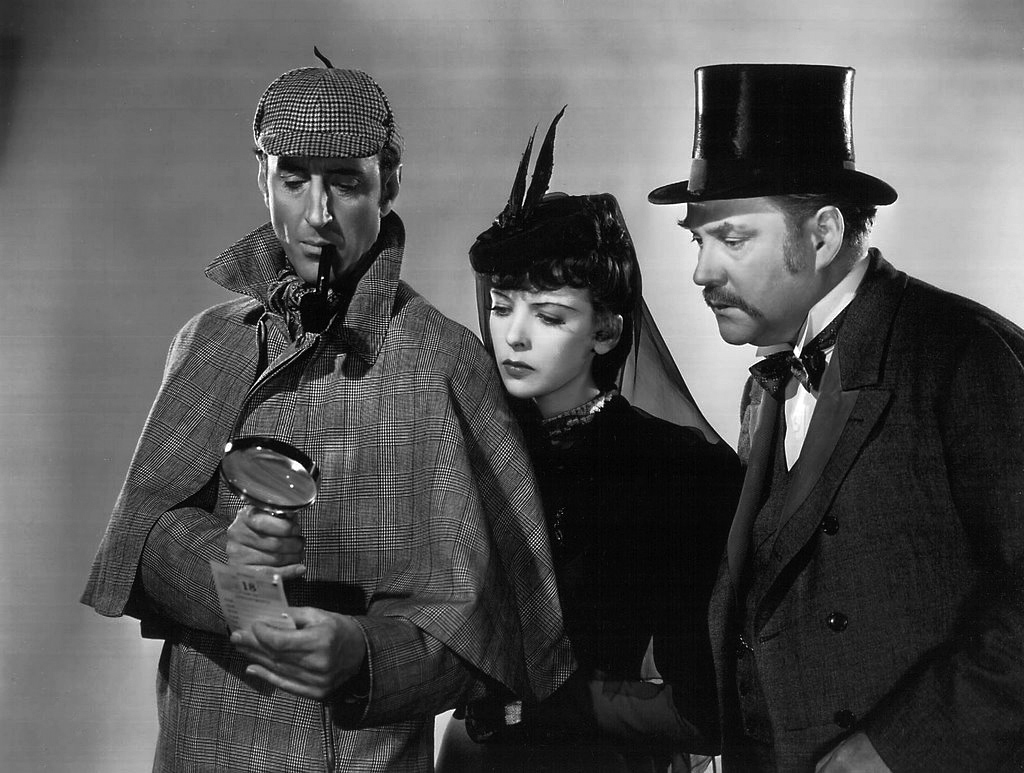
Sherlock Holmes and John Watson about to do philosophy

Let’s review what you need in your worldview in order to have a rationally grounded system of morality.

You need 5 things:

1) Objective moral values

There needs to be a way to distinguish what is good from what is bad. For example, the moral standard might specify that being kind to children is good, but torturing them for fun is bad. If the standard is purely subjective, then people could believe anything and each person would be justified in doing right in their own eyes. Even a “social contract” is just based on people’s opinions. So we need a standard that applies regardless of what people’s individual and collective opinions are.

2) Objective moral duties

Moral duties (moral obligations) refer to the actions that are obligatory based on the moral values defined in 1). Suppose we spot you 1) as an atheist. Why are you obligated to do the good thing, rather than the bad thing? To whom is this obligation owed? Why is rational for you to limit your actions based upon this obligation when it is against your self-interest? Why let other people’s expectations decide what is good for you, especially if you can avoid the consequences of their disapproval?

3) Moral accountability

Suppose we spot you 1) and 2) as an atheist. What difference does it make to you if you just go ahead and disregard your moral obligations to whomever? Is there any reward or punishment for your choice to do right or do wrong? What’s in it for you?

4) Free will

In order for agents to make free moral choices, they must be able to act or abstain from acting by exercising their free will. If there is no free will, then moral choices are impossible. If there are no moral choices, then no one can be held responsible for anything they do. If there is no moral responsibility, then there can be no praise and blame. But then it becomes impossible to praise any action as good or evil.

5) Ultimate significance

Finally, beyond the concept of reward and punishment in 3), we can also ask the question “what does it matter?”. Suppose you do live a good life and you get a reward: 1000 chocolate sundaes. And when you’ve finished eating them, you die for real and that’s the end. In other words, the reward is satisfying, but not really meaningful, ultimately. It’s hard to see how moral actions can be meaningful, ultimately, unless their consequences last on into the future.

Theism rationally grounds all 5 of these. Atheism cannot ground any of them.

Let’s take a look at #4: free will and see how atheism deals with that.

Atheism and free will?

Here’s prominent atheist Jerry Coyne’s editorial in USA Today to explain why atheists can’t ground free will.

Excerpt:

And that’s what neurobiology is telling us: Our brains are simply meat computers that, like real computers, are programmed by our genes and experiences to convert an array of inputs into a predetermined output. Recent experiments involving brain scans show that when a subject “decides” to push a button on the left or right side of a computer, the choice can be predicted by brain activity at least seven seconds before the subject is consciously aware of having made it. (These studies use crude imaging techniques based on blood flow, and I suspect that future understanding of the brain will allow us to predict many of our decisions far earlier than seven seconds in advance.) “Decisions” made like that aren’t conscious ones. And if our choices are unconscious, with some determined well before the moment we think we’ve made them, then we don’t have free will in any meaningful sense.

If you don’t have free will, then you can’t make moral choices, and you can’t be held morally responsible. No free will means no morality.

Here are some more atheists to explain how atheists view morality.

William Provine says atheists have no free will, no moral accountability and no moral significance:

Let me summarize my views on what modern evolutionary biology tells us loud and clear — and these are basically Darwin’s views. There are no gods, no purposes, and no goal-directed forces of any kind. There is no life after death. When I die, I am absolutely certain that I am going to be dead. That’s the end of me. There is no ultimate foundation for ethics, no ultimate meaning in life, and no free will for humans, either.

Richard Dawkins says atheists have no objective moral standards:

In a universe of blind physical forces and genetic replication, some people are going to get hurt, other people are going to get lucky, and you won’t find any rhyme or reason in it, or any justice. The universe that we observe has precisely the properties we should expect if there is, at bottom, no design, no purpose, no evil and no good, nothing but blind, pitiless indifference… DNA neither knows nor cares. DNA just is. And we dance to its music. (Richard Dawkins, River Out of Eden: A Darwinian View of Life (1995))

When village atheists talk about how they can be moral without God, it’s important to ask them to justify the minimum requirements for rational morality. Atheists may act inconsistently with their worldview, believing in free will, expecting praise and blame for complying with the arbitrary standards of their peer group, etc. But there is nothing more to morality on atheism that imitating the herd – at least when the herd is around to watch them. And when the herd loses its Judeo-Christian foundation – watch out. That’s when the real atheism comes out – the atheism that we’ve seen before in countries that turned their backs on God, and the moral law. When God disappears from a society, anything is permissible.