Tag Archives: Radical Feminism

New study: Contraceptives double risk of depression in teenage girls

Hillary Clinton and Planned Parenthood

The Sydney Morning Herald reports:

A Danish study of a million women has found a link between the use of hormonal contraception such as the the pill and increased risk of depression.

Compared with non-users, women and teenage girls aged 15 to 34 who used hormonal contraception had a 1.23 times higher risk of being diagnosed with depression, especially adolescents, according to a paper published in the journal JAMA Psychiatry.

Researchers at the University of Copenhagen in Denmark analysed health registry data of one million Danish women from 2000 and followed them up after an average of six years.

Of the 55 per cent of those who used hormonal contraception, there were just over 23,000 first diagnoses of depression at the time of follow up.

More than 133,000 had received their first prescription of antidepressants.

The highest risk of depression was among the adolescent girls, who had a 1.8-times higher risk of first use of an antidepressant.

The risk varied slightly among the different types of hormonal contraception, but the risk was three times higher among those who used non-oral products, such as progestogen implants.

Few studies have quantified the effect of low-dose hormonal contraception on the risk for depression, but study author Ojvind Lidegaard says their research warrants the need for further studies into the potential adverse effects of the pill.

“Use of hormonal contraceptives was associated with subsequent antidepressant use and first diagnosis of depression at a psychiatric hospital among women living in Denmark.

“Adolescents seemed to be more vulnerable to this risk than women 20 to 34 years old,” Lidegaard said.

Of course, one wonders where these studies were BEFORE the pill was championed by the radical feminists. We didn’t have studies before we adopted abortion, no-fault divorce, single mother welfare and gay marriage, either. Do you think that those might have unintended consequences? Shouldn’t we care about the consequences before we adopt policies that go against traditional moral values?

Anyway, let’s review some studies on birth control pills, since no one ever tells young people these things before it’s too late.

This is from the ultra-leftist Time magazine, of all places.

Excerpt:

Dr. David Gaist, a neurologist at Odense University Hospital and the University of Southern Denmark, and his colleagues found that women taking hormonal contraceptives — those containing estrogen, progestin or a combination of both — showed higher rates of a rare brain tumor known as glioma. Their results, published Thursday in the British Journal of Clinical Pharmacology, raise questions about the connection between oral contraceptives and brain cancer, but shouldn’t yet be interpreted as a reason to stop taking birth control, says Gaist.

Using data from Denmark’s national registries of health records, cancer cases and prescriptions, Gaist zeroed in on the women aged 15 years to 49 years diagnosed with glioma, and then analyzed whether they were prescribed contraceptives and for how long. Overall, women who had used hormonal contraceptives at any point in their lives showed a 50% higher risk of developing the brain tumors compared to those who had not used them. And women who used the birth control for more than five years nearly doubled their risk of the cancer.

Let’s take a look at some previous studies on the effects of contraceptives.

From the Times of India.

Excerpt:

 Women who take oral contraceptives regularly are at a higher risk of developing breast cancer compared to others, shows a study by AIIMS doctors. Breast cancer risk was found to be 9.5 times more in women with a history of consuming such pills. Early menstruation cycle, late marriage and lower duration of breastfeeding were the other major factors responsible for the disease among Indians, according to the study published in the latest issue of the Indian Journal of Cancer.

The study was conducted on 640 women, of which 320 were breast cancer patients. “We found long-term use of oral contraceptive pills (OCP) higher among those suffering from breast cancer-11.9%-compared to healthy individuals-1.2%,” said Dr Umesh Kapil, a professor at the public health nutrition unit, AIIMS. He said breast cancer is caused by repeated exposure of breast cells to circulating ovarian hormones, and long-term use of OCPs, which contain estrogen and progesterone, may be increasing this risk by causing hormonal imbalance.

The study mostly had women who used OCPs for birth control. Emergency contraceptives, popularly called morning-after pills, were not included.

This is not the first study, nor even the second study, to confirm this link.

Birth control pills

Many studies showed that taking birth control pills caused an increased risk of breast cancer.

Study 1: (March 2003)

RESULTS: Among the youngest age group (<35 years, n = 545), significant predictors of risk included African-American race (RR = 2.66: 95% CI 1.4-4.9) and recent use of oral contraceptives (RR = 2.26; 95% CI 1.4-3.6). Although these relationships were strongest for estrogen receptor-negative (ER-) tumors (RRs of 3.30 for race and 3.56 for recent oral contraceptive use), these associations were also apparent for young women with ER+ tumors. Delayed childbearing was a risk factor for ER+ tumors among the older premenopausal women (Ptrend < 0.01), but not for women <35 years in whom early childbearing was associated with an increased risk, reflecting a short-term increase in risk immediately following a birth.

Study 2: (October 2008)

Oral contraceptive use ≥1 year was associated with a 2.5-fold increased risk for triple-negative breast cancer (95% confidence interval, 1.4-4.3) and no significantly increased risk for non-triple-negative breast cancer (Pheterogeneity = 0.008). Furthermore, the risk among oral contraceptive users conferred by longer oral contraceptive duration and by more recent use was significantly greater for triple-negative breast cancer than non-triple-negative breast cancer (Pheterogeneity = 0.02 and 0.01, respectively).

When people talk about a war on women, maybe they should be thinking about this practice of promoting behaviors to women that make them sick. And eventually, we all have to pay for the increased costs of health care when we encourage people to do things that make them sick. We should not be promoting birth control to young women in order to enable them to have recreational sex. It’s not worth the harm it causes them. When you add in the psychological damage and the risk of abortion if the contraception fails, it really is not the right thing to tell a young woman.

What should a woman do if she is attracted to a man who isn’t ready for marriage?

Man helping a woman with proper handgun marksmanship

I have a friend who is now 33 and who has invested all of her relationship time with men who, although they were fun, were never equipped to pull the trigger on marriage. I’ve been investigating her method of choosing men, and it turns out that she basically chooses men based on which one gives her the “tingles”. When pressed, she can’t really explain the pathway forward to marriage from the tingles. And indeed a closer look at the men shows that they are not prepared for marriage responsibilities.

When I look at her, I think “if only women could train themselves to have tingles for men who were actually good at marriage, and interested in getting married”. Is there a way for these women to transfer the tingles from immature boys to marriage-capable men?

Here is a post by super-mom Lindsay, who married young, has three children, and has wisdom beyond her years.

She writes on her blog:

The world has it all backwards when it comes to building romantic relationships. The world says, find someone who is fun to be with and that you’re attracted to, then build a relationship (often built primarily on sex first) and if you don’t break it off and can still stand each other after awhile, maybe start thinking about marriage. Then, once marriage happens, the rest of the world’s advice has to do with how to deal with the various issues that inevitably crop up when you’ve built a relationship on fun and physical attraction and later find out your goals and values are different. The world will also tell you to leave the relationship, even a marriage, as soon as you find attraction waning or problems that aren’t easily solved.

Too often, the church tries to do things the way the world does, except without the sex before marriage. Too many Christian young people were never given guidance on what to look for in a spouse and make the decision based on feeling in love after spending time having fun together. But even where guidance is given, it’s often still focused on finding someone you’re attracted to who happens to have the right qualities rather than learning first to be attracted to the right kind of person. In other words, even Christians usually believe that attraction is fixed and involuntary and try to center relationships around it anyway.

I suggest a better way. My advice is that we learn to be attracted to good character and the types of traits that make a good spouse. Attraction isn’t something that just happens to us. Attraction can be controlled to a large extent. We all have preferences for physical characteristics in the opposite sex, but attraction is more than just noticing someone is good looking, even if that does play a part. These other factors that influence attraction are primarily driven by our mindset and can be modified by our patterns of thought.

In order to control our attraction properly, we should actively think about good character qualities and notice them in others around us and think positive thoughts about those who have them in order to develop a mental pattern of appreciating good character. The opposite should be true of bad character qualities – we should practice seeing them as unattractive. In addition to this, it’s important to actively work to downplay the role of physical traits in our attraction so that character becomes the main factor, not more superficial characteristics like height, hair color, or facial features.

For example, a single woman should learn to appreciate men with a good work ethic, leadership qualities, self-control, and an interest in studying the things of God. She should control her thoughts so as to make character the main thing she evaluates about others and so that she values good character. Thus, she should find her interest in an available man growing when she observes good character while she should find her interest in him waning if she finds bad character such an inability to keep a job, passiveness, sexual immorality, or an anger problem (to name just a few issues).

If we teach our young people to value the kinds of traits that make a good spouse and to actively work to be attracted by their presence and repelled by their absence, they will make better choices when it comes to marriage.

Well, I tried to present this to the 33-year-old, and she assured me that men who are perpetual students are “responsible”, and that men with empty resumes are “hard workers”, and that men with zero earned savings are “good providers”. She said that my concerns about men having good educations, non-empty resumes, and substantial earned savings, etc. are “only valid within a limited scope”. She went on to suggest that a boy in his mid-30s could still be serious about marriage, even if he lives with his parents, has no college degree, has an empty resume, and has zero savings. I am not sure how this would work because marriage requires a certain level of income, and a certain buffer from savings. A standard marriage with 2 children costs hundreds of thousands of dollars – not counting tuition. More if you keep the kids out of public school. Whenever I ask the women in their 30s for the numbers, they haven’t done the analysis. One of them is actually majoring in business (!) but still isn’t able to calculate the cost of marriage enough to know not to marry an unemployed, penniless student. The tingles override all fiscal concerns.

The tragedy is that the youth, beauty and chastity that men find attractive is wasted on men who were chosen because they were free, easy and fun. The tingles must be obeyed, and the solution to criticisms of the tingles is to push the critics away, no matter how accomplished they may be in real life at things that matter: education, career and finances. Only the advisers who agree with the tingles are trustworthy, no matter how much those advisers may have screwed up their own lives. It doesn’t matter how many times the tingles fail to deliver, either, because the alternative to following the tingles (i.e. – growing up) is unthinkable.

It’s sad because men are learning that the easiest way to get a woman to like them is to spiritualize their feelings and intuitions as “God speaking to her”. The 33-year-old woman praised the “spiritual leadership” of a 28-year-old boy who told her that her feelings were God speaking to her. She tried to marry this man, even though he was an unemployed penniless student, before breaking up with him. In other words, you can easily get some crazy young women into a relationship if you tell her that following her heart will work, because God is going to make it all work out. That’s what they want to hear, that’s what they trust. That’s what gives them the tingles.

For some reason, this works on many, many women – it gives them the tingles. But do you know what doesn’t work? Actually being competent at husband roles because you have taken your education, career and investing seriously. That’s really bad, because what you know about practical matters scares many women, making them feel like their feelings and intuitions will not rule over the man’s proven ability. They don’t “trust” men who can demonstrate responsibility and competence, because they know that those men will want to lead, overriding their feelings and intuitions. Demonstrated ability actually causes mistrust.

Marriage-ready men are scary because they have plans for marriage, which may involve obligations for the woman, as she steps into the roles of wife and mother. Obligations such as staying home to homeschool, taking care of the husband’s sexual needs, not wasting money on fun, thrills or travel, having children (which many women do not want because children have needs). Obligations mean that the woman has to care for others, not just be self-centered. Marriage-ready men make the tingles go away, because marriage means obligations, and many women have been taught by feminism to resent the obligations inherent in marriage roles.

In short, some young women want to fly the plane, even if they are going to crash it. The repeated experience of grabbing the controls and crashing over and over does nothing to restrain the desire to let feelings and intuitions rule, either. All a “man” has to do gain her favor is to tell her that this time for sure, she will be able to fly the plane just by following her heart. He just needs to abdicate his duty to protect her by telling her the truth, and she will have the tingles for him. And that’s why many women, under the influence of feminism, have the tingles for the wrong men. Confident promises about an optimistic, easy, fun future mean more to them than the realistic judgment that comes from demonstrated ability as a man.

Why are boys struggling to succeed in school and to find jobs?

Although you might think that there are no reasons for boys underperforming in school and work, a little research shows that this is not the case.

The first reason boys are struggling is because of no-fault divorce. No-fault divorce allows either person in the marriage to end the marriage for any reason or for no reason at all. It was passed because radical feminists and trial lawyers pushed for it. Each special interest group stands to benefit from it in different ways. Feminists oppose the complementary nature of marriage, and trial lawyers just want to drain as much money as they can out of disintegrating families.

70% of divorces are initiated by women, and this is because women tend to emphasize their own subjective feelings of happiness over the objective commitment they make at the wedding. Women today are influenced by feminism to care more about their happiness than they do about loving and serving others, especially husbands and children. This is especially true of the ones who lack trustworthy male influences. The most unstable relationships are lesbian relationships, because there you have two happiness-seekers and no promise-keepers.

In addition, feminism causes women to lose the ability to evaluate men according to traditional male roles, making them vulnerable to predators who do not have the ability to commit to them self-sacrificially. Do you ever wonder why you see single mothers living with atheist men who deliver pizzas and playing video games at age 30? Why is that? Because feminism taught her that men are not better when they are chaste providers and protective mentors. According to feminism, men have no special role as protector, provider and moral/spiritual leader.  Many just pick the best-looking, most entertaining, least demanding, easiest to control man they can find. Someone who doesn’t lead her to behave morally, control her emotions, and put the needs of others above her own desires.

So what happens to boys when marriages can be dissolved so easily?

This article from the Centre for Economic Policy Research explains:

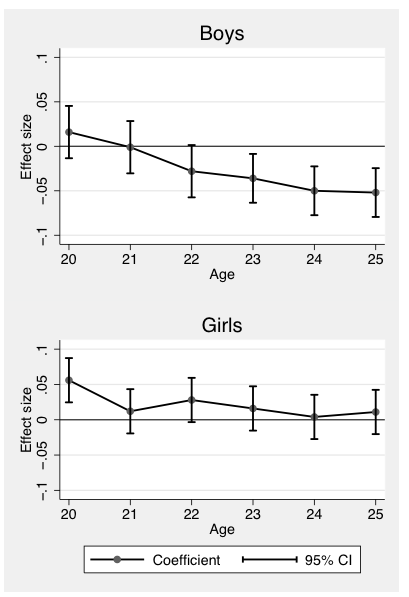
To assess the long-run effect of divorce, we analyse children’s human capital and demographic outcomes. First, we examine college attendance. In Austria, college attendance implies that this person graduated from a higher secondary school. Second, we check the labour market status (employed; unemployed; out-of-labour force) up to the age of 25 years. Third, we examine children’s own family formation behaviour (i.e. fertility and marriage). Finally, we investigate the probability of early mortality (below 25 years of age). Our results show that parental divorce – due to a high level of sexual integration in fathers’ workplaces — has a negative effect on children’s long-term outcomes. Our main findings for human capital outcomes are summarised in Figure 1…

Here’s Figure 1:

Figure 1
Figure 1 (click for larger image)

And Figure 3:  The effect of parental divorce on employment over time.

Figure 3
Figure 3

If you want boys to transition into marriage-minded men, you need to fight against no-fault divorce.

The War Against Boys

The other problem affected boys is also rooted in feminism. Feminism is deeply suspicious of male teachers and male administrators in the schools. As a result, schools tend to be dominated by female teachers and female administrators. Many of these women are feminists, and they seek to change the nature of education from something that is fair to boys and girls, to something that punishes boys and gives the advantage to girls. In addition, feminists in the education industry tend to oppose allowing boys to attend all-male schools, where boys perform at much higher levels.

This article in the left-leaning The Atlantic explains how the school system punishes boys and favors girls – from kindergarten to the workplace, where women receive affirmative action preferences.

Excerpt:

American boys across the ability spectrum are struggling in the nation’s schools, with teachers and administrators failing to engage their specific interests and needs. This neglect has ominous implications not only for the boy’s social and intellectual development but for the national economy, as policy analysts are just beginning to calculate.

[…]Women in the United States now earn 62 percent of associate’s degrees, 57 percent of bachelor’s degrees, 60 percent of master’s degrees, and 52 percent of doctorates.

Boys in all ethnic groups and social classes are far less likely than their sisters to feel connected to school, to earn good grades, or to have high academic aspirations. A recent working paper from the National Bureau of Economic Research documents a remarkable trend among high-achieving students: In the 1980s, nearly the same number of top male and female high school students said they planned to pursue a postgraduate degree (13 percent of boys and 15 percent of girls). By the 2000s, 27 percent of girls expressed that ambition, compared with 16 percent of boys. During the same period, the gap between girls and boys earning mostly A’s nearly doubled—from three to five percentage points.

This gap in education engagement has dire economic consequences for boys. A 2011 Brookings Institution report quantifies the economic decline of the median male: For men ages 25 to 64 with no high school diploma, median annual earnings have declined 66 percent since 1969; for men with only a high school diploma, wages declined by 47 percent. Millions of male workers, say the Brookings authors, have been “unhitched from the engine of growth.”  The College Board delivered this disturbing message in a 2011 report about Hispanic and African-American boys and young adults: “Nearly half of young men of color age 15 to 24 who graduate from high school will end up unemployed, incarcerated or dead.” Working-class white boys are faring only slightly better. When economist Andrew Sum and his colleagues at the Center for Labor Market Studies at Northeastern University examined gender disparities in the Boston Public Schools, they found that for the class of 2007, among blacks and Hispanics, there were 186 females for every 100 males attending a four-year college or university. For white students: 153 females to every 100 males.

Note that radical feminists and socialists oppose solving this problem:

In the U.S., a powerful network of women’s groups works ceaselessly to protect and promote what it sees as female interest. But there is no counterpart working for boys—they are on their own.

[…]The reluctance to face up to the boy gap is evident at every level of government. In Washington, President Obama established a White House Council on Women and Girls shortly after taking office in 2009, declaring: “When our daughters don’t have the same education and career opportunities as our sons, that affects…our economy and our future as a nation.” On the other hand, the proposal for a Council for Boys and Men from a bi-partisan group of academics and political leaders has now been languishing in Secretary of Education Arne Duncan’s office for two years.

Similarly, in Maine, the Portland Press Herald ran an alarming story about the educational deficits of boys—reporting that high school girls outnumber boys by almost a 2-1 ratio in top-10 senior rankings, that men earn about 38 percent of the bachelor’s degrees awarded by Maine’s public universities, and that boys both rich and poor had fallen seriously behind their sisters. But the director of Women’s Studies at the University of Southern Maine, Susan Feiner, expressed frustration over the sudden concern for boys. “It is kind of ironic that a couple of years into a disparity between male and female attendance in college it becomes ‘Oh my God, we really need to look at this. The world is going to end.’”

The rest of the Atlantic article explains how to solve this problem. And the proven solutions clearly show that the problem is not with boys, it’s with an education system that discriminates against boys, making it harder for them to learn the skills they need to find work.

So, the tendency of young men to stay home and play video games comes from discrimination against men in the education system, and no-fault divorce laws that allow spouses (mostly women) to divorce easily. It is women who need to do a better job of “womaning up” to attack no-fault divorce and discrimination against boys in school. But pro-male voices among women are few and far between. Women tend to go along with what makes them look good to others in the culture, and what gives them the most autonomy to pursue happiness (unless they are balanced out by strong men who lead them), and that means the most women tend to just ignore the root causes of male decline.  When I see single women overwhelmingly supporting the anti-male Democrat party, it just tells me that they are not serious about marriage. Whether they intend to or not, they are killing marriage with their political support for misandry.

It would be nice if we got some leadership from pastors in the churches on this issue. It would be if nice the pastors could challenge women to think about how their voting and advocacy of certain policies affect boys. Basically, if pastors could get women to think “and then what happens” to boys who experience no-fault divorce and anti-male schools. But most pastors are like women, and they put more emphasis on being liked based on what is valued in the secular culture. It’s easier for them to remain ignorant and bash men than to pick up a book on education or divorce and read it. If we have a crisis of masculinity, it began in the church, from the “men” behind the pulpit. They need to man up and challenge the feminism that is killing marriage.