Tag Archives: Radical Feminism

What do pastors teach Christian women about relationships and marriage?

Do young women understand how to get to a stable marriage?

I enjoy reading Dalrock’s blog. Recently, he posted a couple of posts (first and second) about theologian Doug Wilson. A friend gave me Wilson’s book “Reforming Marriage”, and I did not find it to be a helpful guide to marriage. So, I was interested to see what Dalrock found in Wilson’s other writings.

Here’s one quote that Dalrock found:

As the apostle Paul is urging young women to marry, he lets a very interesting comment fall in passing. “I will therefore that the younger women marry, bear children, guide the house, give none occasion to the adversary to speak reproachfully” (1 Tim. 5:14). The word translated here as “guide the house” is oikodespotein. The wife is to be the ruler or despot of the home.

And:

A wife therefore has true authority over her home which no one, including her husband, can take away from her.

[…]In a certain sense, a husband… is an honored and permanent guest… he should learn to see himself as a guest.

Now, that seems to contradict the traditional view that men are supposed to be leaders in the home. I don’t think that Christian women are well-served by pastors who dispute the traditional view.

Apparently, lots of women are being told that the traditional meaning of the Bible doesn’t apply to them. I heard Ben Shapiro talk about a church-attending Christian woman who was raging at the Jewish men she had relationships with, because they had not married her. (in his latest podcast, H/T David)

Shapiro mentions this article from the radically-leftist Washington Post:

At my very first job in New York, a colleague jokingly informed me: “You came in a WASP, but you’re leaving a Jew.”

That statement was in reference to the demographics of the office’s staff. Almost everyone who worked there was Jewish, and I, a recent college graduate who had spent my adolescence in a largely Christian community in the South, was not.

[…]Over almost seven years and two serious relationships with Jewish men who at first said religion didn’t matter — and then backtracked and decided it did — I’ve optimistically begun interfaith relationships with an open mind twice, only to become the last woman these men dated before settling down with a nice Jewish girl.

[…]There were times at church that I saw couples worshiping together and felt pangs of jealousy. But I told myself every relationship had its problems and these were relatively minor.

She attended church, but she thought that a difference in religion was “relatively minor”. Nevermind what the Bible says about it. I think that this woman was taught by her pastor that her feelings had more authority than the teachings of the Bible. And that she could retain the label of “Christian” and attend church, despite holding to a worldview that was essentially feminist at its core.

This isn’t the first time that I’ve met “Christian” women raised in the church who thought that the Bible should not have any authority over their choices in relationships. Most woman I met in my teens and 20s believed that. Their only guides were their feelings and intuitions, and that even led some of them to shack up with atheists. And many of the men they chose were just children studying in non-STEM programs, living at home, and racking up debts. They had empty resumes, and empty bank accounts. Nothing I said to these women from wisdom or from the Bible put a dent in their priorities. And in more than one case, pastors backed them up against me.

What prompted me to write this post today was the conjunction of the Dalrock posts with what a friend of mine told me about the Christian woman he is currently dating. So let’s talk about that second part.

My friend is an absolute stud of a Christian man. He has a STEM career, tons of money, his own house, and he has spent a lot of time studying apologetics and engaging in debates. He also attends church and Bible study weekly, and runs an apologetics discussion group. On paper, this guy has everything.

So I was asking him how things were going with the lady. He was telling her about his adventures debating some moral issue. Rather than asking him for details about the exchange, or saying her own view, she completely shut down and refused to discuss it at all! And she wouldn’t even recognize that what he was doing was praiseworthy, in order to encourage him. You would think that a guy would be able to impress a self-described Christian woman with his adventures as a Christian man. But it turns out that a lot of Christian women don’t look for anything seriously Christian in a man or in a marriage.

The experience my friend described basically summarizes what I saw in my teens and 20s, until I met my friend Mary through my blog. Mary is a serious Christian woman who is chaste and active in apologetics. She can run circles around me in debates, and has a computer science degree. She works in computer science, too. Since Mary, I have even met other single and married Christian women with conservative politics, STEM degrees and solid careers and/or marriages, who read apologetics and engage in discussions with non-Christians. They do exist. But I don’t think that any of these great Christian women learned to value these things in church.

I think most pastors fear hurting women’s feelings by expecting them to take the Bible seriously when it comes to relationships and marriage. They minimize the obligations on women to be chaste, to date Christian men, to be focused on marriage while dating, to let husbands lead in the home, etc. It really bothers me that traditional conservative “complementarian” pastors are either unable or unwilling to tell women that the Bible has something to say about how to prepare for marriage, and who they choose to marry. Pastors are free to push their new revisionist feminist version of marriage. But I didn’t get BS and MS degrees in computer science with the plan of putting in 45 years of full-time work in the private sector for a “marriage” that’s been degraded by radical feminism. I offer a lot, and therefore I won’t accept anything less than a Christian wife and a Christian marriage.

People wonder why men are not marrying as often as they used to. I think it has something to do with the fact that pastors are teaching women that husbands ought not be the leaders of their own homes. A Christian man will want his wife to be chief of staff in the home. She should be intelligent, accomplished and effective. Of course he will consult with her before making decisions on how to proceed. But men don’t marry unless we are going to be entrusted with that leadership role. Male leadership in marriage is non-negotiable. And that’s why women need to be wise about choosing the right man for that job – by relying on her mind, instead of on her feelings. Not everything a woman feels like doing is wise.

If you’re a young woman wanting to impress a Christian man with your qualifications for marriage, then check out my marriage questions, and see how you do.
Women who delay marriage for casual sex surprised to be single in their mid-30s

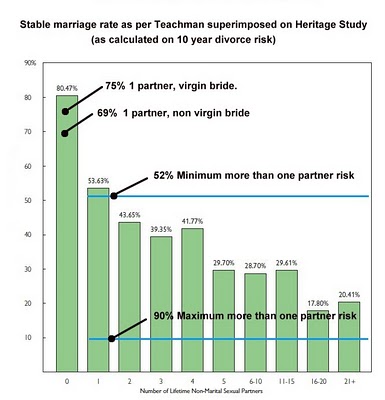
Divorce risk and number of pre-marital sex partners

Dr. Mark Regnerus is a sociologist at the University of Texas at Austin. He has published books on the changing nature of relationships with Oxford University Press. His newest book argues that the Sexual Revolution has caused men to lose interest in marriage because women are now giving them sex for free, without them having to prove their husband credentials first. This causes men to be disinterested in the traditional ways of impressing a woman, namely, getting a job, moving out, being willing to commit, and being able to provide for children who may appear.

The Daily Signal provides a case study taken from Regnerus’ latest book “Cheap Sex”, which illustrates the problem.

Excerpt:

Sarah is 32 years old and recently moved to Texas from New York, looking for a new start—in more ways than one.

Brooklyn had grown too expensive for her hipster pocketbook. A relationship she had hoped would blossom and mature there had instead withered. So to Austin she came, hoping she could improve upon her modest $22,000 annual earnings the previous year.

Her most recent sexual partner—Daniel—was not actually a relationship per se. He was not the reason she moved. Rather, he was a 23-year-old American she had met in China four years before during a three-week language immersion program.

[…]When they first met, and slept together, Sarah was in a relationship with David, the man for which she had moved to, and then away from, New York. She ended up “cheating on him,” that is, David, several times.

[…]If you’re having trouble keeping times, dates, and boyfriends straight, it’s understandable. Sarah herself laughs at the drama of it all.

[…]Getting serious was never much of an option. He was 23, and she was 32: “We both knew … he was graduating from college and, you know, like we both, at least I knew it was never gonna work out. I think he kind of felt the same way.”

[…]When asked how rapidly her relationships tend to become sexual, Sarah replied, “the first or second date.” That account did not stand out from those of many other interviewees.

The numbers are on her side, too. In the 2014 Relationships in America survey, sex before the relationship begins was the modal—meaning the most common—point at which Americans report having first had sex in their current relationships.

Is her timing of sex intentional? No. “It just happens,” she reasoned.

[…]This, she claims, is the standard approach to dating among her peers, if not necessarily the most optimal: “I don’t think it’s unusual, but I think that for a lasting relationship, it’s not the best approach.”

[…]Three years later, now 35, Sarah continues to live in Austin and continues to find commitment elusive. She does not dislike her life, but it is not the one she envisioned a decade earlier.

Daniel is a musician, which doesn’t surprise me at all. A musician, student or other unemployed penniless bad boy will not make any demands on the woman, because he almost certainly has no plan for the future.  This is what many women today want: someone for right now who doesn’t want her to do anything  to prepare for marriage, e.g. – get a real job, stop the thrill-seeking, stop traveling the world. No matter what a woman says about marriage,  if her actions now show an interest in fun and thrills, then she doesn’t want marriage.

The typical woman’s plan for marriage is simply to imagine marriage happening later somehow, without her having to do anything that she doesn’t feel like doing right now. It would be like “planning” for your retirement by taking trips all over the world right now, while imagining living off the interest from a million dollars in savings at age 55. This problem is what happens when the culture tells women that they should not aspire to marriage, and should not measure men to see if they will make good husbands and fathers. If a woman cannot expect a man to be a man (protector, provider, moral and spiritual leader), then she will choose men on other criteria.

This is what women today want:

  • hot appearance
  • confident words about the future
  • empty resume
  • empty bank account
  • several years younger than they are
  • no firm convictions about morality
  • no firm convictions about theology
  • progressive political views, especially on abortion

Men who have no jobs and no money don’t lead women, and are much easier for women to manipulate. The problem with these men is – as any married woman knows – is that those men do not commit. Why not? Because they cannot afford to commit. Marriage, put simply, costs money. Starter houses cost a quarter million. Children cost a quarter million each, not counting college. Retirement costs a quarter million per spouse. And so on. But there is no one in this society telling women that they need to care about choosing men who are serious about the objective duties of the husband role.

Women love to believe that they can choose a hot, irresponsible bad boy who gives them feelings, and then magically mold him into a husband: able to work hard, save money, be self-controlled, faithful and good with children. Feelings determine the choice of man, and feelings tell them that the man can be magically transformed into a husband somehow. Perhaps by giving him premarital sex! That will make him responsible. After all, you can put out a fire with gasoline, right? This is the most common approach women today take to relationships: get drunk, have sex with hot bad boy, shack up with him, wait for him to propose marriage.

I frequently tell my female friends about women I know like the one in the article – many raised by two married parents in Christian homes. They have arts degrees, empty resumes, empty bank accounts, and histories of alcoholism, bulimia, promiscuity and/or divorce. My female friends give me the same advice: “YOU NEED TO LOWER YOUR STANDARDS OR YOU’LL NEVER GET MARRIED”. If that’s the best that they can do, then it’s no wonder that men are not interested in marriage.

If you want men to be interested in marriage, fix the root cause. The root cause of the marriage rate declining is not men. The root cause is feminism.

New study: single-sex schools more successful than mixed-sex schools

Do female-dominated schools discriminate against boys?

Here is the very latest study on this important topic from the Center for Economic and Policy Research (CEPR). They found that boys and girls both do better in single-sex schools, when compared to boys and girls in mixed-sex schools.

Excerpt:

We find robust evidence that pupils in single-sex schools outperform their counterparts in co-ed schools, by 5–10% of a standard deviation for boys and 4–7% for girls, with similar estimates across subjects (which include Korean, English, and maths). This is consistent with the findings reported in Park et al. (2013).

And this study was done in South Korea, where things are a lot more focused on academics than in North America!

In most schools, women comprise on average about 80% of the classroom instructors. This is not even to mention the administrators and the curriculum designers. It is not a friendly environment for boys. In fact, studies have shown that the typical curriculum is biased against boys. Teacher bias may also be a factor, since boys outperform their classroom grades on standardized tests (where there is no bias against them from the teachers).

Regarding the feminist curriculum, consider this report on a study from the UK Telegraph:

A lack of male role models at home and school is turning boys off reading at a young age as they increasingly reject books as “feminine”, it is claimed.

[…]Gavin Barwell, chairman of the All-Party Parliamentary Group on Literacy, said reading was not seen as a “masculine thing” by boys – leaving them lagging behind girls from the age of four onwards.

[…]According to Government figures, boys are less likely to read basic words or recite the alphabet by the age of five and the gap widens throughout compulsory education.

By the age of 16, fewer than 59 per cent of boys gained a good GCSE in English last year compared with 72.5 per cent of girls.

According to a brand new report from the American Enterprise Institute, this discrimination against boys is having a long-term negative effect on their participation in graduate school:

For the eighth year in a row, women earned a majority of doctoral degrees awarded at US universities in 2016. Of the 78,744 doctoral degrees awarded in 2016 (Table B.25), women earned 40,407 of those degrees and 52.1% of the total, compared to 37,145 degrees awarded to men who earned 47.9% of the total…

[…]Women represent 57.5% of all graduate students in the US, meaning that there are now 135 women enrolled in graduate school for every 100 men.

Here is one of the AEI charts:

Graduate school enrollment, male vs female, 2016

You can read about a couple more studies here that also argue that the male-underformance problem is a lack of male teachers in the classroom. It’s important to understand this, because it shows why ignorant cries of “man up” are not going to get men to perform better in school and at work. And men only marry if they feel comfortable taking on the roles of husband and father – which costs money. Men have to be able to earn money in order to engage in marriage and family, and the schools we have right now are set up against them doing that. If you want your daughters to have husbands (instead of marrying government social programs), then you’d better pay attention to these studies and vote accordingly. If you can pull your boys put of mixed-sex schools, it’s a good idea to do that. Homeschooling or single-sex private schools work better for boys.