
Tag Archives: Prosperity

The conflict between the state and the family

A book review by Raymond J. Keating. I just ordered the book.

Excerpt:

Sympathy and compassion help make humans caring, moral beings. Adam Smith, the father of modern economics, understood that, as illustrated by his emphasis on sympathy in The Theory of Moral Sentiments.

Often, however, sympathy and compassion are transformed from tools of moral judgment and action into weapons of blind ideology, irrational emotionalism, and cynical politics. They particularly serve as the bat with which opponents of the welfare state get pummeled. After all, the argument goes, if you oppose an extensive network of government income, housing, healthcare, employment, and child-care assistance programs, you must be severely lacking in sympathy and compassion. To truly care, you must support big government.

That assumption, unfortunately, has long clouded the debate over welfare policies, especially when it comes to government programs affecting family life. The big-government crowd has pushed blindly for government to play an ever-larger role as financial provider for households, thereby contributing critically to the undermining of traditional families. Meanwhile, it should be noted that some who argue against such programs have tried to make their case without fully acknowledging the important economic and societal roles played by the family.

[…]Part of the problem is the failure to apply economic analysis to the family’s role in the economy and to the impact of government policies on the family. That has been remedied to a degree in The War Between the State and the Family: How Government Divides and Impoverishes by Patricia Morgan. Published initially by the London-based Institute of Economic Affairs, it mainly deals with the programs and realities of Great Britain, but the discussion and analysis obviously apply elsewhere, including the United States.

Morgan pulls together overwhelming evidence and data showing the benefits to adults, children, and society in general of marriage and intact families, and the problems of non-marriage, single parenthood, and divorce. And she illustrates how the welfare state subsidizes and encourages family breakdown.

For example, Morgan shows that marriage boosts personal responsibility and employment among males, while single males are far more likely to be jobless and receiving government assistance. She also makes clear that government benefits have a strong impact on marriage and childbearing decisions and responsibilities among both men and women.

She notes the varying ways in which government policies affect such critical decisions: “By rewarding some behaviours and penalising others, tax and welfare systems affect the preference and behaviour of individuals not just through hard cash calculations but by (unavoidably) embodying and promoting certain values and assumptions. . . . The generous subsidisation of the lone-parent household cannot but reinforce the belief that it is quite acceptable for men to expect the state to provide for their offspring.”

Morgan sums up the implications of all this on the size and intrusiveness of government: “Growing family and household fragmentation” drives government spending and taxes ever higher; increases the “number of clients of the state”; “displaces existing institutional and private arrangements”; places the government in the role of parent and provider to children; allows for increased government intrusions into family life; and generates “an increasing mass of legislation and regulation of provisions for custody, access and financial support.” For good measure, child development is inevitably hampered due to the loss of “private investment in children,” which can never be matched in substance or quality by government programs.

She’s like a British Jennifer Roback Morse, and I mean to read her book.

What I find puzzling is that I keep running into young people who aspire to be married and to have children, but who are going about their plan in ways that seem to be counterproductive – at least to me. I see a lot of young people voting Democrat, for example. I find this confusing, because voting Democrat means that there will be fewer jobs, higher taxes, more debt and more crime. That’s just a start. So why are people voting for Democrats when Democrat policies undermine the feasibility of marriage? Probably because they saw Republicans being mocked on Comedy Central and cannot tell the difference between comedy and news.
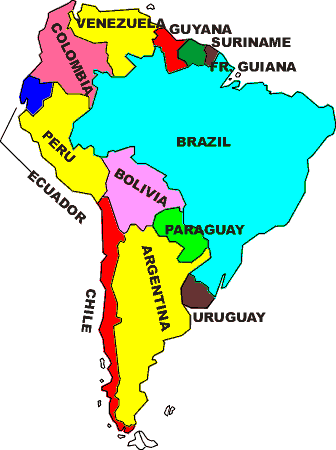
Colombia’s war on terrorism and Chile’s war on poverty

Map of South America

A magnificent column about Colombia’s war on FARC.

Excerpt:

When Juan Manuel Santos came into office as Colombia’s president and emphasized economic issues over the fight against terrorist guerrillas, he was suspected of going soft on those he had combated as minister of defense under the previous administration. Little did his critics know that he was planning the “coup de grace” against the Revolutionary Armed Forces of Colombia (FARC).

The devastating Sept. 22 attack on FARC headquarters in Colombia’s central Meta province all but signifies the end of the five-decade-old conflict. It will take a little while for the official end to be declared, but this war is pretty much over.

[…]For decades, politicians, academics, human rights activists and journalists on both sides of the Atlantic failed to see that there was nothing romantic, “bien-pensant” or Robin Hoodesque about an organization that killed, maimed, kidnapped and extorted for a totalitarian objective.

Colombia’s solitude was such that even the U.S. began to lose faith in its ally a couple of years ago, refusing to approve a free-trade agreement that Bogota had negotiated at a major political cost.

Colombians did not give up and continued to reclaim territory for civilian rule. Much like the defeat of Venezuela’s Cuba-inspired terrorist guerrillas in the 1960s, Colombia’s victory against FARC is the result of civilians awakening to the evil of totalitarian terror.

We get to hear about spectacular military feats, but how many outside Colombia realize that peasants, factory workers, teachers, students and others joined the struggle to defeat FARC, beautifully symbolized by the hundreds of thousands who took to the streets inside Colombia and around the world in 2008 to clamor for the end of terror?

There are still many challenges ahead. The lesson in courage and perseverance that Colombians have given us suggests they are ready to meet them.

I wish that we could sign a free trade deal with them like Canada’s conservative government. Canada is led by a conservative business-friendly economist, and they are very supportive of capitalist democracies like Colombia. Stephen Harper is Canada’s prime minister. He has economics degrees from the University of Calgary. Like Santos, he is very, very tough on terrorism – favoring increased defense spending to protect Canadian interests abroad. And guess what? Canada also has a free trade agreement with another South American country – Chile.

And Chile is also doing very well, even after the massive earthquake.

Excerpt:

Chile’s peso rose to a 27-month high after a report showed the country’s industrial growth accelerated to the fastest since 2006.

The peso appreciated 0.2 percent to 485.23 per U.S. dollar at 11:43 a.m. New York time, from 486.17 yesterday. The currency touched 483.61, the strongest since June 11, 2008. The peso has risen 13 percent during the quarter and 3.6 percent this month.

Chile’s economy is accelerating after the fifth-largest earthquake in a century struck in February, delaying its recovery from a 2009 recession.

“Retail sales grew and industrial production was better than expected,” said Roberto Melzi, a strategist at Barclays Capital in New York.

Retail sales expanded 13 percent in August from a year earlier, and industrial output grew 6.9 percent, the National Statistics Institute said in Santiago. That’s the most since January 2006. Industrial production shrank 17 percent after the 8.8-magnitude Feb. 27 earthquake and its accompanying tsunami, which caused damage worth more than a sixth of Chile’s gross domestic product.

Chile and Colombia are my two favorite South American countries. Both are led by conservative business-friendly economists. Chile’s president Sebastián Piñerahas a Masters and a Ph.D in economics from Harvard, and is successful in the private sector. The Colombian President Juan Manuel Santos specializes in business and economics, with graduate degrees from Harvard and the London School of Economics.

NRSC releases new “Prove Them Wrong” video

This is called a Gadsen flag.

Now, normally, I warn everyone to not give money to the NRSC, because they have a terrible habit of backing liberal, establishment candidates. Well, a funny thing happened – they’re giving lots of money to the Tea Party candidates and nothing to the establishment candidates.

Look at this new video: (H/T The Other McCain)

Marco Rubio, Rand Paul, Sharron Angle, Christine O’Donnell and Joe Miller are ALL in the video. And a Gadsen flag!

Now, read this article from the Daily Caller. (H/T Hot Air)

Excerpt:

Looking at preliminary investments, the NRSC is spending or has spent funds on most competitive U.S. Senate races involving Tea Party-backed Republicans:

—In Kentucky, the NRSC is on the air statewide and has reserved just under $2 million on ad buys for GOP candidate Rand Paul. During the primary, Republican Trey Grayson had the backing of the establishment.

—In Colorado, the NRSC is also on the air statewide in support of Republican Ken Buck, who bested the establishment-backed Jane Norton in the primary. A total of $3.2 million is reserved by the NRSC for ad buys in support of Buck.

—In Nevada, the NRSC has reserved $700,000 in statewide television for GOP nominee and Tea Party-backed Sharron Angle.

—In Pennsylvania, $3 million is reserved for TV for Republican nominee Pat Toomey.

—No airtime has been reserved for Christine O’Donnell in Delaware and Joe Miller in Alaska, but the NRSC has donated $42,600 — the maximum donation allowable under law — to both campaigns.

It’s amazing! I still think you should only give money to specific candidates, but the NRSC sure is smartening up.