Tag Archives: Progress of Science

John C. Sanford’s genetic entropy hypothesis

Apologetics and the progress of science

JoeCoder sent me a recent peer-reviewed paper by John C. Sanford, so I’ve been trying to find something written by him at a layman’s level so I could understand what he is talking about. (I am just a software engineer, not an expert in genetics). His CV is posted at the Cornell University web page.

I found this 20-minute video of an interview with him, in which he explains his thesis:

The most important part of that video is Sanford’s assertion that natural selection cannot remove deleterious mutations from a population faster than they arrive.

And I also found a review of a book that he wrote that explains his ideas at the layman level.

It says:

Dr. John Sanford is a plant geneticist and inventor who conducted research at Cornell University for more than 25 years. He is best known for significant contributions to the field of transgenic crops, including the invention of the biolistic process (“gene gun”).

[…]Sanford argues that, based upon modern scientific evidence and the calculations of population geneticists (who are almost exclusively evolutionists), mutations are occurring at an alarmingly high rate in our genome and that the vast majority of all mutations are either harmful or “nearly-neutral” (meaning a loss for the organism or having no discernible fitness gain). Importantly, Sanford also establishes the extreme rarity of any type of beneficial mutations in comparison with harmful or “nearly-neutral” mutations. Indeed, “beneficial” mutations are so exceedingly rare as to not contribute in any meaningful way. [NOTE: “Beneficial” mutations do not necessarily result from a gain in information, but instead, these changes predominantly involve a net loss of function to the organism, which is also not helpful to [Darwinism]; see Behe, 2010, pp. 419-445.] Sanford concludes that the frequency and generally harmful or neutral nature of mutations prevents them from being useful to any scheme of random evolution.

[…]In the next section of the book, Sanford examines natural selection and asks whether “nature” can “select” in favor of the exceedingly rare “beneficial” mutations and against the deleterious mutations. The concept of natural selection is generally that the organisms that are best adapted to their environment will survive and reproduce, while the less fit will not. Sanford points out that this may be the case with some organisms, but more commonly, selection involves chance and luck. But could this process select against harmful mutations and allow less harmful or even beneficial mutations to thrive? According to Sanford, there are significant challenges to this notion.

Stanford is a co-author of an academic book on these issues that has Dembski and Behe as co-authors.

Now, I do have to post something more complicated about this, which you can skip – it’s an abstract of a paper he co-authored from that book:

Most deleterious mutations have very slight effects on total fitness, and it has become clear that below a certain fitness effect threshold, such low-impact mutations fail to respond to natural selection. The existence of such a selection threshold suggests that many low-impact deleterious mutations should accumulate continuously, resulting in relentless erosion of genetic information. In this paper, we use numerical simulation to examine this problem of selection threshold.

The objective of this research was to investigate the effect of various biological factors individually and jointly on mutation accumulation in a model human population. For this purpose, we used a recently-developed, biologically-realistic numerical simulation program, Mendel’s Accountant. This program introduces new mutations into the population every generation and tracks each mutation through the processes of recombination, gamete formation, mating, and transmission to the new offspring. This method tracks which individuals survive to reproduce after selection, and records the transmission of each surviving mutation every generation. This allows a detailed mechanistic accounting of each mutation that enters and leaves the population over the course of many generations. We term this type of analysis genetic accounting.

Across all reasonable parameters settings, we observed that high impact mutations were selected away with very high efficiency, while very low impact mutations accumulated just as if there was no selection operating. There was always a large transitional zone, wherein mutations with intermediate fitness effects accumulated continuously, but at a lower rate than would occur in the absence of selection. To characterize the accumulation of mutations of different fitness effect we developed a new statistic, selection threshold (STd), which is an empirically determined value for a given population. A population’s selection threshold is defined as that fitness effect wherein deleterious mutations are accumulating at exactly half the rate expected in the absence of selection. This threshold is mid-way between entirely selectable, and entirely unselectable, mutation effects.

Our investigations reveal that under a very wide range of parameter values, selection thresholds for deleterious mutations are surprisingly high. Our analyses of the selection threshold problem indicate that given even modest levels of noise affecting either the genotype-phenotype relationship or the genotypic fitness-survival-reproduction relationship, accumulation of low-impact mutations continually degrades fitness, and this degradation is far more serious than has been previously acknowledged. Simulations based on recently published values for mutation rate and effect-distribution in humans show a steady decline in fitness that is not even halted by extremely intense selection pressure (12 offspring per female, 10 selectively removed). Indeed, we find that under most realistic circumstances, the large majority of harmful mutations are essentially unaffected by natural selection and continue to accumulate unhindered. This finding has major theoretical implications and raises the question, “What mechanism can preserve the many low-impact nucleotide positions that constitute most of the information within a genome?”

If you think all this is interesting, there is a much longer lecture here, which I have not watched. JoeCoder has watched it and he endorses it.

Now I have been told by JoeCoder that there are many critical responses to his hypothesis, most of which have to do with whether natural selection can overcome the difficulty he is laying out. But since this is not my area of expertise, there is not much I can say to adjudicate here, I won’t be able to respond to these. I hope that I will have time to come back to this and read about it at some point. I do have an e-book of the that collection of papers book I linked to above.

Positive arguments for Christian theism

How do atheists try to accommodate the Big Bang in their worldview?

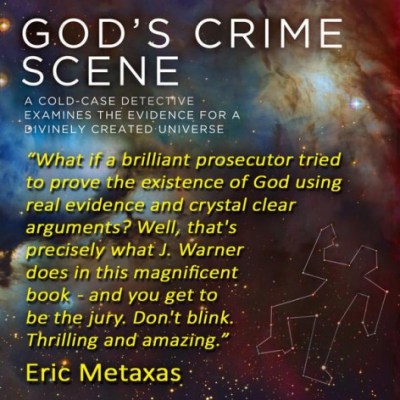
J. Warner Wallace: God's Crime Scene
J. Warner Wallace: God’s Crime Scene

OK, so J. Warner Wallace has a new book out and it’s about science and God. I know, because I saw pictures of his reading list, that he has read tons and tons of atheists like Carl Sagan, Lawrence Krauss and so on.

He’s writing about some of the things he learned from all this reading on his blog, and I wanted to link to something about Lawrence Krauss trying to accommodate the Big Bang within his worldview of atheism.

Wallace writes:

One of the key pieces of evidence in the universe is simply it’s origin. If our universe began to exist, what could have caused it’s beginning? How did everything (all space, time and matter) come into existence from nothing? One way atheist physicists have navigated this dilemma has simply been to redefine the terms they have been using. What do we mean when we say “everything” or “nothing”? At first these two terms might seem rather self-explanatory, but it’s important for us to take the time to define the words. As I’ve already stated, by “everything” we mean all space, time and matter. That’s right, space is “something”; empty space is part of “everything” not part of “nothing”. For some of us, that’s an interesting concept that might be hard to grasp, but it’s an important distinction that must be understood. When we say “nothing”, we mean the complete absence of everything; the thorough non-existence of anything at all (including all space time and matter). These two terms, when defined in this way, are consistent with the principles of the Standard Cosmological Model, but demonstrate the dilemma. If everything came from nothing, what caused this to occur? What is the non-spatial, atemporal, immaterial, uncaused, first cause of the universe? A cause of this sort sounds a lot like a supernatural Being, and that’s why I think many naturalists have begun to redefine the terms.

Lawrence Krauss, Arizona State University Professor (School of Earth and Space Exploration and Director of the Origins Initiative) wrote a book entitled, “A Universe from Nothing: Why There Is Something Rather than Nothing”. As part of the promotion for the book, Krauss appeared on the Colbert Report where he was interviewed by comedian Stephen Colbert. During the interview, Krauss tried to redefine “nothing” to avoid the need for a supernatural first cause:

“Physics has changed what we mean by nothing… Empty space is a boiling, bubbling brew of virtual particles popping in and out of existence… if you wait long enough, that kind of nothing will always produce particles.” (Colbert Nation, June 21st, 2012)

Now if you’re not careful, you might miss Krauss’ subtle redefinition. In describing the sudden appearance of matter (“particles”), Krauss assumes the prior existence of space (“empty space”) and time (“if you wait long enough”). If you’ve got some empty space and wait long enough, matter appears. For Krauss, the “nothing” from which the universe comes includes two common features of “everything” (space and time), and something more (virtual particles). This leaves us with the real question: “Where did the space, time and virtual particles come from (given all our evidence points to their origination at the beginning of our universe)?” Krauss avoids this inquiry by moving space and time from the category of “something” to the category of “nothing”.

If you’ve got a teenager in your house, you might recognize Krauss’ approach to language. I bet you’ve seen your teenager open the refrigerator door, gaze at all the nutritious fruits and vegetables on the shelves, then lament that there is “nothing to eat.”

I used to say that when I was a teenager, but I grew out of it. I didn’t go on the Comedy Channel and try to convince everyone that what I was saying about the refrigerator was scientific.

Anyway, here is a debate between William Lane Craig and Lawrence Krauss, if you want to see how Krauss defends his “refrigerator has nothing to eat” view of cosmology. I know everybody and even many Christians all think that we have something to hide when it comes to science, but if you would just watch these debates, you would see that there is nothing to fear from science at all. We own it.

Meanwhile, I want to show you that this is not at all rare among atheists.

Look, here is Peter Atkins explaining how he makes the Big Bang reconcile with his atheism – and notice that it’s a completely different view than Krauss:

So, just who is this Peter Atkins, and why is he a good spokesman for atheism?

From his Wikipedia bio.

Peter William Atkins (born August 10, 1940) is an English chemist and a fellow and professor of chemistry at Lincoln College of the University of Oxford. He is a prolific writer of popular chemistry textbooks, including Physical Chemistry, 8th ed. (with Julio de Paula of Haverford College), Inorganic Chemistry, and Molecular Quantum Mechanics, 4th ed. Atkins is also the author of a number of science books for the general public, including Atkins’ Molecules and Galileo’s Finger: The Ten Great Ideas of Science.

[…]Atkins is a well-known atheist and supporter of many of Richard Dawkins’ ideas. He has written and spoken on issues of humanism, atheism, and what he sees as the incompatibility between science and religion. According to Atkins, whereas religion scorns the power of human comprehension, science respects it.

[…]He was the first Senior Member for the Oxford Secular Society and an Honorary Associate of the National Secular Society. He is also a member of the Advisory Board of The Reason Project, a US-based charitable foundation devoted to spreading scientific knowledge and secular values in society. The organisation is led by fellow atheist and author Sam Harris.

Now watch that 6-minute video above. Peter Atkins thinks that nothing exists. He thinks he doesn’t exist. He thinks that you don’t exist. This is how atheism adapts to a world where the Big Bang creation event is fact.

I think Peter Atkins should join Lawrence Krauss on the Comedy Channel and present that view. I would laugh. Wouldn’t you?

Walter Bradley lectures on the creation and design of the universe

Dr. Walter L. Bradley

This lecture is special to me, because I bought a VHS tape of it just after I started working full-time, and watched it a million times. It changed my life. The lecture was delivered at the University of California, Santa Barbara.

About the speaker:

Dr. Bradley received his B.S. in Engineering Science and his Ph.D. in Materials Science from the University of Texas in Austin.

Dr. Bradley taught for eight years at the Colorado School of Mines before assuming a position as Professor of Mechanical Engineering at Texas A&M University (TAMU) in 1976.

During his 24 years at Texas A&M, Dr. Bradley served as Head of the Department of Mechanical Engineering at Texas A&M University and as Director of the Polymer Technology Center, and received five College of Engineering Research Awards. He has received over $4,500,000 in research grants and has published over 140 technical articles and book chapters. He has also co-authored “The Mystery Of Life’s Origin: Reassessing Current Theories. He is a Fellow of the American Society for Materials and of the American Scientific Affiliation and serves as a consultant for many Fortune 500 companies.

He currently serves as Distinguished Professor of Engineering at Baylor University.

The lecture: (63 minutes lecture, 25 minutes audience Q&A)

Summary slide:

This slide summarizes the content of the lecture

Introduction:

  • At the beginning of the 20th century, people believed that the progress of science was pointing away from an intelligent Creator and Designer, and towards naturalism
  • A stream of new discoveries has shifted the support of science towards theism, and away from naturalism
  • Richard Dawkins, an atheist, says that nature only has the appearance of design, but that if you look closer, naturalistic mechanisms can account for the appearance of design
  • When deciding between design and apparent design (“designoid”), it matters whether you think there is an intelligence there to do the designing

Evidence #1: The Big Bang:

  • an eternal “steady state” universe is more compatible with naturalism, but a created universe is more compatible with a Creator
  • In 1929, Hubble used telescopes to observe that the light from distant galaxies was redshifted. The further away galaxies were, the faster they were moving away. Therefore, space is expanding in all directions, suggesting an explosive origin of the universe
  • In 1965, the discovery of the cosmic microwave background radiation matched a prediction of the Big Bang cosmology, and of the creation event
  • In 1992, the COBE space telescope allowed us to test four specific predictions of the Big Bang model, especially the predictions for light element abundances (hydrogen and helium), which matched the predictions of the creation model

Evidence #2: Simple mathematical structure of the physical laws

  • the simple mathematical structure of natural laws allows us to understand these laws, make discoveries, and engineer solutions to problems
  • early scientists saw the mathematical structure of the universe to mean that nature was designed by an intelligent to be understood
  • the fundamental equations of the laws of the universe can be easily written on one side of one sheet of paper
  • Eugene Wigner’s famous paper, “The Unreasonable Effectiveness of Mathematics in the Physical Sciences” makes the point that this simple structure is an unexpected gift that allows is to do science

Evidence #3: fine-tuning of the physical constants and quantities

  • in order for any kind of complex life to survive, we need stars that provide energy within specific ranges for long periods of time
  • in order for any kind of complex life to survive, we need planets with stable orbits that will not suffer from extreme temperature swings as it varies in distance from its star
  • in order for any kind of complex life to survive, we need stable atomic structure
  • in order for any kind of complex life to survive, we need to have chemical diversity and correct relative abundances of each element
  • organic life has minimum requirements: process energy, store information, replicate, and you can’t fulfill those functions if there is only one element, e.g. – hydrogen
  • the energy level from the photons from the sun have to match the energy levels of the different elements in order to drive the chemical bonding needed for life
  • These requirements for life of any imaginable type depend on the values of the constants and quantities. The constants and quantities cannot vary much from what they are, or the universe will lose the characteristics (above) that allow it to support complex life of any imaginable time
  • For example, ratio of strong force to electromagnetic force:
    – if 2% larger, then no stable hydrogen, no long-lived stars, no compounds containing hydrogen, e.g. – water
    – if 5% smaller, no stable stars, heavy hydrogen would be unstable, few elements other than hydrogen

Evidence #4: initial conditions for habitability

  • Universe: expansion rate of the universe must be fast enough to avoid a re-collapse, but slow enough to allow matter to clump together and form stars and planets for complex life to live on
  • Planet: right distance from the star to get the right climate
  • Planet: right mass to retain the right atmosphere

Evidence #5: origin of life and information theory

  • It’s possible to explain every process in an automobile engine using plain old naturalistic mechanisms – no supernatural explanation is necessary to understand the processes
  • But the existence of engine itself: engineering all the parts has to be explained by the work of an intelligence
  • Similarly, we can understand how living systems work, but the existence of the living systems requires an intelligence
  • Even the simplest living system has to perform minimal function: capture energy, store information and replicate
  • Living systems are composed of objects like proteins that are composed of sequences of components complex such that the order of the components gives the overall structure function
  • Developing the components for a simple living cell is very improbable – even given the large number of galaxies, stars and planets in the universe, it is unlikely that complex, embodied life would exist anywhere in the universe

Evidence #6: more initial conditions for habitability

  • Location within the galaxy: you need to be away from the center of the galaxy, because the explosions from dying stars, and excessive radiation will kill life
  • Location within the galaxy: you need to be close enough to the center in order catch the heavy elements you need for life from the explosions of other stars
  • Location within the galaxy: the best location is between two arms of  a spiral galaxy, where you can get the heavy elements you need from dying stars, but without being hit with explosions and harmful radiation
  • Star mass: determines rate at which the sun burns, determines the energy level of photons that are used to drive chemical bonding reactions, determines the length of time the star will be stable
  • Star mass: star mass must be the correct value in order to allow liquid water on the planet’s surface, while still preserving stable orbit

I wish there was more curiosity about science in churches, and young Christians understood how critical science is for grounding the rationality of the Christian worldview. We need to be training up more scientists who think about the big questions, like Dr. Walter Bradley.