Tag Archives: Progress of Science

Was atheism or Christianity responsible for the Scientific Revolution?

Christianity and the progress of science

First, here’s an article from the blog of the peer-reviewed journal Nature, probably the best peer-reviewed journal on science in the world.

The article is written by Dr. James Hannam. He has a PhD in the History and Philosophy of Science from the University of Cambridge and is the author of The Genesis of Science: How the Christian Middle Ages Launched the Scientific Revolution (published in the UK as God’s Philosophers: How the Medieval World Laid the Foundations of Modern Science).

Excerpt:

Few topics are as open to misunderstanding as the relationship between faith and reason. The ongoing clash of creationism with evolution obscures the fact that Christianity has actually had a far more positive role to play in the history of science than commonly believed. Indeed, many of the alleged examples of religion holding back scientific progress turn out to be bogus. For instance, the Church has never taught that the Earth is flat and, in the Middle Ages, no one thought so anyway. Popes haven’t tried to ban zero, human dissection or lightening rods, let alone excommunicate Halley’s Comet. No one, I am pleased to say, was ever burnt at the stake for scientific ideas. Yet, all these stories are still regularly trotted out as examples of clerical intransigence in the face of scientific progress.

Admittedly, Galileo was put on trial for claiming it is a fact that the Earth goes around the sun, rather than just a hypothesis as the Catholic Church demanded. Still, historians have found that even his trial was as much a case of papal egotism as scientific conservatism. It hardly deserves to overshadow all the support that the Church has given to scientific investigation over the centuries.

That support took several forms. One was simply financial. Until the French Revolution, the Catholic Church was the leading sponsor of scientific research. Starting in the Middle Ages, it paid for priests, monks and friars to study at the universities. The church even insisted that science and mathematics should be a compulsory part of the syllabus. And after some debate, it accepted that Greek and Arabic natural philosophy were essential tools for defending the faith. By the seventeenth century, the Jesuit order had become the leading scientific organisation in Europe, publishing thousands of papers and spreading new discoveries around the world. The cathedrals themselves were designed to double up as astronomical observatories to allow ever more accurate determination of the calendar. And of course, modern genetics was founded by a future abbot growing peas in the monastic garden.

But religious support for science took deeper forms as well. It was only during the nineteenth century that science began to have any practical applications. Technology had ploughed its own furrow up until the 1830s when the German chemical industry started to employ their first PhDs. Before then, the only reason to study science was curiosity or religious piety. Christians believed that God created the universe and ordained the laws of nature. To study the natural world was to admire the work of God. This could be a religious duty and inspire science when there were few other reasons to bother with it. It was faith that led Copernicus to reject the ugly Ptolemaic universe; that drove Johannes Kepler to discover the constitution of the solar system; and that convinced James Clerk Maxwell he could reduce electromagnetism to a set of equations so elegant they take the breathe away.

Given that the Church has not been an enemy to science, it is less surprising to find that the era which was most dominated by Christian faith, the Middle Ages, was a time of innovation and progress. Inventions like the mechanical clock, glasses, printing and accountancy all burst onto the scene in the late medieval period. In the field of physics, scholars have now found medieval theories about accelerated motion, the rotation of the earth and inertia embedded in the works of Copernicus and Galileo. Even the so-called “dark ages” from 500AD to 1000AD were actually a time of advance after the trough that followed the fall of Rome. Agricultural productivity soared with the use of heavy ploughs, horse collars, crop rotation and watermills, leading to a rapid increase in population.

I don’t know about you, but the first thing I do when I am trying to find a game to play is ask “is it well designed?” If it’s not well-designed, then I will not take the time to learn the rules and practice playing. That was the situation before science started. The non-scientists thought that the universe was chaotic, that there were no rules, and so there was no point in trying to learn the rules. It was the idea that the universe was made by an intelligent Creator and Designer that made the first scientists start to do science. If there are rules to the game, then it’s worth it to learn them. But that’s a belief that’s more at home in a theistic worldview, not in a pagan or atheistic one.
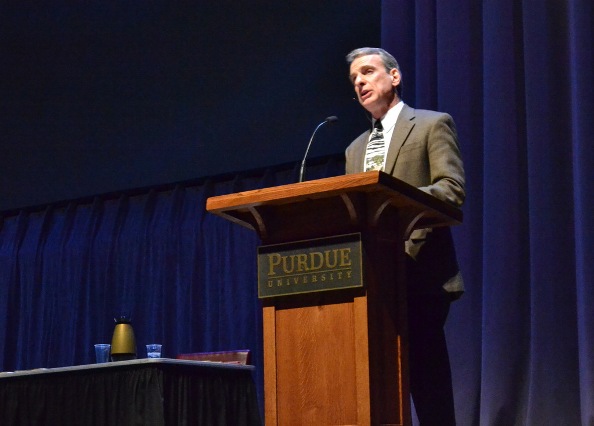
William Lane Craig lectures on naturalistic alternatives to the Big Bang

William Lane Craig lecturing to university students

Here’s the lecture, which was given in 2004 at the University of Colorado, Boulder.

This lecture might be a little advanced for beginners, but if you stretch your mind first, you shouldn’t tear anything. (Note: standard disclaimers apply if you do tear something!)

The description of the video states:

This is quite simply one of the best lectures William Lane Craig (a philosopher of science) has given. Craig explores the origins of the universe. He argues for a beginning of the universe, while refuting scientific models like the Steady State Theory, the Oscillating Theory, Quantum Vacuum Fluctuation Model, Chaotic Inflationary Theory, Quantum Gravity Theory, String Theory, M-Theory and Cyclic Ekpyrotic Theory.

And here is the description of the lecture from Reasonable Faith:

A Templeton Foundation lecture at the University of Colorado, Boulder, laying out the case from contemporary cosmology for the beginning of the universe and its theological implications. Includes a lengthy Q & A period which features previous critics and debate opponents of Dr. Craig who were in attendance, including Michael Tooley, Victor Stenger, and Arnold Guminski.

Craig has previously debated famous atheists Stenger and Tooley previously. And they both asked him questions in the Q&A time of this lecture. Imagine – having laid out your entire case to two people who have debated you before and who know your arguments well. What did they ask Craig, and how did he respond?

The scientific evidence

The Big Bang cosmology that Dr. Craig presents is the standard model for how the universe came into being. It is a theory based on six lines of experimental evidence.

Scientific evidence:

  1. Einstein’s theory of general relativity (GTR)
  2. the red-shifting of light from distant galaxies implies an expanding universe
  3. the cosmic background radiation (which also disproves the oscillating model of the universe)
  4. the second law of thermodynamics applied to star formation theory
  5. hydrogen-helium abundance predictions
  6. radioactive element abundance predictions

It’s probably a good idea to be familiar with these if you are presenting this argument, because experimental science is a reliable way of knowing about reality.

Published research paper

This lecture by Dr. Craig is based on a research paper published in an astrophysics journal, and was delivered to an audience of students and faculty, including atheist physicist Victor Stenger and prominent atheist philosopher Michael Tooley, at the University of Colorado at Boulder.

Here’s the peer-reviewed article that the lecture is based on.

Here’s the abstract:

Both cosmology and philosophy trace their roots to the wonder felt by the ancient Greeks as they contemplated the universe. The ultimate question remains why the universe exists rather than nothing. This question led Leibniz to postulate the existence of a metaphysically necessary being, which he identified as God. Leibniz’s critics, however, disputed this identification, claiming that the space-time universe itself may be the metaphysically necessary being. The discovery during this century that the universe began to exist, however, calls into question the universe’s status as metaphysically necessary, since any necessary being must be eternal in its existence. Although various cosmogonic models claiming to avert the beginning of the universe predicted by the standard model have been and continue to be offered, no model involving an eternal universe has proved as plausible as the standard model. Unless we are to assert that the universe simply sprang into being uncaused out of nothing, we are thus led to Leibniz’s conclusion. Several objections to inferring a supernatural cause of the origin of the universe are considered and found to be unsound.

The whole text of the article is posted online here.

If you want something to post on your Twitter or Facebook that is much shorter than this lecture, then you should check out this quick 4-minute explanation of the kalam argument.

Alexander Vilenkin: “All the evidence we have says that the universe had a beginning”

I’ve decided to explain why physicists believe that there was a creation event in this post. That is to say, I’ve decided to let famous cosmologist Alexander Vilenkin do it.

From Uncommon Descent.

Excerpt:

Did the cosmos have a beginning? The Big Bang theory seems to suggest it did, but in recent decades, cosmologists have concocted elaborate theories – for example, an eternally inflating universe or a cyclic universe – which claim to avoid the need for a beginning of the cosmos. Now it appears that the universe really had a beginning after all, even if it wasn’t necessarily the Big Bang.

At a meeting of scientists – titled “State of the Universe” – convened last week at Cambridge University to honor Stephen Hawking’s 70th birthday, cosmologist Alexander Vilenkin of Tufts University in Boston presented evidence that the universe is not eternal after all, leaving scientists at a loss to explain how the cosmos got started without a supernatural creator. The meeting was reported in New Scientist magazine (Why physicists can’t avoid a creation event, 11 January 2012).

[…]In his presentation, Professor Vilenkin discussed three theories which claim to avoid the need for a beginning of the cosmos.

The three theories are chaotic inflationary model, the oscillating model and quantum gravity model. Regular readers will know that those have all been addressed in William Lane Craig’s peer-reviewed paper that evaluates alternatives to the standard Big Bang cosmology.

But let’s see what Vilenkin said.

More:

One popular theory is eternal inflation. Most readers will be familiar with the theory of inflation, which says that the universe increased in volume by a factor of at least 10^78 in its very early stages (from 10^−36 seconds after the Big Bang to sometime between 10^−33 and 10^−32 seconds), before settling into the slower rate of expansion that we see today. The theory of eternal inflation goes further, and holds that the universe is constantly giving birth to smaller “bubble” universes within an ever-expanding multiverse. Each bubble universe undergoes its own initial period of inflation. In some versions of the theory, the bubbles go both backwards and forwards in time, allowing the possibility of an infinite past. Trouble is, the value of one particular cosmic parameter rules out that possibility:

But in 2003, a team including Vilenkin and Guth considered what eternal inflation would mean for the Hubble constant, which describes mathematically the expansion of the universe. They found that the equations didn’t work (Physical Review Letters, DOI: 10.1103/physrevlett.90.151301). “You can’t construct a space-time with this property,” says Vilenkin. It turns out that the constant has a lower limit that prevents inflation in both time directions. “It can’t possibly be eternal in the past,” says Vilenkin. “There must be some kind of boundary.”

A second option explored by Vilenkin was that of a cyclic universe, where the universe goes through an infinite series of big bangs and crunches, with no specific beginning. It was even claimed that a cyclic universe could explain the low observed value of the cosmological constant. But as Vilenkin found, there’s a problem if you look at the disorder in the universe:

Disorder increases with time. So following each cycle, the universe must get more and more disordered. But if there has already been an infinite number of cycles, the universe we inhabit now should be in a state of maximum disorder. Such a universe would be uniformly lukewarm and featureless, and definitely lacking such complicated beings as stars, planets and physicists – nothing like the one we see around us.

One way around that is to propose that the universe just gets bigger with every cycle. Then the amount of disorder per volume doesn’t increase, so needn’t reach the maximum. But Vilenkin found that this scenario falls prey to the same mathematical argument as eternal inflation: if your universe keeps getting bigger, it must have started somewhere.

However, Vilenkin’s options were not exhausted yet. There was another possibility: that the universe had sprung from an eternal cosmic egg:

Vilenkin’s final strike is an attack on a third, lesser-known proposal that the cosmos existed eternally in a static state called the cosmic egg. This finally “cracked” to create the big bang, leading to the expanding universe we see today. Late last year Vilenkin and graduate student Audrey Mithani showed that the egg could not have existed forever after all, as quantum instabilities would force it to collapse after a finite amount of time (arxiv.org/abs/1110.4096). If it cracked instead, leading to the big bang, then this must have happened before it collapsed – and therefore also after a finite amount of time.

“This is also not a good candidate for a beginningless universe,” Vilenkin concludes.

So at the end of the day, what is Vilenkin’s verdict?

“All the evidence we have says that the universe had a beginning.”

This is consistent with the Borde-Guth-Vilenkin Theorem, which I blogged about before, and which William Lane Craig leveraged to his advantage in his debate with Peter Millican.

The Borde-Guth-Vilenkin (BGV) proof shows that every universe that expands must have a space-time boundary in the past. That means that no expanding universe, no matter what the model, can be eternal into the past. No one denies the expansion of space in our universe, and so we are left with a cosmic beginning. Even speculative alternative cosmologies do not escape the need for a beginning.

Conclusion

If the universe came into being out of nothing, which seems to be the case from science, then the universe has a cause. Things do not pop into being, uncaused, out of nothing. The cause of the universe must be transcendent and supernatural. It must be uncaused, because there cannot be an infinite regress of causes. It must be eternal, because it created time. It must be non-physical, because it created space. There are only two possibilities for such a cause. It could be an abstract object or an agent. Abstract objects cannot cause effects. Therefore, the cause is an agent.

Now, let’s have a discussion about this science in our churches, and see if we can’t train Christians to engage with non-Christians about the evidence so that everyone accepts what science tells us about the origin of the universe.