A pro-abortion activist from New York pled guilty yesterday to making death threats against two high-profile pro-life leaders. He could face up to 51 months in federal custody. Sentencing is scheduled September 12.
Ted Shulman reached an agreement that allowed him to plead guilty to making the death threats against Fr. Frank Pavone of Priests for Life and Prof. Robert George of Princeton University.
Shulman has also repeatedly threatened the lives of Operation Rescue’s Troy Newman and Cheryl Sullenger and other pro-life leaders across the country, including Jill Stanek.
[…]Shulman has been held without bail since his arrest on February 24, 2011, after federal agents raiding his apartment found cyanide and two other deadly substances in his possession. The plea agreement dropped charges related to the deadly substances in return for his guilty plea on the threats.
Schulman, who liked to style himself as the “first pro-choice terrorist” and hosted a blog called “Operation Counterstrike,” is the son of pro-abortion feminist Alix Kates Shulman.
His mother wrote the 1972 sex novel Memoirs of an Ex-Prom Queen and revealed she had four abortions – “not one” of which, she claimed, was “the result of carelessness.” Schulman was born in the middle – two siblings were aborted before his birth, and two after.
This doesn’t surprise me. See, to me, if your worldview includes the believe that it is OK to kill innocent unborn children if they infringe on your prosperity and happiness, then everything is permissible. To me, abortion is worse than slavery, so anyone who actually thinks it is a good thing is really far gone into immorality.
A couple of other examples of pro-abortion violence here and here.
Now, you may think that the view that the unborn deserve protection during pregnancy is something that you either take on faith or not. But I want to explain how you can make a case for the right to life of the unborn, just by using reason and evidence.
To defend the pro-life position, I think you need to sustain 3 arguments:
The unborn is a living being with human DNA, and is therefore human.
There is no morally-relevant difference between an unborn baby, and one already born.
None of the justifications given for terminating an unborn baby are morally adequate.
Now, the pro-abortion debater may object to point 1, perhaps by claiming that the unborn baby is either not living, or not human, or not distinct from the mother.
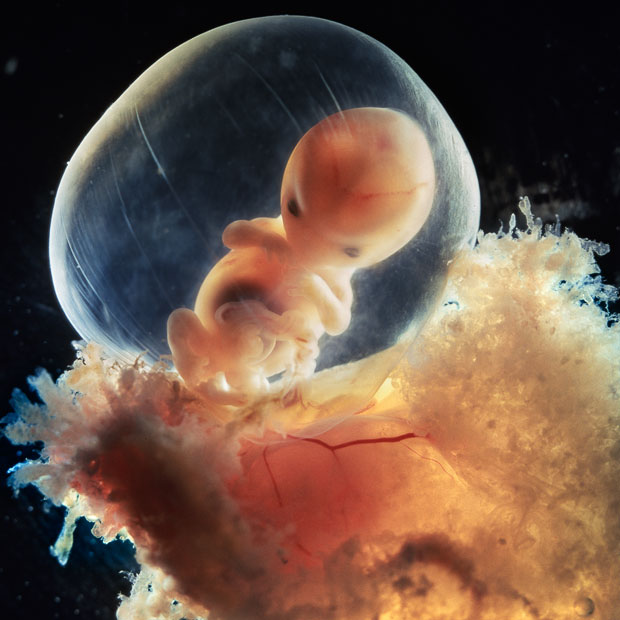
Defending point 1: Well, it is pretty obvious that the unborn child is not inanimate matter. It is definitely living and growing through all 9 months of pregnancy. (Click here for a video that shows what a baby looks like through all 9 months of pregnancy). Since it has human DNA, that makes it a human. And its DNA is different from either its mother or father, so it clearly not just a tissue growth of the father or the mother. More on this point at Christian Cadre, here. An unborn child cannot be the woman’s own body, because then the woman would have four arms, four legs, two heads, four eyes and two different DNA signatures. When you have two different human DNA signatures, you have two different humans.
Secondly, the pro-abortion debater may try to identify a characteristic of the unborn that is not yet present or developed while it is still in the womb, and then argue that because the unborn does not have that characteristic, it does not deserve the protection of the law.
Defending point 2: You need to show that the unborn are not different from the already-born in any meaningful way. The main differences between them are: size, level of development, environment and degree of dependence. Once these characteristics are identified, you can explain that none of these differences provide moral justification for terminating a life. For example, babies inside and outside the womb have the same value, because location does not change a human’s intrinsic value. More at Stand to Reason, here.
Additionally, the pro-abortion debater may try to identify a characteristic of the already-born that is not yet present or developed in the unborn, and then argue that because the unborn does not have that characteristic, that it does not deserve protection, (e.g. – sentience). Most of the these objections that you may encounter are refuted in this essay by Francis Beckwith. Usually these objections fall apart because they assume the thing they are trying to prove, namely, that the unborn deserves less protection than the already born.
Finally, the pro-abortion debater may conceded your points 1 and 2, and admit that the unborn is fully human. But they may then try to provide a moral justification for terminating the life of the unborn, regardless.
Defending point 3: I fully grant that it is sometimes justifiable to terminate an innocent human life, if there is a moral justification. Is there such a justification for abortion? One of the best known attempts to justify abortion is Judith Jarvis Thomson’s “violinist” argument. This argument is summarized by Paul Manata, one of the experts over at Triablogue:
Briefly, this argument goes like this: Say a world-famous violinist developed a fatal kidney ailment and the Society of Music Lovers found that only you had the right blood-type to help. So, they therefore have you kidnapped and then attach you to the violinist’s circulatory system so that your kidneys can be used to extract the poison from his. To unplug yourself from the violinist would be to kill him; therefore, pro-lifers would say a person has to stay attached against her will to the violinist for 9 months. Thompson says that it would be morally virtuous to stay plugged-in. But she asks, “Do you have to?” She appeals to our intuitions and answers, “No.”
Manata then goes on to defeat Thomson’s proposal here, with a short, memorable illustration, which I highly recommend that you check out. More info on how to respond to similar arguments is here.
For those looking for advanced resources, Francis Beckwith, a professor at Baylor University, published the book Defending Life, with Cambridge University Press, 2007.
Arizona Gov. Jan Brewer on Friday signed into law a bill to cut off Planned Parenthood’s access to taxpayer money funneled through the state for non-abortion services.
Arizona already bars use of public money for abortions except to save the life of the mother, but anti-abortion legislators and other supporters of the bill have said the broader prohibition is needed to make sure that no public money indirectly supports abortion services.
“This is a common sense law that tightens existing state regulations and closes loopholes in order to ensure that taxpayer dollars are not used to fund abortions, whether directly or indirectly,” said Brewer, a Republican. “By signing this measure into law, I stand with the majority of Americans who oppose the use of taxpayer funds for abortion.”
Arizona has said a funding ban would interrupt its preventive health care and family planning services for nearly 20,000 women served by the organization’s clinics. The organization has said it will consider a legal challenge.
The measure targeting funding for Planned Parenthood for non-abortion services was one of several approved by Arizona’s Republican-led Legislature related to contentious reproductive health care issues during a 116-day session that ended Thursday. Brewer is a Republican.
Other approved Arizona bills include one generally banning abortions after 20 weeks of pregnancy, which Brewer has already signed, and one loosening a state law that generally requires health care plans to cover contraception.
This is good news for pro-lifers in Arizona, but we are facing some setbacks in Ohio and Texas.


 WINTERY KNIGHT