
Tag Archives: Pro-Life

If you could rescue EITHER embryos OR a 5-year-old, what would you do?

I'm Scheming Unborn Baby, and I approve this study
I’m Scheming Unborn Baby, and I approve this message

I overheard Ben Shapiro talking about some pro-abortion tweet that went viral on Twitter. Basically, the snarky pro-abortion person tried to make the case that unborn children don’t deserve legal protections because people have a moral intuition to save a 5-year-old instead of an embryo, if they can only choose one. The best response to this dilemma comes from Robert George, professor at Princeton University and Christopher Tollefsen.

Their article was posted at The Public Discourse.

Excerpt:

We agree that considering the case as described by Sandel, most people in Jones’s circumstances would choose to rescue the girl. However, this by no means shows that human embryos are not human beings or that they may be deliberately killed to produce stem cells, or in an abortion.

The first thing to notice is that the case as described is not, in fact, analogous to the suggestion that we should perform embryo-destructive research for the benefits it might provide us, or to the suggestion that it is permissible to abort an unborn human being. In both such cases, we are being invited to kill, or authorize the killing of, human embryos or fetuses in order to provide benefits to others. But in the fire scenario, there is no killing; the deaths of the embryos who are lost when Jones opts to save the girl are not killings—no one is acting to destroy the embryos or cause their deaths—but rather are the kind of death we accept as side effects in various cases in which, for example, acting to save one or some persons means that we are unable to save another or others.

Second, there are differences between the embryos and the five-year-old girl that are or can be morally relevant to the decision concerning whom to rescue. For example, the five-year-old will suffer great terror and pain in the fire, but the embryos will not. Moreover, the family of the five-year-old presumably loves her and has developed bonds of attachment and affection with her that will mean much greater grief in the event of her death than in the event of the death of the embryos. While these concerns would not justify killing, they can play a legitimate role in determining how we may allocate scarce resources and, in some cases, whom we may or should rescue. Often, the (or at least a) morally correct decision cannot be made just on the numbers—a point that even utilitarians are willing to acknowledge. And so, for example, it is morally relevant in some cases where choices of whom to rescue must be made that a person we could save is (for example) our own son or daughter, even if saving him or her means that we cannot save, say, three of our neighbors’ children who end up perishing in the fire from which we saved our own child.

The analogy, like Judith Jarvis Thomson’s violin analogy, completely ignores the fact that in a pregnancy, the baby is created as a result of the decisions of the mother and the father of the baby. This is not some stranger, this is their child. And in the case of abortion, it’s not being done to save a 5-year-old. I once heard of a case where a woman killed her unborn child so she wouldn’t look fat on the beach, during her vacation. Hardly a morally sufficient reason.

I really liked this:

The possibility that resources might be used and even, perhaps, lives risked to save the frozen embryos calls to mind the story with which we began our book Embryo: A Defense of Human Life. In 2005, in the aftermath of Hurricane Katrina, a police crew in New Orleans did save a canister of fourteen hundred human embryos from a hospital. Our book began with Noah, one of those embryos, who sixteen months later emerged, via Caesarean section, into the light of the world and his parents’ love. But if those officers had never made it to Noah’s hospital, or if they had abandoned those canisters of liquid nitrogen, the toll of Katrina would have been fourteen hundred human beings higher than it already was, and Noah, sadly, would have perished before having the opportunity to meet his loving family.

The harm of abortion is exactly like the harm of murder in general… each act deprives a person of all of their future. And this against the victim’s will, and without adequate moral justification.

An embryo has a unique genetic signature different from his mother, different from his father. He is a different person, and, if given shelter and food, he will grow up just like any of us do. Is it such a terrible thing to give food and shelter to another human being, that was created as a direct result of the choices of grown-ups? We don’t get to resort to murder of others just in order to make our own lives easier, do we?

Abortion debate: a secular case against legalized abortion

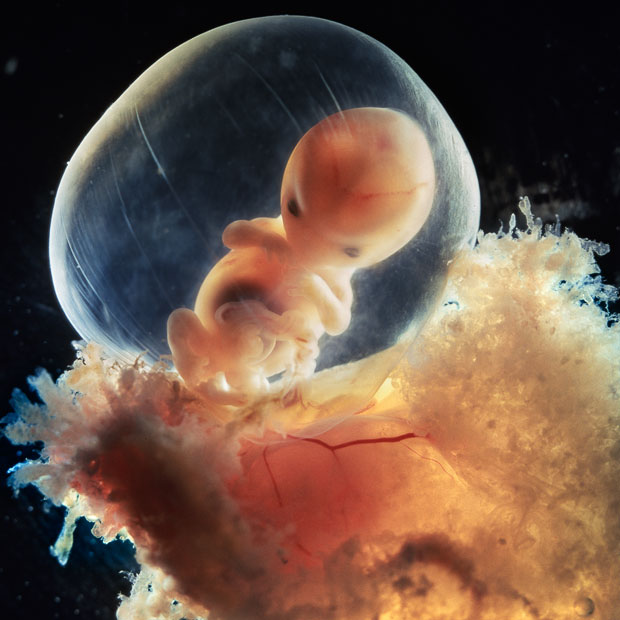
Unborn baby scheming about being only two months old

Note: this post has a twin! Its companion post on a secular case against gay marriage is here.

Now, you may think that the view that the unborn deserve protection during pregnancy is something that you either take on faith or not. But I want to explain how you can make a case for the right to life of the unborn, just by using reason and evidence.

To defend the pro-life position, I think you need to sustain 3 arguments:

  1. The unborn is a living being with human DNA, and is therefore human.
  2. There is no morally-relevant difference between an unborn baby, and one already born.
  3. None of the justifications given for terminating an unborn baby are morally adequate.

Now, the pro-abortion debater may object to point 1, perhaps by claiming that the unborn baby is either not living, or not human, or not distinct from the mother.

Defending point 1: Well, it is pretty obvious that the unborn child is not inanimate matter. It is definitely living and growing through all 9 months of pregnancy. (Click here for a video that shows what a baby looks like through all 9 months of pregnancy). Since it has human DNA, that makes it a human. And its DNA is different from either its mother or father, so it clearly not just a tissue growth of the father or the mother. More on this point at Christian Cadre, here. An unborn child cannot be the woman’s own body, because then the woman would have four arms, four legs, two heads, four eyes and two different DNA signatures. When you have two different human DNA signatures, you have two different humans.

Secondly, the pro-abortion debater may try to identify a characteristic of the unborn that is not yet present or developed while it is still in the womb, and then argue that because the unborn does not have that characteristic, it does not deserve the protection of the law.

Defending point 2: You need to show that the unborn are not different from the already-born in any meaningful way. The main differences between them are: size, level of development, environment and degree of dependence. Once these characteristics are identified, you can explain that none of these differences provide moral justification for terminating a life. For example, babies inside and outside the womb have the same value, because location does not change a human’s intrinsic value.

Additionally, the pro-abortion debater may try to identify a characteristic of the already-born that is not yet present or developed in the unborn, and then argue that because the unborn does not have that characteristic, that it does not deserve protection, (e.g. – sentience). Most of the these objections that you may encounter are refuted in this essay by Francis Beckwith. Usually these objections fall apart because they assume the thing they are trying to prove, namely, that the unborn deserves less protection than the already born.

Finally, the pro-abortion debater may conceded your points 1 and 2, and admit that the unborn is fully human. But they may then try to provide a moral justification for terminating the life of the unborn, regardless.

Defending point 3: I fully grant that it is sometimes justifiable to terminate an innocent human life, if there is a moral justification. Is there such a justification for abortion? One of the best known attempts to justify abortion is Judith Jarvis Thomson’s “violinist” argument. This argument is summarized by Paul Manata, one of the experts over at Triablogue:

Briefly, this argument goes like this: Say a world-famous violinist developed a fatal kidney ailment and the Society of Music Lovers found that only you had the right blood-type to help. So, they therefore have you kidnapped and then attach you to the violinist’s circulatory system so that your kidneys can be used to extract the poison from his. To unplug yourself from the violinist would be to kill him; therefore, pro-lifers would say a person has to stay attached against her will to the violinist for 9 months. Thompson says that it would be morally virtuous to stay plugged-in. But she asks, “Do you have to?” She appeals to our intuitions and answers, “No.”

Manata then goes on to defeat Thomson’s proposal here, with a short, memorable illustration, which I highly recommend that you check out. More info on how to respond to similar arguments is here.

Here is the best book for beginners on the pro-life view.

For those looking for advanced resources, Francis Beckwith, a professor at Baylor University, published the book Defending Life, with Cambridge University Press, 2007.

If unborn babies don’t have consciousness or don’t feel pain, may we kill them?

Unborn baby scheming about pro-life apologetics

Was having a conversation by e-mail yesterday with a pro-abortion atheist, and he gave two reasons why he supported abortion in the first and second trimester. First, he said that unborn babies can’t feel pain, so it’s OK to kill them. Second, he said that unborn babies don’t have consciousness, so it’s OK to kill them. I thought it might be useful to link to something that answers both of these objections.

Frank Beckwith is the author of “Defending Life: A Moral and Legal Case Against Abortion Choice“, which was published by Cambridge University Press, a top academic press. But before Cambridge University Press, Beckwith wrote four easy-to-understand essays for the Christian Research Journal. Part IV is the one that has the response to the two questions raised by my atheist friend.

Part I. The Appeal to Pity

Part II. Arguments from Pity, Tolerance, and Ad Hominem

Part III. Is The Unborn Human Less Than Human?

Part IV. When Does a Human Become a Person?

Excerpt:

Some ethicists argue that the unborn becomes fully human sometime after brain development has begun, when it becomes sentient: capable of experiencing sensations such as pain. The reason for choosing sentience as the criterion is that a being that cannot experience anything (i.e., a presentient unborn entity) cannot be harmed. Of course, if this position is correct, then the unborn becomes fully human probably during the second trimester and at least by the third trimester. Therefore, one does not violate anyone’s rights when one aborts a nonsentient unborn entity. [13]

There are several problems with this argument. First, it confuses harm with hurt and the experience of harm with the reality of harm. [14] One can be harmed without experiencing the hurt that sometimes follows from that harm, and which we often mistake for the harm itself. For example, a temporarily comatose person who is suffocated to death “experiences no harm,” but he is nevertheless harmed. Hence, one does not have to experience harm, which is sometimes manifested in hurt, in order to be truly harmed.

Second, if sentience is the criterion of full humanness, then the reversibly comatose, the momentarily unconscious, and the sleeping would all have to be declared nonpersons. Like the presentient unborn, these individuals are all at the moment nonsentient though they have the natural inherent capacity to be sentient. Yet to countenance their executions would be morally reprehensible. Therefore, one cannot countenance the execution of some unborn entities simply because they are not currently sentient.

Someone may reply that while these objections make important points, there is a problem of false analogy in the second objection: the reversibly comatose, the momentarily unconscious, and the sleeping once functioned as sentient beings, though they are now in a temporary state of nonsentience. The presentient unborn, on the other hand, were never sentient. Hence, one is fully human if one was sentient “in the past” and will probably become sentient again in the future, but this cannot be said of the presentient unborn.

There are at least three problems with this response. First, to claim that a person can be sentient, become nonsentient, and then return to sentience is to assume there is some underlying personal unity to this individual that enables us to say that the person who has returned to sentience is the same person who was sentient prior to becoming nonsentient. But this would mean that sentience is not a necessary condition for personhood. (Neither is it a sufficient condition, for that matter, since nonhuman animals are sentient.) Consequently, it does not make sense to say that a person comes into existence when sentience arises, but it does make sense to say that a fully human entity is a person who has the natural inherent capacity to give rise to sentience. A presentient unborn human entity does have this capacity. Therefore, an ordinary unborn human entity is a person, and hence, fully human.

Second, Ray points out that this attempt to exclude many of the unborn from the class of the fully human is “ad hoc and counterintuitive.” He asks us to “consider the treatment of comatose patients. We would not discriminate against one merely for rarely or never having been sentient in the past while another otherwise comparable patient had been sentient….In such cases, potential counts for everything.” [15]

Third, why should sentience “in the past” be the decisive factor in deciding whether an entity is fully human when the presentient human being “is one with a natural, inherent capacity for performing personal acts?” [16] Since we have already seen that one does not have to experience harm in order to be harmed, it seems more consistent with our moral sensibilities to assert that what makes it wrong to kill the reversibly comatose, the sleeping, the momentarily unconscious, and the presentient unborn is that they all possess the natural inherent capacity to perform personal acts. And what makes it morally right to kill plants and to pull the plug on the respirator-dependent brain dead, who were sentient “in the past,” is that their deaths cannot deprive them of their natural inherent capacity to function as persons, since they do not possess such a capacity.

These four essays are a very good introduction to common responses to pro-abortion arguments. I recommend that people get familiar with this, as once you look into it, you will see that the abortion issue can be debated with as much confidence as William Lane Craig defends Christian theism. You will have the same access to scientific evidence and rational arguments on this topic, and so you will have the upper hand. And that’s fun.

The best introductory book on the abortion / right to life issue is “The Case for Life” by pro-life debater Scott Klusendorf. The best comprehensive book is a tie between “The Ethics of Abortion” by Christopher Kaczor, and Frank Beckwith’s “Defending Life: A Moral and Legal Case Against Abortion Choice“.