Tag Archives: Poverty

An honest look at the many contributions of Hugo Chavez to Venezuela

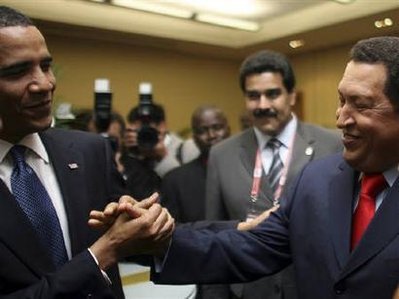
Are Barack Obama and Hugo Chavez very different?

From Reason magazine. (H/T Ian L.)

Excerpt: (links removed)

Hugo Chávez’ presidency has been a disaster for the Venezuelan people. Chávez’ “Socialism of the 21st Century” changed Venezuela from one of the most prosperous and politically free countries in Latin America to one of the least competitive and most repressive countries worldwide. Venezuelans who go to the polls today will ponder many of the President’s policy failures, including a long list of Chávez’nblunders in the last year alone.

Under Chávez’ rule, oil-rich Venezuela has become one of the least economically competitive countries in the world. In 2012, the country ranked 126 of 144 in a study by the World Economic Forum. According to the report, Venezuela now has some of the lowest scores worldwide in functioning of public institutions, trust in the justice system and domestic competition. It has some of the highest scores in terms of regulation, trade tariffs, and rules that deter foreign investment. The country has an inflation rate of 26 percent, and has also suffered several food shortages this year.

Venezuelan infrastructure has been falling apart under Chávez. On August 15th, the Cupira bridge near Caracas collapseddespite repeated warnings from engineers that it was in disrepair. Last month, poor drainage infrastructure led to nationwide flooding, resulting in over 400 families losing their homes and 1,500 people ending up in shelters. Chávez also mismanages Venezuela’s oil wealth. Since the government effectively took control of the national oil company in 2004, it has become much less efficient and production is 25 percent lower than when Chávez took office. Accidents are common—an offshore oil rig sank into the sea in 2010 and an oil refinery explosion in August killed at least 48 people. Despite sitting atop the world’s largest proven oil reserves, Venezuela nowimports and rations gasoline.

According to USA Today, Venezuela has the fourth highest murder rate in the world and is now the most violent South American country. Between the time Chávez took power in 1998 and 2012, kidnappings have risen from a few hundred annually to a record of 16,000 in 2011. Homicide rates have nearly tripled and suspect arrests have fallen by 61 percent. Only eight in every 100 murder investigations lead to an arrest. Murder of police officers has risen by 45 percent  in the last year alone. Violence is much worse for Venezuela’s inmates despite Chávez’ campaign promises of prison reform. A prison riot on August 24 left 26 people dead and 43 injured after inmates took over the compound and held it for four hours. Venezuelans are 20 times more likely to be killed in penitentiaries than outside of them. More than three hundred people have died and 572 have been injured in Venezuelan prisons this year alone.

Venezuelans have also witnessed alarming revocations of political liberties during Chávez’ presidency. On September 10th, Chávez decided to withdraw from the Inter-American Court of Human Rights. He regularly targets media who expose his failures. He recently arrested two journalists for writing a satirical article about his leadership. In addition, he demanded the names of voters who participated in the opposition’s primary election last February, just as he did to those who unsuccessfully voted to remove him from office in 2004. Chávez has banned foreign funding for civil society watch dogs, which will make electoral transparency in upcoming elections difficult.

UPDATE: Reformed Seth sent me this article from Human Rights Watch as well.

Excerpt:

Hugo Chávez’s presidency (1999-2013) was characterized by a dramatic concentration of power and open disregard for basic human rights guarantees.

After enacting a new constitution with ample human rights protections in 1999 – and surviving a short-lived coup d’état in 2002 – Chávez and his followers moved to concentrate power. They seized control of the Supreme Court and undercut the ability of journalists, human rights defenders, and other Venezuelans to exercise fundamental rights.

By his second full term in office, the concentration of power and erosion of human rights protections had given the government free rein to intimidate, censor, and prosecute Venezuelans who criticized the president or thwarted his political agenda. In recent years, the president and his followers used these powers in a wide range of prominent cases, whose damaging impact was felt by entire sectors of Venezuelan society.

Many Venezuelans continued to criticize the government. But the prospect of reprisals – in the form of arbitrary or abusive state action – forced journalists and human rights defenders to weigh the consequences of disseminating information and opinions critical of the government, and undercut the ability of judges to adjudicate politically sensitive cases.

[…]Chávez also rejected international efforts to promote human rights in other countries. In recent years, Venezuela consistently voted against UN General Assembly resolutions condemning abusive practices in North Korea, Burma, Iran, and Syria. Moreover, Chávez was a vocal supporter of Syria’s Bashar al-Assad, Libya’s Muammar Gaddafi, and Iran’s Mahmoud Ahmadinejad, bestowing upon each of these leaders the “Order of the Liberator,” Venezuela’s highest official honor.

Under Chávez, Venezuela’s closest ally was Cuba, the only country in Latin America that systematically represses virtually all forms of political dissent. Chávez identified Fidel Castro – who headed Cuba’s repressive government until his health deteriorated in 2006 – as his model and mentor.

That’s the dream of people on the left like Sean Penn. They love the idea of doing away with liberty and human rights. They want to force their secular leftist ideology on everyone at gunpoint.

Everyone who is praising this communist dictator today should be ashamed. None of them would move out of the United States to live in Venezuela – it’s nothing but hypocrisy.

Related posts

New study: single motherhood hampers the development of children

From the liberal newspaper USA Today, of all places.

Excerpt: (links removed)

A few small, high-quality programs have shown enduring benefits for at-risk kids. But intensive study of Head Start, the nation’s largest and oldest preschool program, finds that the beneficial effects, which are real, wear off by third grade.

The probable reason is not hard to deduce. Children are most likely to succeed in school when pushed by parents who provide stability, help with schooling, and instill an education and work ethic. But for decades now, the American family has been breaking down.

Two-fifths of children born in the USA are born to unmarried mothers, an eightfold increase since 1960. Many succeed thanks to the heroic efforts of strong, motivated single parents and other relatives. But research shows that children of single parents suffer disproportionately high poverty rates, impaired development and low performance in school.

Ron Haskins, an expert on children and families at the Brookings Institution, calls single parenthood a “little motor pushing up the poverty rate.” In 2011, the rate for children of single mothers was more than four times greater than that for children of married couples.

Researchers at Princeton and Columbia, following 5,000 children born to married and unmarried parents, have found that the effects of single parenthood seep into every aspect of kids’ lives.

A typical pattern in these “fragile families” looks like this: When a child is born, most fathers and mothers are in a committed relationship. By the time the child reaches 5, though, many fathers have disappeared. As the mothers move on to new relationships, the children face more instability, often with new siblings born to different fathers. Boys without strong male role models are more likely to turn to gangs and crime.

Single mothers read less to their children, are more likely to use harsh discipline and are less likely to maintain stable routines, such as a regular bedtime. All these behaviors are important predictors of children’s health and development.

It is a tragically familiar pattern. In 1965, Daniel Patrick Moynihan, then a Johnson administration official and later a U.S. senator, warned about an alarming rise — to nearly 24% — in unmarried births in the black community. His prescient warning created a furor among liberals and civil rights leaders, who accused him of blaming the victim. The rates are now 73% for blacks, 53% for Hispanics and 29% for whites.

That’s why I find it so strange that Obama is pushing for more funding for government-run early childhood education, i.e. – “Head Start”. The government’s own studies have shown that Head Start doesn’t work.

In fact, you can argue that Democrat policies actually undermine the family, by paying women to have babies out of wedlock.

Cato Institute economist Dr. Michael Tanner explains:

At the same time, the evidence of a link between the availability of welfare and out-of-wedlock births is overwhelming. There have been 13 major studies of the relationship between the availability of welfare benefits and out-of-wedlock birth. Of these, 11 found a statistically significant correlation. Among the best of these studies is the work done by June O’Neill for the U.S. Department of Health and Human Services. Holding constant a wide range of variables, including income, education, and urban vs. suburban setting, the study found that a 50 percent increase in the value of AFDC and foodstamp payments led to a 43 percent increase in the number of out-of-wedlock births.(7) Likewise, research by Shelley Lundberg and Robert Plotnick of the University of Washington showed that an increase in welfare benefits of $200 per month per family increased the rate of out-of-wedlock births among teenagers by 150 percent.(8)

The same results can be seen from welfare systems in other countries. For example, a recent study of the impact of Canada’s social-welfare system on family structure concluded that “providing additional benefits to single parents encourages births of children to unwed women.”(9)

Of course women do not get pregnant just to get welfare benefits. It is also true that a wide array of other social factors has contributed to the growth in out-of-wedlock births. But, by removing the economic consequences of a out-of-wedlock birth, welfare has removed a major incentive to avoid such pregnancies. A teenager looking around at her friends and neighbors is liable to see several who have given birth out of wedlock. When she sees that they have suffered few visible immediate consequences (the very real consequences of such behavior are often not immediately apparent), she is less inclined to modify her own behavior to prevent pregnancy.

Proof of this can be found in a study by Professor Ellen Freeman of the University of Pennsylvania, who surveyed black, never-pregnant females age 17 or younger. Only 40% of those surveyed said that they thought becoming pregnant in the next year “would make their situation worse.”(10) Likewise, a study by Professor Laurie Schwab Zabin for the Journal of Research on Adolescence found that: “in a sample of inner-city black teens presenting for pregnancy tests, we reported that more than 31 percent of those who elected to carry their pregnancy to term told us, before their pregnancy was diagnosed, that they believed a baby would present a problem…”(11) In other words, 69 percent either did not believe having a baby out-of-wedlock would present a problem or were unsure.

Until teenage girls, particularly those living in relative poverty, can be made to see real consequences from pregnancy, it will be impossible to gain control over the problem of out-of- wedlock births. By disguising those consequences, welfare makes it easier for these girls to make the decisions that will lead to unwed motherhood.

Current welfare policies seem to be designed with an appallingly lack of concern for their impact on out-of-wedlock births. Indeed, Medicaid programs in 11 states actually provide infertility treatments to single women on welfare.(12)

I should also point out that, once the child is born, welfare also appears to discourage the mother from marrying in the future. Research by Robert Hutchins of Cornell University shows that a 10 percent increase in AFDC benefits leads to an eight percent decrease in the marriage rate of single mothers.(13)

As welfare contributes to the rise in out-of-wedlock births and single-parent families, it concomitantly contributes to the associated increase in criminal activity.

Democrats also support the normalizing recreational sex for young children and handing out contraceptives to students without the permission or knowledge of parents. What kind of lasting bond can you create when people have had dozens of sexual partners and have been indoctrinated to view sex as a recreational activity? It just trivializes relationships so that they about sex and fun, instead of being about self-sacrifice, commitment and responsibility. If we are serious about helping children, we need to keep feminists and government out of love and marriage.

The first thing to fix is the widespread belief that men do not have any special roles, and fathers can be substituted for with welfare checks and government programs. Women need to think through what marriage is like, and then control their feelings in order to choose the right man for the roles of husband and father. That is the real cure for single motherhood. The strangest thing in the world I hear from women is what good mothers they would make, and that’s why they should be allowed to use a sperm donor to have a fatherless child. I think that any woman who would contemplate subjecting a child to fatherlessness by choice is by definition someone who does not know or care about the needs of the child. What is amazing to me is many “socially conservative” Christians treat single motherhood as something heroic and praiseworthy, instead of treating it as reckless and harmful to children.

Can we fix poverty by redistributing money, or is the problem something else?

This little blurb by a doctor is making the rounds on Facebook:

Dear Mr. President:

During my shift in the Emergency Room last night, I had the pleasure of evaluating a patient whose smile revealed an expensive Shiny gold tooth, whose body was adorned with a wide assortment of elaborate and costly tattoos, who wore a very expensive brand of tennis shoes and who chatted on a new cellular telephone equipped with a popular R&B ringtone.

While glancing over her Patient chart, I happened to notice that her payer status was listed as “Medicaid”! During my examination of her, the patient informed me that she smokes more than one costly pack of cigarettes every day and somehow still has money to buy pretzels and beer.

And, you and our Congress expect me to pay for this woman’s health care?

I contend that our nation’s “health care crisis” is not the result of a shortage of quality hospitals, doctors or nurses. Rather, it is the result of a “crisis of culture”, a culture in which it is perfectly acceptable to spend money on luxuries and vices while refusing to take care of one’s self or, heaven forbid, purchase health insurance.

It is a culture based on the irresponsible credo that “I can do whatever I want to because someone else will always take care of me”. Once you fix this “culture crisis” that rewards irresponsibility and dependency, you’ll be amazed at how quickly our nation’s health care difficulties will disappear.

Respectfully,
STARNER JONES, MD

My first reaction to this thing was HOAX, but Snopes says it’s not a hoax. In fact, it was a letter published in a newspaper.

And there was even a follow-up letter by the same doctor:

I continue to receive numerous phone calls, letters, emails and face-to-face comments about my letter (“Why Pay For the Care of the Careless”) which appeared in your newspaper a few months ago.

Most people express highest approval for the opinion set forth. Indeed, the truth has an illuminating quality all its own.

However, a few have disagreed and all of them falsely assume that a person who holds the views which I espouse must have been raised in a privileged home. Nothing could be further from the truth.

I grew up in a lower middle class, single parent home in the rural hill country of Pontotoc, Mississippi. While attending public schools, I paid attention in class and did my homework. I ran with the right crowd and stayed out of trouble. My dedication in school resulted in a full-paid scholarship to the prestigious University of the South in Sewanee, TN. After college, I left to go to medical school with everything I owned in three bags. The rest is history.

Motivation, not entitlement, is the key to personal success and happiness in life.

The fact of the matter is that it is often people who have come out of poverty themselves who most disagree with those who want to keep people in poverty by subsidizing their poor decision making. I come from a background where my parents were immigrants and my father worked 3 jobs and my mother worked one. We saw people around us who were poor like us, making these irresponsible spending decisions and they were encouraged to persist in it by welfare programs like Medicaid. They were getting tens of thousands of dollars in benefits, and they would lose those benefits if they worked their way out of poverty.

The fact of the matter is that we are doing the able-bodied non-working poor no favors by allowing them to persist in the worldview of poverty, which is encourages dependence, recklessness, consumption and waste. Eventually, the state runs out of other people’s money to subsidize the able-bodied non-working poor in their perpetual childhood, and then where will they be? We are already $16.5 trillion in debt, and this level of welfare spending is not sustainable. Eventually, they will have to fend for themselves. We will be leaving them uneducated, with no resume, and a host of addictions ranging from the lottery and cigarettes up to drugs and alcohol.

Instead of fretting over feelings, and worrying about being judgmental, we should be fretting about enacting policies that promote marriage, school choice, entrepreneurship, work and so on. Strengthening the family and rewarding hard work. If the concern is that health care costs too much, there are ways to lower the cost of health care with market-oriented reforms. We should be studying the economics of health care and promoting consumer choice, ownership and competition among health care providers. Government is not the answer.

I really recommend that everyone read a book by British doctor Theodore Dalrymple, who gives a close-up view of what government programs actually do to the people we would all like to help. I have linked to all the chapters here, so there is no excuse not to read it and get informed. Then we can read other books on consumer-driven health care in order to learn about how to reduce the cost of health care without growing government.