Tag Archives: Postmodernism

Book review of R.C. Sproul’s “If there’s a God, why are there atheists?”

I have a key that will unlock a puzzling mystery

Brian Auten has a book review posted up at Apologetics 315.

The book is “If There’s A God, Why Are There Atheists?”, by theologian R.C. Sproul. R.C. Sproul is one of my favorite theologians. The book in question has a very, very special place in my heart, because I think that it is one of the major reasons why I was able to resist pernicious ideas like religious pluralism and postmodernism for so long. Once you put on the glasses of Romans 1 and see for the first time what man is really doing with respect to God, you can never see things the same again. I’ll say more about this at the end, but let’s see what Brian wrote first.

The review

So often, you hear atheists complaining about religion is nothing but wish-fulfillment or some sort of crutch for people who are frightened by a variety of things. They think that God is invented to solve several problems. 1) how does the world work?, 2) is there meaning to suffering and evil?, 3) why should I be moral?, and 4) what will happen to me and my loved ones when I die?. On the atheistic view, God is just a crutch that people cling to out of weakness and ignorance. But is this really the case?

Sproul starts the book by investigating three atheists who sought to explain religious belief as a result of psychological factors.

Brian writes:

Before tackling the psychology of atheism, Sproul spends a chapter on the psychology of theism, from the perspective of Freud’s question “If there is no God, why is there religion?”11 What follows is an overview of various psychological explanations of theistic belief: Feuerbach’s “religion is a dream of the human mind.”12 Marx’s belief that religion is “due to the devious imagination of particular segment of mankind.”13 And Nietzche’s idea that “religion endures because weak men need it.”14 The author properly reiterates: “We must be careful to note that the above arguments can never be used as proof for the nonexistence of God. They can be useful for atheists who hear theists state that the only possible explanation for religion is the existence of God.”15 That being said, Sproul also reveals what these arguments presume:

Their arguments already presupposed the nonexistence of God. They were not dealing with the question, Is there a God? They were dealing with the question, Since there is no God, why is there religion?16

Sproul points out the weaknesses of each of these approaches and says “there are just as many arguments showing that unbelief has its roots in the psychological needs of man.”

Wow, could that really be true? What are the real reasons why people reject God? Does the Bible have anything to say about what those reasons are?

Brian cites Sproul’s contention:

The New Testament maintains that unbelief is generated not so much by intellectual causes as by moral and psychological ones. The problem is not that there is insufficient evidence to convince rational beings that there is a God, but that rational beings have a natural hostility to the being of God.

[…]Man’s desire is not that the omnipotent, personal Judeo-Christian God exist, but that He not exist.

In Romans 1:18-23, the apostle Paul explains what is really going on:

18The wrath of God is being revealed from heaven against all the godlessness and wickedness of men who suppress the truth by their wickedness,

19since what may be known about God is plain to them, because God has made it plain to them.

20For since the creation of the world God’s invisible qualities—his eternal power and divine nature—have been clearly seen, being understood from what has been made, so that men are without excuse.

21For although they knew God, they neither glorified him as God nor gave thanks to him, but their thinking became futile and their foolish hearts were darkened.

22Although they claimed to be wise, they became fools

23and exchanged the glory of the immortal God for images made to look like mortal man and birds and animals and reptiles.

On this blog, I regularly present many, many arguments for theism in general, and Christian theism in particular:

Sproul explains why atheists cannot allow themselves to live according to the evidence that is presented to them:

The cumulative effect of this knowledge that is clearly seen is to leave men ‘without excuse.’ Herein lies the basis of the universal guilt of man. No one can claim ignorance of the knowledge of God. No one can cite insufficient evidence for not believing in God. Though people are not persuaded by the evidence, this does not indicate an insufficiency in the evidence, but rather an insufficiency in man.

[…]The basic stages of man’s reaction to God can be formulated by means of the categories of trauma, repression, and substitution.

[…]If God exists, man cannot be a law unto himself. If God exists, man’s will-to-power is destined to run head-on into the will of God.

And this is the force that is animating atheists today. They don’t want to be accountable to God in a relationship, no matter what the evidence is. They have to deny it, so that they can be free to get the benefits of a universe designed for them, without having to give any recognition or acknowledgement back. If they have to lie to themselves to deny the evidence, they will do it. Anything to insulate themselves from the Creator and Designer who reveals himself in Jesus Christ.

The rest of the book review, and the book, deals with explaining in detail how atheists respond to an all-good, all-powerful, all-knowing Creator/Designer. I encourage you to click through and read the whole book review. You can read the review, and the book, and then investigate for yourself whether atheists really are like that.

My survey of atheists

By the way, did you all see my survey of atheists that I did a while back? It’s relevant because one of the questions I asked to my volunteers was “How you begin to follow Christ if it suddenly became clear to you that Christianity was objectively true?”. I got some very strange responses that dovetail nicely with Sproul’s book.

Here are a few of the responses:

  • I would not follow. My own goals are all that I have, and all that I would continue to have in that unlikely situation. I would not yield my autonomy to anyone no matter what their authority to command me.
  • I would not follow, because God doesn’t want humans to act any particular way, and he doesn’t care what we do.
  • I would not follow. Head is spinning. Would go to physician to find out if hallucinating.
  • I hope I would be courageous enough to dedicate my life to rebellion against God.
  • I would not have to change anything unless forced to and all that would change is my actions not my values.  I would certainly balk at someone trying to force me to change my behavior as would you if you were at the mercy of a moral objectivist who felt that all moral goodness is codified in the Koran.
  • He would have to convince me that what he wants for me is what I want for me.

This is all part of my series discussing whether morality is rationally grounded by atheism.

Well Spent Journey did a similar survey of atheists, inspired by mine, and got this result on the relevant question:

12. How would you begin to follow Jesus if it became clear to you that Christianity was true?

– Would follow (5)
– Wouldn’t follow (6)
– Might follow the teachings of Jesus, but that isn’t Christianity (2)
– It would depend on how this truth was revealed (3)
– Christianity can’t be true (3)
– No answer given (4)

…What would be the hardest adjustment you would have to make to live a faithful, public Christian life?

– Adjusting wouldn’t be that difficult; would eagerly welcome knowing that Christianity was true (2)
– Praying, since it seems weird, creepy, and strange
– Trying to figure out how the Bible became so corrupted

– Trying to convince myself that the God of the Bible is deserving of worship (2)
– Don’t think it would be possible to adjust

– No clear response, or not applicable (16)

Yes, they really think like that! Just ask an atheist questions and you’ll see how “objective” they really are. Atheism is entirely psychological. It’s adopted in order to feel sufficient and to operate with autonomy, with the goal of self-centered pleasure-seeking above all. Evidence has nothing to do with it.

UPDATE: Greg Koukl  responded to concerns by Ed Feser, and Ed Feser posted his response here. I agree with Koukl.

William Lane Craig asks: are there objective truths about God?

A conflict of worldviews

In a lecture entitled “Are there Objective Truths About God?”, philosopher William Lane Craig discusses the problem that Christians face when they make truth claims about God. We thinkg that there are objective truths about God – that there are some propositions that describe the way God really is. We think that people who don’t believe in those objective are wrong. But some people want to say that every statement about God is true “for each person” – so that conflicting claims about God are fine and no one is wrong. This could only be the case if everyone is just describing their own preferences, though – if they are making subjective claims about themselves, and not objective claims about God. Unfortunately, Christianity claims to be true for everyone – (e.g. – God is three persons and one being), so that Christians are committed to defending the idea that there are objective truths about God.

Here’s the link to a page containing the lecture audio. (H/T Be Thinking)

The MP3 file is here.

So what questions does Bill answer in the lecture?

What is a self-refuting statement?

The main concept in the lecture is self-refutation. A self-refuting sentence is a sentence that, if true, makes itself false or meaningless. For example, suppose someone said to you: “there are no sentences longer than 5 words” then that would be self-refuting since it falsifies itself. Bill argues that objections to the idea that there are objective truths about God are all self-refuting.

What is truth?

Craig holds that “truth” is a property of a proposition such that a proposition is true if it corresponds to the external world. For example, if I claim that there is a crocodile in your closet and we find a crocodile in your closet, then my statement was true. If there is no crocodile in your closet then my statement was false. The real objective world out there is what makes propositional claims true or false – these are not claims about an individual’s preferences, they are claims about the world. Bill is concerned with truth claims about God that are objective – whether there are propositions about God that are true regardless of what anyone thinks.

Objections to objective truth

Bill discusses 3 objections to the idea that there are objective truths about God. Each objection seeks to make religion subjective, (true for each person, like food preferences or clothing fashion).

Objection #1:The Challenge of Verificationism

The first challenge is that religious claims cannot be verified using the 5 senses, and therefore religious statements are objectively meaningless.

Consider the statement “Only propositions that can be verified with the 5 senses are meaningful”. That statement cannot be verified with the 5 senses. If the statement is true, it makes itself meaningless. It’s self-refuting.

Objection #2: The Challenge of Mystical Anti-Realism

The second challenge is that religious claims, and claims about God, are neither true nor false.

Consider the statement “Propositions about God cannot be true or false”. Craig asks – why should we accept that? Any reason given would have to assert something about God that is true or false, and those reasons would contradict the original statement. For example, “God is too great to be grasped by human categories of thought” is a proposition about God that the speaker thinks is true, which contradicts the original assertion.

Objection #3: The Challenge of Radical Pluralism

The third challenge is that each person invents an entire reality of their own, and that there is no mind-independent objective world shared by individuals.

Consider the statement “There is no objective reality shared by all individuals”. That statement is a statement that applies to all individuals, regardless of what they think.  It’s self-refuting.

Conclusion

Craig ends the lecture by arguing that it is OK for Christians to think that other people’s views are false. It does not follow that just because someone thinks other people’s views are wrong that they am going to mistreat other people. In fact, in Christianity it is objectively true that it is good for Christians to love their enemies. It is objectively true that all human beings have value, because human beings are made by God. So even if Christians disagree with others, they still treat them well, because they think that there are moral truths that they have to conform to.

My thoughts

Sometimes, non-Christians think that it is dangerous to hold beliefs too strongly. But I think what really matters is the content of the belief – some beliefs are false and some are true – you want to believe the true beliefs as strongly as you can, as long as the evidence warrants it. In Christianity, I am absolutely obligated to treat people with whom I disagree with respect and gentleness (1 Pet 3:15-16). The more convinced I am about that belief, the better my opponents will be treated. A stronger belief in Christianity means more tolerance for those who disagree.

Why do non-Christians get so offended when Christians claim to be right about there being only one way to be rightly related to God? Well, for many it’s because their worldview is a personal preference, and they feel uncomfortable having to defend it rationally and evidentially. For most people, religion is just their cultural preference – like cooking style, or favorite sport, or clothing style. That’s why they respond to your truth claims with name-calling like “you’re intolerant” and “you’re judgemental” and “you’re arrogant”. These are just shorthand ways of saying, “I’m offended that you’ve thought things through more than I have, and that your careful arguments and evidence make me fee bad about not having any arguments and evidence for the customs and conventions I was raised in”. My family is from a non-Christian culture, so I have to talk to my relatives about this all the time. They feel judged, but it’s not my fault that they haven’t done any homework to prove out their beliefs.

I got this “you’re mean” reaction a lot from people who are raised to think that their religion is a racial, national or cultural identity. They think that if you tell them they are wrong  on matters of fact that somehow this amounts to some sort of racism or prejudice. You make factual claims, and they hear discrimination. But that’s not how Christians think of religion – we only care if it’s true or not – just like we care whether the claims of history or science are true or not. We not trying to be mean, any more than it’s mean to say things like “water boils at 100 C”. That’s just the way it is, and we’re more than happy to discuss the reasons why we think that, and to look at your reasons to see why you don’t think that.

For further study

A debate between a Christian and a postmodern, featuring Christian scholar Peter Williams and a very strange liberal person. This audio really makes it clear why people are opposed to objective truth claims about religion. Williams’ opponent is the epitome of postmodern relativist irrational universalism.

Mulcair and Trudeau want convicted Canadian terrorists to retain citizenship

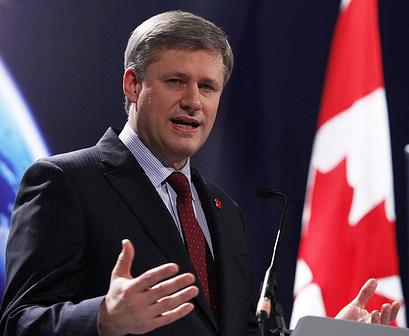
Prime Minister Stephen Harper

This is from the National Post, one of Canada’s two national newspapers.

Excerpt:

The government used its new power to revoke the citizenship of convicted terrorists for the first time on Friday against the imprisoned ringleader of the 2006 al-Qaida-inspired plot to detonate truck bombs in downtown Toronto.

Zakaria Amara was notified in a letter sent to the Quebec penitentiary where is he serving a life sentence that he is no longer a Canadian. He still holds citizenship in Jordan and could be deported there following his release from prison.

[…]Legislation that came into force in May, over the opposition of the NDP and Liberals, allows the government to revoke the citizenship of Canadians who have been convicted of terrorism offences — provided they hold citizenship in a second country.

The law also applies to dual citizens convicted of treason and spying for foreign governments, as well as members of armed groups at war against Canada. A little more than half-a-dozen Canadians have been notified so far that the government was considering revoking their citizenship.

Now, you would think that a law like this would be common sense, but in Canada, you’d be wrong. Two-thirds of the electorate are pro-terrorism in Canada, owing largely to mass immigration from Muslim countries, and and an education system that is anti-Western civilization in a suicidal way. And the leaders of the two socialist opposition parties reflect that suicidal view.

More:

NDP leader Tom Mulcair has said he would scrap the citizenship revocation law, and on Friday Liberal leader Justin Trudeau repeated his pledge to repeal it. “The bill creates second-class citizens,” he said. “No elected official should ever have the exclusive power to revoke Canadian citizenship. Under a Liberal government there will be no two-tiered citizenship. A Canadian is a Canadian is a Canadian.”

Let’s find out exactly who we are talking about here:

Amara emerged in 2005 as one of two leaders of a terrorist group that trained on a rural property north of the city and, inspired by al-Qaida, began planning attacks they thought would convince Canada to withdraw its troops from Afghanistan.

Amara led a faction that was acquiring the components for large truck bombs that were to be detonated during the morning rush hour outside the Toronto Stock Exchange and the Canadian Security Intelligence Service office beside the CN Tower. An Ontario military base was also to be attacked.

Justice Bruce Durno called the plot “spine chilling” and said “the potential for loss of life existed on a scale never before seen in Canada. It was almost unthinkable without the suggestion that metal chips would be put in the bombs. Had the plan been implemented it would have changed the lives of many, if not all Canadians forever.”

Under the liberal governments of the 1980s and 1990s, Canada experienced mass immigration from countries that had no understanding of nor allegiance to Western democratic ideals. This was desired in order to build a majority that would support bigger government, higher taxes, and more dependency. No effort was made to teach incoming immigrants to value democracy and Judeo-Christian values as the source of Canadian success. There were several terrorist attack in Canada during Harper’s 8 year run. If Canada elects leftists, these will continue. Only now, government will not have the tools they need to protect the public from their past immigration laxity. Be warned, Canadians.