
Tag Archives: Postmodernism

Christian NHS worker who gave a book to Muslim co-worker loses her appeal

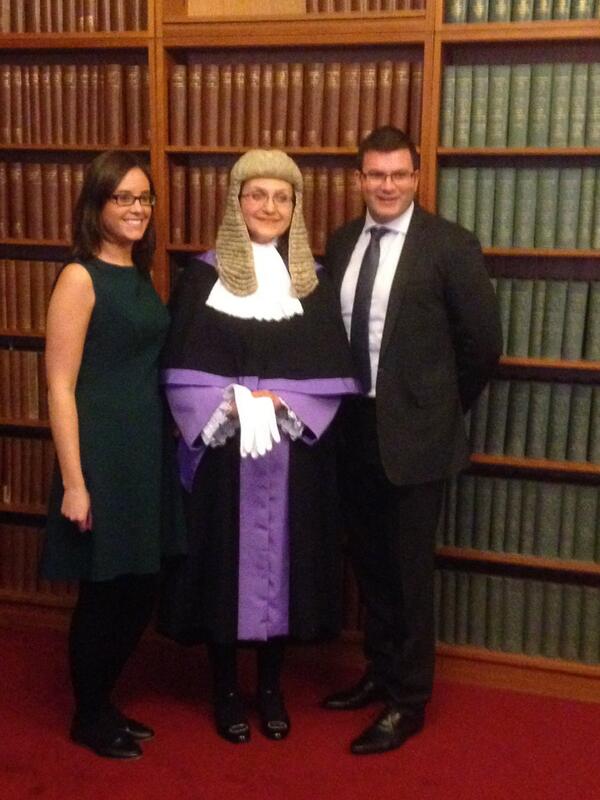
Judge Jennifer Jane Eady, Queens Counsel

The UK Telegraph reports on the state of religious liberty in the United Kingdom.

Excerpt:

A Christian NHS worker suspended for giving a religious book to a Muslim colleague has lost her appeal against a ruling that the decision to discipline her was lawful.

Victoria Wasteney, 39, was found guilty by her NHS employer in 2014 of “harassing and bullying” a work friend for giving her a book about a Muslim woman’s encounter with Christianity, praying with her and asking her to church.

She was suspended for nine months and given a written warning, even though the woman had been happy to discuss faith with her and never gave evidence about her allegations to the NHS.

Ms Wasteney, a senior occupational therapist, challenged the decision by East London NHS Foundation Trust at an employment tribunal last year, but it ruled that her employer had not discriminated against her.

A judge gave her the chance to appeal against that decision, saying it should consider whether the original ruling had correctly applied the European Convention on Human Rights’ strong protection of freedom of religion and expression.

But at a hearing in central London on Thursday, Her Honour Judge Eady QC dismissed the appeal.

Following the decision, Miss Wasteney, from Epping, Essex, said: “What the court clearly failed to do was to say how, in today’s politically correct world, any Christian can even enter into a conversation with a fellow employee on the subject of religion and not, potentially, later end up in an employment tribunal.

“If someone sends you friendly text messages, how is one to know that they are offended? I had no idea that I was upsetting her.”

[…]The woman, who quit her job shortly after making the complaints, never gave any evidence about her allegations to the NHS or later to the employment tribunal.

It sounded to me like the Muslim woman encouraged the Christian woman and the Christian woman was later surprised by the complaints. I think most Christians can take no for an answer, but Christians are caring, and they see offering to pray and offering to bring someone to church as a caring thing to do. If they don’t hear a no, then they keep right on doing what comes naturally to Christians – talking about spiritual things and trying to lead others to the Lord.

It was much easier to do this in the past, before people got more concerned about not feeling offended than they were about discussing what is or is not true. So now, even in a country like England, you can be anything you want to be as long as you’re not behaving like a Christian in public. I think this is especially the case when the people who adjudicate these cases are more focused on feelings… the person who feels the most offended seems to win all the time.

Before I had an alias, I had experience dealing with co-workers who did not much like me talking about spiritual things at work. Some types of people are more risky than others, I’ve found. That’s when I started to make rules based on my experiences, about who was and who was not safe to talk to. And that’s when I decided that to really say what I wanted to say, I’d have to get an alias, and not tell too many co-workers about it.

So who is dangerous? Obviously, people who are committed to a sinful lifestyle already are dangerous to talk to. I don’t talk to people about anything interesting if they are committed to a sinful lifestyle, because they will feel obligated to discuss issues defensively, rather than in a truth-focused way. I also avoid people who are more focused on feelings, family and community above truth. They tend to be more focused on feeling good and getting along, and they are the worst people to disagree with. The safest people are people who like to argue about what is true, and who respond to evidence.

So how to detect who is safe? Well, If the person talks about themselves a lot, and about their feelings, and happy experiences, and their vacations, their families and popular culture fluff, then I would avoid them. Don’t say a word to them. The ones who are safer are the ones who accept disagreements and don’t just rush to agree with you while hiding their own opinions in order to be liked. You also want to avoid people who take everything personally, instead of debating the outside world with a focus on what is true.

I am terrified of people who try to agree with me on everything, or who cannot explain both sides of an issue respectfully. I watch what people watch on TV in the gym – if it’s sports, housewives of beverly hills, or other shallow life enhancement fluff, then I don’t talk to them. If it’s news or business, then it’s safer to talk to them – because then you can talk about facts. Beware of people who try to jump to agreement quickly, without showing any evidence or reasons for their view. It’s always better to talk about issues in the abstract, rather than offering to pray or asking someone to church. For example, you can discuss whether the universe had a beginning, or which books of the Bible were written early. Christians need to learn how to do that – how to talk about facts.

A good question to ask to test a person is to ask where they get their news. If there is no balance there, then it’s a good sign to avoid them. Two of my leftist co-workers this week asked me why I thought that the Washington Post and the New York Times were “radically leftist”. I asked them to name conservative columnists at either paper. They couldn’t name a single one. One tried to google it right in front of me! I named Arthur Brooks, Ross Douthat, Jennifer Rubin, etc. and explained why they weren’t conservative. Then I listed off a half-dozen liberal names at the Washington Post. If the person you are talking to is in a bubble, then they are too risky to talk to. Pretty much everyone on the secular left is that way, and you should check first by seeing what they read for news. If they’re not safe, then get yourself an alias and write something online, instead.

Ryan Bell’s year of atheism testimony shows need for apologetics

The Christian life requires a certain degree of mental toughness and non-conformity

Are you interested in knowing how to avoid losing your Christian faith? Well, an episode of the Unbelievable show featuring well-known apostate Ryan Bell will give you some clues.

But before we go to the podcast, I want to recap some reasons why people think that God exists.

In addition to these arguments for theism, Christians should be able to make a minimal facts case for the resurrection, one that leverages the early creed in 1 Corinthians 15:3-7. And some sort of case for the belief that Jesus was divine using only the earliest sources.

In addition to those positive evidences, there would be informed defenses to other questions like the problem of evil, the problem of suffering, religious pluralism, the hiddenness of God, materialist conceptions of mind, consciousness and neuroscience, the justice of eternal damnation,sovereignty and free will, the doctrine of the Incarnation, the doctrine of the Trinity, and so on.

I listed these out so that you can see how many of these positive arguments and defenses that Ryan Bell wrestles with in his deconversion testimony.

The podcast

Details:

Ryan J Bell is a former pastor who has decided to try being an atheist for a year. He explains why and interacts with New Zealand apologist Matt Flannagan.

The MP3 file is here. (We only care about the first 45 minutes)

Matt Flanagan and Justin Brierley do a great job in this debate getting the real issues on the table, although you have to wait until about 20 minutes in. Quick note about Bell. He has a BA in Pastoral Ministry, an MDiv, and a doctorate in Missional Organization. Now I have a suspicion of people with a background like that – my view is that they are more likely to be impractical and/or insulated from real life.

I also noticed that his politics are liberal, and that he is featured on the web site of GLAAD, a gay rights organization, for supporting gay marriage. Why do people support same-sex marriage? I think the most common reason is because they care more about the needs of adults than they care about the needs of children for a mother and a father. That’s where this guy is coming from – he is a people-pleaser, not someone who promotes the needs of children over the needs of adults.

Summary:

At the start of the podcast, we learn that Bell was in the Seventh Day Adventist church, which is strongly invested in young-Earth creationism. Depending on how strict his young Earth view was, this closes off many of the best arguments for theism from science, such as the cosmological argument, the cosmic fine-tuning argument, the stellar habitability argument, the galactic habitability argument, the Cambrian explosion argument, and even the origin of life argument (to a degree). These are the arguments that make theism non-negotiable.

When he started his journey to atheism, he says that he was reading a book called “Religion Without God” by Ronald Dworkin.I was curious to see what view of faith was embraced by this book. Would it be the Biblical view of faith, trust based on evidence? Or the atheist view of faith, belief without evidence? I found an excerpt from the book in the New York Times, which said this:

In the special case of value, however, faith means something more, because our convictions about value are emotional commitments as well and, whatever tests of coherence and internal support they survive, they must feel right in an emotional way as well. They must have a grip on one’s whole personality. Theologians often say that religious faith is a sui generis experience of conviction. Rudolf Otto, in his markedly influential book, The Idea of the Holy, called the experience “numinous” and said it was a kind of “faith-knowledge.” I mean to suggest that convictions of value are also complex, sui generis, emotional experiences. As we will see… when scientists confront the unimaginable vastness of space and the astounding complexity of atomic particles they have an emotional reaction that matches Otto’s description surprisingly well. Indeed many of them use the very term “numinous” to describe what they feel. They find the universe awe-inspiring and deserving of a kind of emotional response that at least borders on trembling.

The excerpt quotes William James, who reduces religion to non-rational emotional experiences. I don’t know about you, but I don’t think that view of faith is Biblical at all. Biblical faith is rooted in evidence. So clearly, what is important to this Dworkin is not objective evidence, it’s feelings. And this is what Bell was reading. He was not reading academic books like “Debating Christian Theism” to get the best arguments pro-and-con. He was looking for something that “resonated” with his feelings.

His journey was prompted by a female Episcopal priest friend who was asked by an atheist “what difference does religion make in my life?”. So, the framework of his investigation is set by a question that is not focused on truth, but is instead focused on emotions and life enhancement. Now Christianity might be a real stinker of a worldview for life enhancement, and the Bible warns us not to expect a bed of roses in this life. Christianity is not engineered to make you feel good or to make people like you, especially people like female Episcopal priests and GLAAD.

When talking about atheism, he is not concerned with whether atheism is logically consistent or consistent with objective evidence. He is concerned by whether atheists can have the experience of being moral without God. He sees an atheist who has moral preferences and seems like a good person by our arbitrary social standards, and he finds that as “valid” as religion. He is judging worldviews by whether people have their needs met, not by truth.

He says that as a pastor, his method of evangelizing atheists was to encourage them to “try on faith” “go through the motions” “participate in social justice outreach events”, etc. His goal was that they would “step into the stream of the Christian narrative and discover that it held value and meaning to them, and find that they actually believed it”. So his method of recommending Christianity to others has nothing to do with logic, evidence or truth. He is offering Christianity as life enhancement – not knowledge but a “narrative” – a story. If it makes you feel good, and it makes people like you, then you can “believe” it. He says that he was “a Christian by practice, a Christian by tradition”. Not a Christian by truth. Not a Christian by knowledge. He just picked a flavor of ice cream that tasted right to him, one that pleased his parents, friends and community. And now he has new friends and a new community, and he wants to please them and feel good about himself in this new situation.

He says that the Christian worldview is “a way of approaching reality” and “creating meaning” and “identifying meaning in the experiences we have”. And he says that there are “other ways of experiencing meaning”. He talks a lot about his correspondence with people and reading atheists, but nothing about reading Christian scholars who deal with evidence, like William Lane Craig, Stephen C. Meyer or Mike Licona.

Literal, literal quote: (23:35) “Well I think the only access we have to  the question of God’s existence or not is how we feel. I mean there’s no falsifiable data that says God either exists or doesn’t exist. It’s all within the realm of our personal experience”. “If living as though God exists makes you happy and comforts you, then by all means, go for it”. This attitude is so popular in our churches today, and where does it end? In atheism. I had a fundamentalist woman telling me just last night how this feelings mysticism approach was the right approach to faith, and that the head knowledge approach was bad and offensive.

I’m going to cut off my summary there, but the podcast goes on for 45 minutes. Matt Flannagan is brilliant, and went far beyond what I wanted to say to this guy, but in such a winsome way. I recommend listening to the whole thing, and be clear where this fideistic nonsense ends – in atheism.

My thoughts

This podcast is a great warning against two views: 1) faith is belief without evidence and 2) religion not about truth, but about life enhancement. Three other related stories might also help: the story of Dan Barker, the story of Nathan Pratt and the story of Katy Perry. I think the Christian life requires a commitment to truth above all. If you think that you can get by as a Christian relying on hymn singing, church attending, mysticism and emotional experiences, you have another thing coming. This is a different time and a different place than 50 years ago, when that sort of naivete and emotionalism might have been safe. Now we have many challenges – some intellectual and some not. To stand in this environment, it’s going to take a little more than piety and emotions. 

People today are very much looking for religion to meet their needs. And this is not just in terms of internal feelings, but also peer approval and mystical coincidences. They expect God to give them happy feelings. They expect God to give them peer approval. They expect God to make every crazy unBiblical, unwise selfish plan they invent “work out” by miracle. They feel very constrained by planning and moral boundaries, believing in a “God of love” who is primarily concerned with their desires and feelings, not with rules and duties. Nothing in the Bible supports the idea that a relationship with God is for the purpose of making us feel happy and comfortable. When people realize that they will be happier in this life without having to care what God thinks, they will drop their faith, and there are plenty of non-Christians to cheer them on when they do it.

I would say to all of you reading that if the opinions of others causes you to stumble then meditate on the following passage: 1 Cor 4:1-4 too. There is only one person’s opinion that matters, ultimately.

Simon Brace on the nature of spiritual warfare and a plea to churches

C.S. Lewis has some words to live by for you

This passionate, challenging lecture has been getting shared a lot on Facebook, so I thought that I would do a summary of it.

First, you can grab the MP3 file here.

Note that this talk is given by a very conservative evangelical Christian who is speaking to Christians. So this is not intended for a non-Christian audience. However, non-Christians are free to tune in if you want to hear a really passionate, fire-breathing conservative evangelical go non-linear over the superficial turn that the evangelical church has taken. If you are familiar with J.P. Moreland’s view that spiritual warfare is really about disputing speculations and falsehoods using logic and evidence, then you’ll know the meaning of the term “spiritual warfare” he has in mind. When he says spiritual warfare, he means apologetics: knowledge and preparation.

I would really caution you not to listen to this if you are not passionate about defending God’s honor. It will overwhelm and upset you. Having said that, this lecture reflects my convictions about the churches need to drop anti-intellectualism and take up apologetics. And not pre-suppositional apologetics, which I think is ineffective, but evidential apologetics. Evidential apologetics is effective, which is why everyone in the Bible used it.

About the speaker:

Simon Brace is the Director of Evangelism of Southern Evangelical Seminary. Simon was born in Zimbabwe and grew up in South Africa. Simon has a construction background and has lived in a number of countries and travelled extensively. He has a MA in Apologetics and BA in Religious Studies and is currently working on an MA in Philosophy at SES. Simon leads TEAM which is the missions program of SES on local, national, and international trips. In addition, Simon has worked with Ratio Christi at SES, and has an extensive knowledge of Ratio Christi’s history and operation. Simon currently resides in North Carolina with his wife Nel and children, Eva and Olivia.

I liked the second part of the lecture more than the first part, so there is less summarizing of the first part.

Topics:

  • What does the New Testament say about spiritual warfare in Ephesians?
  • Christian slogans about spiritual warfare sound pious, but they are mistaken
  • Today, Christianity is focused on piety and zeal, not on study and knowledge
  • The result is that Christianity in the West is in a state of erosion and decline
  • What we are doing about spiritual warfare is not working to stop the decline
  • Preaching, publishing, programs, retreats, etc. are not very useful for spiritual warfare
  • Enthusiasm and passion without knowledge  are not very useful for spiritual warfare
  • The Church has a theoretical understanding of spiritual warfare, but no real capability
  • Doesn’t work: trying to make Christianity seem popular and cool
  • Doesn’t work: making Christian music and art that non-Christians will like
  • Doesn’t work: pastors trying to be relevant by having cool clothes and cool haircuts
  • Doesn’t work: fundamentalists getting angry about peripheral issues
  • Doesn’t work: not read things apart from the Bible and sound foolish when speaking in the public square
  • Doesn’t work: church leaders think that careful exegesis and expository preaching is a good answer to skeptics
  • What works: we need to train people who are prepared and willing to defend the truth of the Christian faith
  • Evangelicalism has a deep suspicion of reading things outside the Bible, so they are unable to refute anything
  • Evangelicals are hyper-spiritualized and hysterical, focusing on demons, prophecy and end-times, etc.
  • Evangelicals have a pagan view of using their minds to alter reality, which is irrational and superstitious
  • Evangelicals like conservative celebrity preachers who do nothing to correct anti-intellectualism in the church
  • Evangelicals are focused on their personal relationships with Jesus instead of their whole worldview
  • Evangelicals focus too much on homeschooling and not enough on how to impact the secular universities
  • Church programs for youth are about “strumming guitars and eating pizza once a week”, not apologetics
  • Evangelicals have an over-inflated view of the effectiveness of their (non-intellectual) evangelism methods
  • The primary focus and primary responsibility in spiritual warfare is not dealing with supernatural evil
  • The real focus and responsibility in spiritual warfare is specified in 2 Cor 10:3-5
  • What we ought to be doing is defeating speculations (false ideas), using logical arguments and evidence
  • Defending the faith is not memorizing Bible verses and throwing them out randomly
  • Defending the faith is not just preaching the gospel
  • Demolishing an argument requires understanding arguments: premises, conclusions, the laws of logic
  • We should exchange our pious Bible memorizing skills and the like for a class in critical thinking
  • The New Testament requires that elders be capable of refuting those who oppose sound doctrine (Titus 1:9)
  • It is not enough to preach a good sermon, elders have to be able to defend the Christian faith as well
  • People who run conservative seminaries do not mandate that M.Div graduates study apologetics
  • Famous pastors like Driscoll, Begg, etc. need to teach other pastors to emphasize apologetics in church
  • People in church won’t engage the culture unless they have reasons and evidence to believe Christianity is true
  • We need a balance of both piety and intellectual engagement
  • We need to make our evangelism rooted in the intellect in order to have an influence at the university
  • Mission organizations also have a responsibility to defend the faith and not merely preach (1 Peter 3:15)

And here is his closing quote from C.S. Lewis:

To be ignorant and simple now not to be able to meet the enemies on their own ground would be to throw down our weapons and to betray our uneducated brethren who have, under God, no defense but us against the intellectual attacks of the heathen. Good philosophy must exist, if for no other reason, because bad philosophy needs to be answered.

I was really humbled by this, because I sort of knew that the church was anti-intellectual, but I didn’t really reflect on how everyone else in society thinks that we are anti-intellectual. It’s troubling. The quickest way to make Biblical Christianity respectable again is to hit the books and defeat all comers in intellectual disputations. Are we ready to make the sacrifices to do that?.