Tag Archives: Philosophy

Ed Feser describes Peter Singer’s struggle with objective morality

From Ed Feser’s blog, a report on one of the most famous atheist utilitarians.

Excerpt:

The Guardian reportsthat Peter Singer is having second thoughts about some aspects of his moral philosophy.  In particular, he now has doubts about whether preference utilitarianism provides satisfactory moral advice about climate change.  (As the reporter puts it, “preference utilitarianism can provide good arguments not to worry about climate change, as well as arguments to do so.”)  Singer is also now open to the idea that moral value must be grounded in something objective; and though he is still not inclined to believe in God, he acknowledges that a theologically-oriented ethics has the advantage that it provides the only complete answer to the question why we should act morally.

This is progress, though it seems to me that Singer’s conception of moral objectivity is dubious.  Apparently he would ground our knowledge of objective moral truths in “intuition.”  As I have said before, this is bad methodology, at least from an Aristotelian-Thomistic natural law point of view as I understand it.  Moral intuitions track objective moral truth in only a very rough, general, and mutable way.  Practically they are useful – that is why nature put them into us – and they might provide a useful heuristic when philosophically investigating this or that specific moral question.  But intuition does not ground moral truth, it is not an infallible guide to moral truth, and it should never form the basis of a philosophical argument for a controversial moral position.

So Singer has finally become aware of the the difference between relative morality and objective morality, but he’s still not clear about moral epistemology and moral ontology, which comes up so often in William Lane Craig’s debates. Even if we know right and wrong through our moral intuitions, we still have to need a designer of the universe to say how it ought to be, if our intuitions are referring to a real design for the universe, and for us.

Well, still – at least Singer is making progress. But he’ll never be able to arrive at a rational conception of morality on atheism.

Can atheists make sense of morality?

Consider this excerpt from a recent article by Paul Copan.

Excerpt:

Jürgen Habermas is one of Europe’s most prominent philosophers today.  Another fact about Habermas: he’s a dyed-in-the-wool atheist.  Yet he highlights the inescapable historical fact that the biblical faith has had a profound influence in shaping civilization.  Consider carefully his assessment:

“Christianity has functioned for the normative self-understanding of modernity as more than just a precursor or a catalyst. Egalitarian universalism, from which sprang the ideas of freedom and a social solidarity, of an autonomous conduct of life and emancipation, the individual morality of conscience, human rights, and democracy, is the direct heir to the Judaic ethic of justice and the Christian ethic of love.  This legacy, substantially unchanged, has been the object of continual critical appropriation and reinterpretation.  To this day, there is no alternative to it.  And in light of current challenges of a postnational constellation, we continue to draw on the substance of this heritage.  Everything else is just idle postmodern talk.”

[…]This isn’t surprising.  Intrinsic human dignity and worth make sense if we have been made in God’s image rather than being mere molecules in motion.  Biblical theism has the metaphysical capital to sustain the concept of human rights.  Our law courts and legal system assume that humans don’t simply dance to the music of their DNA.  The criminal’s excuse (“Your honor, my genes made me do it”) flies in the face of what we all know of human nature and our presumption of moral responsibility.  Human value and moral agency make better sense if we have come from a supremely valuable being beyond nature.  We certainly have no rational justification to anticipate the emergence of intrinsic human dignity and worth if we are simply the products of mindless, deterministic, valueless material forces in a purposeless cosmos.

Another point that undercuts objective morality and human dignity given naturalism is that many naturalists themselves see the logical outcome of their own metaphysic.  Naturalism, they argue, simply lacks the metaphysical equipment to account for objective moral values.  Many naturalists admit that natural material processes without God cannot bring us to moral responsibility and human dignity and worth.  These features of reality—which we routinely assume—don’t square well with naturalism.  Here’s a sampling of key naturalists on this topic:

  • Friedrich Nietzsche: “Moral judgments agree with religious ones in believing in realities which are no realities….There are altogether no moral facts.”  Indeed, morality “has truth only if God is the truth—it stands or falls with faith in God.”[5]
  • Jean-Paul Sartre: “It [is] very distressing that God does not exist, because all possibility of finding values in a heaven of ideas disappears along with Him.”[6]
  • Bertrand Russell believed that “the whole subject of ethics arises from the pressure of the community on the individual.”[7]
  • E. O. Wilson locates moral feeling in “the hypothalamus and the limbic system”; it is a “device of survival in social organisms.”[8]
  • Jonathan Glover considers morality a “human creation” and calls on humans to “re-create ethics.”[9]

We could add lots more leading naturalists—J.L. Mackie, James Rachels, Peter Singer, and the like; these acknowledge that nature can’t get us to objective moral values and human dignity.

Indeed, thoughtful atheists understand that there is no concept of “ought-to-do” in an accidental universe.

In order to have a robust notion of morality, you need five things:

  • beings with objective moral value
  • objective moral duties
  • free will, in order to make moral choices and be responsible for them
  • ultimate significance for your actions
  • proportional rewards/punishments for your actions

Atheism grounds none of these. Christian theism grounds all of them. So, moral behavior is not rational on atheism. What atheists do is look around at the customs and conventions in the time and place where they exist and they mimic their neighbors. If they can escape the consequences of being caught, or avoid being caught, then they rebel against the conventions of their neighbors. The motive for conforming and not conforming to these arbitrary conventions is the same – pleasure. Nothing is really right or wrong in an accidental universe. There is no way we ought to be, we just try to feel good, and complying (or not) with the arbitrary expectations of society in the time and place where we are is just another way we try to feel good.

Atheists think that moral prohibitions are like changing fashions or culinary preferences. In some societies, slavery was wrong. In others, it’s right. There is no REAL objective truth about whether slavery is right or wrong, on atheism. And that’s why you can see a lot of people who reject God killing unborn children today – which is actually WORSE than slavery. Everyone who is pro-abortion today would have been pro-slavery when slavery was still being practiced. That’s atheist morality. Do what makes you feel good, and use force to avoid being judged and punished by your peers. Survival of the fittest. There is no such thing as objective human rights on atheism, or the right to life.

More about utilitarianism

You can read more about the flaws of utilitarianism in this excellent article by J.P. Moreland.

Excerpt:

Several objections show the inadequacy of utilitarianism as a normative moral theory.

First, utilitarianism can be used to justify actions that are clearly immoral. Consider the case of a severely deformed fetus. The child is certain to live a brief, albeit painless life. He or she will make no contribution to society. Society, however, will bear great expense. Doctors and other caregivers will invest time, emotion, and effort in adding mere hours to the baby’s life. The parents will know and love the child only long enough to be heartbroken at the inevitable loss. An abortion negates all those “utility” losses. There is no positive utility lost. Many of the same costs are involved in the care of the terminally ill elderly. They too may suffer no pain, but they may offer no benefit to society. In balancing positives and negatives, and excluding from the equation the objective sacredness of all human life, we arrive at morally repugnant decisions. Here deontological and virtue ethics steer us clear of what is easier to what is right.

Second, in a similar way, utilitarianism denies the existence of supererogatory acts. These are acts of moral heroism that are not morally obligatory but are still praiseworthy. Examples would be giving 75 percent of your income to the poor or throwing yourself on a bomb to save a stranger. Consider the bomb example. You have two choices — throwing yourself on the bomb or not doing so. Each choice would have consequences and, according to utilitarianism, you are morally obligated to do one or the other depending on which option maximized utility. Thus, there is no room for acts that go beyond the call of morality.

Third, utilitarianism has an inadequate view of human rights and human dignity. If enslaving a minority of people, say by a lottery, would produce the greatest good for the greatest number, or if conceiving children only to harvest their parts would do the same, then these could he justified in a utilitarian scheme. But enslavement and abortion violate individual rights and treat people as a means to an end, not as creatures with intrinsic dignity as human beings. If acts of abortion, active euthanasia, physician-assisted suicide, and so forth maximize utility, then they are morally obligatory for the utilitarian. But any moral system that makes abortion and suicide morally obligatory is surely flawed.

Finally, utilitarianism has an inadequate view of motives and character. We should praise good motives and seek good character because such motives and character are intrinsically valuable. But utilitarianism implies that the only reason we should praise good motives instead of bad ones, or seek good character instead of bad character, is because such acts would maximize utility. But this has the cart before the horse. We should praise good motives and blame bad ones because they are good or bad, not because such acts of praising and blaming produce good consequences.

It would be nice to see Peter Singer in a debate with J.P. Moreland. Moreland could move him along in his thinking, I’m sure.
Theistic evolutionists and the two-platoon strategy

What should we make of theistic evolutionists telling us that you can believe in God, while still knowing that matter, law and chance explain the full development of all of life?

Consider this quotation from Phillip E. Johnson.

Quote:

The National Academy’s way of dealing with the religious implications of evolution is akin to the two-platoon system in American football. When the leading figures of evolutionary science feel free to say what they really believe, writers such as Edward O. Wilson, Richard Dawkins, Daniel Dennett, Carl Sagan, Steven Pinker, Stephen Jay Gould, Richard Lewontin and others state the “God is dead” thesis aggressively, invoking the authority of science to silence any theistic protest. That is the offensive platoon, and the National Academy never raises any objection to its promoting this worldview.

At other times, however, the scientific elite has to protect the teaching of the “fact of evolution” from objections by religious conservatives who know what the offensive platoon is saying and who argue that the science educators are insinuating a worldview that goes far beyond the data. When the objectors are too numerous or influential to be ignored, the defensive platoon takes the field. That is when we read those spin-doctored reassurances saying that many scientists are religious (in some sense), that science does not claim to have proved that God does not exist (but merely that he does not affect the natural world), and that science and religion are separate realms which should never be mixed (unless it is the materialists who are doing the mixing). Once the defensive platoon has done its job it leaves the field, and the offensive platoon goes right back to telling the public that science has shown that “God” is permanently out of business. (The Wedge of Truth, IVP 2000, pp. 88-89).

So what naturalistic scientists believe is that God didn’t do anything to create the diversity of life – that nature does all of its own creating. In fact, it doesn’t matter if the best naturalistic explanation is improbable or implausible – scientists must bitterly cling to materialistic explanations of natural phenomena.

The problem for these scientists is that they are taxpayer-funded, and religious people don’t like paying to have scientists shoehorn reality into a pre-supposed naturalistic framework. Sometimes, religious people get annoyed about being told that sparking gases can create functional proteins. And sometimes, religious people get annoyed about being told that the universe oscillates eternally despite observations that falsify that speculative theory. And sometimes, religious people get annoyed about being told that there are as yet undiscovered fossilized precusors to the Cambrian era fossils.

Naturalists think that opposition to these lame naturalistic theories only ever be religiously-motivated. They cannot accept that people might question their naturalistic just-so stories on scientific grounds. So what do the naturalists do when faced with scientifically-motivated dissent that they think is religiously motivated? Well, they trot out “religious” scientists. These “religious” scientists claim to have a deep personal faith in God, and a belief in miracles. But these religious scientists believe that what actually happened is that law, matter and chance did all the creating of life. This is the “second platoon”. They are sent out to mislead the public by talking about their personal faith, and what God could and couldn’t do, and how evolutionists can believe in God without any evidence of intelligent causes in the history of life. The one question they most want to avoid is whether science, done in the ordinary naturalistic way, can discover evidence of intelligent agency in the history of the development of life.

Now, take a look at this article by Jay Richards. He cites some theistic evolutionists.

Excerpt:

Biologist Ken Miller:

For his part, [Ken] Miller, a biologist, has no qualms about telling us what God would do: “And in Catholicism, he said, God wouldn’t micromanage that way. ‘Surely he can set things up without having to violate his own laws.'”

I am unaware of any tenet of Catholic theology that requires God not to micromanage. It is, however, a tenet of deism.

Got that? What really happened is that God didn’t do anything. How does he know that? From the science? No. Because he assumes naturalism. Oh, it’s true that he says that God is lurking somewhere behind the material processes that created life. But God’s agency is undetectable by the methods of science. And he is hoping that you will accept his subjective pious God-talk as proof that a fundamentally atheistic reality is somehow reconcilable with a robust conception of theism.

More from Richards:

Then we get Stephen Barr offering his private definition of “chance.”

It is possible to believe simultaneously in a world that is shaped by chance and one following a divine plan. “God is in charge and there’s a lot of accident,” said Barr, also a Catholic. “It’s all part of a plan. . . . God may have known where every molecule was going to move.”

What does Barr really believe? He believes that what science shows is that nature created life without any interference by an intelligent agent. Barr then offers believers his subjective pious God-talk to reassure them that evolution is compatible with religion. He has a personal belief – NOT BASED ON SCIENCE – that the material processes that created all of life are “all part of a plan”. He cannot demonstrate that from science – it’s his faith commitment. And more speculations: “God may have known…”. He can’t demonstrate that God did know anything from science. He is just offering a personal opinion about what God “could have” done. The purpose of these subjective opinions is to appease those who ask questions about what natural mechanisms can really create. Can natural causes really account for the development of functional proteins? Never mind that – look at my shiny spiritual-sounding testimony!

That’s theistic evolution. What really happened is that no intelligent causes are needed to explain life. What they say is “God could” and “God might” and “I believe” and “I attend this church” and “I received a Christian award” and “I believe in miracles too”. None of these religious opinions and speculations are scientifically knowable – they are just opinions, speculations and biographical trivia. Atheists and theistic evolutions agree on what science shows about the diversity of life – intelligent causes didn’t do anything.

The quickest way to disarm a theistic evolutionist is to refuse to talk about religion or God, and to ask them to show you the naturalistic explanation of the Big Bang. And the naturalistic explanation of the fine-tuning. And the naturalistic explanation of the origin of life. And the naturalistic explanation of the Cambrian explosion. And so on. Focus on the science – don’t let them turn the conversation to their personal beliefs, or to the Bible, or to religion, or to philosophy. Ask them what they can show in the lab. If naturalistic mechanisms can do all the creating they say it can do, let’s see the demonstration in the lab.

Angus Menuge explains the ontological argument from reason

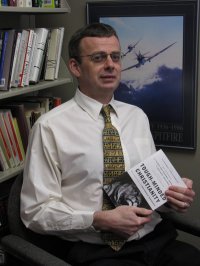
Dr. Angus Menuge
Dr. Angus Menuge

Here’s some information about Dr. Menuge:

Dr. Angus Menuge joined Concordia University Wisconsin in 1991. He earned his BA from the University of Warwick, England, and his MA and Ph.D. degrees from the University of Wisconsin-Madison, where he studied philosophy, computer science and psychology. Menuge’s dissertation was on the philosophy of action explanation, and his current research interests include philosophy of mind, philosophy of science and Christian apologetics.

In 2003, Menuge earned a Diploma in Christian Apologetics from the International Academy of Apologetics, Evangelism and Human Rights, which meets each July in Strasbourg, France. His thesis, a critique of scientific materialism, went on to become the book Agents Under Fire: Materialism and the Rationality of Science (Lanham, MD: Rowman and Littlefield, 2004).

Menuge has also edited volumes on C. S. Lewis, Christ and culture and the vocation of scientist, and has written several Bible studies. He is currently working with Joel Heck (Concordia Texas) on a collection of essays defining Lutheran education for the 21st century, entitled Learning at the Foot of the Cross (Concordia University Press, forthcoming).

A frequent speaker, Menuge has given presentations on Christianity and culture, science and vocation, philosophy of mind, C. S. Lewis, Intelligent Design and the case against scientific materialism. He is a member of the Evangelical Philosophical Society.

Dr. Menuge presented a paper at the real Evangelical Philosophical Society conference for students and professors of philosophy, and you can download the paper here in Word format. (here’s a PDF version I made)

Here is the introduction to the paper that Dr. Menuge read at the EPS conference:

The argument from reason is really a family of arguments to show that reasoning is incompatible with naturalism. Here, naturalism is understood as the idea that foundationally, there are only physical objects, properties and relations, and anything else reduces to, supervenes on, or emerges from that. For our purposes, one of the most important claims of naturalism is that all causation is passive, automatic, event causation (an earthquake automatically causes a tidal wave; the tidal wave responds passively): there are no agent causes, where something does not happen automatically but only because the agent exerts his active power by choosing to do it. The most famous version of the argument from reason is epistemological: if naturalism were true, we could not be justified in believing it. Today, I want to focus on the ontological argument from reason, which asserts that there cannot be reasoning in a naturalistic world, because reasoning requires libertarian free will, and this in turn requires a unified, enduring self with active power.

The two most promising ways out of this argument are: (1) Compatibilism—even in a deterministic, naturalistic world, humans are capable of free acts of reason if their minds are responsive to rational causes; (2) Libertarian Naturalism—a self with libertarian free will emerges from the brain. I argue that neither of these moves works, and so, unless someone has a better idea, the ontological argument from reason stands.

The paper is 11 pages long, and it is awesome for those of you looking for some good discussion of one of the issues in the area of philosophy of mind. The thing you need to know about Dr. Menuge is that he is quite strong and forceful in his writing and presentation, and to me, that is an excellent thing for a scholar to be. He reminds me of Doug Geivett, Paul Copan and William Lane Craig. Very direct, and very confrontational. You can even read an account of his debate with that radical atheist nutcase P.Z. Myers in 2008 here.

By the way, the epistemological argument from reason (P(R) on N & E is low) is the argument made by the famous Christian philosopher Alvin Plantinga. I blogged about that argument before here. You need to know BOTH of these arguments. Plantinga also spoke at the EPS apologetics conference, explaining exactly this argument.

Powerpoint slideshow

But there is more than just the paper! At the EPS apologetics conference, which is meant for lay people as well as scholars, he presented this Powerpoint slideshow, (here’s a PDF version I made) . The slides are easier to understand than the paper, but the paper is not too bad.

And here is another article by Dr. Menuge on intelligent design.