Tag Archives: Person

What is the Christian doctrine of the Trinity?

The Christian doctrine of the Trinity

I have a friend who is considering Christianity and he is stuck on the doctrine of the Trinity. Tom, this one’s for you.

Excerpt:

So, what exactly do we mean when we talk about the Trinity? Writing in the early third century, in hisAgainst Praxeas, Tertullian is credited with first employing the words “Trinity”, “person” and “substance” to convey the idea of the Father, Son and Spirit being “one in essence — but not one in person”. Indeed, Tertullian writes,

“Thus the connection of the Father in the Son, and of the Son in the Paraclete, produces three coherent Persons, who are yet distinct One from Another. These Three are, one essence, not one Person, as it is said, “I and my Father are One,” in respect of unity of substance not singularity of number.”

This concept was established as church orthodoxy at the famous Council of Nicaea in A.D. 325. The Nicene Creed speaks of Christ as “God of God, Light of Light, very God of very God, begotten not made, being of one substance with the Father.”

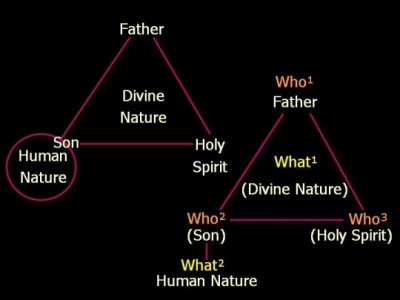
It is this definition that I am going to assume in the discussion that follows. Succinctly, then, the doctrine of the Trinity may be defined thusly: Within the one being or essence that is God, there exists three co-equal and co-divine distinct persons — namely the Father, Son and Holy Spirit — who share that essence fully and completely. This concept is not to be confused with polytheism, which maintains that there are multiple gods. While orthodox Christianity emphatically holds there to be only one God, we nonetheless understand God to be complex in his unity. The concept is also not to be confused with the ancient heresy of modalism, which maintains that God exists in three different modes. The Son has never been the Father and the Holy Spirit has never been the Son or the Father. Modalism is refuted by the picture given to us in all four gospels (Matthew 3:16-17; Mark 1:9-11; Luke 3:21-22; John 1:32-34) in which the Holy Spirit descends on Jesus in the form of a dove and a voice is heard from Heaven “This is my beloved Son. With him I am well pleased.” Similarly, it should be noted that the Father, Son and Spirit do not each make up merely a third of the Godhead. Rather, each of the three persons is God in the full and complete sense of the word.

Having shown that Scripture emphatically rejects the notion that the Father, Son and Spirit are synonymous persons, only five propositions remain to be demonstrated in order to provide Biblical substantiation for the concept of the Trinity. Those propositions are:

  1. There is only one eternal God.
  2. The Father is the eternal God.
  3. The Son is the eternal God.
  4. The Holy Spirit is the eternal God.
  5. Although the Father, Son and Holy Spirit are non-synonymous persons, the concept of the Trinity does not violate the law of non-contradiction.

Let’s take a look at each of these in turn.

He then takes a close look at what the Bible says about God with respect to those assertions. There can be no doubt that the Bible teaches that God is one divine substance, and three persons.

Unborn babies adapt their development based on cues from mom

Unborn baby scheming about the progress of science

From CNN:

When does learning begin? As I explain in the talk I gave at TED, learning starts much earlier than many of us would have imagined: in the womb.

I was surprised as anyone when I first encountered this notion. I’m a science writer, and my job is to trawl the murky depths of the academic journals, looking for something shiny and new — a sparkling idea that catches my eye in the gloom.

[…]What it all adds up to is this: much of what a pregnant woman encounters in her daily life — the air she breathes, the food and drink she consumes, the chemicals she’s exposed to, even the emotions she feels — are shared in some fashion with her fetus. They make up a mix of influences as individual and idiosyncratic as the woman herself. The fetus treats these maternal contributions as information, as what I like to call biological postcards from the world outside.

By attending to such messages, the fetus learns the answers to questions critical to its survival: Will it be born into a world of abundance, or scarcity? Will it be safe and protected, or will it face constant dangers and threats? Will it live a long, fruitful life, or a short, harried one?

The pregnant woman’s diet and stress level, in particular, provide important clues to prevailing conditions, a finger lifted to the wind. The resulting tuning and tweaking of the fetus’s brain and other organs are part of what give humans their enormous flexibility, their ability to thrive in environments as varied as the snow-swept tundra in Siberia and the golden-grassed savanna in Africa.

The recognition that learning actually begins before birth leads us to a striking new conception of the fetus, the pregnant woman and the relationship between them.

The fetus, we now know, is not an inert blob, but an active and dynamic creature, responding and adapting as it readies itself for life in the particular world it will soon enter. The pregnant woman is neither a passive incubator nor a source of always-imminent harm to her fetus, but a powerful and often positive influence on her child even before it’s born. And pregnancy is not a nine-month wait for the big event of birth, but a crucial period unto itself — “a staging period for well-being and disease in later life,” as one scientist puts it.

This crucial period has become a promising new target for prevention, raising hopes of conquering public health scourges like obesity and heart disease by intervening before birth. By “teaching” fetuses the appropriate lessons while they’re still in utero, we could potentially end vicious cycles of poverty, infirmity and illness and initiate virtuous cycles of health, strength and stability.

For those who would like to hear an excellent, formal academic debate on abortion, I will steer you towards this debate between the ACLU’s Nadine Strossen and Life Training Institute’s Scott Klusendorf. You’ve probably never heard anything like this debate – it features real arguments on both sides that will help you to decide whether abortion is moral or not. Over 50 million unborn children have been aborted in the United States since abortion was legalized. Is it time for us to be more careful about with sex? Maybe it’s not just another form of recreation.

For those of you who would like something to read, I recommend “The Case for Life” by Scott Klusendorf for beginners. Advanced students will benefit more from”Defending Life” by Francis J. Beckwith, published by Cambridge University Press.

What is the unborn?

This video may help you to see what is really going on in there.

Chris S. sent me the video.