
Tag Archives: Origin

Audio and video from the debate between William Lane Craig and Lawrence Krauss

Audio of the William Lane Craig vs. Lawrence Krauss debate at North Carolina State University has now been posted at Apologetics 315.

And I also posted some background information on Craig’s arguments.

William Lane Craig’s case

William Lane Craig made 5 arguments for the existence of God:

  • the contingency argument
  • theargument from the origin of the universe (kalam)
  • the argument from cosmic fine-tuning
  • the moral argument
  • the argument from the miracle of the resurrection

These arguments went unrefuted during the debate.

Lawrence Krauss’s case

Lawrence Krauss made the following arguments in his first speech

  • Dr. Craig is a professional debater
  • Dr. Craig is not a scientist
  • Dr. Craig is a philosopher
  • Disproving God’s is a waste of my valuable time
  • Dr. Craig has the burden of proof to show evidence
  • My job is not to present any evidence
  • I think that “extraordinary claims require extraordinary evidence” is a nice slogan, but I have no evidence for it
  • I don’t like that God doesn’t appear on Youtube, therefore he doesn’t exist
  • I don’t like that God didn’t appear to humans until recently, therefore he doesn’t exist
  • I don’t like that the stars didn’t come together to spell “I am here”, therefore God doesn’t exist
  • Dr. Craig has to supply extraordinary evidence, because my favorite slogan says he has to
  • Dr. Craig talks about logic, but the universe is not logical
  • Dr. Craig doesn’t have any arguments, just things he doesn’t like
  • Dr. Craig doesn’t like infinity, and that’s why he believes in the Big Bang cosmology
  • Dr. Craig doesn’t like chance, and that’s why he believes in cosmic fine-tuning
  • Dr. Craig doesn’t like rape, and that’s why he believes in the ontological foundations of morality
  • If people believe in logic, then they can’t do science
  • The things that science discovers contradict the laws of logic
  • For example, Dr. Craig doesn’t like infinity, so he believes in the experimental measurements of the cosmic microwave background radiation
  • For example, Dr. Craig doesn’t like chance, so he believes in the fine-tuning of the gravitational constant for the formation of stable stars
  • Quantum mechanics shows that the universe is stranger than you think, therefore all of Craig’s arguments are false
  • My t-shirt says 2 + 2 = 5, therefore all of Craig’s arguments are false
  • Atheism may look ridiculous, but it’s true, and if you don’t like it, too bad – because the universe is very strange
  • Accidents happen all the time, so that explains the cosmic fine-tuning
  • We all have to convince ourselves of 10 impossible things before breakfast, and atheism is impossible, so you need to convince yourself of it
  • I don’t know about the Big Bang, so Dr. Craig cannot use the Big Bang to to prove the universe began to exist
  • I don’t know about the cosmic fine-tuning, so Dr. Craig cannot use the fine-tuning of cosmological constants to prove the fine-tuning
  • I don’t know anything about science, so Dr. Craig cannot use science in his arguments
  • Dr. Craig says that the universe is contingent because it began to exist 13.7 billion years ago based on the state-of-the-art scientific evidence for the Big Bang creation out of nothing from 1) red-shift of light from distant galaxies, 2) cosmic microwave background radiation, 3) helium-hydrogen abundances, 4) experimental confirmation of general relativity, 5) the second law of thermodynamics, 6) radioactive element abundances, etc., but how does he know that? I don’t know that
  • It’s fine not to know the answer to scientific questions like whether the universe began to exist, it’s more exciting
  • Thinking that the universe began to exist based on 6 pieces of scientific evidence is the “God-of-the-Gaps” fallacy, it’s intellectual laziness
  • But all kidding aside, the universe actually did begin to exist 13.72 billion years ago, exactly like Craig says in his argument
  • I could argue that God created the universe 4.5 seconds ago with all of us sitting believing that we heard Dr. Craig, and how could you prove me wrong? It’s not falsifiable
  • Universes can spontaneously appear out of nothing, and in fact they have to appear out of nothing
  • Nothing is unstable, and space and time can come into existence out of nothing, so that’s not a problem
  • Our universe could have appeared out of a multiverse, an unobservable, untestable multiverse that I have no way of observing or testing, but which was in fact created by none other than the Flying Spaghetti Monster!
  • The universe is not fine-tuned for life, and no scientist says so, especially Martin Rees, the atheist Astronomer Royal, and every other scientist
  • What if God decided that rape was OK, would it be OK? God can change his moral nature arbitrarily, can’t he?
  • Would you have any preference as to whether I was born an atheist baby or a Muslim baby?

Here are the arguments in Krauss’ second speech:

  • We don’t understand the beginning of the universe
  • We don’t understand whether the universe had a cause
  • Steven Weinberg says that science makes it possible to be an atheist, so therefore the universe didn’t begin and didn’t have a cause
  • It’s just intellectual laziness to say that the universe came into being 13.7 billion years ago, and that things that come into being of nothing have a cause
  • Dr. Craig is an expert on nothing, ha ha ha!
  • There are multiple versions of nothing, there’s nothing, and then there is something, which is also nothing if I want it to be
  • There was no space, there was no time, and then the space create the empty space
  • I’m going to give Dr. Craig a break
  • At least in the nothing there were laws like F=ma, and those laws created the empty space, because descriptions of matter that does not even exist yet can create space out of nothing
  • Alan Guth and Alexander Vilenkin are good friends of mine and I talk to them all the time, unlike Dr. Craig
  • Alan Guth and Alexander Vilenkin don’t mention God in their scientific papers, therefore the universe didn’t begin and didn’t have a cause
  • Maybe there is a multiverse that cannot be observed or tested? And my unscientific speculations are a refutation of Craig’s scientific evidence for the fine-tuning
  • Dr. Craig just doesn’t like my speculations about the unobservable, untestable multiverse, and that’s why he believes in the Big Bang cosmology
  • And if you let me speculate about an unobservable, untestable multiverse, then maybe the inanimate invisible universes reproduce and compete for food and mutate like animals and then there is natural selection so that the finely-tuned universes survive and now we’re in one!
  • My cool animation of blue goo mutating proves that the multiverse is real! Empty space is not empty!
  • Darwinism, which is a theory about the origin of species, explains the cosmic fine-tuning that occurred at the moment of creation
  • The unobservable, untestable multiverse universes all have different laws, I believe
  • We don’t know what the right answer is, but we are willing to look at any possibility, as long as the possibilities we look at are not supernatural possibilities, because I am not giving up my right to recreational sex outside of marriage!
  • The discovery of the origin of the universe could be an accident, I don’t know if the universe began to exist or not, maybe all the six scientific evidences are wrong because if I don’t like the evidence we have, so I’ll just wait for new evidence to overturn the evidence we have which I don’t like
  • Maybe there are other forms of life that are unobservable and untestable that are compatible with a universe that has no stable stars, no planets, no elements heavier than hydrogen, no hydrogen, no carbon, etc.

Here are the arguments in Krauss’ third speech:

  • Dr. Craig is stupid
  • Why should we even care about Dr. Craig’s arguments and evidence, we can just count the number of scientists who are atheists and decide whether God exists that way – I decided everything based on what my teachers told me to believe – I needed good grades to make money so I could move out of my bossy parents’ house and have fun!
  • I actually know general relativity, not like Dr. Craig who co-wrote a book on general relativity published by Oxford University Press
  • What quantum mechanics shows is that virtual particles come into being in a quantum vacuum, and then go out of existence almost immediately – and that is exactly like how a 13.7 billion year old universe came into being in a quantum vacuum, and we’re going to disappear very soon
  • Space and the laws of physics can be created, possibly, if you accept my speculations about an unobservable, untestable multiverse
  • I don’t like the God of the Old Testament, especially his prohibition on drunkenness and fornication, therefore he doesn’t exist
  • Groups of people can decide what they think is good and evil, like the Nazis and slave-owners did, and then that becomes good for them in that time and place, and that’s what I mean by morality
  • Here’s something I studied that wasn’t fine-tuned, therefore there is no fine-tuning of the universe
  • Not knowing things is really exciting! Dr. Craig is not really exciting because he knows things – phooey!

Here are the arguments in Krauss’ fourth speech:

  • If you will just grant me an observable, untestable multiverse, then there must be some universe where intelligent life exists
  • Infinite numbers of things exist everywhere in nature, you can see lots of infinite collections of things, like jelly beans and bumblebees and invisible pink unicorns
  • I don’t like the fine-tuning, but if my speculations about the multiverse are proven true, then I won’t have to learn to live with the fine-tuning
  • Inflation, the rapid expansion of the universe which occurs at some time after the the origin of the universe (t = 0), explains the absolute origin of time, space, matter and energy out of nothing that occurred at t = 0
  • Physical processes that develop subsequent to the creation of the universe at t > 0 can explain the fine-tuning of quantities that are set at t = 0
  • Morality is just a bunch of arbitrary conventions decided by groups of people in different times and places by an accidental process of biological and social evolution, but that practice over there by those people is objectively wrong!
  • 1 Cor 15:3-7, which most scholars, even atheists like James Crossley, admit is dated to within 3 years of the death of Jesus, is actually dated to 50 years after the death of Jesus
  • The historical case for the resurrection made by people like N.T. Wright in their multi-volume academic works is on par with the story of Mohammed ascending to Heaven on a horse

If you liked this, please check out my snarky summary of Christopher Hitchens’ speeches in the Craig-Hitchens debate.
The Cambrian explosion: biology’s Big Bang

Consider this article by Jonathan Wells.

First, let’s re-cap the challenge to evolution from the phenomenon of the Cambrian explosion.

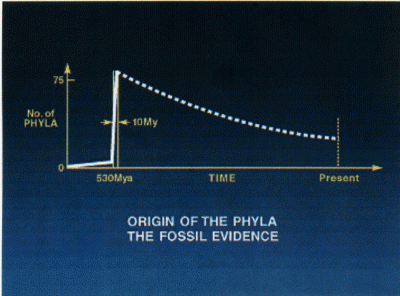
The newly released film “Darwin’s Dilemma” argues that the geologically abrupt appearance of the major groups of animals (the “phyla”) in the Cambrian Explosion posed a serious problem for Charles Darwin’s theory of evolution (as he himself knew), and that subsequent fossil discoveries—far from solving the problem—have made it worse.

Basically, all the major body plans we have today appear in the fossil record in a 2-3 million period about 543 million years ago. There are no precursors in the fossil record showing the gradual evolution of these major body plans.

The Cambrian Explosion: 0 to 60 in a few million years

Darwin expected to discover lots and lots of fossils leading up to the Cambrian explosion period that would show how all these phyla came into existence slowly over time. Unfortunately for the naturalistic evolutionists, the discoveries we’ve been making haven’t shown any hint of precursor fossils leading up the Cambrian explosion.

Since 1859, however, many Precambrian fossils have been found, including microfossils of single-celled bacteria in rocks more than three billion years old. In addition, multicellular Precambrian fossils have been found in the Ediacara Hills of Australia, though there is continuing debate over whether any—or how many—of the Ediacaran fossils were animals, or what relationship—if any—they had to the Cambrian phyla. In 1998, Cambridge University paleobiologist Simon Conway Morris (who is featured in the film “Darwin’s Dilemma”) wrote, “Apart from the few Ediacaran survivors… there seems to be a sharp demarcation between the strange world of Ediacaran life and the relatively familiar Cambrian fossils” (Crucible of Creation, 30).

But wait! Maybe we can’t find the precusor fossils required by Darwinism because they are too small or too soft to have survived for so long?

Since 1859, however, many Precambrian fossils have been found, including microfossils of single-celled bacteria in rocks more than three billion years old. In addition, multicellular Precambrian fossils have been found in the Ediacara Hills of Australia… In 1998, Cambridge University paleobiologist Simon Conway Morris… wrote, “Apart from the few Ediacaran survivors… there seems to be a sharp demarcation between the strange world of Ediacaran life and the relatively familiar Cambrian fossils” (Crucible of Creation, 30).

So there is now no shortage of Precambrian fossils. Not only do we have fossils of bacteria, but we also have many fossils of soft-bodied Multicellular organisms. “In the Ediacaran organisms there is no evidence for any skeletal hard parts,” wrote Conway Morris in 1998. “Ediacaran fossils look as if they were effectively soft-bodied” (Crucible of Creation, 28). The same is true of many of the organisms fossilized in the Cambrian explosion.

But wait! Scientists have discovered lots of exceptionally preserved microbes just before the Cambrian explosion. Don’t microbes count as precursors to the Cambrian explosion phyla?

Richard Callow and Martin Brasier reported in the January 2009 issue of the Journal of the Geological Society, London “a variety of exceptionally preserved microbes” from late Precambrian rocks in England that address “the paradox known as ‘“Darwin’s dilemma’.”

[…]Callow and Brasier didn’t solve Darwin’s dilemma. Instead, they put one more nail in the coffin of Darwin’s attempt to salvage his theory from it. The truth is that “exceptionally preserved microbes” from the late Precambrian actually deepen Darwin’s dilemma, because they suggest that if there had been ancestors to the Cambrian phyla they would have been preserved.

I am willing to believe in evolution. But in order to get me to believe it, I insist on seeing a fossil record that shows the gradual emergence of phyla, one or two at a time, over hundreds of millions of years. That is what Darwinism predicts. We now have a solid record of what came before the Cambrian explosion. So where are the precursors? Where is the record of gradual emergence? Where is my evidence?

What does the peer-reviewed research say?

Story from the Discovery Institute.

A new peer-reviewed paper has been published that concludes that there is no material explanation for the massive amounts of information introduced during the Cambrian explosion, when all of the phyla came into being in the blink of an eye, geologically speaking, with no fossilized precursors.

Excerpt:

Thus, elucidating the materialistic basis of the Cambrian explosion has become more elusive, not less, the more we know about the event itself, and cannot be explained away by coupling extinction of intermediates with long stretches of geologic time, despite the contrary claims of some modern neo-Darwinists.

Once again, the progress of science brings light.

The DI post goes on to cite another passage from the paper:

Beginning some 555 million years ago the Earth’s biota changed in profound and fundamental ways, going from an essentially static system billions of years in existence to the one we find today, a dynamic and awesomely complex system whose origin seems to defy explanation. Part of the intrigue with the Cambrian explosion is that numerous animal phyla with very distinct body plans arrive on the scene in a geological blink of the eye, with little or no warning of what is to come in rocks that predate this interval of time. The abruptness of the transition between the ‘‘Precambrian’’ and the Cambrian was apparent right at the outset of our science with the publication of Murchison’s The Silurian System, a treatise that paradoxically set forth the research agenda for numerous paleontologists — in addition to serving as perennial fodder for creationists. The reasoning is simple — as explained on an intelligent-design t-shirt.

Fact: Forty phyla of complex animals suddenly appear in the fossil record, no forerunners, no transitional forms leading to them; ‘‘a major mystery,’’ a ‘‘challenge.’’ The Theory of Evolution – exploded again (idofcourse.com).

Although we would dispute the numbers, and aside from the last line, there is not much here that we would disagree with. Indeed, many of Darwin’s contemporaries shared these sentiments, and we assume — if Victorian fashion dictated — that they would have worn this same t-shirt with pride.

Here is the reference for the paper:

(Kevin J. Peterson, Michael R. Dietrich and Mark A. McPeek, “MicroRNAs and metazoan macroevolution: insights into canalization, complexity, and the Cambrian explosion,” BioEssays, Vol. 31 (7):736 – 747 (2009).)

I linked before to a bunch of easy-to-understand videos that explain the Cambrian explosion. Here’s another peer-reviewed research paper on the Cambrian explosion written by Stephen C. Meyer, on the Cambrian explosion. This is the paper that got evolutionary biologist Richard Sternberg fired by secular leftists. He has two earned Ph.Ds in biology. I would expect that the people who fired him had never seen the inside of a biology lab. That’s the way it goes – science (intelligent design) vs. religion (materialism).

Videos on intelligent design

The origin of life, part 2 of 2: biological information

Last time we saw how the progress of science in the last 30 years has proved that the environment of the early Earth would not have allowed the emergence of the basic building blocks of life. This time, let’s allow the atheist to assume the building blocks were created by the noodly appendage of the Flying Spaghetti Monster, (peas be upon him), and see whether it’s possible for the blocks to chain themselves together to make a living cell withinin a reasonable amount of time (400 million years, say).

For this post, I will be referencing an article by Stephen C. Meyer, which he published in the Catholic journal “First Things”. I chose this article deliberately because it was written at the level of an ordinary layman, so we could all understand everything well enough to feel confident explaining it to our neighbors. All unattributed quotes are from this article.

The combatants

The contest over origins features two opposing points of view:

  • A Creator and Designer is responsible for the origin of life
  • Matter, chance and long periods of time are sufficient to explain the origin of life

What’s at stake?

Atheistic Cornell University professor Will Provine explains what logically follows from naturalistic evolution:

There are no gods, no purposes, and no goal-directed forces of any kind. There is no life after death. When I die, I am absolutely certain that I am going to be dead. That’s the end of me. There is no ultimate foundation for ethics, no ultimate meaning in life, and no free will for humans, either. What an unintelligible idea.

So, the stakes are high.

Why doubt the apparent design in nature?

There are two main reasons why atheists doubt the appearance of design in nature:

Minimal life functionality requires information

In order for a living organism to support life, it must be able to perform minimal functions:

  • store information
  • transmit information
  • edit information
  • use that information to regulate metabolic processes

There must be sufficient information inside the cells of that organism to support those functions. How does this information exist in the cell, and where did it come from?

Atheism is a pre-scientific worldview

Meyer describes the primitive superstitions of tribes of atheists living in primitive, pre-scientific cultures:

…in the 1870s and 1880s scientists assumed that devising an explanation for the origin of life would be fairly easy….they assumed that life was essentially a rather simple substance called protoplasm that could be easily constructed by combining and recombining simple chemicals such as carbon dioxide, oxygen, and nitrogen. …just as salt could be produced spontaneously by adding sodium to chloride, so… could a living cell be produced by adding together several chemical constituents and then allowing spontaneous chemical reactions to produce the simple protoplasmic substance that they assumed to be the essence of life.

Atheists believe in all kinds of primitive pre-scientific myths, like the eternal universe, etc., which the progress of science has falsified. Can the progress of science falsify the atheistic superstitions about the origin of life?

The Oparin-Haldane hypothesis

Atheists began to panic in the early 20th century as discoveries began to pile up confirming the that the entire physical universe, and time itself, was created by a supernatural force that existed transcendentally, independent of matter, energy, space and time. (See here for a listing of 6 of these discoveries from the progress of science). Atheists decided that they’d better get involved in this “science” thing that the Christians had started.

Meyer reports on one of their first groundless speculations:

During the 1920s and 1930s a more sophisticated version of this so–called “chemical evolutionary theory” was proposed by a Russian biochemist named Alexander I. Oparin…. Oparin, like his nineteenth–century predecessors, suggested that life could have first evolved as the result of a series of chemical reactions.

It was hoped that that the Flying Spaghetti Monster would appear to his true believers and ground this blind speculation, allowing atheists to continue in their flight from rationality and moral obligations.

The Miller-Urey experiment

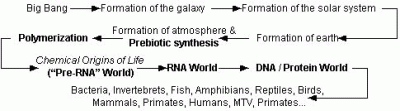
Pre-biotic synthesis (see below) produces amino acids, which are the first step in explaining the origin of the simplest life, on atheism:

How did life begin?
How did life begin?

As we saw last time, the Miller-Urey experiments that were designed to produce the building blocks of life (amino acids) were horribly flawed and did not reflect the conditions that would have existed on the early Earth.

I’ll summarize the problems with the experiment:

  • the gasses were used in the experiment were not those present on the early Earth
  • molecular oxygen was excluded from the experiment
  • Harmful UV radiation was filtered out by the experimenter intervention
  • interfering cross-reactions were prevented by experimenter intervention

Other problems:

  • extinction events, such as meteorite impacts, were excluded not considered
  • the chirality problem (left-handed amino acids, right-handed sugars) was not considered
  • the problem of getting all peptide bonds was not considered

This experiment, though flawed, still exists in biology textbooks today, along side faked photographs of peppered moths and doctored drawings of embryos. All must praise the Flying Spaghetti Monster, and at taxpayer expense!

The problem of biological information

To create life, you need to sequence amino acids into proteins, and sequence the nucleotides on DNA strands.

Meyer explains:

To form a protein, amino acids must link together to form a chain. Yet amino acids form functioning proteins only when they adopt very specific sequential arrangements, rather like properly sequenced letters in an English sentence. Thus, amino acids alone do not make proteins, any more than letters alone make words, sentences, or poetry. In both cases, the sequencing of the constituent parts determines the function (or lack of function) of the whole.

…As it turns out, specific regions of the DNA molecule called coding regions have the same property of “sequence specificity” or “specified complexity” that characterizes written codes, linguistic texts, and protein molecules. Just as the letters in the alphabet of a written language may convey a particular message depending on their arrangement, so too do the sequences of nucleotide bases (the A’s, T’s, G’s, and C’s) inscribed along the spine of a DNA molecule convey a precise set of instructions for building proteins within the cell. The nucleotide bases in DNA function in precisely the same way as symbols in a machine code. In each case, the arrangement of the characters determines the function of the sequence as a whole…. In the case of DNA, the complex but precise sequencing of the four nucleotide bases (A, T, G, and C) stores and transmits the information necessary to build proteins.

…As Bernd–Olaf Kuppers recently stated, “The problem of the origin of life is clearly basically equivalent to the problem of the origin of biological information.”

How do atheists account for this biological information?

Atheistic superstitions about the biological information

Le’s take a look at the atheist’s faith-based explanations of the origin of life: chance, law and self-organization.

For the first one, let’s calculate the odds of building a protein composed of a functional chain of 100 amino acids, by chance. (Think of a meaningful English sentence built with 100 scrabble letters, held together with glue)

1. Chance:

  • BONDING: You need 99 peptide bonds between the 100 amino acids. The odds of getting a peptide bond is 50%. The probability of building a chain of one hundred amino acids in which all linkages involve peptide bonds is roughly (1/2)^99 or 1 chance in 10^30.
  • CHIRALITY: You need 100 left-handed amino acids. The odds of getting a left-handed amino acid is 50%. The probability of attaining at random only L–amino acids in a hypothetical peptide chain one hundred amino acids long is (1/2)^100or again roughly 1 chance in 10^30.
  • SEQUENCE: You need to choose the correct amino acid for each of the 100 links. The odds of getting the right one are 1 in 20. Even if you allow for some variation, the odds of getting a functional sequence is (1/20)^100 or 1 in 10^65.

The final probability of getting a functional protein composed of 100 amino acids is 1 in 10^125. Even if you fill the universe with pre-biotic soup, and react amino acids at Planck time (very fast!) for 14 billion years, you are probably not going to get even 1 such protein. And you need at least 100 of them for minimal life functions, plus DNA and RNA.

Research performed by Doug Axe at Cambridge University, and published in the peer-reviewed Journal of Molecular Biology, has shown that the number of functional amino acid sequences is tiny:

Doug Axe’s research likewise studies genes that it turns out show great evidence of design. Axe studied the sensitivities of protein function to mutations. In these “mutational sensitivity” tests, Dr. Axe mutated certain amino acids in various proteins, or studied the differences between similar proteins, to see how mutations or changes affected their ability to function properly. He found that protein function was highly sensitive to mutation, and that proteins are not very tolerant to changes in their amino acid sequences. In other words, when you mutate, tweak, or change these proteins slightly, they stopped working. In one of his papers, he thus concludes that “functional folds require highly extraordinary sequences,” and that functional protein folds “may be as low as 1 in 10^77.”

The problem of forming DNA by sequencing nucleotides faces similar difficulties. And remember, mutation and selection cannot explain the origin of the first sequence, because mutation and selection require replication, which does not exist until that first living cell is already in place.

2. Law:

The idea here is that components, such as nucleotides, might have special bonding affinities that might cause them to bond together spontaneously into functional sequences. Like if certain SCRABBLE tiles had an affinity for certain other tiles that caused them to bond together whenever they met.

Meyer writes:

Consider what would happen if the individual nucleotide “letters” in a DNA molecule did interact by chemical necessity with each other. Every time adenine (A) occurred in a growing genetic sequence, it would likely drag thymine (T) along with it. Every time cytosine (C) appeared, guanine (G) would follow. As a result, the DNA message text would be peppered with repeating sequences of A’s followed by T’s and C’s followed by G’s.

3. Self-organization:

The idea here is that some spontaneous order might arise due to some physical force, just like rocks sort themselves by size in a rock agitator because of gravity.

Meyer writes:

…just as magnetic letters can be combined and recombined in any way to form various sequences on a metal surface, so too can each of the four bases A, T, G, and C attach to any site on the DNA backbone with equal facility, making all sequences equally probable (or improbable). The same type of chemical bond occurs between the bases and the backbone regardless of which base attaches. All four bases are acceptable; none is preferred. In other words, differential bonding affinities do not account for the sequencing of the bases. Because these same facts hold for RNA molecules, researchers who speculate that life began in an “RNA world” have also failed to solve the sequencing problem…

Understanding what creates information

The bottom line is that in order for software code, or even English letters, to be functional, it needs to defy ordering mechanisms. Biological sequences are functional for the same reason that software code or English text is functional – because some intelligent agent chose an irregular sequence of characters in order to achieve a specific purpose. Look at the letters in this post – they are not ORDERED by physical laws. They are SELECTED by an intelligent agent.

Meyer writes:

To see the distinction between order and information, compare the sequence “ABABABABAB ABAB” to the sequence “Time and tide wait for no man.” The first sequence is repetitive and ordered, but not complex or informative.

What causes specified, complex sequences?

…the information contained in an English sentence or computer software does not derive from the chemistry of the ink or the physics of magnetism, but from a source extrinsic to physics and chemistry altogether. Indeed, in both cases, the message transcends the properties of the medium… Our experience with information–intensive systems (especially codes and languages) indicates that such systems always come from an intelligent source…

And this is what everybody means by “intelligent design”. This design inference came from the progress of science. The more we discovered about the cell, the more nature pointed towards a creative, designing intelligence. The only option left to atheists now is blind faith that the Flying Spaghetti Monster will swoop in and undo the progress of science over the last 100 years. Good luck with that, atheists!

Further study

One of my favorite resources on the origin of life is this interview from the University of California with former atheist and origin of life researcher Dean Kenyon. Kenyon, a professor of Biology at San Francisco State University, wrote the textbook on “chemical evolution”, which is the view that chemicals can arrange themselves in order to create the first living cell, without intervention.

This interview from the University of California with another origin of life researcher, Charles Thaxton, is also one of my favorites.

You’ll need Quicktime to see the videos, or buy the videos from ARN. (Kenyon, Thaxton) I have both of them – they rock!