Tag Archives: Naturalism

Ten scientific problems with global warming alarmism

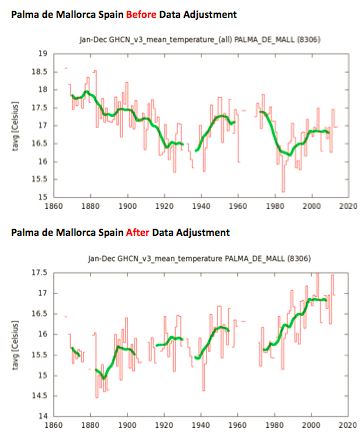
How climate scientists adjust the data to prove they need more grant money
How climate scientists adjust the data to prove they need more grant money (see #10 in the list below)

My friend Bruce posted this article from the the Daily Wire, and I think it’s a good summary of the scientific evidence against global warming alarmism. After we go over this, I’ll take a stab at explaining why so many non-scientists desperately want to believe that global warming is true, and why they try to push everyone else to believe it, too.

First, the list:

  1. Temperature records from around the world do not support the assumption that today’s temperatures are unusual.
  2. Satellite temperature data does not support the assumption that temperatures are rising rapidly
  3. Current temperatures are always compared to the temperatures of the 1980’s, but for many parts of the world the 1980’s was the coldest decade of the last 100+ years
  4. The world experienced a significant cooling trend between 1940 and 1980
  5. Urban heat island effect skews the temperature data of a significant number of weather stations
  6. There is a natural inverse relationship between global temperatures and atmospheric CO2 levels
  7. The CO2 cannot, from a scientific perspective, be the cause of significant global temperature changes
  8. There have been many periods during our recent history that a warmer climate was prevalent long before the industrial revolution
  9. Glaciers have been melting for more than 150 years
  10. “Data adjustment” is used to continue the perception of global warming

So, we can’t look at all of these in one post. Obviously, the satellite measurements are the best thing to look at, since they cannot be tampered with as easily as the ground measurements, and they show no warming for 18 years.

But let’s look at number 8 instead:

Even in the 1990 IPCC report a chart appeared that showed the medieval warm period as having had warmer temperatures than those currently being experienced.  But it is hard to convince people about global warming with that information, so five years later a new graph was presented, now known as the famous hockey stick graph, which did away with the medieval warm period.  Yet the evidence is overwhelming at so many levels that warmer periods existed on Earth during the medieval warm period as well as during Roman Times and other time periods during the last 10,000 years.  There is plenty of evidence found in the Dutch archives that shows that over the centuries, parts of the Netherlands disappeared beneath the water during these warm periods, only to appear again when the climate turned colder.  The famous Belgian city of Brugge, once known as “Venice of the North,” was a sea port during the warm period that set Europe free from the dark ages (when temperatures were much colder), but when temperatures began to drop with the onset of the little ice age, the ocean receded and now Brugge is ten miles away from the coastline.  Consequently, during the medieval warm period the Vikings settled in Iceland and Greenland and even along the coast of Canada, where they enjoyed the warmer temperatures, until the climate turned cold again, after which they perished from Greenland and Iceland became ice-locked again during the bitter cold winters.  The camps promoting global warming have been systematically erasing mention of these events in order to bolster the notion that today’s climate is unusual compared to our recent history.

That’s right, the world was much warmer than it is now during the Medieval Warming Period… so warm that you could actually farm on Greenland. But now it’s all frozen over.

Bruce also posted this article from Forbes magazine about the so-called consensus about global warming among scientists.

It says:

It is becoming clear that not only do many scientists dispute the asserted global warming crisis, but these skeptical scientists may indeed form a scientific consensus.

[…]Only 36 percent of geoscientists and engineers believe that humans are creating a global warming crisis, according to a survey reported in the peer-reviewed Organization Studies. By contrast, a strong majority of the 1,077 respondents believe that nature is the primary cause of recent global warming and/or that future global warming will not be a very serious problem.

The survey results show geoscientists (also known as earth scientists) and engineers hold similar views as meteorologists. Two recent surveys of meteorologists (summarized here and here) revealed similar skepticism of alarmist global warming claims.

According to the newly published survey of geoscientists and engineers, merely 36 percent of respondents fit the “Comply with Kyoto” model. The scientists in this group “express the strong belief that climate change is happening, that it is not a normal cycle of nature, and humans are the main or central cause.”

The authors of the survey report, however, note that the overwhelming majority of scientists fall within four other models, each of which is skeptical of alarmist global warming claims.

[…]Taken together, these four skeptical groups numerically blow away the 36 percent of scientists who believe global warming is human caused and a serious concern.

Many people listen to Obama, who never passed a science class in his life, talk about how most scientists support the idea of man-made global warming. But the truth is that his statements are just more “you can keep your health plan” and “you can keep your doctor”. He says what he wants people to believe so they will like him and rely on him to save them. But he has no knowledge of climate science any more than he has knowledge of health care policy.

Why do people believe weird things?

So why do people believe these things? People believe these things for the same reason that primitive people would sacrifice animals in order to get a bountiful harvest or be spared being struck by lightning. They fear the future, and they want to believe that they are doing something in order to save themselves from doom. There is something credulous in us that seeks to know and control the future. When we are told a noble lie by grant-seeking, attention-craving academics, we believe it because we want to believe it. We want to believe that the future is going to be OK, especially when all we have to do to make it OK is recycle cans and turn off our lights when we are not using them.

This is the real psychological motivation behind the desperate desire to believe in the global warming myth. We are scared, and we want someone to save us from the future. And we jump at the chance of controlling the future, especially when it means recycling cans, rather than having to deal with our own sinfulness. We invent a new morality that justifies us rather than having to comply with the old morality. Freedom to commit adultery, as long as we recycle cans to save the planet. Sanctification through purchasing carbon credits, instead of  sanctification through chastity, sobriety and self-control.

Self-refuting statements defined and some common examples

A conflict of worldviews

A fine article by Aaron, who writes at Apologetics Junkie.

Excerpt:

A self-defeating (or self-refuting) statement is one that fails to meet its own standard. In other words, it is a statement that cannot live up to its own criteria. Imagine if I were to say,

I cannot speak a word in English.

You intuitively see a problem here. I told you in English that I cannot speak a word in English. This statement is self-refuting. It does not meet its own standard or criteria. It self-destructs.

The important thing to remember with self-defeating statements is that they are necessarily false. In other words, there is no possible way for them to be true. This is because they violate a very fundamental law of logic, the law of non-contradiction. This law states that A and non-A cannot both be true at the same time and in the same sense. For example, it is not possible for God to exist and not exist at the same time and in the same sense. This would violate the law of non-contradiction. So if I were to say, “God told me He doesn’t exist” you would see intuitively the obvious self-refuting nature of this statement.

Aaron goes on to explain how to deal with self-refuting statements in the article.

Here are 20 examples of self-refutation, just to encourage you to click through and read it:

1. There is no truth.

2. You can’t know truth.

3. No one has the truth.

4. All truth is relative.

5. It’s true for you but not for me.

6. There are no absolutes.

7. No one can know any truth about religion.

8. You can’t know anything for sure.

9. You should doubt everything.

10. Only science can give us truth.

11. You can only know truth through experience.

12. All truth depends on your perspective.

13. You shouldn’t judge.

14. You shouldn’t force your morality on people.

15. You should live and let live.

16. God doesn’t take sides.

17. You shouldn’t try to convert people.

18. That’s just your view.

19. You should be tolerant of all views.

20. It is arrogant to claim to have the truth.

Aaron explains how to respond to each of those! Read them all – it’s important to know, because you hear these all the time.

Add yours in the comments!

Lawrence Krauss debates “A Universe From Nothing” with an astrophysicist

Two horses fight it out, may the best horse win!

Dina sent me news of a cracking good episode of Unbelievable, which features Lawrence Krauss, who debated William Lane Craig. Krauss’ book was also reviewed in the New York Times.

The MP3 file is here.

Details:

Lawrence Krauss is a Cosmologist at Arizona State University who describes himself as an “anti-theist”. His latest book “A Universe From Nothing” has received both acclaim and criticism for its attempt to answer the question “Why is there something rather than nothing?” Debating the issue with Krauss is Rodney Holder, Course director at the Faraday Institute, Cambridge. An astrophysicist and priest by background. In a lively exchange they debate whether Krauss’ “nothing” is “nothing”, fine tuning and multiverses, scientific knowledge, miracles and the usefulness of theology and philosophy.

This debate is quite entertaining, and do not be intimidated if your don’t understand science. You can understand pretty easily who is arguing based on facts and who is speculating about unobservable, untestable entities. At one point, Krauss actually denies that there is any fine-tuning in the universe, so please see this link to refute that claim as well as this podcast which explains some examples of fine-tuning. Krauss gets a bit angry at the beginning, but calms down.

Quotation marks are for direct quotes, italics is for made-up snark. See below the summary for more posts that are related to this one.

Summary of the discussion: (picked up at 9:30 when they start talking about the book)

Brierley:

  • explain your theory of how the universe can come into being from nothing

Krauss:

  • the nothing that preceded the universe is “no space, no time, no universe”
  • theists say that God is responsible for creating the universe out of this nothing
  • but the laws of nature can create the universe uncaused out of nothing

Holder:

  • Krauss sometimes writes that the nothing is really a quantum vacuum, but that is not nothing
  • He even acknowledges in his book that a quantum vacuum is not nothing
  • He thinks that the nothing has properties, even though it has no being
  • It has the property of being unstable
  • It has the property of being acted on by quantum fields
  • It has the property of being acted on by gravity

Krauss:

  • But nothing can have the potential to do things inside it
  • For example suppose you have an electron, which is not nothing
  • If it jumps from one level to another, it emits light
  • There was no potential for the light in the electron, but it was there as part of atomic structure

Holder:

  • But in cases like that, there is something physical that has the potential
Krauss:
  • Well, how did God makes the universe then if it had no potential?

Holder:

  • God existed, and the potential for creating the universe in himself

Brierley:

Krauss:
  • It was written by a philosopher, so I dismissed it

Brierley:

Krauss:
  • These book reviewers have not even read my book!

Krauss:

  • Science will be able to figure out how to make something from nothing in the future
  • We are even now speculating about interesting questions, like is there a multiverse?

Brierley:

  • Consider the critical review of your book in the New York Times
  • The author of the review claims that you equivocate on the term “nothing”
  • In order to get things to pop into being, you have to make “nothing” mean “something”
  • Reviewer: none of Krauss’ theories explain how something can come from actual nothingness

Krauss:

  • In physics, something and nothing are not that different
  • The reviewer doesn’t understand the physics
  • He doesn’t understand quantum field theory
  • You could call a quantum vacuum “nothing”, (this is the vacuum fluctuation model, refuted by William Lane Craig in a peer-reviewed publication in an astrophysics journal – get the full text of the article here)
  • Maybe there is an eternally existing multiverse that we can’t observe or test scientifically
  • Maybe it has laws that we don’t know about which allow our universe to pop into being
  • Maybe this popping into being is uncaused
  • (alarmed) Who made God? Who made God?

Holder:

  • God is eternal and necessary

Krauss:

  • (interrupting, angry) What does it mean for something to be necessary?

Holder:

  • Basically, you have to decide whether there is more evidence that the necessary being God or a multiverse

Brierley:

  • So Dr. Krauss are you willing to say that the universe is a brute fact, in some sense, and requires no explanation

Krauss:

  • (angry) Religious people are stupid because they just assume brute facts, not like me and my unobservable, untestable multiverse
  • (angry) Religious people are against the progress of science, they don’t want to figure out how things work

Brierley:

  • But isn’t it possible that naturalists can be opposed to the progress of science?
  • What about the way the Fred Hoyle opposed the Big Bang because he wanted an eternal universe

Krauss:

  • (angry) But naturalists like me let the facts determine our beliefs, like the facts about the eternal unobservable, untestable multiverse
  • (angry, shouting) Philosophers are stupid, they know nothing!

=== Break ===

Brierley:

  • Do you see any evidence of purpose in the universe?

Krauss:

  • Well maybe I would believe if the stars lined up to spell out a message from God

Brierley:

  • Actually no, that wouldn’t be evidence for God on your multiverse view
  • if there an infinite number of universes existing for an infinite amount of time, then anything can happen no matter how unlikely it is
  • therefore, no evidence could convince you that God exists, since the unobservable, untestable, eternal multiverse can make anything it wants

Krauss:

  • That’s a true statement, and very convenient for atheists who don’t want to be accountable to God, don’t you think?
Brierley:
  • Back to the multiverse, how does it solve the fine-tuning?

Krauss:

  • “We have no idea if the universe is fine-tuned for life”, even though the atheist Martin Rees who endorsed Krauss’ book wrote his own book about the fine-tuning of the universe called “Just Six Numbers”
  • Inflationary theory does suggest a way to create multiple universes, (this is the chaotic inflationary model, refuted by William Lane Craig in a peer-reviewed publication in an astrophysics journal – get the full text of the article here)

Brierley:

  • But this theory is still very much a hypothesis, isn’t it? We can’t observe or test this hypothesis can we?

Krauss:

  • “No, and that is really important to state”
  • “I’m an empiricist, so if you can’t falsify it and if you can’t test it then it’s not science”
  • In my book, I speculate about a way that we could test the multiverse theory

Holder:

  • Yes, in principle, the multiverse would be scientific if you could test it through other theories like inflationary theory
  • There are a lot of speculations about multiverse theory, but no evidence from predictions that were validated in the lab

Krauss:

  • “I agree completely with everything you just said”

Brierley:

  • Roger Penrose agrees with Holder that the multiverse theory is too speculative
  • (To Holder) Isn’t the multiverse theory better than positing a completely different kind of being, which is God?

Holder:

  • The multiverse theory is extremely speculative
  • Even if the multiverse were true, you would still need to explain the multiverse

Krauss:

  • People don’t oppose my book because it’s full of self-contradictory speculations
  • People oppose my book because they are stupid and ignorant

Holder:

  • There are things that exist that science cannot measure, like objective morality
  • It’s possible to give explanations for moral behavior by appealing to evolution
  • But that does not ground self-sacrificial morality, such as what occurs in the Christian life

Brierley:

  • Dawkins says there is no purpose or morality in in the universe, do you agree?

Krauss:

  • “There is certainly no evidence of any of that”

Brierley:

  • In the book, you talk about how we live in a special time in the universe’s history to be able to do science, (i.e. – The Privileged Planet hypothesis)
  • You also write about how all the discoveries were are making will not be communicated to anyone in other places in the universe
  • So what is the meaning of doing science on your view? And why are you sad at the knowledge that will not be available to people in the future?
  • Are you longing for some kind of purpose?

Krauss:

  • No, I just get enjoyment from studying the universe with science to gain understanding

Holder:

  • What do you make of Einstein’s statement about the unexpected comprehensibility of the universe
  • Theists would say that this is because God wanted us to study and understand and gain knowledge

Krauss:

  • “It is remarkable that the universe is comprehensible”

Brierley:

  • Why is the universe comprehensible?

Krauss:

  • Well, maybe the universe just has to be that way

Brierley:

  • What do you make of the heat death of the universe, when all life in the universe will die out?

Krauss:

  • That’s the way the universe is
=== BREAK ===

Krauss:

  • I wouldn’t want to live in a universe where there was a God
  • God is a cosmic Saddam Hussein
  • “Religious people turn their minds off” and believe in God for consolation

Holder:

  • First, Jesus is the revelation of God and he is no Saddam Hussein
  • Second, the Christian life is anything but easy, we are facing some persecution already in the UK
  • Third, there is also the problem of being accountable to God when we die
  • It’s very much like science – Christianity is the way it is, not the way we want it to be

Krauss:

  • “If you don’t believe in him, you don’t get any of the benefits, so you have to believe”
  • “And then if you’ve done something wrong, you’re going to be judged for it”
  • “So I don’t want to be judged by God, I want to be… that’s the bottom line”

Holder:

  • Well, Jesus has died to pay the price for those things we’ve done wrong
  • Although we will have to face the charges for what we’ve done, believers will ultimately be forgiven

UPDATE: Peter Sean Bradley note that Krauss is now walking back his rhetoric in response to criticisms from people like atheist John Horgan.

Related posts