Commenting on proposed state laws to protect scientists from discrimination, University of Chicago biology professor Jerry Coyne sums up the Darwinist approach to academic freedom:
“… I abhor discrimination against hiring simply because of someone’s religion, but adherence to ID (which, after all, claims to be a nonreligious theory) should be absolute grounds for not hiring a science professor.” (emphasis mine)
Actually, Coyne has no problem with discrimination against a scientist because of religious belief. Coyne took strong exception to NIH director Francis Collins’ public discussion of his Christian beliefs:
Collins gets away with this kind of stuff [i.e. publicly stating that science is compatible with belief in God] only because, in America, Christianity is a socially sanctioned superstition. He’s the chief government scientist, but he won’t stop conflating science and faith. He had his chance, and he blew it. He should step down.
[…]Coyne has failed to provide a shred of evidence that adherence to ID is associated in any way with bad science. How many of the scientists who have signed the Discovery Institute’s “A Scientific Dissent from Darwinism” — all of whom, according to Coyne, should be unemployable in science — practice bad science in any measurable way? Where is Coyne’s objective evidence that these scientists who support ID are substandard scientists, let alone so substandard that not a single one of them should be employed in science?
Yet Coyne insists that scientists — not just evolutionary biologists but any scientists — be banned from employment merely for affirming the evidence for design in nature.
Coyne provides no evidence that adherence to ID is associated with substandard science. He makes no argument at all for discriminating against scientists who recognize design in nature. He merely asserts that such scientists (mostly scientists who don’t share his atheist metaphysics) must not be allowed to work as scientists.
For Coyne, and for his atheist comrades who exert disproportionate influence in the scientific profession, actual evidence of scientific skill or accomplishment are of less importance in hiring a scientist than whether the scientist passes the materialist/atheist litmus test. An atheist who is an utterly undistinguished biologist can gain international renown as a defender of science, whereas a superbly accomplished astrophysicist is denied employment because he has expressed doubts about the adequacy of Darwinism to explain all aspects of living things and has expressed a willngness to take ID seriously.
Jerry Coyne’s inquisition is a small part of a fervent crusade on the part of (mostly atheist) scientists to eliminate scientists who acknowledge design in nature from the scientific profession. But most of this science is paid for by taxpayers, who ultimately decide whether or not such discrimination is acceptable in science.
Coyne’s explicit metaphysical litmus test is clear evidence that we need legislation to protect academic freedom for scientists.
This is another case where the close-minded inquisitors can be promoted higher in the academy based on their ideological purity, while the really brilliant scientists are burned at the stake as heretics.
In A Meaningful World: How the Arts and Sciences Reveal the Genius of Nature, Benjamin Wiker and Jonathan Witt argue that, contrary to the nihilism spawned by reductionist materialism, meaning virtually pervades the cosmos. They demonstrate how meaning is evident, not only in the biological realm, but also in chemistry, mathematics, and astrophysics. Wiker and Witt go beyond offering an argument for intelligent design; they set out to prove that the universe is a work of genius intelligence; it is “meaning-full” rather than meaningless. They postulate that, akin to the elaborate, multi-layered works of the literary mastermind William Shakespeare, the universe and the life it contains cannot simply be reduced to their smallest parts; they must be taken as ingeniously contrived, integrated wholes whose parts are often interdependent and viable only within their appropriate context. They liken reductionism to an acid that damages everything it touches, be it man’s brilliant creative expressions or the scientific endeavor to discover the truth about the nature of life and the universe.
This is a good book for people who want to know the difference that objective detection of design makes to a person’s worldview. If there is a design in the universe, there is a designer. And that design comes out in science, literature, art and almost everything else.
First, let’s re-cap the challenge to evolution from the phenomenon of the Cambrian explosion.
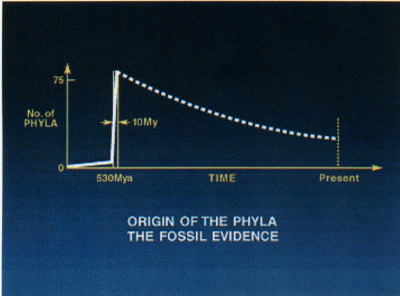
The newly released film “Darwin’s Dilemma” argues that the geologically abrupt appearance of the major groups of animals (the “phyla”) in the Cambrian Explosion posed a serious problem for Charles Darwin’s theory of evolution (as he himself knew), and that subsequent fossil discoveries—far from solving the problem—have made it worse.
Basically, all the major body plans we have today appear in the fossil record in a 2-3 million period about 543 million years ago. There are no precursors in the fossil record showing the gradual evolution of these major body plans.
The Cambrian Explosion: 0 to 60 in a few million years
Darwin expected to discover lots and lots of fossils leading up to the Cambrian explosion period that would show how all these phyla came into existence slowly over time. Unfortunately for the naturalistic evolutionists, the discoveries we’ve been making haven’t shown any hint of precursor fossils leading up the Cambrian explosion.
Since 1859, however, many Precambrian fossils have been found, including microfossils of single-celled bacteria in rocks more than three billion years old. In addition, multicellular Precambrian fossils have been found in the Ediacara Hills of Australia, though there is continuing debate over whether any—or how many—of the Ediacaran fossils were animals, or what relationship—if any—they had to the Cambrian phyla. In 1998, Cambridge University paleobiologist Simon Conway Morris (who is featured in the film “Darwin’s Dilemma”) wrote, “Apart from the few Ediacaran survivors… there seems to be a sharp demarcation between the strange world of Ediacaran life and the relatively familiar Cambrian fossils” (Crucible of Creation, 30).
But wait! Maybe we can’t find the precusor fossils required by Darwinism because they are too small or too soft to have survived for so long?
Since 1859, however, many Precambrian fossils have been found, including microfossils of single-celled bacteria in rocks more than three billion years old. In addition, multicellular Precambrian fossils have been found in the Ediacara Hills of Australia… In 1998, Cambridge University paleobiologist Simon Conway Morris… wrote, “Apart from the few Ediacaran survivors… there seems to be a sharp demarcation between the strange world of Ediacaran life and the relatively familiar Cambrian fossils” (Crucible of Creation, 30).
So there is now no shortage of Precambrian fossils. Not only do we have fossils of bacteria, but we also have many fossils of soft-bodied Multicellular organisms. “In the Ediacaran organisms there is no evidence for any skeletal hard parts,” wrote Conway Morris in 1998. “Ediacaran fossils look as if they were effectively soft-bodied” (Crucible of Creation, 28). The same is true of many of the organisms fossilized in the Cambrian explosion.
But wait! Scientists have discovered lots of exceptionally preserved microbes just before the Cambrian explosion. Don’t microbes count as precursors to the Cambrian explosion phyla?
Richard Callow and Martin Brasier reported in the January 2009 issue of the Journal of the Geological Society, London “a variety of exceptionally preserved microbes” from late Precambrian rocks in England that address “the paradox known as ‘“Darwin’s dilemma’.”
[…]Callow and Brasier didn’t solve Darwin’s dilemma. Instead, they put one more nail in the coffin of Darwin’s attempt to salvage his theory from it. The truth is that “exceptionally preserved microbes” from the late Precambrian actually deepen Darwin’s dilemma, because they suggest that if there had been ancestors to the Cambrian phyla they would have been preserved.
I am willing to believe in evolution. But in order to get me to believe it, I insist on seeing a fossil record that shows the gradual emergence of phyla, one or two at a time, over hundreds of millions of years. That is what Darwinism predicts. We now have a solid record of what came before the Cambrian explosion. So where are the precursors? Where is the record of gradual emergence? Where is my evidence?
A new peer-reviewed paper has been published that concludes that there is no material explanation for the massive amounts of information introduced during the Cambrian explosion, when all of the phyla came into being in the blink of an eye, geologically speaking, with no fossilized precursors.
Excerpt:
Thus, elucidating the materialistic basis of the Cambrian explosion has become more elusive, not less, the more we know about the event itself, and cannot be explained away by coupling extinction of intermediates with long stretches of geologic time, despite the contrary claims of some modern neo-Darwinists.
Once again, the progress of science brings light.
The DI post goes on to cite another passage from the paper:
Beginning some 555 million years ago the Earth’s biota changed in profound and fundamental ways, going from an essentially static system billions of years in existence to the one we find today, a dynamic and awesomely complex system whose origin seems to defy explanation. Part of the intrigue with the Cambrian explosion is that numerous animal phyla with very distinct body plans arrive on the scene in a geological blink of the eye, with little or no warning of what is to come in rocks that predate this interval of time. The abruptness of the transition between the ‘‘Precambrian’’ and the Cambrian was apparent right at the outset of our science with the publication of Murchison’s The Silurian System, a treatise that paradoxically set forth the research agenda for numerous paleontologists — in addition to serving as perennial fodder for creationists. The reasoning is simple — as explained on an intelligent-design t-shirt.
Fact: Forty phyla of complex animals suddenly appear in the fossil record, no forerunners, no transitional forms leading to them; ‘‘a major mystery,’’ a ‘‘challenge.’’ The Theory of Evolution – exploded again (idofcourse.com).
Although we would dispute the numbers, and aside from the last line, there is not much here that we would disagree with. Indeed, many of Darwin’s contemporaries shared these sentiments, and we assume — if Victorian fashion dictated — that they would have worn this same t-shirt with pride.
I linked before to a bunch of easy-to-understand videos that explain the Cambrian explosion. Here’s another peer-reviewed research paper on the Cambrian explosion written by Stephen C. Meyer, on the Cambrian explosion. This is the paper that got evolutionary biologist Richard Sternberg fired by secular leftists. He has two earned Ph.Ds in biology. I would expect that the people who fired him had never seen the inside of a biology lab. That’s the way it goes – science (intelligent design) vs. religion (materialism).

 WINTERY KNIGHT