Tag Archives: Morality

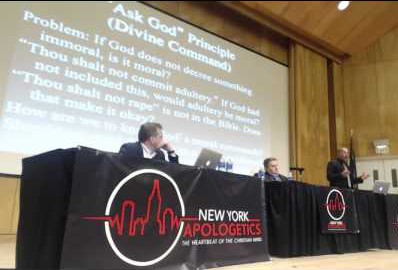
Atheist Michael Shermer tries to rationally ground morality in debate with Frank Turek

Michael Shermer debates Frank Turek: atheism and morality

The topic of the debate was on the grounding of morality – which worldview (theism or atheism) is better at grounding morality?

And here is the MP3 for the cross-examination only, which is what I will be summarizing. (12.5 Mb)

The full debate can be seen here and can be heard here.

Turek’s cross-examination period starts at 74m22s and ends at 89m20s.

Shermer’s cross-examination period starts at 89m50s and ends at 105m0s.

Topics of Turek’s cross-examination:

  • evolution produces Shermer’s moral sense and Hitler’s moral sense
  • why does Shermer think his is better than Hitler’s, since both were produced by the same evolution?
  • what makes right or wrong if evolution is the source of morality?
  • why is Stalin’s opinion of right and wrong less valuable than the herd’s opinion of right and wrong?
  • do the Founding Fathers ground inalienable rights in a Creator, or in evolution?
  • can atheism ground the existence of inalienable rights?
  • can you ground objective moral values and objective moral duties by asking people how they feel?
  • can you ground objective human rights on atheism by shouting like a madman and interrupting?
  • how can you trust your thinking if they are the result of an unguided, random process of evolution?
  • how can you have rational thoughts if materialism is true, and you are a machine made out of meat?
  • can you ground objective moral values and objective moral duties on personal preferences?
  • how do the personal preferences of some individuals create an objective moral duty for other individuals?
  • does naturalistic evolution orient human beings toward survival or truth?
  • on materialism, what is the chemical composition of justice?

Topics of Shermer’s cross-examination:

  • Radical muslims are exactly the same as evangelical Christians, and have the same God (Allah is the same as the Triune Christian God)
  • Radical muslims would assert that their God is the same as the Triune Christian God, with Jesus and the Holy Spirit also being God
  • Therefore, we can lay the blame for what radical muslims do on the backs of evangelical Christians
  • Radical muslims and evangelical Christians are the same, because “you’re enthusiastic, they’re enthusiastic”
  • The Bible’s notion of indentured servitude to pay off debt is the identical to the idea of slavery based on race
  • The Bible’s notion that masters and slaves are equal in the sight of God forms a basis for thinking they are unequal
  • The Bible teaches things that I disagree with, like the idea that marriage should provide children with a mother and a father
  • Gay marriage is solidly grounded in evolution, even though the morality that evolution produces varies by time and place
  • Atheists can ground objective moral values and objective moral duties by asking people how they feel
  • Can atheists who want to legalize gay marriage because “they’re in love” prohibit polygamy or incest as marriage?
  • Is shouting “you’re on the wrong side of history” a way to rationally ground morality in an accidental atheistic universe?
  • Is it loving for atheists to celebrate a lifestyle that exposes gay men to sickness and premature death?
  • Is it “bigotry” for the Center for Disease Control to warn men who have sex with men about higher health risks?
  • How do Christians decide what is right and wrong when they are confronted with a moral dilemma?
  • How do humans sense the objective moral standard that is required for them to make moral judgments
  • Can enlightenment philosophers who merely imagine human rights actually create those human rights?
  • If revelations change over time for Mormons, does that undermine the need for God to ground objective morality?

I apologize for the poor quality of the video and audio. The moderator was extremely ineffective, letting Shermer go on and on making speeches instead of asking questions during his questioning time. Also, Shermer apparently thought that shouting at Turek and waving his finger at Turek was a good strategy to defend against Turek’s use of logic and evidence.

My thoughts on Michael Shermer

I do want to make some general comments about what Shermer said. Shermer’s view of morality is “what is best for the greatest number of people”. There are no inalienable rights that act as a break on the will of the majority. Shermer has no objection to anything that the majority has decided in any time or in any place. If he were there, he would agree that whatever they decided was morally right.

Two hundred years ago, Shermer would have endorsed slavery. And if he were in Germany 50 years ago, he would have endorsed the Holocaust. If he lived in a Pakistan today, he would endorse stoning women for wearing the wrong clothes. Atheists always think that whatever the majority is doing in a particular time and place is right for them. There are no inalienable human rights that exist apart from human opinions, on atheism.

Another problem is that Shermer is constantly making moral judgments when his own view is that morality is constantly changing in different times and places. He condemns the moral values of other times and places without having any standard in his worldview that can decide between different moral values and duties. It is like saying that lunch is better than breakfast because lunch is here and now, and breakfast was then and there. That is literally what atheists do when they make moral judgments. They have no standard that applies to different times and places, just the ever evolving opinions of the majority of people in different times and places.

Is Michael Shermer concerned about morality?

Finally, I want people to understand what kind of person Michael Shermer is. You can read a post by PZ Myers on his blog Pharyngula to get the picture. I think it’s useful to know about Shermer’s own morality since he seems to like to make moral judgments so much during debates. In my own experience in dealing with atheists, although they will talk about slavery and the Crusades, there is nothing in an atheist’s moral system that makes things wrong for all times and all places. They bring it up to stop you from judging them about the things that they care about. When an atheist says “the Crusades! Slavery!” what they really mean is “I need to shame you for having a basis for moral judgments against me, so that you won’t say anything about me getting married women drunk then raping them”. That’s what atheistic use of moral language is really about.

What atheists really think about morality

Atheist Richard Dawkins says atheists have no objective moral standards:

In a universe of blind physical forces and genetic replication, some people are going to get hurt, other people are going to get lucky, and you won’t find any rhyme or reason in it, or any justice. The universe that we observe has precisely the properties we should expect if there is, at bottom, no design, no purpose, no evil and no good, nothing but blind, pitiless indifference… DNA neither knows nor cares. DNA just is. And we dance to its music. (Richard Dawkins, River Out of Eden: A Darwinian View of Life (1995))

So, when Shermer tries to shame Christians for behaviors in other times and places which our society here and now disagrees with, what he really means is “morality, objectively speaking, is nonsense, but I will use your moral sense that comes from your non-atheistic worldview to shame you, so that you won’t have the confidence to judge me for my immoral behavior”. And we need to get used to understanding this about atheists. Morality is nonsense to them, and their real goal is to get you off their back for their hedonism. For atheists, morality is just complying with arbitrary social customs which vary by time and place. There is nothing more to it than aping their neighbors (at least when their neighbors are watching). And they would have aped slave-owners, widow-burners and Nazi prison guards too, if they lived in that time and place. And shouted at Christians for disagreeing with them, just like Shermer did about gay marriage.

If you like the way that Frank Turek debates, then be sure and check out his new book “Stealing From God“. I highly recommend it.
Atheist Richard Carrier, who divorced his wife to go polyamorous, seeks new sex partner

Goodness Without God: is it possible?

Is atheism a rational worldview, or is it just rationalizing sexual misbehavior?

A while back, prominent atheist Dr. Richard Carrier explained how he was divorcing his wife – who supported him financially – in order to go polyamorous full-time.

The Yeti’s Roar, a libertarian atheist blog reacted to the news: (link removed)

In a recent blog post, entitled “Coming Out Poly + A Change of Life Venue”, the esteemed Dr. Richard Carrier PhD, discusses his “coming out” as polyamorous, an “orientation” that he just discovered at the young age of 47.

[…]Carrier claims that after 17 years of marriage, he cheated on his wife multiple times, for reasons that he won’t disclose.  In the midst of his infidelity, he suddenly “discovered” (as a middle aged man) that he was polyamorous.  Even though his wife attempted to make the marriage work by allowing him to see other women under the guise of an “open marriage”, Carrier still decided to kick her to the curb.   So in Carrier’s view, his affairs were not a mistake, but rather a fun new “lifestyle choice” that he will pursue, regardless of the past commitment to his wife.

What is even more despicable about Carrier’s behavior toward his wife is the fact that she supported him financially.

[…] The only reason he has been able to live a comfortable lifestyle while blogging and writing obscure books is due to his wife’s financial support.  The reason that he could afford to invest his time in getting graduate degrees from Columbia in subjects that will never land him a decent paying job is due to the support of his wife.  The reason he was able to travel around the country for low paying speaking engagements instead of having to get a real job is due to his wife’s financial support.  And how does he repay his wife for the support she has given him?  He cheats on her, waits until he is making enough money where he no longer needs her income, and kicks her to the curb.

So, whenever Richard Carrier was talking about morality without God, now we know what he meant. He even dedicated his book on morality without God to his now ex-wife. How ironic.

But the new polyamoratheism news is that Carrier is actually searching for a new “date”.

I am not linking to his blog post, but it says: (H/T The Yeti’s Roar)

I’ll start by making sure anyone considering this is up to speed. I am polyamorous. I currently have many girlfriends. All I consider my friends. Some are just occasional lovers. Some I am more involved with. They are also polyamorous, or near enough (not all of them identify that way, but all of them enjoy open relationships). And I will always have relationships with them, as long as they’ll have me in their life.

Many different things can be meant by the following terms, but just for the present purpose, if by a primary relationship is meant someone you live with or just about as good as live with, a secondary as someone you date regularly, and a tertiary as someone you date occasionally, all my relationships are tertiary, but only because of geography. I live just below Sacramento, California, where the rents are cheap, which means, where no one wants to live. And I’m unlikely to move anytime soon. So relationships with me, at best, are likely to be tertiary—long distance chatting with occasional being together throughout the year. Even so, I always take such friendships seriously.

[…]I’m 0.5 on the Kinsey scale. Not heavy into kink (but get along well with people who are). I have an unusual fetish or two but don’t expect any of my partners to share them. I’m pro sex worker, and though I personally find strip clubs and brothels uninteresting at best (uncomfortable at worst), I like partners who are or who have been sex workers. I also like women who have or pursue a lot of partners or who love to boast of their sexual exploits, especially over wine or whiskey or equivalent. I’m not going to get all butt-hurt or angsty over how high Your Number is. It very much has the opposite effect on me.

[…]I am also planning to have a hotel room, and am comfortable sharing it platonically. Certainly I would enjoy sharing it non-platonically, but I don’t expect it. I can’t believe (even though I know) there are still guys who assume the other sh*t buys them sex, thus necessitating I say this: if you are going to have sex with me, it has to be because it’s fun and you want to, not because it’s something you owe me. On the same understanding, if you have a place for me to crash in town (platonically or not), and are happy to have me over to spare me the cost of hiring a room, that would be lovely. And yes, if you are poly or open and live with a partner or two, I’m comfortable with that as well.

This also means you don’t have to live in the LA area to join me for this. If you can get to LA, and don’t mind sharing a room (at my expense), the opportunity remains.

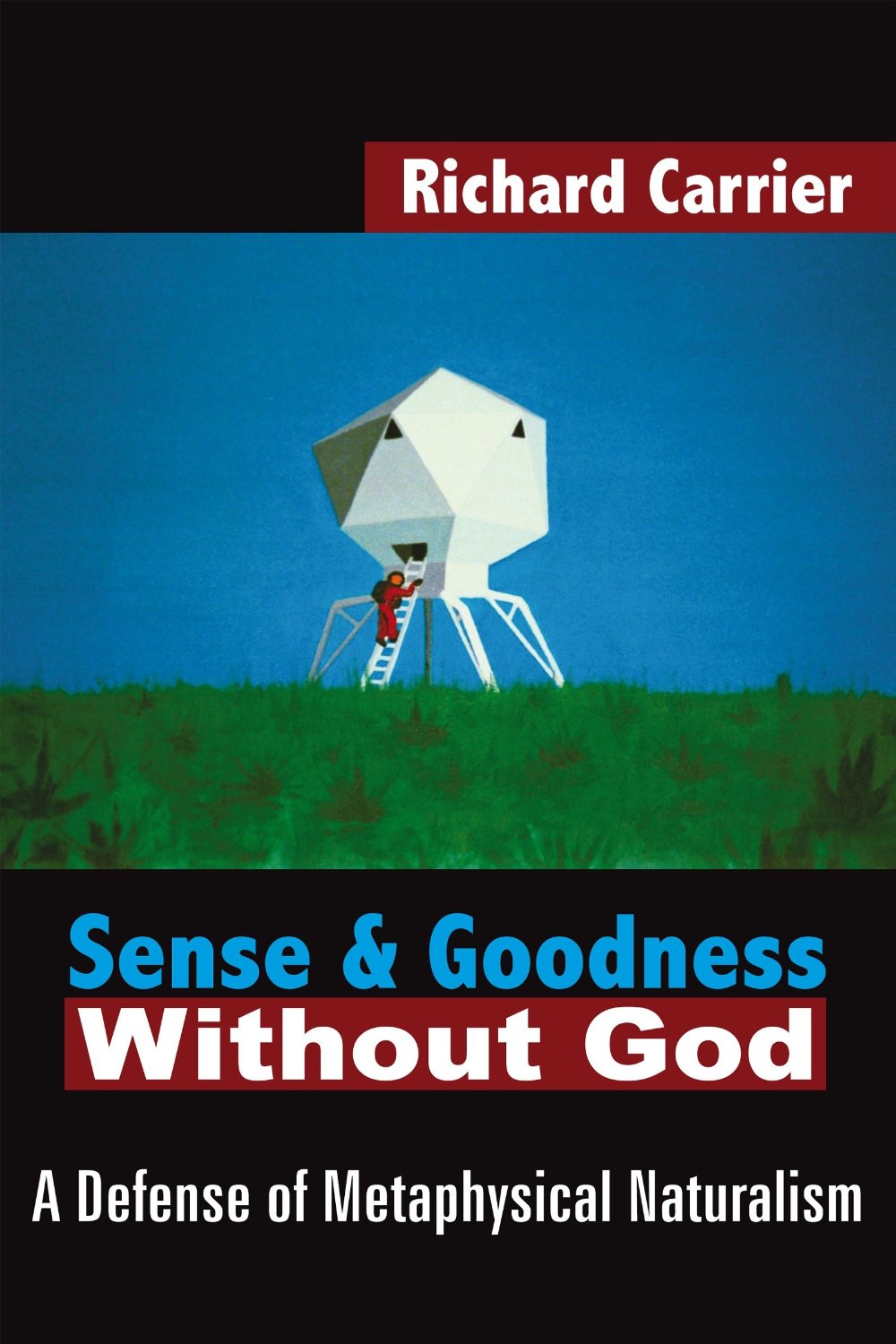
This is Richard Carrier’s book on morality without God:

Goodness Without God: Now we know what it looks like
Goodness without God: Now we know what he was talking about

And the book is dedicated to his wife, now ex-wife:

For Jen…

My buxom brunette
My wellspring of joy
My north star of sanity

Indeed.

You can read a multi-part review of the book here on Deeper Waters (Nick Peters’ site)

I trust that everyone now understands what I was saying about the reasons why atheists jettison God and objective morality. Sexual freedom is definitely a big one, and probably the biggest. This is not a worldview, people, it’s not something that is derived from logic and evidence. It starts and ends with getting rid of moral accountability to the Creator. Period. End of issue.

Not that all atheists are as immoral as Carrier, and not all atheists are motivated by sexual perversion. But the primary motivation is always to be able to get God out of the morality business. There’s no denying that atheists look pretty normal in a society that is still running on the fumes of a declining Judeo -Christian value system. But if you look at how they vote, e.g. – for abortion, for gay marriage, against religious liberty, etc., it’s very clear that they want the society to move away from Judeo-Christian values. And it is this desire that more and more human beings not respect the moral oughts that God prescribes that is the real rebellion.

Romans 1:18-21 nails this:

18The wrath of God is being revealed from heaven against all the godlessness and wickedness of men who suppress the truth by their wickedness,

19since what may be known about God is plain to them, because God has made it plain to them.

20For since the creation of the world God’s invisible qualities—his eternal power and divine nature—have been clearly seen, being understood from what has been made, so that men are without excuse.

21For although they knew God, they neither glorified him as God nor gave thanks to him, but their thinking became futile and their foolish hearts were darkened.

What is expected in the Christian worldview is not to pick and choose a few moral behaviors here and there. Individual moral values are not the issue. When Christ calls a man, he call him to die to himself and his own self-interest, and to take up his moral positions and champion them. Have you ever tried to champion the pro-life cause in an increasingly secular society? How about championing the pro-marriage cause? In order to be a Christian, you don’t just accept the sacrifice of Jesus as atonement for sin, but you also let him lead. And one of those areas of letting him lead is in defining what is and is not moral. It’s very easy for a man to not murder unborn children himself, and to marry someone of the opposite sex, and congratulate himself on how moral he is. Personal morality is not the issue. Inventing your own arbitrary  moral code and then following it might make you feel good, but that is not what God requires. The real challenge of Christianity has to do with standing up for the truth claims, including the moral values, in the face of a society that will not approve of you.

What is required of a man on the Christian worldview is total abandonment to God’s calling and a 100% re-prioritization of his life. It’s not about doing X and Y, but not A and B, and getting a passing grade. It’s about putting Jesus Christ in as your commanding officer in every area of your life.

Physicist Victor Stenger debates William Lane Craig: Does God Exist?

This debate took place on March 1, 2010 at Oregon State University.

In this debate, Victor Stenger does affirm his belief that the universe could be eternal in his second rebuttal (1:02:30), thus denying the standard Big Bang cosmology. He also denies the law of conservation of energy and asserts that something can come from nothing in his concluding speech (1:33:50). He also caused the audience to start laughing when he said that Jesus was not moral and supported slavery. There is almost no snark in this summary. Instead, I quoted Dr. Stenger verbatim in many places. I still think that it is very entertaining even without the snarky paraphrasing.

The debate includes 30 minutes of Q&A with the students.

Here is the MP3 file for the audio.

Here’s the video of the debate:

Dr. Craig’s opening speech:

  • The ontological argument
  • The contingency argument
  • The cosmological argument
  • The moral argument
  • The resurrection of Jesus (3-fact version)
  • Religious experience

Dr. Stenger’s opening speech:

  • There is no scientific evidence for God’s existence in the textbooks
  • There is no scientific evidence for God acting in the universe
  • God doesn’t talk to people and tell them things they couldn’t possibly know
  • The Bible says that the Earth is flat, etc.
  • There is no scientific evidence that God answers prayers
  • God doesn’t exist because people who believe in him are ignorant
  • Human life is not optimally designed and appears to be the result of a blind, ad hoc evolutionary process
  • The beginning of the universe is not ordered (low entropy) but random and chaotic
  • It’s theoretically possible that quantum tunneling explains the origin of the universe
  • The laws of physics are not objectively real, they are “our inventions”
  • Regarding the beginning of the universe, the explanation is that something came from nothing*
  • Nothing* isn’t really nothing, it is “the total chaos that we project existed just before the big bang”
  • If something has no structure, then “it is as much nothing as nothing can be”
  • Consciousness is explainable solely on the basis of material processes
  • There are well-informed, rational non-believers in the world and God would not allow that

Dr. Craig’s first rebuttal:

Stenger’s argument that there is no objective evidence for God’s existence:

  • First, it is not required that God rely only on objective evidence in order to draw people to himself (Alvin Plantinga)
  • Second, God is not required to provide evidence to everyone, only to the people who he knows would respond to him
  • Third, Craig gave lots of objective evidence, from science, history and philosophy
  • Stenger asks for certain evidence (answered prayers, prophecy, etc.), but Craig presented the evidence we have

Stenger’s argument that the balance of energy is zero so “nothing” exists:

  • if you have the same amount of assets and liabilities, it doesn’t mean that nothing exists – your assets and liabilities exist
  • Christopher Isham says that there needs to be a cause to create the positive and negative energy even if they balance
  • the quantum gravity model contradicts observations
  • the vacuum is not the same as nothing, it contains energy and matter
  • the BVG theorem proves that any universe that is expanding must have a beginning

Stenger’s argument that mental operations can be reduced to physical operations:

  • mental properties are not reducible to physical properties
  • epiphenomenalism: is incompatible with self-identity over time
  • epiphenomenalism: is incompatible with thoughts about other things
  • epiphenomenalism: is incompatible with free will
  • substance dualism (mind/body dualism) is a better explanation for our mental experience
  • God is a soul without a body
Dr. Stenger’s first rebuttal:

Craig’s cosmological argument:

  • Craig’s premise is “everything has a cause”, but quantum mechanics has causeless events
  • There are speculative theories about how something could have come into being uncaused out of nothing
  • “I don’t know of a single working cosmologist today who believes there was a singularity prior to the Big Bang”
  • “If there wasn’t a singularity then there’s no basis for arguing that time began at that point”
  • “There’s no reason from cosmology that we know of that the universe can’t be eternal”
  • “When I talk about an eternal universe, I mean a universe that has no beginning or end”
  • The Hartle-Hawking model doesn’t have a beginning
  • “There was no violation of energy conservation by having a universe coming from nothing”
  • “The universe could have come from a previous universe for example or even just from a region of chaos”
  • The paper by Vilenkin is counteracted by other papers (he doesn’t specify which ones)

Craig’s moral argument:

  • Dr. Craig is arguing from ignorance
  • But morality can be decided by humanity just like governments pass laws, and that’s objective
  • Dr. Craig has too little respect for the human intellect
  • I don’t need to tell me that slavery is wrong
  • The Bible supports slavery
  • Atheists can behave as good as theists
  • Morality just evolved naturally as an aid to survival

Craig’s resurrection argument:

  • No Roman historians wrote about the execution of Jesus but none of them did
  • The empty tomb is doubtful because it is only mentioned in the gospels, not by Paul
  • John Dominic Crossan says there was no empty tomb
  • Christianity only survived because the Roman empire thought that they were useful

Dr. Craig’s second rebuttal:

Craig’s cosmological argument:

  • There is no reason to prefer an indeterministic interpretation of quantum mechanics
  • Dr. Stenger himself wrote that deterministic interpretations of quantum mechanics are possible
  • The vacuum in quantum mechanics is not nothing
  • The quantum vacuum he proposes cannot be eternal
  • The cosmological argument does not require a singularity
  • The Hartle-Hawking model is from 1983
  • Hawking says that there is a beginning of space and time after that model
  • The Hartle-Hawking model does still have a beginning of time – the model is not eternal
  • The BVG theorem that requires a beginning for expanding universes is widely accepted among cosmologists

Craig’s moral argument:

  • Stenger redefined objective to mean that most people agree with it – but that’s not what objective means
  • Objective means right and wrong whether anyone accepts it or not
  • Richard Dawkins himself says that on atheism there is “no evil and no good” – why is he wrong?
  • Even Dr. Stenger says that morality is the same as passing laws – it’s arbitrary and varies by time and place
  • But on his view, right and wrong are the same as deciding which side of the road to drive on
  • But somethings really are right and some things are really wrong

Craig’s resurrection argument:

  • Josephus is a Roman historian and he wrote about Jesus, for example
  • There were four biographies of Jesus are the best sources for his life
  • The scholars that Stenger mentioned are on the radical fringe

Dr. Stenger’s second rebuttal:

Knowledge and the burden of proof:

  • Dr. Craig has to bear the burden of proof, not me – because his claim is more “extravagant”
  • “I don’t have to prove that a God was not necessary to create the universe”
  • “I don’t have to prove that a God did not design the universe and life”
  • “I don’t have to prove that the universe did not have a beginning”
  • “I don’t have to prove that God did not provide us with our moral sense”
  • There are a lot of books written about how morality evolved naturally
  • “I don’t have to prove that the events surrounding the supposed resurrection of Jesus did not take place”
  • Bart Ehrman says that the gospels are generally unreliable (Note: Ehrman accepts all 3 of Craig’s minimal facts)
  • Just because people are willing to die for a cause, does not make their leader God, e.g. – the Emperor of Japan

Aesthetic concerns about the universe:

  • I don’t like dark matter and I wouldn’t have made the universe with dark matter
  • I don’t like the doctrine of penal substitution
  • I don’t like the doctrine of original sin
  • I don’t like the heat death of the universe

Dr. Craig’s conclusion:

The case for atheism:

  • Dr. Stenger had two arguments and he has to support his premises
  • Dr. Craig addressed his two arguments and each premise and Dr. Stenger never came back on it

The contingency argument:

  • Dr. Stenger has dropped the refutation of this argument

The cosmological argument:

  • The theoretical vacuum he proposes cannot be eternal

The moral argument:

  • He asserts that things are wrong, but there is no grounding for that to be objective on atheism

The resurrection of Jesus:

  • There are surveys of scholars on the empty tomb and 75% of them agree with it
  • Bart Ehrman agrees with all 3 of the minimal facts that Dr. Craig presented
  • Ehrman’s objection to the resurrection is not historical: he’s an atheist – he thinks miracles are impossible

Religious experience:

  • No response from Dr. Stenger

Dr. Stenger’s conclusion

The cosmological argument:

  • “I argued that we have very good physical reasons to understand how something can come from nothing”
  • “There is a natural tendency in the universe… to go from.. simpler thing to the more complicated thing”
  • The transition from a vapor to a liquid to ice shows how something could come from nothing
  • “It cannot be proven that the universe had a beginning”

The moral argument:

  • Objective morality, which is independent of what people think, could be developed based on what people think
  • “Jesus himself was not a tremendously moral person… he had no particular regard for the poor… he certainly supported slavery… he was for the subjugation of women” (audience laughter)

The resurrection argument:

  • Bart Ehrman says that the majority of the gospels are unreliable

Religious experience:

  • I don’t see any evidence that there is anything more to religious experience than just stuff in their heads

God’s purpose of the world should be to make people feel happy:

  • God could have made people feel happier
  • God could have made people not die
  • God could could have made the universe smaller: it’s too big
  • God could have made it possible for humans to live anywhere “even in space”