Tag Archives: Morality

My conversation about morality with an atheist millennial man

This is one of the memes from the Wintery Knight facebook page
A meme that was posted on the WK Facebook page, by the new meme admin

I spent some time talking to an atheist millennial recently. He considers himself a moral person, and he is very helpful to others. I asked him to define morality, and he said that morality was feeling good, and helping other people to feel good. I was trying to think of a way to punch a hole in his feelings-based utilitarianism. How could I show him that happy feelings are not a good basis for morality?

Now, you’re probably thinking that abortion is the most obvious example of something that is morally wrong – it’s just killing a baby because adults don’t want to take responsibility for their foolish pursuit of pleasure. But atheists typically don’t think of unborn children as people. They usually believe in naturalistic evolution, and they are committed to a view of reality where the universe is an accident, human beings are accidents, there are no objective human rights, and biological evolution progresses because the strong survive while the weak die. So you aren’t going to be able to generate a moral standard that includes compassion for weak unborn children on that scenario. If the rule is “let’s do what makes us happy”, and the unborn child can’t voice her opinion, then the selfish grown-ups win.

Instead, I decided to focus on fatherlessness. I asked him whether he thought that fatherlessness harmed children. Surprisingly, he said that it didn’t, and that he had a relative who was doing a great job raising fatherless kids. I asked him if he had ever looked at the research on what father absence does to children. He hadn’t. Then I asked him if a system of sexual rules based on “me feeling good, and other people around me feeling good”, was likely to protect children. He went silent.

Well, that was the end of that conversation. And I think it was a nice window into how millennials – who are absolutely clueless about what research says about sex, dating, marriage and parenting – think about relationships. They’re making decisions based on their feelings, then acting surprised when their “common sense” decisions based on happiness “in the moment” blow up in their faces, and destroy the lives of their children, including their unborn children.

Unfortunately, young people are having children outside of a marriage commitment more and more.
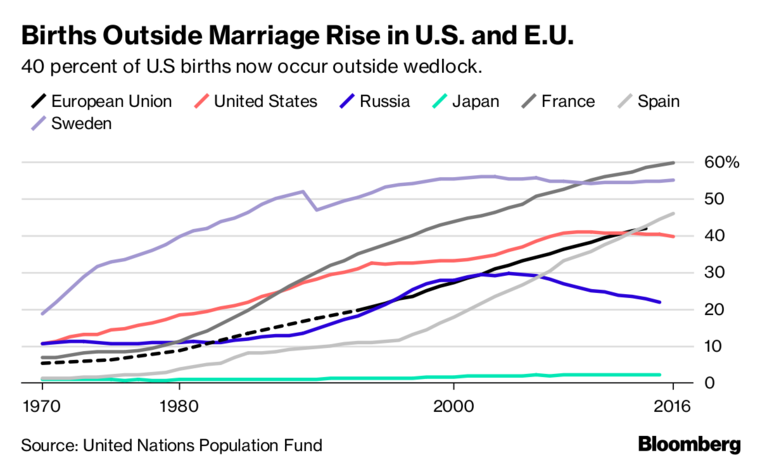
Out-of-wedlocks births rising as cohabitation replaces marriage

Far-left Bloomberg News reports:

Forty percent of all births in the U.S. now occur outside of wedlock, up from 10 percent in 1970, according to an annual report released on Wednesday by the United Nations Population Fund (UNFPA), the largest international provider of sexual and reproductive health services. That number is even higher in the European Union.

The EU has a higher rate of fatherless births because they have high taxes and big government to allow women to have children without having to commit to a husband:

The EU likely sees more births out of wedlock because many member countries have welfare systems that support gender-balanced child care, said Michael Hermann, UNFPA’s senior adviser on economics and demography, in an interview. Public health care systems, paid paternal leave, early education programs and tax incentives give unwed parents support beyond what a partner can provide.

More welfare and more government services make it easier for women to pursue relationships with men who aren’t interested in marriage. Hot bad boys who give them all the tingles. Big government makes those boring, predictable marriage-ready men dispensable. Big government also makes it much harder for a man who does marry to afford a stay-at-home mother for his kids, because he has to pay higher taxes for big government.

More:

The data show such births in the U.S. and EU are predominantly to unmarried couples living together rather than to single mothers, the report says.

[…]Jones also noted that the rise in births outside of marriage is closely correlated to delays in childbearing. “Women are claiming their ground professionally,” she said. “Delaying motherhood is a rational decision when you consider the impact it can have on your career, and that’s contributing to this trend.”

[….]The traditional progression of Western life “has been reversed,” said John Santelli, a professor in population, family health and pediatrics at Columbia’s Mailman School of Public Health. “Cohabiting partners are having children before getting married. That’s a long-term trend across developing nations.”

Regardless of marital status, more couples are choosing not to have kids at all. The U.S. fertility rate hit a historic 30-year low last year, according to the Centers for Disease Control and Prevention. Hermann said the rise in births outside of wedlock has actually mitigated the decline in fertility, which “would be much steeper if women weren’t having children outside marriage.”

What’s interesting about this anti-marriage article is that they have nothing to say about the research showing that cohabitation – and also marriages that occur after a period of cohabitation – are inferior to no-cohabitation marriages. People who are serious about self-control, and who are serious about committing through thick and thin, tend to have longer lasting marriages. But we don’t prioritize chastity, fidelity and self-sacrificial commitment anymore, because that relationships that require self-denial make us unhappy.

The article concludes: “We can’t go back to the ’50s”. Right. Because if feelings-based “morality” is assumed, then any choice between adult happiness and children’s happiness will favor the adults. Today’s young people carefully AVOID any evidence that contradicts their new “happiness-morality”. They act surprised when their unstable relationships dissolve, leaving children separated from their fathers. Marriage requires that both partners have a system of morality that puts the commitment above happy feelings. People have to be accustomed to doing things that feel bad, just because they are good and moral things to do according to an objective standard of morality. The new atheist morality of happy feelings doesn’t develop the character needed for commitment.

If you ask an atheist millennial, they think they are doing a great job of being “moral”. They don’t see the messes they are making for children as something that they are causing themselves, with their own foolish feelings-based decision-making. They think they know everything about relationships through their feelings. They think that they are exempt from the patterns of cause and effect in the peer-reviewed research.


Are all sins equally bad? Or are there degrees of severity for different sins?

Bible study that hits the spot

This question came up recently so I did some digging on theology web sites to find what Bible verses applied to the question.

Here’s what Ligonier said:

It’s clear that we have different degrees of sin when we consider the warnings of Scripture. There are at least twenty-two references in the New Testament to degrees of rewards that are given to the saints in heaven. There are different levels, different rewards, and different roles in heaven. The Bible warns us against adding to the severity of our judgment. Jesus said to Pontius Pilate, “He who delivered me over to you has the greater sin” (John 19:11). Jesus measures and evaluates guilt, and with the greater guilt and greater responsibility comes the greater judgment. It’s a motif that permeates the New Testament.

The idea of gradation of sin and reward is based upon God’s justice. If I commit twice as many sins as another person, justice demands that the punishment fits the crime. If I’ve been twice as virtuous as another person, justice demands that I get more of a reward. God tells us that entrance into heaven will be only on the basis of the merit of Christ, but once we get to heaven, rewards will be dispensed according to works. Those who have been abundant in good works will receive an abundant reward. Those who have been derelict and negligent in good works will have a small reward in heaven. By the same token, those who have been grievous enemies of God will have severe torments in hell. Those who have been less hostile will have a lesser punishment at the hands of God. He is perfectly just, and when He judges, He will take into account all of the extenuating circumstances. Jesus said, “I tell you, on the day of judgment people will give account for every careless word they speak” (Matt. 12:36).

A while back, my friend Dina sent me a sermon where that exact passage (John 19) was brought up by the pastor.

I think the correct position is that any sin is enough to separate you from God, but some sins are more severe than others in God’s objective standard of right and wrong.

OK, that was fine and good, but then I noticed a few days later that Michael Krueger had also blogged about this “all sin are equal” view, too.

Krueger says this:

First, to say all sins are the same is to confuse the effect of sin with the heinousness of sin.  While all sins are equal in their effect (they separate us from God), they are not all equally heinous.

Second, the Bible differentiates between sins. Some sins are more severe in terms of impact (1 Cor 6:18), in terms of culpability (Rom 1:21-32), and in terms of the judgment warranted (2 Pet 2:17;  Mark 9:42; James 3:1).

Even more Bible references, so we’re not on the wrong track.

So then why do some people insist that all sins are equal? It turns out that it is coming from the secular ideal of non-judgmentalism.

Krueger explains:

We should begin by observing that this phrase does not come from Scripture.  People do not use it because it appears in the Bible. Why then do they use it?

One reason, as noted above, is that some Christians use this phrase to uphold the seriousness of sin. It is viewed as a way to remind people not to be dismissive about their sin or regard it is a triviality.

Others use this phrase as way to “flatten out” all sins so that they are not distinguishable from each other.  Or, to put it another way, this phrase is used to portray all human beings as precisely the same.  If all sins are equal, and all people sin, then no one is more holy than anyone else.

In a world fascinated with “equality,” this usage of the phrase is particularly attractive to folks. It allows everyone to be lumped together into a single undifferentiated mass.

Such a move is also useful as a way to prevent particular behaviors from being condemned.  If all sins are equal, and everyone is a sinner, then you are not allowed to highlight any particular sin (or sinner).

Needless to say, this usage of the phrase has featured largely in the recent cultural debates over issues like homosexuality.  Yes, homosexuality is a sin, some Christians reluctantly concede.  But, they argue, all sins are equal in God’s sight and therefore it is no different than anything else.  Therefore, Christians ought to stop talking about homosexuality unless they are also willing to talk about impatience, anger, gluttony, and so on.

Krueger also posted this fascinating follow up post, where he looks at how the phrase is being used by people on Twitter.

Look at these tweets:

  • All sins are equal. People tend to forget that. There is no bigger or smaller sin. Being gay and lying, very equal.

  • all sins are equal in God’s eyes. whatever you’re doing, is no better than what someone else is doing.

  • If you have sex before marriage please don’t come on social media preaching about the wrongs of homosexuality. All sins are equal

  • Need people to realize that all sins are equal… don’t try to look down on me or question my faith just cuz you sin differently than I do.

  • Don’t understand why you’re so quick to judge me, when all sins are equal. So much for family..

  • if you think being gay is a sin, let me ask you something, have you not done anything wrong in your life? all sins are equal. we’re sinners

  • Nope no difference at all. All sins are equal no matter what you’re running for. The bible says do not judge lest ye be judged

  • A huge problem I have with religion is the notion that all sins are equal. Like pre-martial sex and murder are the same amount t of bad.

  • people do bad things because they believe that all sins are equal and ~god~ loves y’all equally so he’s going to forgive you naman ha ha ha

  • It a sin to condemn another sinner and their actions. All sins are equal. So what makes you better than the person you’re condemning?

  • I think so b/c having sex before marriage doesn’t make you less of a women then if you waited until marriage.. all sins are equal soo

  • friendly reminder, all sins are equal in gods eyes so you’re not better than I am in any way. please worry about your own sins before mine.

  • People don’t like when I suggest abortion as an option. This is a free country and all sins are equal so mind your business!!!

  • What I do is no worse than wat you do… all sins are equal no matter what it is… a sin is a sin

  • to god all sins are equal so you have no right to compare your sins to someone else’s bc in the end it doesn’t matter

The first thing that I noticed is that premarital sex and homosexuality are the most popular sins. I would think that divorce and abortion would be up there in the rankings, as well.

Something strange has happened in our society such that more and more people want to be led by their feelings, rather than be bounded by rules or standards. When people get caught breaking moral rules, rather than be accountable, they attack the person judging them. They would rather escape the judgment of their peers than admit fault and try to fix the mistake, and do better next time.

It’s so bad now, that the people who have morals and who make moral judgments are seen as the real bad people. The immoral people are on the offense, and even trying to ban people from being able to disagree with them. We’re seeing that with people who are being attacked for defending natural marriage against divorce and redefinition of marriage. In France, they want to make speech critical of abortion a criminal offense. And in Canada, they’ve now made speech critical of the gay agenda a criminal offense. (It’s already a human rights tribunal offense)

What is even more interesting is when the people who push the “don’t judge me” line try to justify it from the Bible. Very strange, but we seem to have forgotten the value of setting moral boundaries. Now moral boundaries are “evil”. Instead, having compassion for people who break the moral boundaries and harm themselves and others is “good”.

Is Sam Harris successful at rationally grounding objective moral values and duties?

I have a key that will unlock a puzzling mystery

I just wanted to put out a few snips from this layperson-level article on the Reasonable Faith web site. The article is about atheist scholar Sam Harris, and his attempt to provide a basis for morality on atheism.

Here’s the Harris project:

The question then is, what is the best foundation for the existence of objective moral values and duties? What grounds them? What makes certain actions good or evil, right or wrong? Traditionally, God has been the highest Good (summum bonum) and His commandments constitutive of our moral duties. But if God does not exist, what foundation remains for objective moral values and duties?

Dr. Craig is able to show why Harris’ attempt to ground the objective moral value of humans in “human flourishing” fails, by using the law of identity to show that Harris’ rule doesn’t account for the possibility that those who do evil could possibly flourish and be happy. If Harris is right that objective morality is identical to human flourishing, then it cannot even be possible that this be the case. This can be a bit confusing to non-philosophers, though, so I’ll focus on Dr. Craig’s argument against Harris’ attempt to ground objective moral duties.

Dr. Craig writes:

That takes us to a second question: Does atheism provide a sound foundation for objective moral duties? Duty has to do with moral obligation and prohibition, what I ought or ought not to do. Here reviewers of The Moral Landscape have been merciless in pounding Harris’ attempt to provide a naturalistic account of moral obligation. Two problems stand out.

First: Natural science tells us only what is, not what ought to be, the case. As philosopher Jerry Fodor has written, “Science is about facts, not norms; it might tell us how we are, but it wouldn’t tell us what is wrong with how we are.” In particular it cannot tell us that we have a moral obligation to take actions that are conducive to human flourishing.

So if there is no God, what foundation remains for objective moral duties? On the naturalistic view, human beings are just animals, and animals have no moral obligations to one another. When a lion kills a zebra, it kills the zebra, but it does not murder the zebra. When a great white shark forcibly copulates with a female, it forcibly copulates with her but it does not rape her — for there is no moral dimension to these actions. They are neither prohibited nor obligatory.

So if God does not exist, why think we have any moral obligations to do anything? Who or what imposes these moral duties on us? Where do they come from? It is hard to see why they would be anything more than a subjective impression ingrained into us by societal and parental conditioning.

So we might feel morally obligated to do something, maybe what our herd expects of us in this time and place we live in. But on atheism those feelings are arbitrary. After all, societies have evolved where feelings of obligation are felt by people to perform suicide bombings against civilians. On atheism, those feelings are as valid and grounded as any other “duties” because they emerge from the same process in other times and places. Obligations change between time and place – they are not objectively real. But that means that our moral duties are not objective, they are arbitrary – if atheism is true. The same “socio-biological evolution” is generating opposite moral duties in different times and places. This is not “objective”.

And the second objection is even more lethal:

Second: “ought” implies “can.” A person is not morally responsible for an action he is unable to avoid. For example, if somebody shoves you into another person, you are not to blame for bumping into this person. You had no choice. But Harris believes that all of our actions are causally determined and that there is no free will. Harris rejects not only libertarian accounts of freedom but also compatibilistic accounts of freedom. But if there is no free will, no one is morally responsible for anything. In the end, Harris admits this, though it’s tucked away in his endnotes. Moral responsibility, he says, “is a social construct,” not an objective reality: “in neuroscientific terms no person is more or less responsible than any other” for the actions they perform. His thoroughgoing determinism spells the end of any hope or possibility of objective moral duties on his worldview because we have no control over what we do.

Harris recognizes that “determinism really does threaten free will and responsibility as we intuitively understand them.” But not to worry! “The illusion of free will is itself an illusion.” The point, I take it, is that we do not really have the illusion of free will. Not only is such a claim patently false phenomenologically, as any of us can attest, but it is also irrelevant. The fact remains that whether we experience the illusion of free will or not, on Harris’ view we are thoroughly determined in all that we think and do and can therefore have no moral responsibilities.

On Harris’ view, human beings are computers made out of meat. But if you cannot freely make moral choices, then you cannot choose to perform moral duties or not. What is amazing to me is why he wants to deny free will in the first place. He is surely very well aware of his own experience of free will, and his own consciousness, for that matter. Before we even start to look at scientific evidences against atheism like the origin of the universe, the cosmic fine-tuning, the origin of life, the Cambrian explosion, etc. we already have evidence within ourselves that naturalism is false.

Just in passing, my friend Micah sent me this article about Sam Harris’ academic credentials. Although Harris has a PhD in neuroscience, the underlying reality is a bit more complicated. When I watched him debate William Lane Craig, he seemed to be ignorant of simple problems with his utilitarian moral views, and his inability to ground libertarian free will. The problems with utilitarianism have been known for hundreds of years. You can watch the debate yourself and see if you think he was prepared or not.