
Tag Archives: Molecular Biology

New book on intelligent design by molecular biologist Douglas Axe

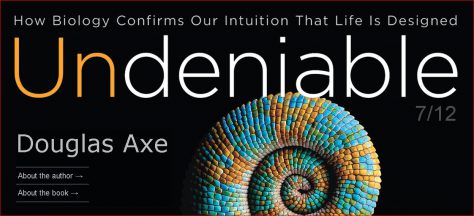
Undeniable: How Biology Confirms Our Intuition That Life Is Designed

It’s not out yet, but the Kindle edition is only $12.99, so I pre-ordered it. That helps to get the book up in the bestseller lists. I’ll add it to my list of books that I am reading for the third quarter later, and maybe feature it in the coveted spot in the right column of the blog.

Anyway, here is the description:

Throughout his distinguished and unconventional career, engineer-turned-molecular-biologist Douglas Axe has been asking the questions that much of the scientific community would rather silence. Now, he presents his conclusions in this brave and pioneering book. Axe argues that the key to understanding our origin is the “design intuition”—the innate belief held by all humans that tasks we would need knowledge to accomplish can only be accomplished by someone who has that knowledge. For the ingenious task of inventing life, this knower can only be God.

Starting with the hallowed halls of academic science, Axe dismantles the widespread belief that Darwin’s theory of evolution is indisputably true, showing instead that a gaping hole has been at its center from the beginning. He then explains in plain English the science that proves our design intuition scientifically valid. Lastly, he uses everyday experience to empower ordinary people to defend their design intuition, giving them the confidence and courage to explain why it has to be true and the vision to imagine what biology will become when people stand up for this truth.

Armed with that confidence, readers will affirm what once seemed obvious to all of us—that living creatures, from single-celled cyanobacteria to orca whales and human beings, are brilliantly conceived, utterly beyond the reach of accident.

Our intuition was right all along.

Trailer is here:

Evolution News has a deal for those who pre-order:

A remarkable thing about evolutionary theory is the way it demands that we deny our intuition at almost every step. Evolutionists then assure us that the science is all figured out, so we needn’t trouble our silly heads about the relevant biology.

In a new book, Douglas Axe of Biologic Institute turns this standard assurance on its head. In Undeniable: How Biology Confirms Our Intuition That Life Is Designed, Dr. Axe restores the place of intuition alongside intellect in considering the question of life’s origins.

Undeniable will be published on July 12 by HarperOne, but you can pre-order before then and participate in an exclusive, private conference call with Dr. Axe and talk- show host Michael Medved. You’ll also receive digital versions of three complete books from Discovery Institute Press: Debating Darwin’s Doubt, The Unofficial Guide to Cosmos, and Science & Human Origins. See here for easy instructions.

And now, I have a secret story to tell you. I met Doug Axe face to face way back in the late 1990s. He told me and some other people about the post-doctoral work he was doing at Cambridge University on the probabilities of getting a functional protein by chance. He made me promise not to tell anyone, and I never did. It was from conversations like that with the intelligent design scholars that I decided to start using an alias.

From his research at Cambrudge, Dr. Axe found that the number of functional amino acid sequences is tiny:

Doug Axe’s research likewise studies genes that it turns out show great evidence of design. Axe studied the sensitivities of protein function to mutations. In these “mutational sensitivity” tests, Dr. Axe mutated certain amino acids in various proteins, or studied the differences between similar proteins, to see how mutations or changes affected their ability to function properly. He found that protein function was highly sensitive to mutation, and that proteins are not very tolerant to changes in their amino acid sequences. In other words, when you mutate, tweak, or change these proteins slightly, they stopped working. In one of his papers, he thus concludes that “functional folds require highly extraordinary sequences,” and that functional protein folds “may be as low as 1 in 10^77.”

The problem of forming DNA by sequencing nucleotides faces similar difficulties. And remember, mutation and selection cannot explain the origin of the first sequence, because mutation and selection require replication, which does not exist until that first living cell is already in place.

He published his findings in four separate publications with the prestigious Journal of Molecular Biology, and got his PhD with it. To get a PhD from Caltech, and then do post-doctoral work at Cambridge, you have to be good. And Dr. Axe is very, very good.

I have used the papers he wrote in many, many conversations with engineers in different companies where I have worked. He hit a home run with that research. You could never look at the evidence for intelligent design the same way again. Christian parents, if you have any children, be sure that you tell them about Doug Axe’s story.

List of peer-reviewed papers supporting intelligent design now up to 50

Ann Gauger working away in her lab
Molecular biologist Ann Gauger working in her lab

From Evolution News.

Excerpt: (links removed)

While intelligent design research is a new scientific field, recent years have been a period of encouraging growth, producing a strong record of peer-reviewed scientific publications. New publications continue to appear, now listed at our updated page.

The current boom goes back to 2004, when Discovery Institute senior fellow Stephen Meyer published a groundbreaking paper advocating ID in the journal Proceedings of the Biological Society of Washington. There are multiple hubs of ID-related research.

Biologic Institute, led by molecular biologists Doug Axe and Ann Gauger, is “developing and testing the scientific case for intelligent design in biology.” Biologic conducts laboratory and theoretical research on the origin and role of information in biology, the fine-tuning of the universe for life, and methods of detecting design in nature. That’s Dr. Gauger at the Biologic lab pictured above.

Another ID research group is the Evolutionary Informatics Lab, founded by senior Discovery Institute fellow William Dembski along with Robert Marks, Distinguished Professor of Electrical and Computer Engineering at Baylor University. Their lab has attracted graduate-student researchers and published multiple peer-reviewed articles in technical science and engineering journals showing that computer programming “points to the need for an ultimate information source qua intelligent designer.”

Other pro-ID scientists around the world are publishing peer-reviewed pro-ID scientific papers. These include biologist Ralph Seelke at the University of Wisconsin Superior, Wolf-Ekkehard Lönnig who recently retired from the Max Planck Institute for Plant Breeding Research in Germany, and Lehigh University biochemist Michael Behe.

Researchers have published their work in a variety of relevant technical venues, including peer-reviewed scientific journals, peer-reviewed scientific books from mainstream university presses, trade-press books, peer-edited scientific anthologies, peer-edited scientific conference proceedings and peer-reviewed philosophy of science journals and books.

These papers have appeared in scientific journals such as Protein ScienceJournal of Molecular BiologyTheoretical Biology and Medical ModellingJournal of Advanced Computational Intelligence and Intelligent InformaticsQuarterly Review of BiologyCell Biology InternationalRivista di Biologia/Biology ForumPhysics of Life ReviewsAnnual Review of Genetics, and many others. At the same time, pro-ID scientists have presented their research at conferences worldwide in fields such as genetics, biochemistry, engineering, and computer science.

This body of research is converging on a consensus: complex biological features cannot arise by unguided Darwinian mechanisms, but require an intelligent cause.

My favorite area of ID research is the area of protein formation. I like to read about the research done by Doug Axe and Ann Gauger in that area. Research performed by Doug Axe at Cambridge University, and published in the peer-reviewed Journal of Molecular Biology, has shown that the number of functional amino acid sequences (ones that can form functioning proteins) is tiny:

Doug Axe’s research likewise studies genes that it turns out show great evidence of design. Axe studied the sensitivities of protein function to mutations. In these “mutational sensitivity” tests, Dr. Axe mutated certain amino acids in various proteins, or studied the differences between similar proteins, to see how mutations or changes affected their ability to function properly. He found that protein function was highly sensitive to mutation, and that proteins are not very tolerant to changes in their amino acid sequences. In other words, when you mutate, tweak, or change these proteins slightly, they stopped working. In one of his papers, he thus concludes that “functional folds require highly extraordinary sequences,” and that functional protein folds “may be as low as 1 in 10^77.”

The problem of forming DNA by sequencing nucleotides faces similar difficulties. And remember, mutation and selection cannot explain the origin of the first sequence, because mutation and selection require replication, which does not exist until that first living cell is already in place. I think that this very valuable research, indeed.

You can read more about the problem of protein synthesis in this previous post.

William Dembski reviews a new book by two theistic evolutionists

From Patheos, an opening statement by William Dembski. This is the first part of a four-part debate with two scientists of the Biologos group, which advocates for theistic evolution. (And not to be confused with the Biologic Institute, which is supportive of intelligent design).

Excerpt:

Throughout their book, Giberson and Collins overconfidently proclaim that Darwinian evolution is a slam-dunk. Thus one reads, “There has been no scientific discovery since Darwin–not one–which has suggested that evolution is not the best explanation for the origin of species” (21-22). No theory is that good. Every theory admits anomalies. Every theory faces disconfirming evidence. Repeatedly readers are informed that mountains of overwhelming evidence support Darwin’s theory and that the authors are “unfamiliar with any premier scientists who reject evolution.” And just so there’s no doubt, in that same paragraph, they reiterate, “There are certainly a few scientists who reject evolution . . . But these are never premier scientists.”

Oh, you reject Darwinian evolution; you can’t be a premier scientist. What counterexample would convince Giberson and Collins to retract such a claim? How about Henry Schaefer’s signature on a “Dissent from Darwin” list? Schaefer heads the computational quantum chemistry lab at the University of Georgia, has published over a thousand peer-reviewed journal articles, and is one of the most widely cited chemists in the world. Then again, Giberson and Collins look askance at this list (according to them, it has too many emeriti professors and not enough biologists). But why engage in such posturing about scientific pecking order in the first place? The issue is not who’s doubting Darwinism, but what are the arguments for and against it and whether they have merit. Giberson and Collins’ constant drumming of mainstream and consensus science is beside the point–science progresses by diverging from the mainstream and by breaking with consensus.

Because Giberson and Collins assert that natural selection is such a powerful mechanism for driving evolution–and one that admits no reasoned dissent–it’s worth recounting here briefly why the intelligent design community is so skeptical of it. It’s not, as theistic evolutionists often suggest, that we have a desperate need to shore up faith and morality and are using ID as our instrument of choice to accomplish that end. Rather, it’s that natural selection is, in essence, a trial and error tinkering mechanism for which all evidence suggests that its power is quite limited. Trial and error works fine when you have something that’s functional and are trying to enhance it or adapt it to a new situation.

But for natural selection, as a trial and error mechanism, to traverse vast swatches of biological function space, we need to see an extended series of small gradual structural changes (under neo-Darwinism, these are genetic mutations leaving effects at the phenotypic level) that continually improve, or at least maintain, function, with evolving functions and evolving structures covarying and reinforcing each other. But we know of no detailed testable (macro-)evolutionary pathways like this in any field, whether in the evolution of living forms or in the evolution of language or in the evolution of technologies. In fact, when we can trace such evolutionary pathways, we find that significant change happens in creative leaps, not via trial and error tinkering.

Everyone who has read Dembski’s opening remarks in this four-part series is raving about the quality of what he’s written. I was hoping to wait for the response before publishing his opening salvo, so we could balance it, but no reply has appeared yet. For me, there is only one issue in the debate about the origin of life: if natural causes can create life from non-life with the time and resources available on the early Earth, then show me the mechanism. That’s all I want to see – the evidence that natural causes can do the creating that the naturalists say that it can do. I don’t want to hear about feelings, possibilities, what God could or couldn’t do, philosophy, what church you attend, your favorite hymn, the way you were raised, your religious experiences, etc. I just want to see you prove that nature can do all the creating that you say it can do.