Young women are taking more honors classes, getting better grades and have a higher overall GPA than their male peers, according to a report compiling SAT Test data.
The report, released by the College Board, looked at the test scores of college-bound seniors in 2016, and reviewed high school data demographics. Girls, it turns out, are doing much better in high school than boys. In a chart compiled by American Enterprise Scholar Mark Perry, it’s clear that girls are outperforming boys on nearly every level in high school.
[…]Don’t expect to hear calls for helping boys perform better in school. Activists have focused so heavily on girls for years now that boys have gotten the message that they no longer matter. It’s what Christina Hoff Sommers wrote about in her book “The War Against Boys” nearly two decades ago.
What Perry noted in the chart above isn’t new for this year, it’s been a trend since before Hoff Sommers’ book. Yet the focus is still on girls.
[…]More girls than boys are attending college and getting master’s and doctoral degrees.
The article notes that boys perform better on math SATs, which makes you wonder why they have lower GPAs. Most teachers and administrators in traditional schools are women. When those women administrators and teachers attend college, they learn that women have been held back by men and discriminated against. Then they get jobs in the education system teaching boys and girls. Could it be that when a teacher grades a boy, she grades a boy lower than a standardized test would? As a way of “making up” for the supposed discrimination against women?
Has anyone ever studied this to see if there is discrimination against boys in the schools?
A new study of nearly 6,000 elementary school children has found that boys are discriminated against beginning in kindergarten. Christopher Cornwell, an economics professor at the University of Georgia, says that ”gender disparities in teacher grades start early and uniformly favor girls.”
Despite having higher scores on standardized tests, boys get lower grades than girls. Why? Because teachers are basing grades at least partly on classroom behavior, and the standards are very much geared to female norms.
[…]Here’s what the disparity looks like for kindergarten boys:
Std. Deviation
Test Scores
Grades
Reading
-.017
-.27
Math
+.02
-.15
Science
+.035
-.14
(Note: Values are approx., gauged visually from study graphic.)
Another interesting finding was that boys who adhere to female norms on non-cognitive skills were not penalized. Effectively, the more female behavior was rewarded with a grade “bonus” for males.
The implications of this are obvious. Masculinity, even normal maleness, is being punished in schools from a very young age. Only the most female-acting boys are rewarded with a fair assessment.
What the study shows is that administrators and teachers don’t grade like standardized tests – they have other criteria that discriminate in favor of girls and against boys. And now we are seeing the effects of this attack on boys in college admissions and graduation rates – not to mention affirmative action for women employees in the workplace.
You can find out more about the war against boys in Christina Hoff Sommers’ book “The War Against Boys”. If you send your boy(s) to government-run schools, this is a must-read. Sommers is a Democrat, and a traditional equity feminism but unlike most school administrators and teachers, she does not believe that it is OK to discriminate against boys to keep them down.
Although you might think that there are no reasons for boys underperforming in school and work, a little research shows that this is not the case.
The first reason boys are struggling is because of no-fault divorce. No-fault divorce allows either person in the marriage to end the marriage for any reason or for no reason at all. It was passed because radical feminists and trial lawyers pushed for it. Each special interest group stands to benefit from it in different ways. Feminists oppose the complementary nature of marriage, and trial lawyers just want to drain as much money as they can out of disintegrating families.
70% of divorces are initiated by women, and this is because women tend to emphasize their own subjective feelings of happiness over the objective commitment they make at the wedding. Women today are influenced by feminism to care more about their happiness than they do about loving and serving others, especially husbands and children. This is especially true of the ones who lack trustworthy male influences. The most unstable relationships are lesbian relationships, because there you have two happiness-seekers and no promise-keepers.
In addition, feminism causes women to lose the ability to evaluate men according to traditional male roles, making them vulnerable to predators who do not have the ability to commit to them self-sacrificially. Do you ever wonder why you see single mothers living with atheist men who deliver pizzas and playing video games at age 30? Why is that? Because feminism taught her that men are not better when they are chaste providers and protective mentors. According to feminism, men have no special role as protector, provider and moral/spiritual leader. Many just pick the best-looking, most entertaining, least demanding, easiest to control man they can find. Someone who doesn’t lead her to behave morally, control her emotions, and put the needs of others above her own desires.
So what happens to boys when marriages can be dissolved so easily?
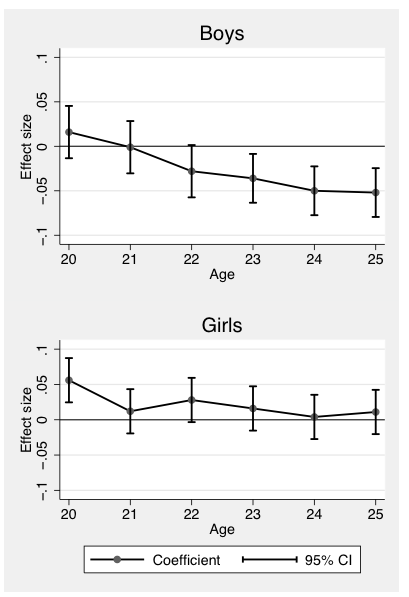
To assess the long-run effect of divorce, we analyse children’s human capital and demographic outcomes. First, we examine college attendance. In Austria, college attendance implies that this person graduated from a higher secondary school. Second, we check the labour market status (employed; unemployed; out-of-labour force) up to the age of 25 years. Third, we examine children’s own family formation behaviour (i.e. fertility and marriage). Finally, we investigate the probability of early mortality (below 25 years of age). Our results show that parental divorce – due to a high level of sexual integration in fathers’ workplaces — has a negative effect on children’s long-term outcomes. Our main findings for human capital outcomes are summarised in Figure 1…
Here’s Figure 1:
Figure 1 (click for larger image)
And Figure 3: The effect of parental divorce on employment over time.
Figure 3
If you want boys to transition into marriage-minded men, you need to fight against no-fault divorce.
The War Against Boys
The other problem affected boys is also rooted in feminism. Feminism is deeply suspicious of male teachers and male administrators in the schools. As a result, schools tend to be dominated by female teachers and female administrators. Many of these women are feminists, and they seek to change the nature of education from something that is fair to boys and girls, to something that punishes boys and gives the advantage to girls. In addition, feminists in the education industry tend to oppose allowing boys to attend all-male schools, where boys perform at much higher levels.
This article in the left-leaning The Atlantic explains how the school system punishes boys and favors girls – from kindergarten to the workplace, where women receive affirmative action preferences.
Excerpt:
American boys across the ability spectrum are struggling in the nation’s schools, with teachers and administrators failing to engage their specific interests and needs. This neglect has ominous implications not only for the boy’s social and intellectual development but for the national economy, as policy analysts are just beginning to calculate.
[…]Women in the United States now earn 62 percent of associate’s degrees, 57 percent of bachelor’s degrees, 60 percent of master’s degrees, and 52 percent of doctorates.
Boys in all ethnic groups and social classes are far less likely than their sisters to feel connected to school, to earn good grades, or to have high academic aspirations. A recent working paper from the National Bureau of Economic Research documents a remarkable trend among high-achieving students: In the 1980s, nearly the same number of top male and female high school students said they planned to pursue a postgraduate degree (13 percent of boys and 15 percent of girls). By the 2000s, 27 percent of girls expressed that ambition, compared with 16 percent of boys. During the same period, the gap between girls and boys earning mostly A’s nearly doubled—from three to five percentage points.
This gap in education engagement has dire economic consequences for boys. A 2011 Brookings Institution report quantifies the economic decline of the median male: For men ages 25 to 64 with no high school diploma, median annual earnings have declined 66 percent since 1969; for men with only a high school diploma, wages declined by 47 percent. Millions of male workers, say the Brookings authors, have been “unhitched from the engine of growth.” The College Board delivered this disturbing message in a 2011 report about Hispanic and African-American boys and young adults: “Nearly half of young men of color age 15 to 24 who graduate from high school will end up unemployed, incarcerated or dead.” Working-class white boys are faring only slightly better. When economist Andrew Sum and his colleagues at the Center for Labor Market Studies at Northeastern University examined gender disparities in the Boston Public Schools, they found that for the class of 2007, among blacks and Hispanics, there were 186 females for every 100 males attending a four-year college or university. For white students: 153 females to every 100 males.
Note that radical feminists and socialists oppose solving this problem:
In the U.S., a powerful network of women’s groups works ceaselessly to protect and promote what it sees as female interest. But there is no counterpart working for boys—they are on their own.
[…]The reluctance to face up to the boy gap is evident at every level of government. In Washington, President Obama established a White House Council on Women and Girls shortly after taking office in 2009, declaring: “When our daughters don’t have the same education and career opportunities as our sons, that affects…our economy and our future as a nation.” On the other hand, the proposal for a Council for Boys and Men from a bi-partisan group of academics and political leaders has now been languishing in Secretary of Education Arne Duncan’s office for two years.
Similarly, in Maine, the Portland Press Herald ran an alarming story about the educational deficits of boys—reporting that high school girls outnumber boys by almost a 2-1 ratio in top-10 senior rankings, that men earn about 38 percent of the bachelor’s degrees awarded by Maine’s public universities, and that boys both rich and poor had fallen seriously behind their sisters. But the director of Women’s Studies at the University of Southern Maine, Susan Feiner, expressed frustration over the sudden concern for boys. “It is kind of ironic that a couple of years into a disparity between male and female attendance in college it becomes ‘Oh my God, we really need to look at this. The world is going to end.’”
The rest of the Atlantic article explains how to solve this problem. And the proven solutions clearly show that the problem is not with boys, it’s with an education system that discriminates against boys, making it harder for them to learn the skills they need to find work.
So, the tendency of young men to stay home and play video games comes from discrimination against men in the education system, and no-fault divorce laws that allow spouses (mostly women) to divorce easily. It is women who need to do a better job of “womaning up” to attack no-fault divorce and discrimination against boys in school. But pro-male voices among women are few and far between. Women tend to go along with what makes them look good to others in the culture, and what gives them the most autonomy to pursue happiness (unless they are balanced out by strong men who lead them), and that means the most women tend to just ignore the root causes of male decline. When I see single women overwhelmingly supporting the anti-male Democrat party, it just tells me that they are not serious about marriage. Whether they intend to or not, they are killing marriage with their political support for misandry.
It would be nice if we got some leadership from pastors in the churches on this issue. It would be if nice the pastors could challenge women to think about how their voting and advocacy of certain policies affect boys. Basically, if pastors could get women to think “and then what happens” to boys who experience no-fault divorce and anti-male schools. But most pastors are like women, and they put more emphasis on being liked based on what is valued in the secular culture. It’s easier for them to remain ignorant and bash men than to pick up a book on education or divorce and read it. If we have a crisis of masculinity, it began in the church, from the “men” behind the pulpit. They need to man up and challenge the feminism that is killing marriage.
A new study of nearly 6,000 elementary school children has found that boys are discriminated against beginning in kindergarten. Christopher Cornwell, an economics professor at the University of Georgia, says that ”gender disparities in teacher grades start early and uniformly favor girls.”
Despite having higher scores on standardized tests, boys get lower grades than girls. Why? Because teachers are basing grades at least partly on classroom behavior, and the standards are very much geared to female norms.
[…]Here’s what the disparity looks like for kindergarten boys:
Std. Deviation
Test Scores
Grades
Reading
-.017
-.27
Math
+.02
-.15
Science
+.035
-.14
(Note: Values are approx., gauged visually from study graphic.)
Another interesting finding was that boys who adhere to female norms on non-cognitive skills were not penalized. Effectively, the more female behavior was rewarded with a grade “bonus” for males.
The implications of this are obvious. Masculinity, even normal maleness, is being punished in schools from a very young age. Only the most female-acting boys are rewarded with a fair assessment.
The results demonstrated that schoolteachers are prejudiced against boys. When teachers do not just grade on performance, but include a number of intangible qualities that girls are more likely to possess, they are acting as bigots.
I recommend that everyone pick up a copy of “The War Against Boys” by AEI scholar Christina Hoff Sommers to learn more about this anti-male discrimination problem.
I see a lot of people raving at men to “man up” these days. Many of those people are pastors who remain ignorant about the real, systemic causes of male underachievement. Even very obvious factors – like the dominance of female teachers and administrators in schools – are ignored by the blame-men crowd. Boys generally learn better when they learn from male teachers in all-male classrooms. But unfortunately for boys, there are people who don’t want to do what works for men, especially when it doesn’t fit with feminist ideology.


 WINTERY KNIGHT