
Tag Archives: Misandry

How can we get single men and husbands to be interested in church and ministry?

Church sucks, that's why men are bored there
Church is ineffective and impractical, and that’s why men are bored there

Consider this passage from William Lane Craig’s April 2013 newsletter, which made me very excited and happy. (H/T Triablogue)

Here it is:

One overwhelming impression of these engagements is the way in which the intellectual defense of Christian faith attracts men. Both at Texas A&M and again at Miami every single student who got up to ask a question was a guy! I wondered if the girls are just shy. But then I remembered a lengthy clip Jan and I watched of cast members of Downton Abbey doing a Q&A with an audience in New York. Almost every person who came to the microphone at that event was a woman! It wasn’t until late into the evening that a man finally asked a question, which was remarked by all the cast members. Why the difference between that session and the ones I experienced?—simply because the Downton Abbey program is highly relational, which is more appealing to women, whereas my talks were principally intellectually oriented, which is more appealing to men.

Churches have difficulty attracting men, and the church is becoming increasingly feminized. I believe that apologetics is a key to attracting large numbers of men (as well as women) to church and to Christ. By presenting rational arguments and historical evidences for the truth of the Gospel, by appealing to the mind as well as the heart, we can bring a great influx of men into the Kingdom. I’m so pleased that the church in Canada seems to be awakening to this challenge! I’m convinced that we have the opportunity to revolutionize Western Christianity by reclaiming our intellectual heritage.

Now, I hear a lot of complaints from women in the church and pastors in the church about men not being interested in going to church. I think that the problem is that church is hostile to men’s natures. Men thrive on conflict and competition. Men prefer strict rules and moral judgments. Men prefer to shame people who underperform, rather than coddle them. Men are practical and results focused. So how should the church accommodate the different nature that men have? Apologetics is one way to appeal to the male nature.

Let’s take a look at it.

Pastors: church as it is now is abrasive to men’s male nature

In a recent William Lane Craig podcast, at time 8:47, the WLC tells Kevin Harris about how he and his wife Jan asked about six of the young men who attend his “Defenders” apologetics class which morning service they attended: traditional or contemporary. ALL of the young men said that they attended neither service, because they go to church to learn something and the service has no educational value to them. The only attend the Defenders class. The apologetics class taught them things they could actually use – things they could actually use to think better, and fight better. This is my experience as well, although I am looking for a better church that does have some appeal to men. I might even have to move to find a decent church that has apologetics.

There is absolutely nothing going on in most churches that is valuable to a man. Men, by and large, only pray as a last resort, after we have done everything we can to solve the problem ourselves. We pay the most attention to the parts of the Bible that help us debate with non-Christians, or that give us things to do. We like to find evidence in the real world that connects with what the Bible is saying. We are interested in planning, execution and results. We are not very interested in feelings, singing, devotions, or bending the rules to make people doing bad things feel good. Now that’s not necessarily true for all men, but it is true for the majority of men.

And lest some people worry that fighting makes enemies, it doesn’t. Fighting with non-Christians has two effects: 1) they respect Christianity more, and 2) they want to be your friends and talk to you about spiritual things. Atheists see your standing up for what you believe in and living consistently with it indicative of authenticity. That is not the exception, Christian women and pastors – that is the rule. Atheists don’t think that standing up for what you believe in makes Christianity look fake, they think it makes Christianity look authentic. Well, at least the ones who are worth talking to think that.

Wives: don’t choose men who had no interest in advocating for Christianity before you married them

A related problem I see is the problem of wives marrying the wrong men then complaining that the men they freely chose to marry are not interested in church. This is actually the woman’s fault. Most women don’t think about what is best for God when they think about who to marry and have children with, they think about what makes them feel good. They don’t have any kind of plan where they match the man’s ability to the roles he will play as husband and father – they just pick who makes them feel good. This works about as well as buying and selling stocks based on which make you feel good, or choosing electronics and computers based on the color, or choosing a job or a church based on what the building looks like. The Bible lays out a few minimal requirements for a man: chastity, self-sacrificial love, providing for family, leading on moral and spiritual issues. Most young, unmarried women don’t value those things. If a woman picks a man who doesn’t make any demands on them, and who doesn’t judge them, then she cannot depend on him to show spiritual and moral leadership later on in the marriage. So don’t pick a man like that.

Wives: men respond to attention, recognition and approval from women

The reason that most husbands don’t engage in Christianity is because most wives (not my married friends of course) haven’t approached Christianity as something that is objectively true. Men don’t create illusions for themselves in order to feel better – they are more practical than that. Men only invest in things that they think are true, and where they can see that their practical efforts will make a difference. Men are turned off by the view that Christianity is just something that helps families and communities bond, and makes people feel comfort. We think that’s weakness, and we abhor weakness. Once men get the idea that a woman thinks of Christianity as feelings-fulfillment, we stop trying to achieve anything for the Kingdom of God. Men don’t want to be roped into Christianity if all it means is helping people get along and feel good. But they very much want to be roped into a demanding relationship with God where their efforts to achieve results count with God and gets them recognition and approval from their wives.

So how do wives learn to recognize and approve of what men do as Christians? Well, women need to learn apologetics and they need to practice debating with non-Christians. That will teach them to value conflict and competition, and to see how engagement and authenticity drives relationships with non-Christians forward. If women show an interest in objective truth, moral goodness and theological correctness, then men will become interested in these things, too. They will do it because men are addicted to pleasing women, and they want to help women more than anything in the world, second only to pleasing God. Men will enthusiastically engage in whatever will get them praise and recognition from women, and that means that women have to care about Christianity beyond their personal emotional experience of it and beyond their social cohesion experience of it. Initially, wives must be ready to praise and encourage their husbands, and then once the husbands get it, then they will be self-motivated and move out on their own. It will be self-sustaining.
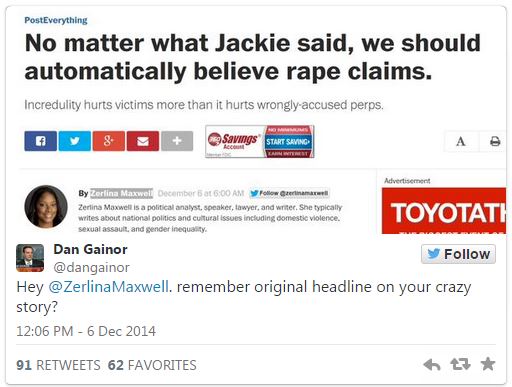

We need to teach women to not make false accusations of rape

Zerlina Maxwell writes in the Washington Post: “we should automatically believe rape claims”

Here’s the news story that is prompting this post, from the Washington Free Beacon.

Excerpt:

Rolling Stone settled the defamation lawsuit filed by a University of Virginia fraternity over a false story about a rape on campus, agreeing to pay $1.65 million on Tuesday.

The lawsuit stemmed from the 2014 story “A Rape on Campus,” published in Rolling Stone by Sabrina Rubin Erdely. The story detailed the sexual assault of a woman identified only as “Jackie” at the Virginia Alpha Chapter of the Phi Kappa Psi fraternity.

The story was officially retracted in 2015 after a police investigation did not find any evidence to back up the story. News outlets also began to question Jackie’s story, and once again did not find any evidence to confirm her account.

The fraternity sought $25 million and settled for $1.65 million. Phi Kappa Psi plans to donate a “significant portion” to groups that provide sexual assault awareness education, prevention training, and victim counseling services, according to the Associated Press.

Rolling Stone and Erdely had an agenda, and they were recklessly oblivious to the harm they would cause innocent victims in their ruthless pursuit of that agenda,” the fraternity’s lawsuit said.

Rolling Stone settled another defamation lawsuit against university administrator Nicole Eramo for $3 million.

Naturally, the liberal mainstream media – which anxiously reported on the hoax – is not nearly as interested in reporting on the correction. Because they have their agenda of blaming men for the free choices that women make. But it’s not just liberal mainstream media that pushes the rape culture myth. At the time this Rolling Stone story came out, I remember that traditional pro-marriage advocates like Brad Wilcox gleefully tweeted the false rape accusation story, and then had to take it back later. So this was by no means seen through at the beginning, except by men’s rights activists who were familiar with the nature of false rape hoax stories. “Pro-marriage” people are anxious to prove that they can fit in with liberals, and if they have to denigrate men to do it, they will.

So why do some women lie about rape? Let’s look at a study.

Studies show about 40% of rape accusations are false

False accusations of rape or sexual assault are commonly used by women to get attention and sympathy, or to get an alibi when they’ve done something wrong, or to get revenge on someone who has rejected them.

Here’s a Fox News article from a prominent equity feminist, Wendy McElroy.

Excerpt:

“Forty-one percent of all reports are false.”

This claim comes from a study conducted by Eugene J. Kanin of Purdue University. Kanin examined 109 rape complaints registered in a Midwestern city from 1978 to 1987.

Of these, 45 were ultimately classified by the police as “false.” Also based on police records, Kanin determined that 50 percent of the rapes reported at two major universities were “false.”

Although Kanin offers solid research, I would need to see more studies with different populations before accepting the figure of 50 percent as prevalent; to me, the figure seems high.

But even a skeptic like me must credit a DNA exclusion rate of 20 percent that remained constant over several years when conducted by FBI labs. This is especially true when 20 percent more were found to be questionable.

False accusations are not rare. They are common.

If you would like to get an idea of how false rape accusations are handled by the police, here is an example. Usually no charges are filed against the women, or if charges are filed, then they get off without jail time. Meanwhile, men falsely accused of rape spend years in jail, until the women finally admits she made the whole thing up. The presumption is that women always tell the truth, and that evidence isn’t needed to prove her charges.

False accusations in divorce trials

False accusations of domestic violence and sexual abuse are also commonly made during divorce settlements in order to get custody of the children, and the attendant benefits.

Consider this article from Touchstone magazine, by Stephen Baskerville.

Excerpt:

Today it is not clear that we have learned anything from these miscarriages of justice. If anything, the hysteria has been institutionalized in the divorce courts, where false allegations have become routine.

What is ironic about these witch-hunts is the fact that it is easily demonstrable that the child abuse epidemic—which is very real—is almost entirely the creation of feminism and the welfare bureaucracies themselves. It is well established by scholars that an intact family is the safest place for women and children and that very little abuse takes place in married families. Child abuse overwhelmingly occurs in single-parent homes, homes from which the father has been removed. Domestic violence, too, is far more likely during or after the breakup of a marriage than among married couples.

Yet patently false accusations of both child abuse and domestic violence are rampant in divorce courts, almost always for purposes of breaking up families, securing child custody, and eliminating fathers. “With child abuse and spouse abuse you don’t have to prove anything,” the leader of a legal seminar tells divorcing mothers, according to the Chicago Tribune. “You just have to accuse.”

Among scholars and legal practitioners it is common knowledge that patently trumped-up accusations are routinely used, and virtually never punished, in divorce and custody proceedings. Elaine Epstein, president of the Massachusetts Women’s Bar Association, writes that “allegations of abuse are now used for tactical advantage” in custody cases. The Illinois Bar Journal describes how abuse accusations readily “become part of the gamesmanship of divorce.” The UMKC Law Reviewreports on a survey of judges and attorneys revealing that disregard for due process and allegations of domestic violence are used as a “litigation strategy.” In the Yale Law Review, Jeannie Suk calls domestic violence accusations a system of “state-imposed de facto divorce” and documents how courts use unsupported accusations to justify evicting Americans from their homes and children.

I often hear men, especially men in the church, complaining that young men won’t get married because they are too busy watching porn and playing video games. But maybe the real reason is that they don’t want to be exposed to domestic violence laws and divorced courts that are waiting to separate them from their earnings.

If the church isn’t speaking out against premarital sex (to women) and against no-fault divorce (to women) and against biased domestic violence laws (to women), then they have no one to blame for the so-called “marriage strike” but themselves. Unfortunately, it seems that no one who advocates for marriage has the courage to attack the root cause of the marriage decline: women’s own irresponsible choices. When women choose immoral men and then choose to have sex with them before marriage, they have no one to blame but themselves for the damage that results.

Domestic violence rates

Here’s a recent article in the radically leftist UK Guardian that summarizes the evidence that women commit domestic violence at the same rates as men.

Excerpt:

Domestic violence has traditionally been understood as a crime perpetrated by domineering men against defenceless women. Research spanning over 40 years has, however, consistently found that men and women self-report perpetrating domestic violence at similar rates. Professor John Archer from the University of Central Lancashire has conducted a number of meta-analytic reviews of these studies and found that women are as likely to use domestic violence as men, but women are twice as likely as men to be injured or killed during a domestic assault. Men still represent a substantial proportion of people who are assaulted, injured or killed by an intimate partner (50%, 30% and 25% respectively).

If the empirical research is correct in suggesting that between a quarter and half of all domestic violence victims are men, a question follows: why has women’s domestic violence towards men been unreported for so long, and what has changed in the last five years to make it more visible?

One reason may be the feminist movement. Feminism took up the cause of domestic abuse of women in the 1970s, with the world’s first women’s refuge being opened by Erin Pizzey in 1971. Feminism understood domestic violence as the natural extension of men’s patriarchal attitudes towards women, leading men to feel they had the right to control their partners, using violence if necessary. Feminists campaigned successfully to bring the issue into the public arena, thereby securing resources to establish services to help victims. This activism and advocacy led to governmental and public acceptance that “domestic violence” was synonymous with violence against women.

[…]The dual stereotypes of the violent man and passive woman have undoubtedly obscured the existence of male victims of domestic violence in the past. Men were also unlikely to view their own victimisation as either domestic violence or a criminal assault, and so were unlikely to seek help.

More domestic violence studies from multiple countries are discussed here. They confirm the study discussed above – the rates are similar for men and women. But all the taxing and spending is for women, not men. It’s a huge difference in how women and men are treated, just like there is a difference in concern and spending with breast cancer vs prostate cancer.

I’ve only met one unmarried woman in my entire life who was aware of all of these injustices against men. And yet so many women want to get married, and think they are qualified for marriage. What kind of friend could a woman be to a man, when she only knows about the trendy problems that concern leftists (global warming, rape culture, transgenders in bathrooms, etc.) but nothing about the problems that face unmarried men – especially if they take on the challenges of marriage and fatherhood? The typical young, unmarried woman today (Christian and non-Christian) is pro-abortion, pro-no-fault-divorce, pro-big-government,  a radical feminist and anti-male. Why do they think that marriage is something they deserve? What exactly is it that they offer a man?

Men on strike: the social changes that caused men to opt out of marriage

SurveyMonkey election poll cross tabs for unmarried women Nov 2016
SurveyMonkey election poll cross tabs for unmarried women only Nov 2016

I read and enjoyed Dr. Helen Smith’s book “Men on Strike” last year. The book explains a few of the developments that have led to men underperforming in school and in the workplace, and opting out of marriage and fatherhood.

Dr. Helen comes to this problem as a secular libertarian, not as a Christian conservative.

A review of Dr. Helen’s book appeared in Salvo magazine. The review is written by Terrell Clemmons, who has the best Christian worldview of any woman I know – I frequently rely on her advice.

Terrell writes:

While the feminist movement may originally have been about equal respect for both sexes, what it has morphed into, she argues, is female privilege. From rape laws that empower women but not the men they may falsely accuse, to divorce laws tilted in favor of the wife, to the feminization of the U.S. education system, men have become the sex under the gun, while women enjoy the status of a protected class.

But unlike their mothers or grandmothers, men today are not taking to the streets burning their undergarments and shrieking demands (thank God). They’re doing just the opposite, which is far worse. They’re going on strike. The strike zones are manifold:

Higher Education.In addition to the enrollment imbalance, which is approaching a 60/40 ratio of women to men, college has become, in the words of one professor, “a hostile working environment [in which] males increasingly feel emasculated.” Smith quotes a student named John, who had this to say about his college experience: “I had already been cautious around women, having grown up with Tawana Brawley in my backyard and daily stories of sexual harassment; I played it safe and passive every time. But it doesn’t matter. The only way not to lose is to not play. So I’m out.”

Work,including community involvement. With higher female graduation rates and salaries, men today are falling behind their fathers economically and professionally. Consequently, their efforts to prove themselves worthy mates through hard work and higher earnings don’t win female attention the way they used to. Discouraged, too many retreat to a man cave, and inertia sets in from there.

Marriage.Marriage rates are down, and honest men opting out will tell you why. Smith cites a Rutgers University study of single heterosexual men which turned up the top reasons they hadn’t married. They can get sex and the companionship of cohabitation without marriage more easily than in times past, and they don’t want to open themselves up to the risk of divorce and financial loss. It really isn’t that complicated a decision. In fact, it’s often not an actual decision at all. It just happens.

The simplest explanation for the difficulties that boys face in an education system that is dominated by women (teachers and administrators) is discrimination. And in the workplace, the government requires employers to report on male and female head counts, and promote women who are not qualified. I have seen receptionists with tattoos and no college degrees promoted to six-figure manager jobs in companies where I worked.

There is one more which to me was the most surprising one in the book – paternity fraud, and the laws that support paternity fraud:

Take the following cases of nonconsensual insemination: Nathaniel from California, age 15, had sex with 34-year-old Ricci, which, due to his age, was legally considered nonconsensual. Emile from Louisiana was visiting his parents in the hospital when a nurse offered him oral sex, if he wore a condom, which she conveniently offered to dispose of for him afterward. S. F. from Alabama passed out drunk at the home of a female friend and awoke undressed the following morning. In all three cases, including the one involving the minor, a woman got sperm and, nine months later, a child, and the man got ordered by a court of law to pay support for eighteen years.

Less devious, but similarly amiss, are those cases in which a man, having been betrayed by his wife or girlfriend, was nevertheless held financially responsible for a child genetically proven to be another man’s offspring. While not as sensational as sperm-jacking, it is another form of paternity extortion.

In each of those cases, the man was found liable to pay child support – including the case of the 15-year-old boy, who was forced to pay child support to his statutory rapist when he turned 18. This is how the court system works, and more and more men are understanding the risks.

I often encounter “pro-marriage” people while gathering stories for the blog. These pro-marriage people come in two varieties.

On the one end of the spectrum are people like Terrell Clemmons and Jennifer Roback Morse, who understand marriage, but who also understand the social changes that have made marriage unattractive for men. Both Clemmons and Morse have a background in STEM fields, so they are able to understand incentives and tradeoffs. They understand that society has to rollback the changes to education, divorce laws, etc. if they expect men to be interested in marriage again. They understand that men are not just accessories of women, but instead have their own desires, feelings and reasons for marrying.

On the other end of the spectrum are feminist men, who are not able to understand the changing incentives that face men in a world that has evolved under the influence of radical feminism. It is just simpler (less thinking) for these men to accept the radical feminism as a given, and then urge men to “man up”. I think a much better idea would be for the “man up” crowd to realize how marriage has changed, and how the schools and the workplace have changed, then make all of these things more attractive to men. It doesn’t do any good to try to “dare” men into jumping off a cliff. Men aren’t stupid, and they do what is in their own best interests. If the man-up crowd wants younger men to marry, then they need to change the incentives offered to men. And that means changing women first.