Tag Archives: Million

A third Obama-subsidized green energy firm is bankrupt after $118.5 million loan

CNS News explains how well stimulus spending stimulates the economy.

Excerpt:

 The third federally subsidized green energy company to declare bankruptcy seems to indicate a pattern, said Rep. Cliff Stearns, chairman of the House Energy and Commerce subcommittee on oversight and investigations.

“One bankruptcy may be a fluke, two could be coincidence, but three is a trend,” Stearns said in a written statement. “Our investigation continues, and we are working to ensure taxpayers never are never again stuck paying hundreds of millions of dollars because of the administration’s risky bets.”

Ener1, which makes batteries for electric vehicles, announced Thursday it had filed for Chapter 11 bankruptcy protection. The company had been awarded a $118.5 million from the Energy Department through the American Recovery and Reinvestment Act, better known as the stimulus.

The Obama administration has already been under fire for a $535 million stimulus-funded loan it made to California-based solar panel company Solyndra, which filed for Chapter 11 bankruptcy protection last fall before being raided by the FBI. The House Energy and Commerce Committee has been investigating the Solyndra loan.Also late last fall, the Massachusetts-based Beacon Power, green energy storage plant that got $43 million in stimulus funds, filed for Chapter 11 bankruptcy protection.

Ener1 announced the Chapter 11 filing one year to the day that Vice President Joe Biden visited a Greenville, Ind. plant on Jan. 26, 2011.

If we want the economy to do well, then we need to elect someone who understands free market capitalism – not a socialist community organizer. Let the private sector create jobs. They know how to compete. They know how to survive. They know how to give customers what they want. They know how to be efficient.

Related posts

Mitt Romney’s tax returns would make him lose the election to Obama

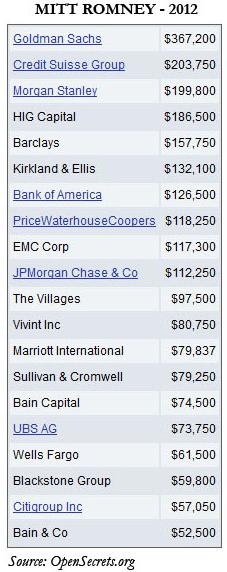
Wall Street Banks contributions to Mitt Romney
Wall Street banks make huge contributions to Mitt Romney

From The Hill. (H/T Riehl Worldview)

Excerpt:

It’s important not to overstate the perils Romney faces. He is still by far the best-funded candidate in the race. He has a state-by-state infrastructure that is the envy of his rivals. Even if he were to lose Saturday’s South Carolina primary, he would  likely remain the overall favorite to clinch the nomination.

But the procession of errors has been striking nonetheless — and it has raised concerns among many in the GOP about his vulnerabilities in a general election contest with President Obama.

Most of Romney’s awkwardness has revolved around questions about his wealth. During a heated exchange during a debate last month, he ill-advisedly offered to bet Perry $10,000 that his own account of what he had written in one of his books was correct. Perry declined, saying he was “not in the betting business,” but the episode heightened perceptions that Romney is out of touch with most Americans.

The same pattern keeps cropping up. Earlier this week, he was asked about the effective tax rate he pays on his income, and managed to injure himself twice in the space of a few sentences. First, he acknowledged that his tax rate was “probably closer to the 15 percent rate than anything.” He then added: “I get speaker’s fees from time to time, but not very much.”

The first claim was almost certainly true. Romney’s income is believed to come chiefly from long-term investments rather than earned income, and that would indeed make him liable for capital gains tax levied at a 15 percent rate. But it still places the multimillionaire in a more lightly taxed band than many voters — something which Newt Gingrich tried to take advantage of with his mocking proposal to introduce a “Mitt Romney 15 percent flat tax.”

Perhaps even worse was Romney’s “not very much” comment. His latest financial disclosure form, which covered the period from February 2010 to February 2011, revealed that he earned $374,327 for speeches. The sum is approximately seven times the median household income in the United States.

Those remarks had been preceded by a televised debate at which he gave a muddled response about whether he would release his tax returns.

Romney flubbed the tax-return question for a second time at a debate last Thursday, eliciting boos from the crowd when he said he would “maybe” follow the example of his late father, former Michigan Gov. George Romney, who released 12 years of tax returns when running for the presidency in 1968.

Romney’s mangled syntax on these occasions seems symptomatic of a wider personal unease in discussing his finances. GOP consultants say he needs to get over that discomfort if he is to prove an effective candidate.

Another concern that I have is that Mitt Romney has $20-100 million dollars in his retirement account.

Excerpt:

Like many Americans, Mitt Romney has an individual retirement account. Unlike most Americans, Mr. Romney has between $20.7 million and $101.6 million in it, a big chunk of his fortune.

Experts on estate planning said it is highly unusual to accumulate such a considerable sum in an IRA, an investment vehicle restricted by annual contribution limits. It appears that Mr. Romney’s grew so large mostly because it holds investments in Bain Capital, the private-equity firm he helped start.

[…]Mr. Romney is one of the richest presidential candidates in decades, and his GOP opponents increasingly are trying to turn wealth into a liability. President Barack Obama is expected to do the same if the former Massachusetts governor wraps up the nomination. Mr. Romney’s tax liability has emerged as a debating point in the GOP nominating contest, a proxy for a bigger argument over who should shoulder the nation’s tax burden.

In recent days, Mr. Romney’s rivals have pressed him to release his tax returns. They have attacked him for his role at Bain Capital, the source of his wealth. When Mr. Romney revealed Tuesday that his effective federal income-tax rate had been about 15% in recent years, both the White House and GOP candidates used the number as a cudgel.

[…]Michael Whitty, a lawyer at Vedder Price in Chicago who advises private-equity executives, said it is impossible to determine from Mr. Romney’s public disclosures how the IRA grew so large. Based on its listed holdings, which include many Bain Capital vehicles, Mr. Whitty theorizes Mr. Romney may have invested in Bain funds through a 401(k)-type plan, or directed some of his Bain holdings into such a plan, which he then rolled into an IRA.

How is he going to explain that? This might be one of the reasons why Romney is not releasing his tax returns. He needs to be pounded on this by Gingrich and Santorum until he drops out – we can’t afford to choose a nominee who has no hope of beating Barack Obama.

Related posts

Bad news for believers in naturalistic explanations of the Cambrian explosion

Before we see the new discovery, let’s review what the Cambrian explosion is all about.

Video 1:

Video 2:

Casey Luskin explains the new discovery at Evolution News.

Excerpt:

A recent article in Science begins by observing that the lack of evolutionary ancestors for the animal phyla that appear abruptly in the Cambrian explosion has been troubling to many evolutionary scientists:

Ever since Darwin there has been a disturbing void, both paleontological and psychological, at the base of the Phanerozoic eon. If his theory of gradualistic evolution be true, then surely the pre-Phanerozoic oceans must have swarmed with living animals — despite their conspicuous absence from the early fossil record.

(N. J. Butterfield, “Terminal Developments in Ediacaran Embryology,” Science, Vol. 334:1655-1656 (December 23, 2011).)

The articles goes on to explain that in 1998, tiny fossil animal embryos were reported that offered “palpable relief” to those evolutionary scientists worried about the lack of Precambrian ancestors.

However, new analyses of these microfossils now strongly suggest that they were not multicellular animals, and thus could not be Precambrian multicellular metazoa that have long been the holy grail for evolutionary paleontologists. Rather, they likely represent single-celled amoeba-like organisms.

[…]A Science Daily article on the study explains that many Darwinian scientists will be dismayed by the results of this study:

Professor Philip Donoghue said: “We were very surprised by our results — we’ve been convinced for so long that these fossils represented the embryos of the earliest animals — much of what has been written about the fossils for the last ten years is flat wrong. Our colleagues are not going to like the result.”

How did the investigators determine the nature of these ancient organisms? The fossils were exceptionally well preserved, such that, as the lead author on the paper stated, “the fossils are so amazing that even their nuclei have been preserved.” These allowed the authors to determine that these were in fact eukaryotic organisms, but not multicellular animals.

Casey goes on to answer the response by naturalists that “the fossil record is incomplete”.

I think it’s important, when deciding whether naturalistic evolution happened, to be aware of these problem areas. So often when discussing Darwinian evolution, people like journalists and philosophers and economists, etc. will just accept the theory because they trust in what experts tell them. There can be a lot of pressure in the university to not be seen as a dumb person, so that people will just go along with whatever their professor tells them to believe. And, that’s not necessarily a bad policy when time is short. However, that is taking evolution on blind faith. It’s a good thing, as we get older, to go back and revisit these things to see if they are really true.

For example, a really educated Darwinian should be able to finish a sentence like this: “People who doubt fully naturalistic evolution do so because of the following pieces of scientific evidence…” If you meet someone who cannot finish this statement, but who still espouses Darwinian evolution, then you know that you are dealing with someone who has jumped to the answer without really working through the problem by themselves. It can be very tempting, especially for artsy types, to just try to jump to the answer that all the smart people believe without really working through the problem. But that’s not a good way to decide what’s true. Everyone has to work through these problems themselves, and listening to the best people on both sides is the way to do that. People who question evolution nowadays don’t question that the universe is billions of years old or that scientific methods have to be used to answer scientific questions. By all means, let’s decide how we got here by appealing to science.

If you would like to see a nice hour-long video on the Cambrian explosion, then click here.

By the way, if you missed my previous post on the new discovery of oxygen in the early Earth’s environment, and the challenge it represents to naturalistic scenarios for the origin of life, then do check that out.