Tag Archives: Marriage

Two black economists explain how to end poverty in America

Economist Walter Williams

Walter Wiliams is one of my two favorite economists, the other being Thomas Sowell.

Here is his article on wealth and poverty on Creators written by Dr. Williams.

First, real poverty is not common in America:

There is no material poverty in the U.S. Here are a few facts about people whom the Census Bureau labels as poor. Dr. Robert Rector and Rachel Sheffield, in their study “Understanding Poverty in the United States: Surprising Facts About America’s Poor”, report that 80 percent of poor households have air conditioning; nearly three-quarters have a car or truck, and 31 percent have two or more. Two-thirds have cable or satellite TV. Half have one or more computers. Forty-two percent own their homes. Poor Americans have more living space than the typical non-poor person in Sweden, France or the U.K. What we have in our nation are dependency and poverty of the spirit, with people making unwise choices and leading pathological lives aided and abetted by the welfare state.

Second, the “poverty” is not caused by racism, but by poor choices:

The Census Bureau pegs the poverty rate among blacks at 35 percent and among whites at 13 percent. The illegitimacy rate among blacks is 72 percent, and among whites it’s 30 percent. A statistic that one doesn’t hear much about is that the poverty rate among black married families has been in the single digits for more than two decades, currently at 8 percent. For married white families, it’s 5 percent. Now the politically incorrect questions: Whose fault is it to have children without the benefit of marriage and risk a life of dependency? Do people have free will, or are they governed by instincts?

There may be some pinhead sociologists who blame the weak black family structure on racial discrimination. But why was the black illegitimacy rate only 14 percent in 1940, and why, as Dr. Thomas Sowell reports, do we find that census data “going back a hundred years, when blacks were just one generation out of slavery … showed that a slightly higher percentage of black adults had married than white adults. This fact remained true in every census from 1890 to 1940”? Is anyone willing to advance the argument that the reason the illegitimacy rate among blacks was lower and marriage rates higher in earlier periods was there was less racial discrimination and greater opportunity?

Third, avoiding poverty is the result of good choices:

No one can blame a person if he starts out in life poor, because how one starts out is not his fault.

If he stays poor, he is to blame because it is his fault. Avoiding long-term poverty is not rocket science. First, graduate from high school. Second, get married before you have children, and stay married. Third, work at any kind of job, even one that starts out paying the minimum wage. And finally, avoid engaging in criminal behavior. It turns out that a married couple, each earning the minimum wage, would earn an annual combined income of $30,000. The Census Bureau poverty line for a family of two is $15,500, and for a family of four, it’s $23,000. By the way, no adult who starts out earning the minimum wage does so for very long.

Fourth, what stops people from making good choices is big government:

Since President Lyndon Johnson declared war on poverty, the nation has spent about $18 trillion at the federal, state and local levels of government on programs justified by the “need” to deal with some aspect of poverty. In a column of mine in 1995, I pointed out that at that time, the nation had spent $5.4 trillion on the War on Poverty, and with that princely sum, “you could purchase every U.S. factory, all manufacturing equipment, and every office building. With what’s left over, one could buy every airline, trucking company and our commercial maritime fleet. If you’re still in the shopping mood, you could also buy every television, radio and power company, plus every retail and wholesale store in the entire nation”. Today’s total of $18 trillion spent on poverty means you could purchase everything produced in our country each year and then some.

Regarding those last two points, here is Thomas Sowell:
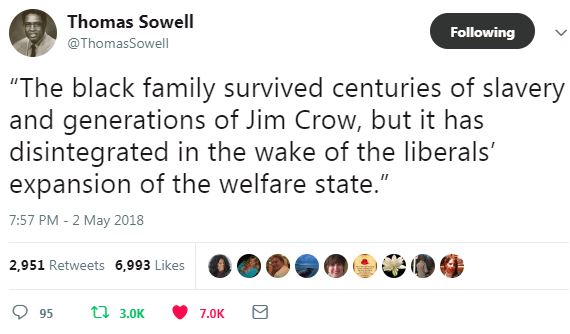
Economist Thomas Sowell blames welfare for killing the black family

To illustrate this point, here’s a graph with some helpful data taken from the U. S. Census.

Black women were more likely to be married before welfare programs

In fact, there is a whole video featuring Thomas Sowell to go with this graph:

And an article to go with it:

If we wanted to be serious about evidence, we might compare where blacks stood a hundred years after the end of slavery with where they stood after 30 years of the liberal welfare state. In other words, we could compare hard evidence on “the legacy of slavery” with hard evidence on the legacy of liberals.

Despite the grand myth that black economic progress began or accelerated with the passage of the civil rights laws and “war on poverty” programs of the 1960s, the cold fact is that the poverty rate among blacks fell from 87 percent in 1940 to 47 percent by 1960. This was before any of those programs began.

Over the next 20 years, the poverty rate among blacks fell another 18 percentage points, compared to the 40-point drop in the previous 20 years. This was the continuation of a previous economic trend, at a slower rate of progress, not the economic grand deliverance proclaimed by liberals and self-serving black “leaders.”

Ending the Jim Crow laws was a landmark achievement. But, despite the great proliferation of black political and other “leaders” that resulted from the laws and policies of the 1960s, nothing comparable happened economically. And there were serious retrogressions socially.

Nearly a hundred years of the supposed “legacy of slavery” found most black children being raised in two-parent families in 1960. But thirty years after the liberal welfare state found the great majority of black children being raised by a single parent.

The rest of the article points out how even crime rates among blacks were caused by the implementation of soft law enforcement policies by progressives. Just look at the big cities if you want to know what it is like for blacks to be ruled by Democrats. It sucks!

If everybody started to read more Thomas Sowell books, we would be much better off as a country! Only good things happen when people stop watching TV and listening to music and watching movies, and instead settle down in a chair with a Thomas Sowell book. I recommended a bunch of them in a previous post.
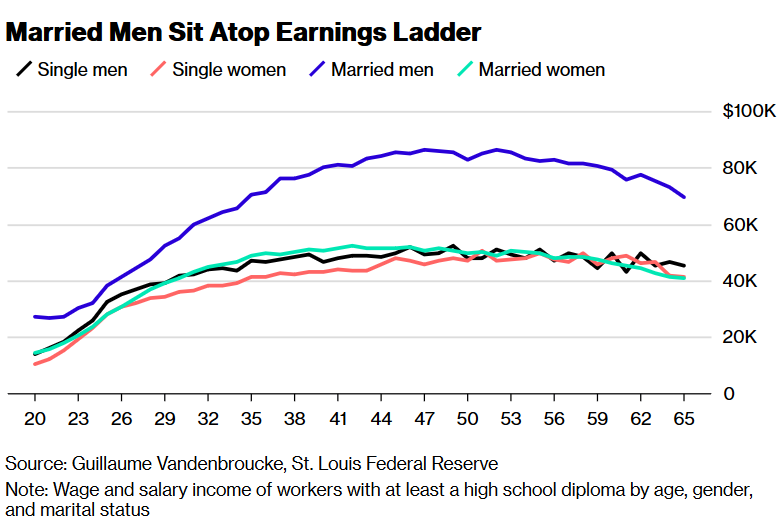

Why should a woman marry a man while she’s still under 25?

Married men seem to enjoy a boost in earnings from age 23-43
Married men seem to enjoy a boost in earnings between age 22-45

I saw a bunch of pro-marriage friends were tweeting about this article from the St. Louis Federal Reserve which talks about how well married men do financially compared to single men, and using it as a reason to argue that men should get married. The article from the St. Louis Reserve doesn’t have much commentary, but this article from the far-left Washington Post by Brad Wilcox has a lot to say.

Excerpt:

Marriage has a transformative effect on adult behavior, emotional health, and financial well-being—particularly for men.

[…]Men who get married work harder and more strategically, and earn more money than their single peers from similar backgrounds. Marriage also transforms men’s social worlds; they spend less time with friends and more time with family; they also go to bars less and to church more.

[…]Our research, featured in a recent report, “For Richer, For Poorer: How Family Structures Economic Success in America,” indicates that men who are married work about 400 hours more per year  than their single peers with equivalent backgrounds. They also work more strategically: one Harvard study found that married men were much less likely than their single peers to quit their current job unless they had lined up another job.

This translates into a substantial marriage premium for men. On average, young married men, aged 28-30, make $15,900 more than their single peers, and married men aged 44-46 make $18,800 more than their single peers.

That’s even after controlling for differences in education, race, ethnicity, regional unemployment, and scores on a test of general knowledge. What’s more: the marriage premium operates for black, Hispanic, and less-educated men in much the same way as it does for men in general.

For instance, men with a high-school degree or less make at least $17,000 more than their single peers.

So, what about these differences between married men and single men? Are men able to earn more if they have a wife to support them and care for their needs? Or is it just that women prefer men who are already able to take care of themselves?

Well, in most cases, it’s the former:

2. Married men are motivated to maximize their income. For many men, this responsibility ethic translates into a different orientation toward work, more hours, and more strategic work choices. Sociologist Elizabeth Gorman finds that married men are more likely to value higher-paying jobs than their single peers.

This is partly why studies find that men increase their work hours after marrying and reduce their hours after divorcing. It’s also why married men are less likely to quit a current job without finding a new job. Indeed, they are also less likely to be fired than their single peers.

3. Married men benefit from the advice and encouragement of their wives. Although there is less research on this, we suspect that men also work harder and more strategically because they are encouraged to do so by their wives, who have an obvious interest in their success. One study appears to buttress this point, finding that men with better-educated wives earn more, even after controlling for their own education.

4. Employers like married men with children.  There is evidence that employers  prefer and promote men who are married with children, especially compared to their childless male peers and to mothers. Married men are often seen as more responsible and dedicated workers and are rewarded with more opportunities by employers. While illegal bias and long-held stereotypes appear to play a role in this historic preference, it nonetheless helps explain why married family men get paid more.

Now what’s the purpose of me writing this? Well, I’m actually NOT writing this to pressure men to get married. Why not? Because although marriage was a pretty good deal 100 years ago, it’s not as good of a deal under the current laws and policies, e.g. – no-fault divorce, the threats of false accusations, the Sexual Revolution, etc. So I wouldn’t advise a man to rush into marriage to just anybody in order to get the financial (and health) benefits of having a wife. Marriage is only safe when you choose a woman carefully.

But I am writing this to women who are being told by the culture to delay marriage, and especially to delay marriage to use your youth and beauty to “have fun” with boys who won’t commit to marriage. If a woman loves a marriage-focused man and really wants to take care of him and support him, then early marriage is one of the very best ways to really help him during the years (22-45) when it really makes a difference. Marrying a man who wants marriage when you’re still young means that he will have many, many measurable benefits.

It’s important to marry a man when the marriage has the potential to do the most good for him in areas like health, career, finances and children. Men typically don’t want to marry women who are older, because they have more sexual experience and because they get used to giving a man sex in order to get him to do what she wants. Once a woman gets used to doing this, it becomes much harder to trust a good man to lead, and to give a man respect as a leader.

In addition, men know that women never change who they are really attracted to. If a woman chooses superficially attractive men who won’t commit over and over, then even if she “settles” for a man later on, she probably won’t be able to be attracted him. Men know not to choose women who won’t value them for their traditional moral values, conservative politics and ability to perform traditional male roles like providing. Men know that a woman who feels that she is “settling” for less than she deserves is more likely to disrespect him, and to withhold sex from him.

Now pro-marriage parents and pro-marriage pastors will typically tell you that they want to let their daughters decide when to marry, so that they will be happy having “fun” before marriage, and happy being provided for after marriage. But when those women are done playing the field and in their mid-thirties, their relatives and pastors are not thinking about what men’s interests are. They’re thinking about how to get this woman married, regardless of the man’s interests. And men know that. So they aren’t going to be bullied or shamed into a marriage after the window when it benefits them has closed. If parents and pastors want their daughters married AT ALL, then they need to encourage women to be self-controlled and marriage-focused EARLY.

Are men allowed to have preferences about which women are best for marriage?

Telling a woman how to make wise decisions protects her

So, in my last post, I explained why men have to be careful about choosing a wife. Men have plans and they need a woman with the right skills to achieve it. Even if a woman genuinely repents her past, she may not have developed the skills for a godly man’s marriage plan. For example, her 50K of student loans makes it harder to afford a stay-at-home homeschooling mother.

But many Christian women feel that there is no such thing as a Christian woman who is a bad candidate for marriage. It doesn’t matter what a Christian woman did in the past. A man should never evaluate her skills for the roles of wife and mother. After all, if God forgives a Christian woman for running up student loan debt for a useless women’s studies degree, or for getting drunk and sleeping around with hawt bad boys in college, then no Christian man should hold her past decisions against her when choosing a wife. Men are obligated to disregard the past anti-marriage decisions made by women. To do anything else is to deny the Gospel of Jesus Christ. So many Christian women say.

What would happen if the shoe were on the other foot? What if it were the MAN who had been selfish, lazy and irresponsible? What if the MAN had made choices that seriously harmed his ability to perform male marriage roles like protecting and providing for his wife and children? Would marriage-ready women be obligated to marry this man as much as a man who had remained chaste, got a good education, built up a gapless resume, saved enough for a downpayment on a house, and taught apologetics in his home church? Is she allowed to prefer a man who has made good decisions to prepare for his marriage roles over a man who has made horrible decisions, but just hollers “grace” when anyone questions his ability to be a husband and father?

This MUST-READ article from The Federalist asks and answers that question. (H/T Lindsay)

Do you agree with the author?

I think it’s time for a conversation about another elephant in the room: this idea that women prefer physically fit men with good jobs and no criminal record. It’s incredibly sexist and matriarchal to insist that women have a natural preference for men who have invested time and energy into stewarding their bodies, have shown the capability of earning a living and supporting a family, and have not gone to jail for attempting to grow 452 marijuana plants in their mother’s basement.

I know more than a few men who spent their twenties languishing in their parents’ homes, subsisting on Cheetos and Mountain Dew, playing Xbox, watching pornography, and smoking controlled substances. If one of these men turns his life around, accepts Jesus, and starts fresh, young women have no right to overlook him as a potential mate just because he is 280 pounds, has almost no marketable skills at 30 years old, and cannot vote, serve on a jury, or own a firearm. He is created in the image of God, and accepted by Jesus! Any women who would overlook every other noble quality he possesses for basic financial security and a clean background check (not to mention browsing history) isn’t a woman he should want.

Men like this have often long since repented of their listless and slothful ways. If the lingering consequences of their pasts didn’t stop Christ from living and dying for them, then it shouldn’t stop a Christian woman from loving them, either. Period.

The Federalist article makes it clear that a man’s poor choices about his education, job, obedience to the law, and physical fitness CLEARLY compromise his ability to perform his male duties to protect and provide. What about moral and spiritual leading? Well if he didn’t spent his teens and 20s studying  apologetics, moral issues, etc. then he isn’t going to compare favorably to a man who teaches apologetics in his church, debates atheists, and writes blog posts for the Life Training Institute.

My friend Lee is a superb stay-at-home wife and mother. She says that we shouldn’t accept “Jesus forgives me” as an immediate reversal of past harmful choices:

I would note that there is a difference between just being forgiven of sin and actually repenting of it. Repenting is a turning away from and will manifest in changes; paying down debts, becoming chaste, becoming otherwise responsible and wise. Someone’s past doesn’t have to define their future. But that will manifest in observable and measurable changes.

She’s right.

I knew a Christian woman who had 25,000 worth of student loan debt when she was 29. She wasn’t using her degree, she was just working as a waitress. I found her a job as an IT project manager in an FT100 company, so she could pay off her loans. She declined, because “being a waitress is the easiest job I’ve ever had”. She hasn’t worked full-time as a professional since January 2013. She’ll say “Jesus forgives me!” and “I hate my student loans!”, but the loans are even larger now, and the wasteful spending on fun and thrills hasn’t stopped. Hollering “grace” and saying you hate debt doesn’t make you a good steward – and you’ll need to be a good steward if you are in a marriage. She’s not ready to manage the finances of a household. If she had taken the job, and paid off the loans, then she would have overcome the mistake, and become marriage-ready.

So what’s really behind the hysteria against men evaluating women for marriage?

Deti nails the real root problem:

Not one person – NOT ONE PERSON – said that nonvirgins with tattoos and debt are bad people; that they are irredeemable, that they’re bad Christians; that they cannot be Christians; that they’re unsalvageable; that they’re ugly; or that they couldn’t and shouldn’t marry. That is NOT what was said.

All that was said was that men prefer tattooless, debtfree virgins for marriage. That’s all.

[…]The bible… teaches repentance is the way to salvation. But repentance does not mean you no longer bear the scars of your past sins in body and mind. You do. Oh yes you do. The effects can be minimized, even overcome. But they’re still there.

And more to the point, what’s really being complained about here is a Christian woman acknowledging that men have preferences and that men are entitled to have preferences. If women want men, then they have to satisfy those preferences or lower their standards until they find men whose preferences they can satisfy.

This can’t be overemphasized – it’s the idea that men have preferences. Its’ the idea that there’s a man that’s one-half of that relationship, and there are things HE wants, and HE needs, and HE desires. Why does it matter what HE wants? Why do we care about him?

Men don’t want to marry high N women. Men don’t want to take on debt and they don’t prefer markedup tatted up women who look and act like men.

What this gets down to is women objecting to men having standards. Because that leads to men judging women. And that leads to men evaluating women. And that leads to men rejecting some women and accepting others. And women hate judgment and rejection, especially when it’s “less than” men who are doing the judging and rejecting.

One of my editors for this post (Mary) didn’t think that some readers would know what N refers to, so I’ll tell you. N refers to the number of sexual partners a person has had.

The reason we discuss best practices for marriage-minded women is so that young women, especially young women who lack a father in the home, can get some kind of guidance about how to resist the culture’s lies about men, sex and marriage. Such a woman has NOWHERE TO GO in this culture in order to learn how to relate to men, and how to marry to a man who will love her faithfully and forever. That’s not fair! We have to help her!

What Christian men are doing by promoting chastity, sobriety, good stewardship and self-control to these young women is protecting them from a culture that lies to them. The well-meaning Christian women who think that talking about moral boundaries and wisdom will hurt the feelings of women who have made mistakes are actually making it harder for young women who have no guidance at all. The most vulnerable ones are the ones who need to hear that chastity is wise. Doing a STEM degree is wise. Getting out of debt by spending less is wise. Not seeking attention with graffiti on your body is wise. That’s what unmarried women need to hear.

It’s amazing to me that so many Christians do not understand the protective value of recommending Biblical morality and Biblical wisdom to young women. They would rather sacrifice these young women to the secular culture than allow older women to feel bad about their past decisions. So many Christians seem to be more concerned about their own feelings than about promoting and defending what the Bible teaches to young people who really need help.