Tag Archives: Marriage

Southern Baptist conference hosts Roman Catholic scholar to speak on the defense of marriage

Roman Catholic marriage defender Sherif Giris speaks to about 1500 Southern Baptists at the 2014 ERLC National Conference on “The Gospel, Homosexuality, and the Future of Marriage.” This is a very good introduction to the defense of marriage.

Topics:

  • his experience doing formal debates on the definition of marriage in the most liberal universities
  • the gay marriage side has no argument for redefining marriage it’s all emotions
  • on their view, what makes a marriage is a strong emotional bond
  • however their view does not rationally ground any of traditional marriage norms
  • it does not rationally ground the norm of marriage being permanent
  • it does not rationally ground the norm of marriage being sexually exclusive
  • it does not rationally ground the norm of marriage being for only two people
  • it does not rationally ground the norm of marriage involving sexual activity
  • it does not rationally ground the norm of marriage involving a connection to family life
  • if we redefine marriage to mean “emotional bond” all these features are not essential
  • the community of marriage involves cooperation: common actions towards a common end in a context of commitment
  • marriage unites two people at all levels
  • it unites them sexually for purpose: not for feelings, but for reproduction
  • the sexual act in marriage is oriented to generating family life, which requires commitment
  • family life leads naturally into the norms of permanence and exclusivity
  • the redefined view of marriage as emotional bonding is opposed to all of this
  • we can see the priorities of the redefiners in their support for no-fault divorce
  • they we acting on their view of making marriage about emotional fulfillment
  • they pushed by saying “how would no-fault divorce affect your marriage?”
  • no-fault divorce was the first marriage redefinition and it undermined permanence
  • it affected the entire community – a generation of kids raised without father
  • it causes a host of problems to kids, crime, lower test scores, earlier sexual activity, etc.
  • this is why marriage matters – to give children what they need
  • defending marriage as part of the Christian life
  • we have to understand the motives of the marriage redefiners and addressing their needs

I think it’s a good point to bring up no-fault divorce to show us how people on the secular left who want a more adult-friendly definition of marriage do their redefining at the expense of children. If this life is the only one you have, and there is no design for how humans ought to be, then it makes a lot of sense to maximize your own freedom and view your children as competitors against your happiness. Or, maybe you lie to yourself and say that fatherlessness and instability doesn’t really hurt children, because “children are resilient”.

The capacity for humans to deceive themselves when it comes to having freedom to “be happy” knows no bounds. It falls to us as Christians, then, to speak out for children – born and unborn. We are the only ones who still believe that in a conflict between adult selfishness and a child’s rights, that the child’s rights should win out. Children are not commodities, and there are more important things than our own happiness to consider. There are more important things than appearing “nice” to our peers to consider.

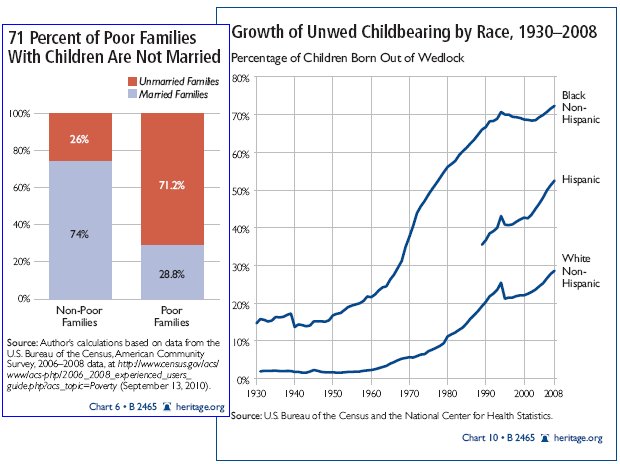
The biggest driver of income inequality is single motherhood

Welfare and out-of-wedlock births

Indian economist Aparna Mathur, whose work I’ve featured here before, writes about it in Forbes magazine.

Excerpt:

The fabric of our society is changing. In 1980, approximately 78 percent of families with children were headed by married parents. In 2012, married parents headed only 66 percent of families with children. In a new report, Bradford Wilcox and Robert Lerman explore the role of family structure with new data and analysis, and document how this retreat from marriage is not simply a social and cultural phenomenon. It has important economic implications for, amongst others, men’s labor force participation rates, children’s high school dropout rates and teen pregnancy rates. Since these factors are highly correlated with economic opportunity and the ability to move up the income ladder, this suggests that income inequality and economic mobility across generations are critically influenced by people’s decisions and attitudes towards marriage. Understanding the role of family structure is therefore key to understanding the big economic challenges of our time.

[…]Wilcox and Lerman document how the shift away from marriage and traditional family structures has had important consequences for family incomes, and has been correlated with rising family-income inequality and declines in men’s labor force participation rates. Using data from the Current Population Survey, the authors find that between 1980 and 2012, median family income rose 30 percent for married parent families, For unmarried parents, family incomes rose only 14 percent.

These differential patterns of changes in family income have exacerbated family-income inequality. Since unmarried parent families generally expand the ranks of low-income families, while high-income, high-education adults increasingly marry partners from similar socioeconomic backgrounds, inequality trends are worsened. Comparing the 90th percentile families to the 10th percentile families in 2012, the top 10 percent had incomes that were more than 11 times higher than the bottom 10 percent. However, if we restrict the sample to married families with children, the ratio drops to nearly 7, suggesting that within married families, income inequality is less stark. The authors estimate that approximately 32 percent of the growth in family-income inequality between 1979 and 2012 is associated with changes in family structure. Other research, studying the period 1968-2000, finds that the changing family structure, accounted for 11 percent of the rise widening of the income gap between the bottom and top deciles.

Another interesting observation relates to the trends in employment participation by men. The Wilcox-Lerman study finds that for married fathers, employment and participation rates have remained consistently higher than for married men with no children and unmarried men with no children. The authors speculate that between 1980 and 2008, about 51 percent of the decline in men’s employment rates can be associated with the retreat from marriage.

And why is single motherhood so ascendant today? Well, part of it is the loss of morality caused by secularism. If there is no God, then there is no way we ought to be, so let’s just do whatever makes us feel good, and pass the bill to the taxpayers. That only works, though, if we elect politicians who want taxpayers who are responsible to pay for the ones who are irresponsible.

So have we done that? Yes – Robert Rector explains in The Daily Signal.

He writes:

It is no accident that the collapse of marriage in America largely began with the War on Poverty and the proliferation of means-tested welfare programs that it fostered.

When the War on Poverty began, only a single welfare program—Aid to Families with Dependent Children —assisted single parents.

Today, dozens of programs provide benefits to families with children, including the Earned Income Tax Credit, Temporary Assistance for Needy Families, the Women, Infants and Children food program, Supplemental Security Income, food stamps, child nutrition programs, public housing and Section 8 housing, and Medicaid.

Although married couples with children can also receive aid through these programs, the overwhelming majority of assistance to families with children goes to single-parent households.

The burgeoning welfare state has promoted single parenthood in two ways. First, means-tested welfare programs such as those described above financially enable single parenthood. It is difficult for single mothers with a high school degree or less to support children without the aid of another parent.

Means-tested welfare programs substantially reduce this difficulty by providing extensive support to single parents. Welfare thereby reduces the financial need for marriage. Since the beginning of the War on Poverty, less-educated mothers have increasingly become married to the welfare state and to the U.S. taxpayer rather than to the fathers of their children.

As means-tested benefits expanded, welfare began to serve as a substitute for a husband in the home, and low-income marriage began to disappear. As husbands left the home, the need for more welfare to support single mothers increased. The War on Poverty created a destructive feedback loop: Welfare promoted the decline of marriage, which generated a need for more welfare.

A second major problem is that the means-tested welfare system actively penalizes low-income parents who do marry. All means-tested welfare programs are designed so that a family’s benefits are reduced as earnings rise. In practice, this means that, if a low-income single mother marries an employed father, her welfare benefits will generally be substantially reduced. The mother can maximize welfare by remaining unmarried and keeping the father’s income “off the books.”

For example, a single mother with two children who earns $15,000 per year would generally receive around $5,200 per year of food stamp benefits. However, if she marries a father with the same earnings level, her food stamps would be cut to zero.

So you see, the thing the left complains about the most is actually the thing they do the most to cause. They are all about taxpayer-funded welfare programs and growing government to make more and more people dependent. They are causing the income inequality and then complaining about what they cause.

Should Christianity be open and inclusive to those who practice idolatry?

Why, oh why, did I not write this parody of gay activist Matthew Vines. It’s entitled “The Case for Idolatry“. It’s a parody of Matthew Vines’ case for compatibility between Christianity and the gay lifestyle.

Excerpt:

For as long as I can remember, I’ve wanted to worship idols. It’s not that my parents raised me that way, because they didn’t; I was brought up in a loving, secure, Christian home. But from childhood until today, my heart has been drawn to idolatry. In fact, if I’m honest, one of the defining features of my identity has been my desire to put something else – popularity, money, influence, sex, success – in place of God.

That’s just who I am.

For many years, I was taught that idolatry was sinful. As a good Christian, I fought the desire to commit idolatry, and repented when I got it wrong. But the desire to worship idols never went away.

I wanted it to, but it didn’t.

So it has been such a blessing to discover that worshipping one God, and him alone, isn’t for everyone. There are thousands of Christians out there who have found faithful, loving ways of expressing worship both to God and to idols, without compromising either their faith or their view of Scripture. In recent years, I have finally summoned the courage to admit that I am one of them. Let me give you a few reasons why I believe that idolatry and Christianity are compatible.

I start with my own story, and the stories of many others like me. I am an evangelical, and I have a very high view of the Bible – I am currently studying for a PhD in biblical studies at King’s College London, which will be my third theology degree – as well as knowing both the ancient languages and the state of scholarly research. Yet, after much prayerful study, I have discovered the liberating truth that it is possible to be an idolatrous Christian. That, at least, is evidence that you can be an evangelical and an idolater.

Not only that, but a number of evangelical writers have been challenging the monolatrous narrative in a series of scholarly books. A number of these provide a powerful case for listening to the diversity of the ancient witnesses in their original contexts, and call for a Christlike approach of humility, openness and inclusion towards our idolatrous brothers and sisters.

Some, on hearing this, will of course want to rush straight to the “clobber passages” in Paul’s letters (which we will consider in a moment), in a bid to secure the fundamentalist ramparts and shut down future dialogue. But as we consider the scriptural material, two things stand out. Firstly, the vast majority of references to idols and idolatry in the Bible come in the Old Testament – the same Old Testament that tells us we can’t eat shellfish or gather sticks on Saturdays. When advocates of monolatry eat bacon sandwiches and drive cars at the weekend, they indicate that we should move beyond Old Testament commandments in the new covenant, and rightly so.

Secondly, and even more significantly, we need to read the whole Bible with reference to the approach of Jesus. To be a Christian is to be a Jesus-person: one whose life is based on his priorities, not on the priorities of subsequent theologians. And when we look at Jesus, we notice that he welcomed everyone who came to him, including those people that the (one-God worshipping) religious leaders rejected – and that Jesus said absolutely nothing about idols in any of the four Gospels.

Skip forward a bit:

We should also remember that, as we have discovered more about the human brain, we have found out all sorts of things about idolatry that the biblical writers simply did not know. The prophets and apostles knew nothing of cortexes and neurons, and had no idea that some people are pre-wired to commit idolatry, so they never talked about it. But as we have learned more about genetics, neural pathways, hormones and so on, we have come to realise that some tendencies – alcoholism, for example – scientifically result from the way we are made, and therefore cannot be the basis for moral disapproval or condemnation. To disregard the findings of science on this point is like continuing to insist that the world is flat.

With all of these preliminary ideas in place, we can finally turn to Paul, who has sadly been used as a judgmental battering ram by monolaters for centuries. When we do, what immediately strikes us is that in the ultimate “clobber passage”, namely Romans 1, the problem isn’t really idol-worship at all! The problem, as Paul puts it, is not that people worship idols, but that they “exchanged the glory of the immortal God for images” (1:23). Paul isn’t talking about people who are idolatrous by nature. He is talking about people who were naturally worshippers of Israel’s God, and exchanged it for the worship of idols. What else could the word “exchange” here possibly mean?

Not only that, but none of his references apply to idolatry as we know it today: putting something above God in our affections. Paul, as a Hellenistic Roman citizen, simply would not have had a category for that kind of thing. In his world, idolatry meant physically bowing down to tribal or household deities – statues and images made of bronze or wood or stone – and as such, the worship of power or money or sex or popularity had nothing to do with his prohibitions.

Read the whole thing. You might recognize these arguments from Matthew Vines’ debate with Michael Brown about whether you can be a practicing gay person and a Christian at the same time. I I summarized the debate in this post.

I wrote this in reaction to the debate:

Even heterosexuals who have not married are called upon to embrace lifelong celibacy. I am in my 30s and am a virgin because I have not married. I wouldn’t seek to reinrepret the Bible to allow premarital sex just because what I am doing is difficult. I would rather just do what the Bible says than reinterpret it to suit me. And it’s just as hard for me to be chaste as it would be for him to be. In short, it’s a character issue. He takes his right to recreational sex as non-negotiable, and reinterprets the Bible to suit. I take the Bible as non-negotiable, and comply with it regardless of whether it seems to make me less happy. With respect to the purposes of God for me in this world, my happiness is expendable. If I don’t find someone to marry, I’m going to be “afflicted” with the lifelong celibacy that Vines seems to think is torture, but let me tell you – God is happy with the contributions I am making for him, and if I have to be chaste through my whole life, I am 100% fine with that. I serve the King. And not the reverse.

So back to the parody. Apparently, Matthew Vines is saying that he doesn’t really use arguments like the ones above, so thankfully Samuel James has gone through Vines’ book and listed out exact quotes where he uses the arguments in the parody. This is worth a read as well – it’s really first class work, because a lot of people who think Christianity is supposed to be about us being happy and fulfilled buy into these reinterpretations of the Bible. We need to be ready with an answer.