Tag Archives: Marriage

Five liberal Democrat policies that hurt minorities

Marriage and Poverty

The five policies are:

  • higher minimum wage rates
  • opposition to school voucher programs
  • releasing criminals from jail
  • affirmative action
  • single mother welfare

This article is by Jason L. Riley, and it appeared in the Wall Street Journal.

Excerpt:

At the urging of labor unions, President Obama has pushed for higher minimum wages that price a disproportionate percentage of blacks out of the labor force. At the urging of teachers unions, he has fought voucher programs that give ghetto children access to better schools.

Both policies have a lengthy track record of keeping millions of blacks ill-educated and unemployed. Since the 1970s, when the federal government began tracking the racial achievement gap, black test scores in math, reading and science have on average trailed far behind those of their white classmates. And minimum-wage mandates have been so effective for so long at keeping blacks out of work that 1930, the last year in which there was no federal minimum-wage law, was also the last year that the black unemployment rate was lower than the white rate. For the past half-century, black joblessness on average has been double that of whites.

Last week the Justice Department said it would release some 6,000 inmates from federal prison starting later this month. The goal, according to the White House, is to ease overcrowding and roll back tough sentencing rules implemented in the 1980s and ’90s.

But why are the administration’s sympathies with the lawbreakers instead of their usual victims—the mostly law-abiding residents in low-income communities where many of these inmates eventually are headed? In dozens of large U.S. cities, violent crime, including murder, has climbed over the past year, and it is hard to see how these changes are in the interest of public safety.

The administration assures skeptics that only “nonviolent” drug offenders will be released, but who pays the price if we guess wrong, as officials have so often done in the past?

When Los Angeles asked the Rand Corp. in the 1990s to identify inmates suitable for early release, the researchers concluded that “almost no one housed in the Los Angeles jails could be considered non-serious or simply troublesome to their local communities” and that “jail capacity should be expanded so as to allow lengthier incarceration of the more dangerous.”

A 2002 federal report tracked the recidivism rate of some 91,000 supposedly nonviolent offenders in 15 states over a three-year period. More than 21% wound up rearrested for violent crimes, including more than 700 murders and more than 600 rapes. The report also noted the difficulty of identifying low-risk inmates. Auto thieves were rearrested for committing more than a third of the homicides and a disproportionate share of other violent offenses.

Keep in mind that when criminals are release, they don’t go move into wealthy progressive neighborhoods. It’s not the wealthy leftists elites who have to deal with the released inmates. It’s the poor, low-income minority neighborhoods that have to deal with them.

By the way, I covered the minimum wage argument here, and I covered the school choice argument here.

That covers the first 3 policies. This article from The College Fix covers the fourth policy, affirmative action.

It says:

A UCLA law professor critiques affirmative action as detrimental to the very people it strives to aid: minority students.

Professor Richard Sander, though liberal-leaning, has deemed affirmative action practices as harmful, a notion that contradicts a liberal view in college admissions, said Stuart Taylor, a nonresident senior fellow at the Brookings Institution.

[…]Sander began teaching law at UCLA in 1989. After a few years he garnered an interest in academic support and asked permission to analyze which strategies most effectively assist struggling students.

After reviewing statistics on performance, especially those of students with lower academic merit, he noticed correlations between race and academic success.

“I was struck by both the degree to which it correlated with having weak academic entering credentials and its correlation with race,” Sander said in a recent interview with The College Fix. “And as I looked into our admissions process I realized that we were giving really a large admissions preference.”

Sander noticed that students admitted into the law school with lower academic credentials than their peers had significantly lower percentages of passing the Multistate Bar Examination, Sander said. This especially pertained to minority students who were given special consideration in the admittance process due to their race rather than their academic preparedness.

He then began thinking about whether or not these students would have better chances of succeeding if they went to a less elite university, he said.

He called this discrepancy a mismatch; when minority students with lower credentials than their peers are accepted into more challenging universities and then suffer academically as a result.

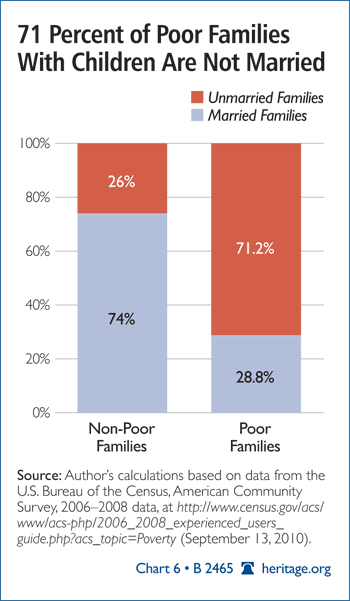
And the fifth policy is welfare. Welfare encourages women to not marry the men that they have sex with, since they will lose their single mother benefits if they do. Children who are raised fatherless are more likely to struggle in a number of areas, and they are especially likely to be poor. What we should be doing (if we really want to help the poor) is paying people to get married and stay married. But Democrats are opposed to that. The connection between welfare, fatherlessness, poverty and crime is explained in a previous post.


Study: remaining a virgin longer leads to more satisfying relationships

Boys and girls playing the famous co-operative board game
Boys and girls playing the famous co-operative board game “Pandemic”

OK, so this week I got to be a facilitator between a man and a woman in a relationship. I got to hear a bit about what they thought was appropriate in the area of physical touching. These two had made great decisions, and it protected them both. Anyway, thinking about them caused me to think about the studies I had posted about boundaries in sexual matters a few years back. So I’m going to re-post them to remind everyone not to be in a rush to say yes to premarital sex.

The first article from the UK Daily Mail is about study showing the benefits of abstinence for relationship quality.

Excerpt:

People who lose their virginity later than their teenage years are more likely to enjoy satisfying relationships later in life, according to a new study.

Researchers found that people who didn’t have sex until they turned 20 or even later are more likely to end up in a happy relationship.

[…]Previous research suggests that there may be cause for concern, as timing of sexual development can have significant immediate consequences for adolescents’ physical and mental health.

However, until now little had been done to study long-term outcomes, and how early sexual initiation might affect romantic relationships in adulthood.

Psychological scientist Paige Harden, of the University of Texas in the United States, set about changing this.

She wanted to investigate whether the timing of sexual initiation in adolescence might predict romantic outcomes – such as whether people get married or live with their partners, how many romantic partners they’ve had, and whether they’re satisfied with their relationship – later in adulthood.

Doctor Harden used data from the National Longitudinal Study on Adolescent Health to look at 1,659 same-sex sibling pairs who were followed from around the age of 16 to about the age of 29.

Each sibling was classified as having an ‘early’ (younger than 15), ‘on-time’ (age 15 to 19), or ‘late’ (older than 19) first experience with sexual intercourse.

Those who lost their virginity later on in life were more likely to have a well-paid job.

They found, as expected, later timing of first sexual experience was associated with higher educational attainment and higher household income in adulthood when compared with the early and on-time groups.

People who had a later first sexual experience were also less likely to be married and they had fewer romantic partners in adulthood.

Among the participants who were married or living with a partner, later sexual initiation was linked with significantly lower levels of relationship dissatisfaction in adulthood.

This sounds a lot like the results from the previous studies that were featured in this UK Daily Mail article.

Excerpt:

“Courtship is a time for exploration and decision-making about the relationship, when partners assess compatibility, make commitments and build on emotional and physical intimacy.”

“The rapid entry into sexual relationships may, however, cut short this process, setting the stage for “sliding” rather than “deciding” to enter co-habiting unions.”

“Around a third of the men and women said they’d had sex within the first month of dating, while about 28 per cent waited at least six months, the Journal of Marriage and Family reported.”

“Analysis of the data clearly showed the women who had waited to have sex to be happier. And those who waited at least six months scored more highly in every category measured than those who got intimate within the first month. Even their sex lives were better.”

“The link was weaker for men. However, those who waited to get physically involved had fewer rows.

[…]‘A strong sexual desire may thwart the development of other key ingredients of a healthy relationship such as commitment, mutual understanding or shared values,’ the report said. ‘Good sex is sometimes confused with love; some couples overlook problematic aspects of their relationship that ultimately matter more in the long run.’”

So, it looks like you lose some stability if you push too hard on the premarital sex. Is stability important to you? Well, divorce is a financial disaster for men and women – so that’s one reason to care about stability. If your plan for marriage is to provide a stable environment for your kids, then that’s another good reason to care about stability. If you are getting married in part to advance your cause through effective children, then you have to control yourself now in order to be the person who can give them what they need later. This is not out of your control, this is not unpredictable. There are best practices.

If you keep rushing into things and experiencing painful break-ups, you will naturally stop the behaviors that allow you commit out of self-preservation. You will begin to resent having to care for that other person, except maybe when it makes you feel good. When you invest a lot and break up, you become less willing to invest in that other person. You retreat into your shell. You resent having responsibilities and obligations to that other person. You expect things to work on their own, apart from your efforts to make them work, because that’s how you avoid getting hurt. You try not to invest too much, because you imagine that things will fall apart and you’ll get hurt again. You focus on just feeling good now, so that when the relationship fails, you come out “ahead”. But this is not the way to make a stable marriage.

Marriage requires you to give 100% and regardless of how you feel. That’s what a commitment is – it’s a decision to perform regardless of feelings. To get stability, you want to be comfortable with investing in that other person – taking on responsibilities, satisfying expectations, performing obligations. Both of you have to be comfortable with the selflessness of commitment, and be ruled by your own decisions, instead of your feelings. And your goal here is not to find someone who gives you good feelings right now. Your goal is to find someone who will not hurt you the more that you give of yourself, up to an including marriage. It’s not good feelings that you are looking for, it’s the safety to commit everything you have to this other person, and not get hurt. The real joy of a relationship is not fun and thrills, it’s giving everything you have to another person, and knowing that if you fall, they will catch you.

If you choose candidates carefully, involve wise mentors, and set proper boundaries, you’ll find that relationships are a lot less painful, and that when you really want to commit, then you will be able to commit with your whole heart, and to be content with the commitment. There are plenty of ways to love and serve another person other than sex, as you both get to know each other and size each other up for a life-long commitment. Premarital sex is counterproductive… it’s speaking in a language that is designed for two people who have already made a lifelong commitment to have a common plan and a common purpose. Sex makes sense when you have that commitment, but it undermines communication and objective evaluation if it’s done before that commitment commitment is in place.

New study: 50 percent of divorced people wish they had never ended their marriage

Does government provide incentives for people to get married?
If you are in a bad marriage then wait a little to divorce, it may get better

The study was reported in the UK Daily Mail.

Excerpt:

The decision to divorce is always going to be difficult, and for many there can be good reason to end a marriage.

Yet, 50 per cent of divorcees have regrets about their break-up, a study revealed. Researchers found that after the dust settled, 54 per cent experienced second thoughts about whether they had made the right decision, with many realising they miss or still love their ex-partner.

For some, the regrets have been so severe that 42 per cent have had moments where they considered giving their relationship another go, with a large percentage actually making the effort to try again and 21 per cent of those still together now.

[…]A spokesman for the survey, who asked 2,000 UK men and women that have either divorced or called time on a long-term relationship of more than five years, says: ‘Getting divorced is a huge step for any relationship, and sometimes, the words ‘I want a divorce’ can be said in the heat of an argument.

But once you calm down and really think about things, many realise it’s the last thing they want, but by then, you can feel it’s too late to take it back.

And even if you don’t regret it immediately, dealing with the aftermath of a break-up can lead to more second thoughts. But it’s great to see some have managed to talk about their regrets and give things another go.’

The study found one in five said the regrets started straight away, with another 19 per cent having second thoughts within a week of saying the D-word.

TOP TEN REASONS FOR REGRETTING A DIVORCE

  1. Missing an ex-partner 
  2. Feeling like a failure 
  3. Still being in love with an ex-partner
  4. Realising they were being unreasonable
  5. Feeling lonely
  6. Discovering the grass isn’t always greener
  7. An ex-partner finding someone new
  8. Realising they are not better off on their own
  9. Damaging the relationship with their children
  10. Children’s lives being affected  

But for some, it took longer with more than one in ten admitting it took a year or more for them to wish they hadn’t left their partner.

Others admitted they wished they could take things back when the divorce officially came through. Especially when they have worked to divide their assets or started telling people they were calling it quits.

This study fits together well with another study that I blogged about before.

The article is by Mona Charen, and the study is by the Institute for American Values. It’s an older article, but I was reading a book that mentioned the study, so I thought I would blog on it.

Excerpt:

Now, the Institute for American Values (www.americanvalues.org) has released a new study with some intriguing data about the effects of divorce on the unhappy couples themselves. It seems that another great myth is about to tumble – the myth that at least divorce makes unhappily married adults happier.

According to the survey, conducted by a team of family researchers, unhappily married adults who divorced were no happier five years after the divorce than were equally unhappy couples who remained together. And two-thirds of unhappily married people who remained married reported marriages that were happy five years later. Even among those who had rated their marriages as “very unhappy,” nearly 80 percent said they were happily married five years later. These were not bored or dissatisfied whiners. They had endured serious problems, including alcoholism, infidelity, verbal abuse, emotional neglect, depression, illness, and work and money troubles.

Even more surprising, unhappy spouses who divorced actually showed slightly more depressive symptoms five years later than those who didn’t. (They did, however, report more personal growth.) And – make of this what you will – the divorced sample reported a good deal more alcohol consumption than the married group.

[…]The data show that if a couple is unhappy, the chances of their being happily married five years hence are 64 percent if they stay together but only 19 percent if they divorce and remarry. (The authors acknowledge that five years is a relatively short period and many divorced people will eventually remarry, some happily.)

How did the unhappy couples turn their lives around? The study found three principal techniques. The first was endurance. Many couples do not so much solve their problems as transcend them. By taking one day at a time and pushing through their difficulties, many couples found that time itself often improved matters. Moreover, these couples maintained a negative view of the effects of divorce. “The grass is always greener,” explained one husband, “but it’s Astroturf.”

Others were more aggressive. Those the researchers labeled the “marital work ethic” types tackled their problems by arranging for more private time with one another, seeking counseling (from clergy or professionals), receiving help from in-laws or other relatives, or in some cases, threatening divorce or consulting a divorce lawyer.

In the third category were the “personal happiness seekers” who found other ways to improve their overall contentment even if they could not markedly improve their marital happiness.

Certainly the survey found some marriages that were impossible to save and some divorced couples who were happier than those who had remained married. That is as one would expect.

But the most telling aspect of this research is the light it sheds on the importance of the attitude toward marriage. Those who enter marriage with a dim (some might say accurate) view of divorce and a strong religious or other motivation for avoiding it are not only less likely to divorce; they are also less likely to be unhappy. That is the arresting news here. We’ve known that commitment was good for the children of such marriages. We’ve known that commitment was good for society. But until now, it was not clear that commitment actually made married couples themselves more likely to be happy.

I think the last point is a good point. Right now, a lot of young people are choosing mates based on superficial criteria (looks, money, popularity). The purpose of marriage is, in their opinion, to be happy. And their spouse’s job is to make them happy. That’s their view of marriage. But this ignores the realities of what marriage is about. Marriage is not a contract, it’s a covenant. People who marry ought to be getting into it because they want the responsibility of loving another sinner in close quarters. It’s not about feelings and life enhancement. The most important thing to look for in a spouse is their ability to love self-sacrificially and to make and sustain long-term commitments. Both of these capabilities are damaged the more a person goes through painful serial break-ups, because people become unable to trust and instead withhold love and commitment for their own safety.