Tag Archives: Mainstream Media

Do mainstream journalists understand the controversy over human origins?

When it comes to evolution, liberal and conservative commentators often have no idea what the controversy is actually about.

James Klinghoffer explains in this post on Evolution News. (H/T Mary)

Excerpt:

Among hot-button controversies of the day, Darwinian evolution may be unique in being a question on which people express forceful opinions all the time, at high levels of the media and politics, all under a protocol where it’s the norm to have not even a basic idea what you’re talking about.

So Wall Street Journal online columnist James Taranto tries to take to task author Jacob Weisberg for Weisberg’s column on Slate that includes this derisive reference to Republicans in Congress:

Some of the congressional Republicans who are preventing action to help the economy are simply intellectual primitives who reject modern economics on the same basis that they reject Darwin and climate science.

Weisberg has demonstrated ignorant prejudice in the past. He has written elsewherethat intelligent design is the assertion “that gaps in evolutionary science prove God must have had a role in creation.” But Taranto, a conservative, seems to understand even less than Weisberg.

He nicely offers that Weisberg could be more polite in casting insults:

Darwin is a red herring here. Although disparaging people for holding harmless religious beliefs as “intellectual primitives” is awfully uncivil, we agree with Weisberg that people who “reject” the theory of natural selection are mistaken.

I’ve never met a single person, nor heard of one, who “rejects” natural selection. This is not a matter of science but of sociology: They do not exist.

If anyone did reject natural selection, they would be not only “mistaken” but probably delusional. In reality, the evolution debate turns, in part, on the question of how much of life’s history can be explained in the neo-Darwinian terms of natural selection operating unguided on chance genetic variation. Darwin skeptics argue, not on the basis of “religious beliefs” whether harmless or otherwise, that the development of complex life may be explained in this Darwinian fashion only up to a point.

Read the rest.

If you are reading an article about intelligent design and evolution, and it is devoid of references to specified complexity, probability bounds and protein sequences, then stop reading that article. If the article contains any mention of God or the Bible, then it is also a useless article, because the controversy is about what the scientific evidence shows – not about religion.

Intelligent design is a scientific theory. Opposition to evolution is based solely on scientific concerns. There should be no talk of “beliefs” in articles about evolution and ID. There should only the experimental results showing what natural causes can and cannot do to produce certain effects in nature, like functional proteins. Either we have the means to create these effects using natural mechanisms, or we require intelligent causes to explain them (as in other sciences, like archaeology). That is the issue. Unfortunately, most journalists don’t know that, because they are not reading any science books written in the last 20 years.

To understand intelligent design, read this FAQ. Then read “Signature in the Cell” by Stephen C. Meyer.
Does the mainstream media tell the truth about Cuba?

From the Heritage Foundation.

Excerpt:

Last week, just outside Cuba’s holiest Catholic shrine, government thugs attacked in plain daylight a group of opposition women — beating them, stoning them and stripping them naked to the waist. The women, mostly black and middle-aged, suffered this public humiliation because they were trying to find a dignified way to bring attention to the plight of their husbands, who are in prison for freely speaking their minds.

The archbishop of Santiago de Cuba has condemned the attack. You can find an eyewitness account in Spanish in the above video.

It should make for poignant watching today, the anniversary of the start of the Cuban Revolution.

Unfortunately, there’s nothing unusual in this grotesque attack on the Damas de Blanco (or Ladies in White, the harassed association of wives of political prisoners) on the street outside the shrine of Our Lady of La Caridad del Cobre. It’s routine for Cubans to be publicly degraded, brutalized and imprisoned when they dare speak their minds. Their daily existence has been one of fear and wretched suffering for 50 years now.

Yet the chances are that you probably haven’t heard about this story. A quick Google search of the attacks on the Damas de Blanco turned up only about five hits, none from a major publication. Why?

Not because it’s a dog-bites-man story (literally, in this case), as some journalists might have you believe. No, it’s simply because the media don’t report the daily attacks on the Cuban dissidents.

The left in America seems to really approve of communism in Cuba. One wonders if they have any idea what really goes on there. Or maybe they do know, and they approve of it.

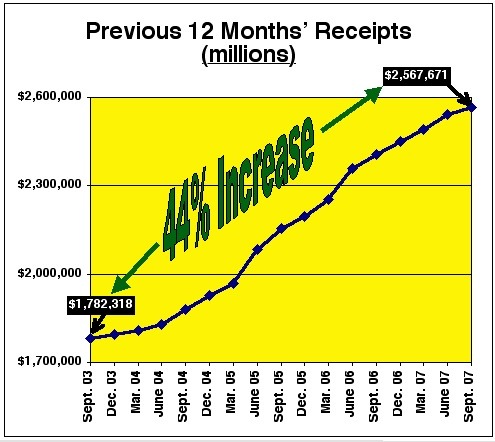
Bush’s tax cuts led to a 44% increase in revenues from 2003 to 2007

Federal Receipts 2003 through 2007

From Newsbusters. It turns out that Bush’s tax cuts in 2001 and 2003 were not responsible for adding to the deficit. They actually increased the amount of tax money being collected, as the economy grew, and more jobs were created. People pay more in taxes when they have jobs.

Excerpt:

The graph doesn’t show collections tanking, does it? Instead, the graph shows that collections increased by 44%, or almost $800 billion, in four years. Adding up the individual increments in each of the four years compared to 2003 (2004 – $98B; 2005 – $371B; 2006 – $624B; 2007 – $785B; 2008, not shown, treating IRS stimulus payments as outlays instead of negative receipts – $835B), what really happened is that in the five full fiscal years after George W. Bush got the across-the-board and investment-related tax cuts he had been pushing for since taking office in 2001, the cumulative increase in tax collections was over $2.7 trillion.

Doubtless, the static analysis crowd will claim that collections would have been even higher (I guess by a cumulative $1.6 trillion, given the AP’s Democratic Party talking point above) if the Bush cuts hadn’t been enacted. Two words, guys: Prove it. Two follow-up words: You can’t.

We can argue all day long about the how much of the increase in collections was due to the incentive effects of the tax cuts and how of the improvement might have occurred anyway, but no one can credibly act as if it’s an established fact that the Bush cuts somehow caused collections to go $1.6 trillion in the opposite direction. There is absolutely no proof for this contention, and plenty of evidence that the Bush cuts jump-started an economy and federal collections, both of which had been flat or declining during the two years leading up to mid-2003. The more reasonable conclusion to reach is that the country would already be dead in the water if the Bush tax cuts hadn’t passed in 2003. Instead, the wire service hopes that its “Bush tax cuts cost us” meme will be gullibly recited during the next several days at its subscribing newspaper, TV, and radio outlets. “Disgraceful” doesn’t even begin to describe this pathetic promotion of self-evident falsehood.

The fact is that the federal budget was one good year away from balancing after the $162 deficit reported in fiscal 2007. Unfortunately, that was the last budget passed by a Republican-controlled Congress, and it was the only year which showed a modest increase in overall spending. Beginning in 2007 with effects beginning in fiscal 2008, the House and Senate controlled by Nancy Pelosi and Harry Reid began increasing spending at rates far beyond what profligate Republicans spent earlier in the decade, and, unfortunately, Bush 43 made no real effort to stop them…

Read the whole thing.

UPDATE: Reggie sent me this article showing that the Reagan tax cuts also increased revenues.

Excerpt:

In 1980, the last year before the tax cuts, tax revenues were $956 billion (in constant 1996 dollars).

Revenues exceeded that 1980 level in eight of the next 10 years. Annual revenues over the next decade averaged $102 billion above their 1980 level (in constant 1996 dollars).

The graph is here.

When you get people to start engaging in the economy, you can collect more taxes from them. They engage when they think that they will be able to keep more of what they make from their labor.