Tag Archives: Logic

Brian Auten interviews pro-life debater Scott Klusendorf

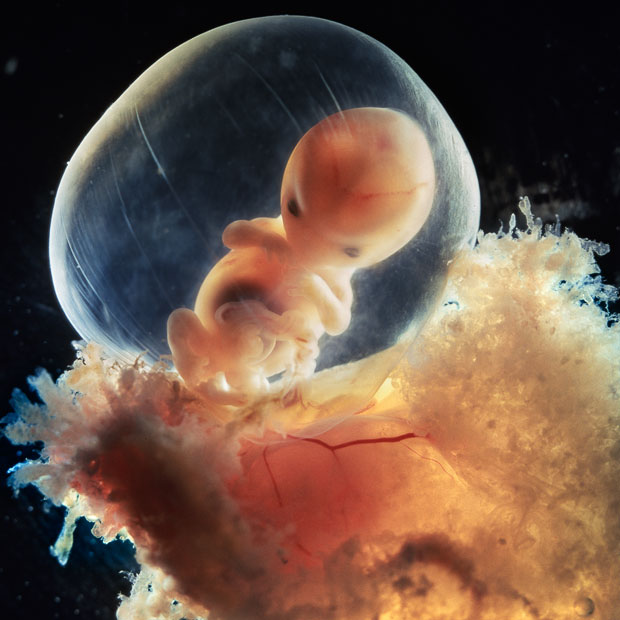
Unborn baby scheming about making abortion unthinkable

Scott Klusendorf is a tough, practical pro-life debater. When you listen to him talk about moral issues, it’s like listening to Tim Tebow talk about running the two-minute offense. Even if you are not into bio-ethics, you will have a good time listening to him work through the topics. Anyone who likes to understand issues strategically and operationally will enjoy this interview. It’s extremely practical because Scott is the top pro-life debater in the world. He has had to defend all of his views on the field.

Details:

Today’s interview is witth Scott Klusendorf, president of Life Training Institute. LTI is the first place to look for excellent resources to get better equipped to defend the pro-life position. Scott talks about defining abortion and its terms, the issue of the debate, the legal history of abortion, defending the pro-life view using science and philosophy, the four pillars of the pro-life argument, answering a litany of objections to the pro-life position, the right and wrong use of emotional appeals, taking on the right tone in the debate, how to get better equipped, and more.

Click here to get the 45 minute interview. The article he mentions “How to Defend Your Pro-Life Views in 5 Minutes or Less” is worth the read, and it’s a good summary of some of the points he makes in the lecture.

If you like this interview, please be sure and buy the best basic book on pro-life apologetics – Scott Klusendorf’s “The Case for Life“. I do have to mention that Scott is an evangelical Christian. Evangelicals are very much into understanding and debating pro-life and pro-marriage positions – we want to understand and we want to explain why we believe what we believe.

Learn more by reading

You can learn more by reading basic pro-life apologetics… from Francis Beckwith. You might recognize Frank Beckwith as the author of “Defending Life: A Moral and Legal Case Against Abortion Choice“. He wrote that book for Cambridge University Press, a top academic press. But before Cambridge University Press, Beckwith wrote easy-to-understand essays for the Christian Research Journal.

Here are four essays that answer common arguments in favor of legalized abortion.

Part I. The Appeal to Pity

Excerpt:

Anyone who keeps up with the many pro-choice demonstrations in the United States cannot help but see on pro-choice placards and buttons a drawing of the infamous coat hanger. This symbol of the pro-choice movement represents the many women who were harmed or killed because they either performed illegal abortions on themselves (i.e., the surgery was performed with a “coat hanger”) or went to unscrupulous physicians (or “back-alley butchers”). Hence, as the argument goes, if abortion is made illegal, then women will once again be harmed. Needless to say, this argument serves a powerful rhetorical purpose. Although the thought of finding a deceased young woman with a bloody coat hanger dangling between her legs is — to say the least — unpleasant, powerful and emotionally charged rhetoric does not a good argument make.

The chief reason this argument fails is because it commits the fallacy of begging the question. In fact, as we shall see, this fallacy seems to lurk behind a good percentage of the popular arguments for the pro-choice position. One begs the question when one assumes what one is trying to prove. Another way of putting it is to say that the arguer is reasoning in a circle. For example, if one concludes that the Boston Celtics are the best team because no team is as good, one is not giving any reasons for this belief other than the conclusion one is trying to prove, since to claim that a team is the best team is exactly the same as saying that no team is as good.

The question-begging nature of the coat-hanger argument is not difficult to discern: only by assuming that the unborn are not fully human does the argument work. If the unborn are not fully human, then the pro-choice advocate has a legitimate concern, just as one would have in overturning a law forbidding appendicitis operations if countless people were needlessly dying of both appendicitis and illegal operations. But if the unborn are fully human, this pro-choice argument is tantamount to saying that because people die or are harmed while killing other people, the state should make it safe for them to do so.

Part II. Arguments from Pity, Tolerance, and Ad Hominem

Excerpt:

A woman who becomes pregnant due to an act of either rape or incest is the victim of a horribly violent and morally reprehensible crime. Although pregnancy as a result of either rape or incest is extremely rare, [1] there is no getting around the fact that pregnancy does occur in some instances.

[…]Despite its forceful appeal to our sympathies, there are several problems with this argument. First, it is not relevant to the case for abortion on demand, the position defended by the popular pro-choice movement. This position states that a woman has a right to have an abortion for any reason she prefers during the entire nine months of pregnancy, whether it be for gender-selection, convenience, or rape. [3] To argue for abortion on demand from the hard cases of rape and incest is like trying to argue for the elimination of traffic laws from the fact that one might have to violate some of them in rare circumstances, such as when one’s spouse or child needs to be rushed to the hospital. Proving an exception does not establish a general rule.

[…]Fourth, this argument begs the question by assuming that the unborn is not fully human. For if the unborn is fully human, then we must weigh the relieving of the woman’s mental suffering against the right-to-life of an innocent human being. And homicide of another is never justified to relieve one of emotional distress. Although such a judgment is indeed anguishing, we must not forget that the same innocent unborn entity that the career-oriented woman will abort in order to avoid interference with a job promotion is biologically and morally indistinguishable from the unborn entity that results from an act of rape or incest. And since abortion for career advancement cannot be justified if the unborn entity is fully human, abortion cannot be justified in the cases of rape and incest. In both cases abortion results in the death of an innocent human life. As Dr. Bernard Nathanson has written, “The unwanted pregnancy flows biologically from the sexual act, but not morally from it.” [5]Hence, this argument, like the ones we have already covered in this series, is successful only if the unborn are not fully human.

Part III. Is The Unborn Human Less Than Human?

(No excerpt)

Part IV. When Does a Human Become a Person?

Excerpt:

Some ethicists argue that the unborn becomes fully human sometime after brain development has begun, when it becomes sentient: capable of experiencing sensations such as pain. The reason for choosing sentience as the criterion is that a being that cannot experience anything (i.e., a presentient unborn entity) cannot be harmed. Of course, if this position is correct, then the unborn becomes fully human probably during the second trimester and at least by the third trimester. Therefore, one does not violate anyone’s rights when one aborts a nonsentient unborn entity. [13]

There are several problems with this argument. First, it confuses harm with hurt and the experience of harm with the reality of harm. [14] One can be harmed without experiencing the hurt that sometimes follows from that harm, and which we often mistake for the harm itself. For example, a temporarily comatose person who is suffocated to death “experiences no harm,” but he is nevertheless harmed. Hence, one does not have to experience harm, which is sometimes manifested in hurt, in order to be truly harmed.

Second, if sentience is the criterion of full humanness, then the reversibly comatose, the momentarily unconscious, and the sleeping would all have to be declared nonpersons. Like the presentient unborn, these individuals are all at the moment nonsentient though they have the natural inherent capacity to be sentient. Yet to countenance their executions would be morally reprehensible. Therefore, one cannot countenance the execution of some unborn entities simply because they are not currently sentient.

Someone may reply that while these objections make important points, there is a problem of false analogy in the second objection: the reversibly comatose, the momentarily unconscious, and the sleeping once functioned as sentient beings, though they are now in a temporary state of nonsentience. The presentient unborn, on the other hand, were never sentient. Hence, one is fully human if one was sentient “in the past” and will probably become sentient again in the future, but this cannot be said of the presentient unborn.

There are at least three problems with this response. First, to claim that a person can be sentient, become nonsentient, and then return to sentience is to assume there is some underlying personal unity to this individual that enables us to say that the person who has returned to sentience is the same person who was sentient prior to becoming nonsentient. But this would mean that sentience is not a necessary condition for personhood. (Neither is it a sufficient condition, for that matter, since nonhuman animals are sentient.) Consequently, it does not make sense to say that a person comes into existence when sentience arises, but it does make sense to say that a fully human entity is a person who has the natural inherent capacity to give rise to sentience. A presentient unborn human entity does have this capacity. Therefore, an ordinary unborn human entity is a person, and hence, fully human.

Second, Ray points out that this attempt to exclude many of the unborn from the class of the fully human is “ad hoc and counterintuitive.” He asks us to “consider the treatment of comatose patients. We would not discriminate against one merely for rarely or never having been sentient in the past while another otherwise comparable patient had been sentient….In such cases, potential counts for everything.” [15]

Third, why should sentience “in the past” be the decisive factor in deciding whether an entity is fully human when the presentient human being “is one with a natural, inherent capacity for performing personal acts?” [16] Since we have already seen that one does not have to experience harm in order to be harmed, it seems more consistent with our moral sensibilities to assert that what makes it wrong to kill the reversibly comatose, the sleeping, the momentarily unconscious, and the presentient unborn is that they all possess the natural inherent capacity to perform personal acts. And what makes it morally right to kill plants and to pull the plug on the respirator-dependent brain dead, who were sentient “in the past,” is that their deaths cannot deprive them of their natural inherent capacity to function as persons, since they do not possess such a capacity.

These four essays are a very good introduction to common responses to pro-abortion arguments. I recommend that people get familiar with this, as once you look into it, you will see that the abortion issue can be debated with as much confidence as William Lane Craig defends Christian theism. You will have the same access to scientific evidence and rational arguments on this topic, and so you will have the upper hand. And that’s fun.

Who are you to judge? Answering the challenge of moral relativism

Brett Kunkle explains. (H/T Apologetics 315)

Excerpt:

So how should Christians think about judging?  First, we must ask what one means by “judge.”  The dictionary distinguishes several definitions.  To judge can mean to pass legal judgment, like a judge sentencing a criminal at the conclusion of a courtroom trial.  Nothing wrong with this kind of judging.

To judge can also mean to form an opinion or conclusion about someone or something.  These are assessments or evaluations.  A coach judges the skill level of a player trying to make the team.  A mom judges the nutritional value of food she serves her family.  A plumber judges a clogged sink to fix it.  Such judgments or assessments are made all the time, everyday.  Again, nothing wrong with this kind of judging.

But Jesus definitely suggests some sort of judging is wrong, so what was He talking about?  Well, if you really want to know, never read a Bible verse.  To determine the meaning of a single verse, you must read the surrounding verses.  Context is king.  When we look at the rest of Matthew 7, we actually discover Jesus doing the very thing most Christians think He has forbidden.

In verse 6, He warns, “Do not give what is holy to dogs, and do not throw your pearls before swine…”  He calls out “false prophets” (v. 15) and says there will come a day when he will say to some, “depart from me, you who practice lawlessness” (v. 23).  Ouch, those are harsh moral judgments.  So clearly, not all judging is out-of-bounds for Jesus.

The context makes clear Jesus is after a particular kind of judgment:

For in the way you judge, you will be judged; and by your standard of measure, it will be measured to you.  Why do you look at the speck that is in your brother’s eye, but do not notice the log that is in your own eye?  Or how can you say to your brother, “Let me take the speck out of your eye,” and behold, the log is in your own eye?  You hypocrite, first take the log out of your own eye, and then you will see clearly to take the speck out of your brother’s eye (vv. 2-5).

When Jesus warns “do not judge,” He doesn’t mean we should never assess moral behavior.  Rather, he warns against self-righteous and hypocritical judgments.  When you judge, take the log out of your own eye first.  This is something we Christians need to work on.  But notice that Jesus is not saying it is never right to judge, He is explaining how we are to judge rightly.

Now I don’t see why everyone seems to be so proud of not judging these days. I love to make moral judgments. My moral judgments aren’t arbitrary. I’m not trying to force anyone to agree with me if they don’t want to. But I do like to set out moral boundaries and then explain with evidence why those boundaries are there. And those boundaries are not arbitrary, they are there to protect myself and others from harm. It’s wrong to tell people that it’s fine for them to do whatever they want in order to feel “happy”. It is often in the pursuit of happiness that people break the rules and then cause the most harm to themselves and others.

William Lane Craig debates Peter Atkins: Does God Exist?

I noticed that Apologetics 315 posted the video of a debate from the Reasonable Faith speaking tour in the UK:

This is a must-see debate. You will love this debate. LOVE IT. I LOVED THIS DEBATE.

Details:

On Wednesday 26th October 2011 William Lane Craig debated Peter Atkins on the topic: Does God Exist? This debate took place at the University of Manchester  as part of the UK Reasonable Faith Tour with William Lane Craig. The debate was chaired by Christopher Whitehead, Head of Chemistry School at the University. Post-debate discussion was moderated by Peter S Williams, Philosopher in Residence at the Damaris Trust, UK.

Dr. William Lane Craig:

William Lane Craig (born August 23, 1949) is an American analytic philosopher, philosophical theologian, and Christian apologist. He is known for his work on the philosophy of time and the philosophy of religion, specifically the existence of God and the defense of Christian theism. He has authored or edited over 30 books including The Kalam Cosmological Argument (1979), Theism, Atheism and Big Bang Cosmology(co-authored with Quentin Smith, 1993), Time and Eternity: Exploring God’s Relationship to Time (2001), and Einstein, Relativity and Absolute Simultaneity (co-edited with Quentin Smith, 2007).

Craig received a Bachelor of Arts degree in communications from Wheaton College, Illinois, in 1971 and two summa cum laudemaster’s degrees from Trinity Evangelical Divinity School in Deerfield, Illinois, in 1975, in philosophy of religion and ecclesiastical history. He earned a Ph.D. in philosophy under John Hick at the University of Birmingham, England in 1977 and a Th.D. underWolfhart Pannenberg at the University of Munich in 1984.

Dr. Peter Atkins:

Peter William Atkins (born 10 August 1940) is a British chemist and former Professor of Chemistry at the University of Oxford and a Fellow of Lincoln College. He is a prolific writer of popular chemistry textbooks, including Physical Chemistry, Inorganic Chemistry, and Molecular Quantum Mechanics. Atkins is also the author of a number of science books for the general public, including Atkins’ Molecules and Galileo’s Finger: The Ten Great Ideas of Science.

Atkins studied chemistry at the University of Leicester, obtaining a bachelor’s degree in chemistry, and – in 1964 – a PhD for research into electron spin resonance spectroscopy, and other aspects of theoretical chemistry. Atkins then took a postdoctoral position at the UCLA as aHarkness Fellow of the Commonwealth fund. He returned to Oxford in 1965 as fellow and tutor of Lincoln College, and lecturer in physical chemistry (later, professor of physical chemistry).

You can get the audio of the debate here, along with links to their previous debate from 1998. This debate is accessible and understandable to novice-level Christians.

I am happy when debates like this come out. I have friends who are Christians who doubt the importance of apologetics in evangelism, because they don’t think that apologists can prove anything or win arguments. I have friends who are skeptical of using arguments that assume a 14-billion year old universe, because they think that the Big Bang is compatible with atheism (!). I have friends who think that philosophical arguments have no persuasive force. I have friends who think that nothing can be proven from history, beyond a reasonable doubt. I have co-workers who ask me whether anyone wins these debates. I think that this debate answers all of those questions.

This debate clearly shows why Christians should not shy away from studying science, philosophy and history. We will not discover anything that harms Christian theism by thinking logically and by looking at the evidence. To the contrary, it is the atheist who makes war on the progress of science, and who is forced to resist the clear experimental evidence, and to resort to baseless speculations and blind faith. If you want to see a good debate with an intelligent atheist, I recommend watching the debate between William Lane Craig and Peter Millican instead. But if you want to see a really, really overwhelming defeat for atheism, watch this debate. It is very clear at the end of this debate why Richard Dawkins refused to debate William Lane Craig at Oxford.

SUMMARY OF THE OPENING SPEECHES

I only had time to summarize the first two speeches. Keep in mind that Dr. Craig always shines in his rebuttals, and this debate is no different. So you’ll want to watch those rebuttals. Dr. Atkins literally says in this debate in his first rebuttal “There was nothing here originally. There is nothing here now. But it is an interesting form of nothing which seems to be something.” And the audience laughs nervously. This debate is like that. You will see a clear winner and clear loser in this debate. This fight is decided by knockout.

William Lane Craig opening speech:

1. the origin of the universe
2. the moral argument
3. the resurrection of Jesus

Peter Atkins opening speech:

1. Dr. Craig is stupid, lazy and evil:
– Dr. Craig’s arguments are old: from the 11th century! Old arguments can’t be true
– Dr. Craig is just asserting that “God did it” because he is lazy
– Dr. Craig feels pressured to agree with the theistic majority
– Dr. Craig needs a psychological crutch to comfort him
– Dr. Craig is fearful of death
– Dr. Craig is just wishing for an eternal life of bliss
– Dr. Craig is driven by his heart, and not by his head

2. Origin of the universe:
– Maybe the universe is eternal and has no beginning – we don’t know
– Maybe mommy universes can give birth to daughter universes
– It is naive to think that a cause is needed to cause the creation of the universe from nothing
– Science is just about to show how it is possible that something appears out of nothing without cause
– Some scientists have already begun to speculate about about how something can come into being out of nothing
– Maybe nothing is not really nothing, but it is actually something
– It would be admitting defeat to say that God created the universe out of nothing

3. Fine-Tuning:
– It could be the case that the fundamental constants are not variable
– It could be the case that the fine-tuning of the cosmic constants is a happy accident
– It could be the case that there are billions of billions of unobservable universes that are not fine tuned
– It could be the case that the cosmic constants in these billions and billions of unobservable universes are all random so that some are fine-tuned
– Anyone who infers that an intelligence is the best explanation of a finely-tuned set of life-permitting cosmic constants is lazy

4. Purpose:
– Philosophers and theologians are stupid
– I don’t think that there is purpose in the universe
– I think that the universe is more grand if there is no purpose, so there is no purpose

5. Miracles:
– I don’t think that miracles happen
– The resurrection is a fabrication
– It could be the case that Jesus didn’t exist
– It could be the case that Jesus wasn’t really crucified
– It could be the case that Jesus didn’t  really die after being crucified
– It could be the case that the disciples stole his body
– It could be the case that the women went to the wrong hole in the ground
– the gospels are political propaganda written long after the events they are reporting on

6. Theodicy:
– God has no morally sufficient reason for allowing humans to perform actions that result in suffering
– God has no morally sufficient reason for allowing nature to cause suffering

7. Morality:
–  customs and conventions emerges arbitrarily in different times and places based on an awareness of the consequences of actions, as well as various anecdotes and experiences
–  these customs and conventions are decided based on the goal for survival, in much the same way as politeness and manners emerge for decorum and to avoid offense
– it is childish to presume that there is an umpire God who decides moral values and duties

8. Religious believers are stupid, lazy and evil:
– the notion of God has arisen because people are stupid and want to be comforted
– there are no arguments or evidences for belief in God
– people who believe in God do not think, but instead take refuge in incomprehensible nonsense