
Tag Archives: Life

Six reasons why you should believe in non-physical souls

The first argument for theism that most people learn is the moral argument. Why the moral argument? Because it’s the most accessible – everyone you talk to expects to be treated a certain way. But there’s another argument that’s intuitive for humans: the argument from mind. Everyone has the experience of consciousness and free will. You can make a good argument for God from that.

Here’s the podcast:

Details:

In this podcast, J. Warner examines the evidence for the existence of the mind (and inferentially, the soul) as he looks at six classic philosophical arguments. Jim also briefly discusses Thomas Nagel’s book, Mind and Cosmos and discusses the limitations of physicalism.

The MP3 file is here. (67 MB, 72 minutes)

Topics:

  • Atheist Thomas Nagel’s latest book “Mind and Cosmos” makes the case that materialism cannot account for the evidence of mental phenomena
  • Nagel writes in this recent New York Times article that materialism cannot account for the reality of consciousness, meaning, intention and purpose
  • Quote from the Nagel article:

Even though the theistic outlook, in some versions, is consistent with the available scientific evidence, I don’t believe it, and am drawn instead to a naturalistic, though non-materialist, alternative. Mind, I suspect, is not an inexplicable accident or a divine and anomalous gift but a basic aspect of nature that we will not understand until we transcend the built-in limits of contemporary scientific orthodoxy.

  • When looking at this question, it’s important to not have our conclusions pre-determined by presupposing materialism or atheism
  • If your mind/soul doesn’t exist and you are a purely physical being then that is a defeater for Christianity, so we need to respond
  • Traditionally, Christians have been committed to a view of human nature called “dualism” – human beings are souls who have bodies
  • The best way* to argue for the existence of the soul is using philosophical arguments

The case:

  • The law of identity says that if A = B’ if A and B have the exact same properties
  • If A = the mind and B = the brain, then is A identical to B?
  • Wallace will present 6 arguments to show that A is not identical to B because they have different properties

Not everyone of the arguments below might make sense to you, but you will probably find one or two that strike you as correct. Some of the points are more illustrative than persuasive, like #2. However, I do find #3, #5 and #6 persuasive.

1) First-person access to mental properties

  • Thought experiment: Imagine your dream car, and picture it clearly in your mind
  • If we invited an artist to come and sketch out your dream car, then we could see your dream car’s shape on paper
  • This concept of your dream car is not something that people can see by looking at your brain structure
  • Physical properties can be physically accessed, but the properties of your dream care and privately accessed

2) Our experience of consciousness implies that we are not our bodies

  • Common sense notion of personhood is that we own our bodies, but we are not our bodies

3) Persistent self-identity through time

  • Thought experiment: replacing a new car with an old car one piece at a time
  • When you change even the smallest part of a physical object, it changes the identity of that object
  • Similarly, your body is undergoing changes constantly over time
  • Every cell in your body is different from the body you had 10 years ago
  • Even your brain cells undergo changes (see this from New Scientist – WK)
  • If you are the same person you were 10 years ago, then you are not your physical body

4) Mental properties cannot be measured like physical objects

  • Physical objects can be measured (e.g. – use physical measurements to measure weight, size, etc.)
  • Mental properties cannot be measured

5) Intentionality or About-ness

  • Mental entities can refer to realities that are physical, something outside of themselves
  • A tree is not about anything, it just is a physical object
  • But you can have thoughts about the tree out there in the garden that needs water

6) Free will and personal responsibility

  • If humans are purely physical, then all our actions are determined by sensory inputs and genetic programming
  • Biological determinism is not compatible with free will, and free will is required for personal responsibility
  • Our experience of moral choices and moral responsibility requires free will, and free will requires minds/souls

He spends the last 10 minutes of the podcast responding to naturalistic objections to the mind/soul hypothesis.

*Now in the podcast, Wallace does say that scientific evidence is not the best kind of evidence to use when discussing this issue of body/soul and mind/brain. But I did blog before about two pieces of evidence that I think are relevant to this discussion: corroborated near-death experiences and mental effort.

You might remember that Dr. Craig brought up the issue of substance dualism, and the argument from intentionality (“aboutness”), in his debate with the naturalist philosopher Alex Rosenberg, so this argument about dualism is battle-ready. You can add it to your list of arguments for Christian theism along with all the other arguments like the Big Bang, the fine-tuning, the origin of life, stellar habitability, galactic habitability, irreducible complexity, molecular machines, the Cambrian explosion, the moral argument, the resurrection, biological convergence, and so on.

Andy Bannister and Michael Ruse discuss how atheists find meaning in life

An old post of mine appeared in a recent Mid-Week Apologetics Booster over at Christian Worldview Blog, so I decided to re-post it below. I am still trying to adjust to the fact that I am not going to be ruled by the secular left for the next 4 years. It’s a happy surprise, but I need some time to adjust. This post was originally published in March 2016, but I added a new image.

I’m summarizing a recent episode of the Unbelievable show.

Details:

Atheist philosopher Michael Ruse joins Justin as we spend a second week looking at Andy Bannister’s new book ‘The atheist who didn’t exist’.

Its amusingly titled chapters include ‘The Peculiar Case of the Postmodern Penguin (or: Why Life without God is Meaningless). Michael and Andy debate whether it’s a problem that atheists can’t have meaning with a ‘capital M’.

Here is a summary of the discussion between Ruse and Bannister, and my comments below the summary.

The MP3 file is here.

Summary:

  • Ruse: ultimate questions are serious questions, and some religions are attempting to provide serious answers to those questions
  • Ruse: there is a psychological element to belief in God but it’s not a complete explanation, but it can apply to non-belief as well
  • Bannister: there are psychological reasons why people would prefer unbelief (quotes Thomas Nagel and Aldous Huxley)
  • Bannister: (to Ruse) what do you think would follow next if you got new information that caused you to believe in God?
  • Ruse: I’d feel scared, I’d think of all the reasons that God would dislike me, rather than any reasons why God would save me
  • Bannister: according to the Bible, God is not so much interested in mere belief, but in active trust in him
  • Ruse: without being smug, I just completed 50 years as a college professor of philosophy, and I have a sense of worth from that
  • Ruse: if God turns up, and says that 50 years of being a professor is not good enough, well, I don’t know God, I’m sorry, I did my best
  • Brierley: Andy, explain to us this story of how a penguin explained to you how he invented a subjective meaning in life for himself?
  • Brierley: (reads the story)
  • Bannister: when it comes to reading a book, the real meaning is the meaning the author intended the book to have
  • Bannister: readers can inject their own meaning into the book that has nothing to do with it, but the author gives the real meaning
  • Bannister: meaning in life is like reading a book – you can make up your own meaning, but the author’s meaning is the real meaning
  • Brierley: (to Ruse) on atheism, is there any objective meaning?
  • Ruse: “obviously, someone like myself cannot have meaning with a capital M in that sense”
  • Ruse: the real question is and atheist can find a sense of self-worth, “I find that I’m happier within myself, I can find meaning”
  • Bannister: what would you say to someone who drinks away the family inheritance and gets the same sense of happiness you have?
  • Bannister: what would you say to all the people who are unable to get “a sense of self-worth” from their career, because of where they are born, sickness, etc.
  • Ruse: I have nothing to offer them, some people are born into such awful situations that they are bound to be bad people
  • Ruse: these unfair accidents of birth, etc.,  fits with atheism better
  • Ruse: what we should do is change society so that more people can build a sense of self-worth through achievements
  • Ruse: that way, they can say to God “I used my talents” so they can create feelings of self-worth and happiness (apart from God)
  • Bannister: meaning in life cannot be answered without answering questions related to identity, value, which are rooted in the overall worldview
  • Bannister: on the Christian worldview, you have an infinite worth, your value isn’t determined by circumstances, earnings, friends, etc.
  • Bannister: your value comes from what Jesus was willing to pay to save you, namely, giving his own life for you
  • Bannister: when I travel to meet other Christians in other parts of the world, they have a happiness that should not be there if they are getting happiness from wealth, fame, achievements, etc.
  • Bannister: but when you come to the West, many people who have wealth, fame, achievement, etc. are unhappy
  • Ruse: well maybe who look after a flock of sheep every day may get a sense of self-worth from that, or from other jobs
  • Ruse: I do take Christianity very seriously, it is a grown-up proposal to answer grown-up questions – it works if it is true
  • Ruse: we don’t have to follow Nietzche’s statement that if there is no God, there is no meaning in life – we can find a middle way, we can achieve meaning in life by using our talents to achieve things
  • Bannister: I disagree with Michael, I don’t think that the meaning you invent for yourself is authentic meaning
  • Bannister: distracting yourself with amusing things and happiness is not an answer to the problem
  • Brierley: (to Ruse) are you saying that you have searched for ultimate meaning, and you are settling for subjective meaning?
  • Ruse: my subjective meaning is not second class to objective meaning, “I feel a real deep sense of achievement, of meaning, of self-worth, of having used my talents properly, and I don’t feel in any sense a sense of regret” (what matters to him is how he feels)
  • Bannister: notice how Michael keeps bringing in value judgments. e.g. – “use my talents well”, that implies that there is a right way and a wrong to use your talents, which assumes an objective scale of right and wrong, which makes no sense in atheism
  • Bannister: an atheist can sit in a sun room and enjoy the feelings of happiness generated by the light and heat of the Sun, without asking whether there is a Sun out there
  • Bannister: ultimately, at the end of the day, my concern is not whether something makes me happy or makes me feel fulfilled
  • Bannister: ultimately, at the end of the day, I think there is only one real reason to wrestle with these questions of meaning, and that is to find truth
  • Ruse: sometimes we reach a point where we cannot get to true answers to some questions, sometimes we look for truth, but then give up and confess “I cannot find it” and then move on from there

Is it possible to dispense with God’s advice on your decision-making and achieve something that affects a lot of people, or makes people like you, or makes you famous, etc., and then have that please God? “Look, God, I did something I liked that affected a lot of people, and made them feel happy as they were on their way to Hell because they rejected you”. I think a lot of celebrities, athletes and musicians have feelings that they have achieved something, but having feelings of achievement because you entertain people doesn’t mean anything to God.

So what is the standard? How you imitate Jesus – self-control, self-denial and self-sacrifice to honor God – that is the standard. If I had to choose between giving up two hours of my life to summarize this discussion for my readers, and all the fame and fortune that people who make godless TV shows, movies and music have, I would choose to make this debate summary. My goal in life is not to have fun, thrills, travel and feel happy in this world. I have a Boss. Performing actions that respect the Boss is objectively meaningful. It’s may not seem like much compared to what James Bond does in million-dollar movies, but at least I am wearing the right uniform, and playing for the right team.

I’m starting to notice that a lot of younger Christians are more interested in feeling good, having fun, being liked by others than they are in being able to know what’s true or show what’s true. Christians are no exception to this problem of finding meaning in life. A lot of us are just taking in entertainment and trying hard not to think at all.

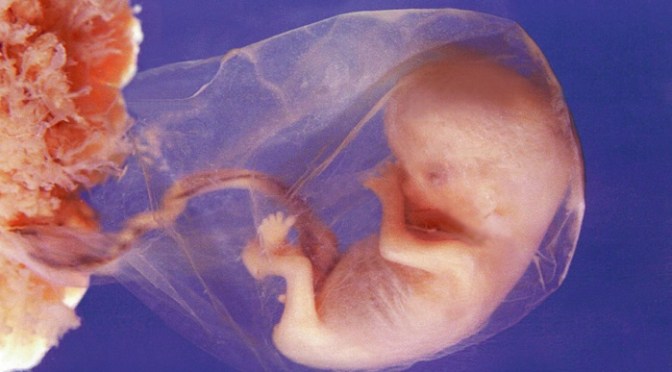
If unborn babies don’t have consciousness or don’t feel pain, may we kill them?

Was having a conversation by e-mail yesterday with a pro-abortion atheist, and he gave two reasons why he supported abortion in the first and second trimester. First, he said that unborn babies can’t feel pain, so it’s OK to kill them. Second, he said that unborn babies don’t have consciousness, so it’s OK to kill them. I thought it might be useful to link to something that answers both of these objections.

Frank Beckwith is the author of “Defending Life: A Moral and Legal Case Against Abortion Choice“, which was published by Cambridge University Press, a top academic press. But before Cambridge University Press, Beckwith wrote four easy-to-understand essays for the Christian Research Journal. Part IV is the one that has the response to the two questions raised by my atheist friend.

Part I. The Appeal to Pity

Part II. Arguments from Pity, Tolerance, and Ad Hominem

Part III. Is The Unborn Human Less Than Human?

Part IV. When Does a Human Become a Person?

Excerpt:

Some ethicists argue that the unborn becomes fully human sometime after brain development has begun, when it becomes sentient: capable of experiencing sensations such as pain. The reason for choosing sentience as the criterion is that a being that cannot experience anything (i.e., a presentient unborn entity) cannot be harmed. Of course, if this position is correct, then the unborn becomes fully human probably during the second trimester and at least by the third trimester. Therefore, one does not violate anyone’s rights when one aborts a nonsentient unborn entity. [13]

There are several problems with this argument. First, it confuses harm with hurt and the experience of harm with the reality of harm. [14] One can be harmed without experiencing the hurt that sometimes follows from that harm, and which we often mistake for the harm itself. For example, a temporarily comatose person who is suffocated to death “experiences no harm,” but he is nevertheless harmed. Hence, one does not have to experience harm, which is sometimes manifested in hurt, in order to be truly harmed.

Second, if sentience is the criterion of full humanness, then the reversibly comatose, the momentarily unconscious, and the sleeping would all have to be declared nonpersons. Like the presentient unborn, these individuals are all at the moment nonsentient though they have the natural inherent capacity to be sentient. Yet to countenance their executions would be morally reprehensible. Therefore, one cannot countenance the execution of some unborn entities simply because they are not currently sentient.

Someone may reply that while these objections make important points, there is a problem of false analogy in the second objection: the reversibly comatose, the momentarily unconscious, and the sleeping once functioned as sentient beings, though they are now in a temporary state of nonsentience. The presentient unborn, on the other hand, were never sentient. Hence, one is fully human if one was sentient “in the past” and will probably become sentient again in the future, but this cannot be said of the presentient unborn.

There are at least three problems with this response. First, to claim that a person can be sentient, become nonsentient, and then return to sentience is to assume there is some underlying personal unity to this individual that enables us to say that the person who has returned to sentience is the same person who was sentient prior to becoming nonsentient. But this would mean that sentience is not a necessary condition for personhood. (Neither is it a sufficient condition, for that matter, since nonhuman animals are sentient.) Consequently, it does not make sense to say that a person comes into existence when sentience arises, but it does make sense to say that a fully human entity is a person who has the natural inherent capacity to give rise to sentience. A presentient unborn human entity does have this capacity. Therefore, an ordinary unborn human entity is a person, and hence, fully human.

Second, Ray points out that this attempt to exclude many of the unborn from the class of the fully human is “ad hoc and counterintuitive.” He asks us to “consider the treatment of comatose patients. We would not discriminate against one merely for rarely or never having been sentient in the past while another otherwise comparable patient had been sentient….In such cases, potential counts for everything.” [15]

Third, why should sentience “in the past” be the decisive factor in deciding whether an entity is fully human when the presentient human being “is one with a natural, inherent capacity for performing personal acts?” [16] Since we have already seen that one does not have to experience harm in order to be harmed, it seems more consistent with our moral sensibilities to assert that what makes it wrong to kill the reversibly comatose, the sleeping, the momentarily unconscious, and the presentient unborn is that they all possess the natural inherent capacity to perform personal acts. And what makes it morally right to kill plants and to pull the plug on the respirator-dependent brain dead, who were sentient “in the past,” is that their deaths cannot deprive them of their natural inherent capacity to function as persons, since they do not possess such a capacity.

These four essays are a very good introduction to common responses to pro-abortion arguments. I recommend that people get familiar with this, as once you look into it, you will see that the abortion issue can be debated with as much confidence as William Lane Craig defends Christian theism. You will have the same access to scientific evidence and rational arguments on this topic, and so you will have the upper hand. And that’s fun.

The best introductory book on the abortion / right to life issue is “The Case for Life” by pro-life debater Scott Klusendorf. The best comprehensive book is a tie between “The Ethics of Abortion” by Christopher Kaczor, and Frank Beckwith’s “Defending Life: A Moral and Legal Case Against Abortion Choice“.