This guy has one of the sharpest channels on YouTube, very un-PC. I don’t agree with him on everything, but he is outrageously popular.
Watch: (20 minutes) (H/T William)
This might be a very useful thing to show to pastors who favor socialist policies and big government redistribution. He actually says that the conservative policies that conservatives embrace attracted him to theism. I just think that is so hilarious… because all the pastors seem to want to embrace left-wing causes. Especially things like global warming, illegal immigration, redistribution of wealth, single payer health care, etc. Well, the kinds of atheists we like – the ones who believe in liberty, prosperity, security – don’t hold our small government politics against us.
No Christian presents their views through government – that’s why we are all crazy about apologetics. We love apologetics as much as secular leftists love big government. At least apologetics is non-coercive he says. But when atheists enforce their view through big government, backed by prisons and guns, that is coercive. His arguments about demographics, and being willing to marry, have kids for the good of society are terrific to illustrate the value of self-sacrifice within the Christian worldview. Far from being a liability, devotion to small government, low taxes and individual liberty is actually an asset when evangelizing. Just as pious pastors are all rushing to join the open borders, global warming, single-payer health care, radical feminism team, we find out that principled atheists are uncomfortable with many of those things. Maybe we should take note of that, instead of just blindly following the crowd.
Have a look at this video, and put THIS apologetic argument into your quiver. There is much, much more to evangelism and apologetics than what you read in books on apologetics. And this is why I work so hard to connect the Christian worldview to every other area of knowledge. You don’t always have to talk about old, boring William Lane Craig style apologetics with atheists. Sometimes, you can just talk to them about tax policy and free speech. Why not? Atheists are sometimes complicated people.
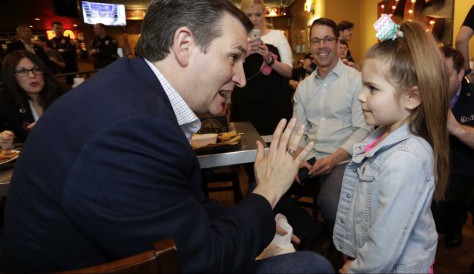
Ted Cruz explains policy to little girl who wants to be President
Tony Perkins of the Family Research Council, my second favorite think tank behind the Heritage Foundation, is advising the Ted Cruz campaign about religious liberty issues. They’ve actually made a list of things for him to do if he is elected President. Since this issue is the core of my being – it animates my whole life plan – I was curious to see what Cruz intends to do about religious liberty.
Here is Todd Starnes of Fox News writing about it:
America’s Christian bakers and florists and wedding planners will be safe under a Ted Cruz presidency.
“I am absolutely convinced in my discussions with the senator that religious liberty will be a lot better off in America with a Cruz administration,” said Tony Perkins, president of the Family Research Council and Chair of Cruz’s Religious Liberty Advisory Council.
The council released exclusively to me its initial recommendations for both legislative and executive actions that will restore the nation’s First Freedom – the freedom of religion.
[…]The council, made up of prominent religious leaders, recommended 15 action items that will protect Americans from discrimination by the federal government on the basis of their view of marriage and also protect employers threatened by the HHS contraception mandate.
[…]The council is also calling on Cruz to direct a review of the IRS’ treatment of religious organizations and to direct federal agencies to respect the free exercise of religion.
The list includes measures to promote religious liberty at the Department of Education, the IRS, the Department of Health and Human Services, the armed forces, and in the federal government as a whole.
Cruz has a record on defending religious liberty:
Cruz has been a passionate advocate of religious liberty for years. He’s been in the front line trenches defending our First Freedom – helping secure courtroom victories to preserve the Texas Ten Commandments monument and the Mojave Desert Veterans Memorial.
“As president, I have pledged on my first day in office to rescind every single one of President Obama’s unconstitutional executive actions, and to direct every federal agency to respect and protect the religious liberty of every American,” Cruz said.
His vow is certainly welcome news to American Christians who have been subjected to eight years of vicious attacks by militant LGBT and atheist groups – not to mention the Obama administration.
“Our constitutional liberties should not be subject to the whims of the current administration, and – whether Hobby Lobby or the Little Sisters of the Poor – people of faith should not be made to bow down at the altar of political correctness,” Cruz said.
I took a look over the names of the people on his panel of policy advisors, and was surprised to see people I actually know on it. You probably know these names as well: Jay Wesley Richards, Everett Piper, Bishop Harry Jackson, Ken Blackwell, and Jason Benham. Jason Benham has had to face discrimination himself, when his show was pulled because of his Christian worldview. If I had to pick a scholar who has the same interests as me across the board, it would probably be Jay Richards. So, needless to say, I’m pretty pleased with this. Seems to me like we have been losing, losing, losing at religious liberty for the last 8 years under Obama and his Democrat allies in the House, Senate, federal government and Supreme Court. If Cruz wins, thins are going to change for us on this all-important issue. I just want to be free to be me, and not to be punished for disagreeing with other people on issues of morality and conscience.
I guess it goes without saying that Donald Trump is the polar opposite of Cruz on all of these issues. That’s why it’s important to me that someone with a record of standing up for religious liberty at the Supreme Court wins the nomination. I don’t want someone who only has talk – and Trump’s talk isn’t even that encouraging. He’s promised gay rights activists “forward motion” on gay rights. I think we’ve had enough of #NewYorkValues already under Obama, Mr. Trump.
By the way, if you’re not listening the Family Research Council Washington Watch Weekly podcast, please subscribe. They cover everything from social issues, to fiscal issues, to foreign policy. One of their frequent guests is retired Lt. General William G. Boykin, who is also on Cruz’s foreign policy advisory committee, which I blogged about before.
I was asked a question by e-mail by Kerri about why some Christians like Bernie Sanders and his plan for big government, more spending, higher taxes and more debt.
I found a paper (PDF) on the University of Washington web site that makes the case for why Christians ought to care about more than just social issues when it comes to politics and elections.
Here’s the abstract:
What accounts for cross-national variation in religiosity as measured by church attendance and non-religious rates? Examining answers from both secularization theory and the religious economy perspective, we assert that cross-national variation in religious participation is a function of government welfare spending and provide a theory that links macro-sociological outcomes with individual rationality. Churches historically have provided social welfare. As governments gradually assume many of these welfare functions, individuals with elastic preferences for spiritual goods will reduce their level of participation since the desired welfare goods can be obtained from secular sources. Cross-national data on welfare spending and religious participation show a strong negative relationship between these two variables after controlling for other aspects of modernization.
Here’s the conclusion:
It is quite apparent that there is a strong statistical relationship between state social welfare spending and religious participation and religiosity. Countries with higher levels of per capita welfare have a proclivity for less religious participation and tend to have higher percentages of non-religious individuals. People living in countries with high social welfare spending per capita even have less of a tendency to take comfort in religion, perhaps knowing that the state is there to help them in times of crisis.34 As laid out in the theory above, there is likely a substitution effect for some individuals between state-provided services and religious services. Religion will still be there to serve the spiritual needs of people seeking answers to the philosophic mysteries of life, but those who value those spiritual goods less than the tangible welfare benefits churches provide will be less likely to participate in religious services once secular substitutes become available. Given that religious practice and values are often passed down from generation to generation, the weakening of practice in one generation will likely translate into weaker practice in subsequent generations. Does this mean that secularization theory is correct in its prediction that religion will gradually fade away? Doubtful. Realizing that there is still a yearning among many people to understand the mysteries of life, religion is not likely to dissipate at any time soon. Government simply cannot offer credible substitutes for these less tangible, supernatural goods. The explosion in spirituality once religion was made legal in former Soviet bloc countries lends credence to this assertion (Greeley 1994). As religious markets become more deregulated in various parts of the world, it is likely that new religious movements will take advantage of increased liberty and discover ways to expand.
Perhaps one of the most important lessons from the findings above is that the religiosity of a society is not simply determined by sociological factors. Government policy can play an important role in shaping the religiosity of a nation. Policies aimed at regulating the activities of religious organizations — from tax laws to zoning regulations — have important effects on the firms that supply religious goods and services. Many of these policies are designed consciously to promote or inhibit religious practice. Alternatively, welfare policy has been shown here to unintentionally affect the demand for religious services, likely over the course of generations. And, finally, since an extensive welfare state is considered by many to be a hallmark of modernized societies, the microfoundational analysis presented above provides a way of incorporating a component part of the secularization thesis (which relies heavily on notions of modernization) into the religious economy perspective.
Have you ever heard a sermon that addresses the size of government and individual liberty and prosperity? I haven’t. You’d have to be reading Christian scholars like Wayne Grudem or Jay Richards to find that. The typical church you attend either praises big government or says nothing about it. After all, we can keep making withdrawals on the liberties we have right now without ever worrying about having to make any deposits, right? Everything will be fine, and it’s easier not to have to think about what’s down the road to serfdom, so long as the scenery is nice for us right now. Religion is primarily about comfort, not truth. Right?
The truth is that religious liberty and freedom of conscience works better in societies where individuals are large, and government is small. We can do more as Christians to help others and draw attention to Christ when we are allowed to keep our own money, and make our own lives the way we want. When a secular government takes half our money to buy the votes of people who just want money and not a transformed life, we lose. It’s our job to attach wisdom and goodness to our giving when we give of ourselves to others. In the long run, that wisdom and goodness rubs off on the people we give to, reducing the need for them to be dependent on others. Government just takes our money and sends it to people who are living unwisely, with no strings attached. That will never get people out of dependency. It’s a mistake for Christians to use government as a substitute for doing the work of charity. That’s our job.



 WINTERY KNIGHT