
Tag Archives: Laziness

If government is paying the piper, then government is calling the tune

Veronique de Rugy

Check out this post from GMU economist Veronica de Rugy on Big Government. (H/T ECM)

First, she puts up this chart.
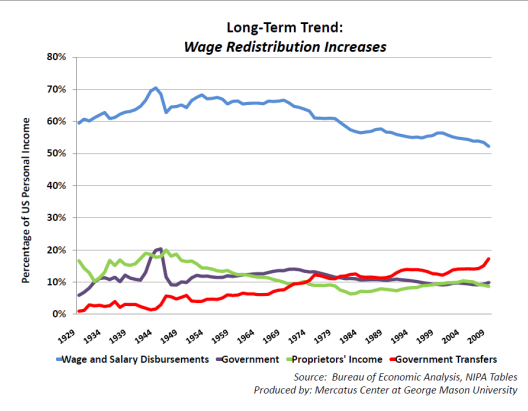
Veronique writes:

On this chart we can see the changes over time in the composition of personal income in the United States since 1929. The most notable trend is the increase in the portion of personal income coming from government transfers (mainly social Security payments, unemployment benefits, food stamps, and personal and business tax credits.)  And the increase isn’t minor: the proportion of total personal income constituted by government money has grown from 0.9% to 17.2%.

Complementary decreases of wage earnings as percentages of total personal income (from 59.5% to 52.3%) are also going on.

The problem with government giving people money is that it creates a culture of dependency, as with Greece. Politicians take money from job-creating business-owners, or from productive individual workers, and they redistribute it to whiny unproductive, immature victim groups like unions, in order to buy their votes. Eventually, the government goes too far making promises and the productive people just stop or slow their working or they move away, since they keep less and less of their own money for the same amount of work and risk-taking.

And that’s when welfare checks of the losers dry up, and they have no choice but to riot and kill people. Why do they riot? Well, if they were earning their own money by working, then they would know that they are responsible for themselves, not government. They would understand that something might go wrong, and they would know that they had to cut their spending and save for a rainy day. So when things do go bad, they would have known how to live cheaply off of their savings while they find another job.

But people who take welfare don’t save – they think the money will always be there. What do they do when the taxpayers slow or stop production? They have no skills, and they have no savings. They can’t just find a new government because a new government isn’t going to find any more money from somewhere – there isn’t any left. So the only way to get their welfare back is to revolt – which is exactly what the socialists in Greece are doing right now. They’ve been spoiled rotten and they want their welfare back, like little babies crying for their mommies.

It’s sick. And this is what Obama and the Democrats idolize, because that’s how they grew up – begging their rich parents for money and bailouts for their own irresponsible behaviors. Their policies aren’t thought through – it’s just reliving their silver spoon childhoods of never having to work for anything.

Would you like to know what Republicans are like? Consider Michele Bachmann.

At 13, Bachmann was forced to become almost financially independent after her parents divorced. She used her babysitting money to buy her own clothes and lunches at school and saved up enough to purchase her first pair of contact lenses. Between college semesters at Winona State University, she took her hardworking streak to Alaska where on one memorable day she cleaned 280 salmon.

She also quit her job as a tax litigation attorney to homeschool her five kids, because she didn’t like the job the public schools were doing. Her business runs a small business, and she helped him to start it. That’s what Republicans do. We work. And we give.

We need to stop increasing the size of government so they can “take care” of all our needs. We need to take care of all our needs, and to take care of our neighbor’s needs, too. That’s capitalism. Having something to share from what you can make from your own industry and labor.

MUST-SEE: Cowardly Richard Dawkins explains why he won’t debate William Lane Craig

Richard Dawkins explains why he will not debate William Lane Craig. (Posted by ChristianJR4, H/T Brian Auten of Apologetics 315)

Let’s re-cap Dawkins’ reasons in point form: (with my comments in parentheses)

  • Dawkins claims that he is willing to debate high-ranking clergymen (but Craig is a scholar, not a clergyman)
  • Dawkins claims that Craig is a creationist (but Craig supports his kalam cosmological argument with the Big Bang)
  • Dawkins claims that Craig’s only claim to fame is that he is a professional debater (but see Craig’s CV and publications below, which is far more prestigious than Dawkins)
  • Dawkins claims that he’s too busy (busy cowering in fear hugging his Darwin doll for comfort)

Let’s review William Lane Craig’s qualifications:

William Lane Craig is Research Professor of Philosophy at Talbot School of Theology in La Mirada, California.

Dr. Craig pursued his undergraduate studies at Wheaton College (B.A. 1971) and graduate studies at Trinity Evangelical Divinity School (M.A. 1974; M.A. 1975), the University of Birmingham (England) (Ph.D. 1977), and the University of Munich (Germany) (D.Theol. 1984). From 1980-86 he taught Philosophy of Religion at Trinity… In 1987 they moved to Brussels, Belgium, where Dr. Craig pursued research at the University of Louvain until assuming his position at Talbot in 1994.

He has authored or edited over thirty books, including The Kalam Cosmological Argument; Assessing the New Testament Evidence for the Historicity of the Resurrection of Jesus; Divine Foreknowledge and Human Freedom; Theism, Atheism and Big Bang Cosmology; and God, Time and Eternity, as well as over a hundred articles in professional journals of philosophy and theology, including The Journal of Philosophy, New Testament Studies, Journal for the Study of the New Testament, American Philosophical Quarterly, Philosophical Studies, Philosophy, and British Journal for Philosophy of Science.

Craig’s CV is here.

Craig’s list of publications is here.

Here are some of Craig’s most recent publications:

From 2007:

  • Ed. with Quentin Smith. Einstein, Relativity, and Absolute Simultaneity. Routledge Studies in Contemporary Philosophy. London: Routledge, 2007, 302 pp.
  • “Theistic Critiques of Atheism.” In The Cambridge Companion to Atheism, pp. 69-85. Ed. M. Martin. Cambridge Companions to Philosophy. Cambridge University Press, 2007.
  • “The Metaphysics of Special Relativity: Three Views.” In Einstein, Relativity, and Absolute Simultaneity, pp. 11-49. Ed. Wm. L. Craig and Quentin Smith. Routledge Studies in Contemporary Philosophy. London: Routledge, 2007.
  • “Creation and Divine Action.” In The Routledge Companion to Philosophy of Religion, pp. 318-28. Ed. Chad Meister and Paul Copan. London: Routledge, 2007.

From 2008:

  • God and Ethics: A Contemporary Debate. With Paul Kurtz. Ed. Nathan King and Robert Garcia. With responses by Louise Antony, Walter Sinnott-Armstrong, John Hare, Donald Hubin, Stephen Layman, Mark Murphy, and Richard Swinburne. Lanham, Md.: Rowman & Littlefield, 2008.
  • “Time, Eternity, and Eschatology.” In The Oxford Handbook on Eschatology, pp. 596-613. Ed. J. Walls. Oxford: Oxford University Press, 2008.

From 2009:

  • Ed. with J. P. Moreland. Blackwell Companion to Natural Theology. Oxford: Blackwell.
  • “The Kalam Cosmological Argument.” With James Sinclair. In Blackwell Companion to Natural Theology. Ed. Wm. L. Craig and J. P. Moreland. Oxford: Blackwell.
  • “In Defense of Theistic Arguments.” In The Future of Atheism: Alister McGrath and Daniel Dennett in Dialogue. Ed. Robert Stewart. Philadelphia: Fortress Press.

Forthcoming:

  • “The Cosmological Argument.” In Philosophy of Religion: Classic and Contemporary Issues. Ed. Paul Copan and Chad Meister. Cambridge: Blackwell.
  • “Cosmological Argument”; “Middle Knowledge.” In The Cambridge Dictionary of Christian Theology. Ed. G. Fergusson et al. Cambridge: Cambridge University Press.
  • “Divine Eternity.” In Oxford Handbook of Philosophical Theology. Ed. Thomas Flint and Michael Rea. Oxford: Oxford University Press.

Richard Dawkins is eminently qualified to debate uninformed clergymen, but he has too much at stake (in terms of book royalties) to disappoint his loyal horde of foam-flecked fundies by debating a professional scholar who has debated hundreds of times, against the top non-Christian scholars, in hundreds of universities, including Harvard, Cambridge and Oxford.

See that debate up there with Daniel Dennett? You can listen to Craig’s response to Daniel Dennett here. Or you can watch Craig’s debate with Christopher Hitchens. Then you’ll know why Dawkins soils his knickers at the thought of facing Craig in a public debate.

What are the real reasons why he won’t debate Craig?

I can think of three reasons why Dawkins would avoid a debate with Craig:

  1. He doesn’t know how to defend atheism and disprove theism in public
  2. He doesn’t have the intellectual capacity to understand logic and study evidence
  3. He doesn’t want to debate a real scholar and be humiliated in public, like Hitchens and Dennett

My opinion is that he is guilty of all 3 of these.

If you are an atheist, you should be ashamed to be represented by a LAZY, IGNORANT COWARD like Richard Dawkins.

Previous posts on Richard Dawkins and other New Atheists

Is it necessary to use words to preach the gospel?

The Pugnacious Irishman has some thoughts on it.

Here’s the problem he ran into at church last week:

The message today was a message that contradicts the biblical witness, yet it is a message I hear frequently in the 21st century.  I cannot see Jesus proclaiming the message that was proclaimed today.

[…]Our pastor’s main intention was to press home that our actions need to match our beliefs.

[…]Things started going off the rails, though, when a very obvious second message was proclaimed: the whole “actions-proclamation” dichotomy.

[…]Here’s why I say that: I thought I was just reading into the message, but that was put to rest when I heard the worship leader’s application: “go out and proclaim the gospel at all times.  Use words if necessary.”  He got it loud and clear.  When we got to my car, my wife, who is not an apologetics freak like myself (she’s normal, thank God!), turned to me and said, “I know what his intentions were, but do you get the notion that he was saying that you don’t need to talk to others about Jesus?”

Go here to read Rich’s answer to the problem.

I will surprise no one by stating that it is impossible to preach the gospel without using words, which is why Jesus used them, and why we have people writing letters, preaching sermons and disputing in public throughout the New Testament. In fact, it is literally impossible for someone to be saved without hearing about the life, death and resurrection of Jesus. The propositional content about these events is required, not optional.

Basically, the message of Christianity is that we are all sinful, and in need of a Lord and Savior so that we can be rightly related to God again. Works are just epiphenomena that occur after you have already been saved, showing that you really are saved. The message of the feminized church, on the other hand, is “do nice things because it makes you feel good, and it makes other people feel good – and that’s what Christianity is about”. So, saying things that make non-Christians feel bad, or that imply that they should be studying to change their beliefs is intolerant or harassment or a hate-crime.

Well, I haven’t been snarky, since, oh… yesterday. So let me tell you exactly why people in the feminized church emphasize actions instead of words, by referring to some of my favorite posts from way back when the blog started. That way, all you new readers can read stuff from back when I actually wrote really good posts on Christian apologetics, instead of really bad posts on politics.

Here are some of my thoughts on why people in church want to do nice things instead of telling others the good news and defending it against attacks. (If you only have time to read one of them read this one)