
Tag Archives: Law School

In Canada, Trinity Western University’s law school loses accreditation

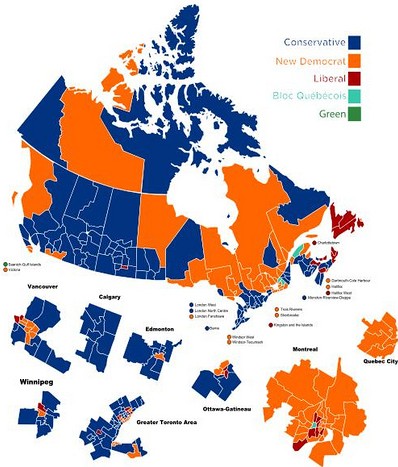
Canada election 2011: Consersvatives in Blue, Socialists in Red, Communists in Orange
2011 election: Conservatives in Blue, Socialists in Red, Communists in Orange

Canada legalized gay marriage in 2005, and they are about 10 years ahead of us in destroying religious liberty. Want to know what comes after a country legalizes same-sex marriage? Then look to Canada. Specifically, look to the financial hub of Canada, the very liberal province of Ontario.

The Daily Caller reports on it.

A court in Canada has upheld the denial of accreditation to a Christian law school, holding the private school’s prohibition of homosexual behavior is sufficiently discriminatory that its degrees can be invalidated for that reason alone.

Trinity Western University is a 4,000-student, evangelical Protestant college in the Vancouver suburb of Langley. It has been seeking to open a law school, but has struggled to obtain accreditation in several provinces. This difficulty is not based on the school’s academics, but rather is based on outside objections to the covenant the school makes all students and professors sign. The covenant, among other things, forbids all sex other than that within heterosexual marriage, a rule opponents say discriminates against both gays and those who do not believe in marriage.

The actual regulation says nothing about gay anything. It is just as much opposed to heterosexual extra-marital sex as it is to homosexual extra-marital sex. But somehow, in Canada, if you believe what the Bible teaches about sex, then you can’t practice law. Because rainbow flag, tolerance and diversity.

More:

Based on the rule, the Law Society of Upper Canada, which governs bar admission in Ontario, refused to accredit the school, meaning graduates would not be allowed to practice law in the province. Trinity sued, leading to Thursday’s decision.

In its ruling, the Ontario Superior Court found that the denial of accreditation did violate Trinity’s freedom of religion, but that this violation was acceptable because of the greater good of protecting equality.

[…]The court also held that individual evangelical Christians could not claim to have had their freedom violated by the ruling, because they could still attend law school elsewhere.

Got that? So gay people who want a wedding cake, wedding flowers, wedding venue, wedding photography, etc. ARE having their rights violated even though they can go elsewhere. But Christian students who want to attend Trinity ARE NOT having their rights violated when they have to go elsewhere. It’s “equal”, in the eyes of the secular left.

Let’s take a look at two 5-minute clips of the Ontario decision from two Canadian journalists.

Ezra Levant (who is Jewish):

Brian Lilley (who is Catholic):

In Canada, gay rights trump religious liberty rights.

But Canada is a different country, would the Democrats really be able to go after Christian schools the same way here?

This article from Campus Reform says yes.

Excerpt:

The recent Supreme Court opinion threatens the operations of religious colleges, according to a constitutional lawyer.

“If same-sex marriage is really the law of the land, if it’s really constitutionally required, isn’t there a risk that accrediting bodies are going to start pressuring religious colleges to recognize same-sex marriages for all purposes on their campuses as a condition of accreditation?” constitutional lawyer Gene Schaerr rhetorically asked Tuesday in his analysis of Obergefell v Hodges.

By the way, I don’t need to mention that many Christians in Canada voted for the bigger government over the last two decades, and that’s conservative Christianity is almost dead there. Why would “Christians” vote to expand for bigger secular government? Because Christians in Canada thought that it was the government’s job to take care of poverty and to give everyone “free health care”. When you ask a secular government to control more and more of our lives, this is what you get. Let me be clear: a “Christian” who favors bigger government favors the end of Christianity. Period. That clear enough for you?

Sherif Girgis: intellectual diversity in university law schools

Is there a diversity problem in elite law schools? Sherif Girgis thinks that there is, and in this lecture he makes the case.

(27 minutes of lecture, 6 minutes of Q&A)

I highly recommend watching this video, especially if you are on the left on social issues, and you think everyone on the right is stupid and evil.

Another looming debt crisis: law school students racking up $100,000+ in debt

Consider this scary article from the Competitive Enterprise Institute. (H/T Hans)

Excerpt: (links removed)

Federal financial aid policies haveencouraged law students to borrow increasing amounts to attend law school, despite the glut of lawyers (oddly, government policies encourage more people to go to law school, driving up law schooltuition, even as the Obama administration seeks to cut back on vocational education aimed at training the skilled blue-collar workers who are in desperately short supply in much of the country). The result, says law professor Brian Tamanaha, is a “Quickly Exploding Law Graduate Debt Disaster” in which most recent graduates of many law schools will never be able to pay off their staggering student loan debt. At the liberal Balkinization blog, Tamanaha notes that the average student has over $100,000 in debt just from law school at many schools…

[…]As one commenter noted earlier, federal financial aid and student loans have driven up law school tuition and student loan debt: “education loans . . . often have implicit government guarantees,” even those not explicitly backed by the government. As a result, “like the GSE’s, the supply of credit for education loans has continued to expand. So in a way colleges and universities, public and private have been in a bubble akin to the housing bubble. The benefits to the institutions are irresistible and so there is no way they will try to reign in costs and thus tuition. Not as long as students are willing and able to borrow.” When the bubble pops, taxpayers will be on the hook for countless billions of dollars (many graduates already are not repaying their student loans). “Why is college so expensive? A new study points to a disconcerting culprit: financial aid,” notes Paul Kix on page K1 of the March 25 Boston Globe. I and professors and education experts commented earlier on that study at Minding the Campus. Other studies also have concluded that increased federal financial aid, such as student loans, drives up college tuition, and you can find links to some of them here.

[…]When law school graduates are unable to pay off their student loans, lenders will come after their elderly parents who co-signed for the loans.  As the Washington Post notes, “Americans 60 and older still owe about $36 billion in student loans . . . Many have co-signed for loans with their children or grandchildren to help them afford ballooning tuition.”

According to the liberal New York Times, law schools do a woeful job of preparing students to practice law.

Excerpt:

The lesson today — the ins and outs of closing a deal — seems lifted from Corporate Lawyering 101.

“How do you get a merger done?” asks Scott B. Connolly, an attorney.

There is silence from three well-dressed people in their early 20s, sitting at a conference table in a downtown building here last month.

“What steps would you need to take to accomplish a merger?” Mr. Connolly prods.

After a pause, a participant gives it a shot: “You buy all the stock of one company. Is that what you need?”

“That’s a stock acquisition,” Mr. Connolly says. “The question is, when you close a merger, how does that deal get done?”

The answer — draft a certificate of merger and file it with the secretary of state — is part of a crash course in legal training. But the three people taking notes are not students. They are associates at a law firm called Drinker Biddle & Reath, hired to handle corporate transactions. And they have each spent three years and as much as $150,000 for a legal degree.

What they did not get, for all that time and money, was much practical training. Law schools have long emphasized the theoretical over the useful, with classes that are often overstuffed with antiquated distinctions, like the variety of property law in post-feudal England. Professors are rewarded for chin-stroking scholarship, like law review articles with titles like “A Future Foretold: Neo-Aristotelian Praise of Postmodern Legal Theory.”

So, for decades, clients have essentially underwritten the training of new lawyers, paying as much as $300 an hour for the time of associates learning on the job. But the downturn in the economy, and long-running efforts to rethink legal fees, have prompted more and more of those clients to send a simple message to law firms: Teach new hires on your own dime.

“The fundamental issue is that law schools are producing people who are not capable of being counselors,” says Jeffrey W. Carr, the general counsel of FMC Technologies, a Houston company that makes oil drilling equipment. “They are lawyers in the sense that they have law degrees, but they aren’t ready to be a provider of services.”

[…]Consider, for instance, Contracts, a first-year staple. It is one of many that originated in the Langdell era and endures today. In it, students will typically encounter such classics as Hadley v. Baxendale, an 1854 dispute about financial damages caused by the late delivery of a crankshaft to a British miller.

Here is what students will rarely encounter in Contracts: actual contracts, the sort that lawyers need to draft and file. Likewise, Criminal Procedure class is normally filled with case studies about common law crimes — like murder and theft — but hardly mentions plea bargaining, even though a vast majority of criminal cases are resolved by that method.

[…]“We should be teaching what is really going on in the legal system,” says Edward L. Rubin, a professor and former dean at the Vanderbilt Law School, “not what was going on in the 1870s, when much of the legal curriculum was put in place.”

Not only that, but the marketplace is saturated with lawyers already. When supply increases and demand decreases, prices fall. The new batch of lawyers are not going to be able to command the same salaries as the old batch.