Tag Archives: Joblessness

A critical evaluation of Obama’s economic narrative, using evidence

This article is currently the most popular one on Investors Business Daily.

Excerpt:

In making his case for re-election in the face of historically high unemployment and sluggish growth, President Obama has a simple and straightforward argument.

Things were terrible when I arrived, he says, thanks to Bush-era policies of tax cuts and deregulation. We stopped the decline, but the ditch was so deep that it will take time to get out. Still, we are making progress, even if it isn’t as fast as everyone would like.

So the last thing we want to do is return to the failed Bush policies that, he says, drove us into the ditch.

That argument appears to be working. More people continue to blame Bush than Obama for the current poor state of affairs, and some surveys show that consumer confidence has recently increased.

But each part of Obama’s argument is based on claims that are not accurate…

The article lists 5 claims made by Obama, and assesses each claim against the evidence.

Here are the 5 claims:

  1. Bush tax cuts and deregulation caused the recession.
  2. I stopped a second Great Depression.
  3. My policies are working.
  4. A slow recovery was inevitable.
  5. Nobody could have done any better.

And here’s the critique of point number one: (links removed)

At a campaign rally, Obama said Romney is “just churning out the same ideas that we saw in the decade before I took office . . . the same tax cuts and deregulation agenda that helped get us into this mess in the first place.”

It’s a standard Obama talking point. But it’s not true. Bush’s tax cuts did not cause the last recession.

In fact, once they were fully in effect in 2003, they sparked stronger growth — generating more than 8 million new jobs over the next four years, and GDP growth averaging close to 3%.

Those tax cuts didn’t explode the deficit, either, as Obama frequently claims. Deficits steadily declined after 2003, until the recession hit.

Nor was Bush a deregulator. Conservative Heritage Foundation’s regulation expert James Gattuso concluded, after reviewing Bush’s record, that “regulation grew substantially during the Bush years.”

Even the Washington Post’s fact-checker, Glenn Kessler, gave Obama’s claim three out of four “Pinocchios,” saying “it is time for the Obama campaign to retire this talking point, no matter how much it seems to resonate with voters.”

What did cause the economic crisis? The housing bubble. And that, in turn, was the result of a determined federal effort to boost homeownership by, among other things, pressuring banks to lower lending standards.

Now I know that some people (like Jerry) who get their policy news from the Comedy Channel think that the Bush tax cuts made the deficits explode, but of course, deficits were shrinking until the two spendthrifts Nancy Pelosi and Harry Reid got hold of the purse strings after taking the House and Senate in 2007.

Look:
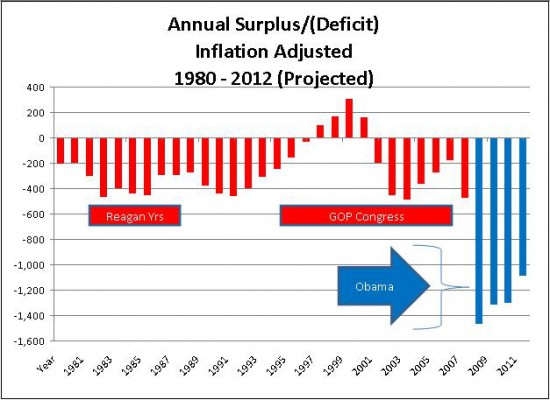
Barack Obama: Budget Deficits
Barack Obama: Budget Deficits – last GOP budget was 2007

Similarly, Obama clowns on the Comedy Channel and MSNBC also think that the Bush tax cuts made revenues go down.

Ooops:
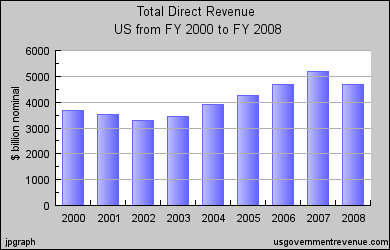
Did the Bush tax cuts make revenues decrease? No!

You can tune into MSNBC and the Comedy Channel on any given night and see the clowns there claiming that Bush’s $160 billion deficit in 2007 is actually higher than the $450 billion deficit in 2004, after the 2.2 trillion of tax cuts were passed.

Read the whole thing, it will help you to be persuasive when discussing Obama’s rhetoric. People aren’t saying that Romney won the debate because he had “zingers”. People are saying that Romney won the debate because he had facts and evidence. 

My prescription for voters in this election is more economics, and cut back on the Comedy Channel. Democrats must all buy Thomas Sowell’s “Basic Economics” and read that all the way through. I know that graphs aren’t as entertaining as Rachel Madclown, but we all must make an effort for the sake of the prosperity of our children, and our children’s children.

We must make the moral argument against dependence on government

Consider this article by Jackie Gingrich Cushman.

Full text:

The Obama administration’s policies are bad. Bad in the sense that the policies are morally corrupting. They take money and control away from people and give them to government bureaucrats, who then decide what should be done. The policies encourage people to be less responsible personally and to rely more on the government.

Former British Prime Minister Margaret Thatcher argued that “socialism itself — in all its incarnations, wherever and however it was applied — was morally corrupting,” Claire Berlinski wrote in “There Is No Alternative: Why Margaret Thatcher Matters” (Basic Books, 2008). “Socialism turned good citizens into bad ones; it turned strong nations into weak ones; it promoted vice and discouraged virtue … transformed formerly hardworking and self-reliant men and women into whining, weak and flabby loafers.”

Sound familiar?

Republicans are currently debating the surface arguments about the Obama administration’s programs — they cost too much, they are not paid for and there is too much government intervention.

The core of the matter is the same today as it was in Great Britain in the 1970s.

The system President Obama is championing is morally wrong.

In order to win in November, Republican nominee Mitt Romney must win the argument, and thereby win the vote.

The argument is that the system Obama is promoting is bad and that it creates a weak society. Romney needs to articulate what it is to be an American; why we must defend America’s core values; why they are good values.

Romney’s speech this week at the Clinton Global Initiative reverberated with these themes.

He talked about “the incomparable dignity of work.”

“Free enterprise,” he said, “has done more to bless humanity than any other economic system not only because it is the only system that creates a prosperous middle class, but also because it is the only system where the individual enjoys the freedom to guide and build his or her own life. Free enterprise cannot only make us better off financially, it can make us better people.”

Romney recounted the story of Muhammed Bouazizi of Tunisia. “He was just 26 years old. He had provided for his family since he was a young boy. He worked a small fruit stand, selling to passers-by. The regular harassment by corrupt bureaucrats was elevated one day when they took crates of his fruit and his weighing scales away from him.

“On the day of his protest, witnesses say that an officer slapped Bouazizi and he cried out: ‘Why are you doing this to me? I’m a simple person, and I just want to work.'”

“I just want to work,” Romney repeated.

“Work. That must be at the heart of our effort to help people build economies that can create jobs for people, young and old alike. Work builds self-esteem,” he continued. “It transforms minds from fantasy and fanaticism to reality and grounding. Work will not long tolerate corruption nor quietly endure the brazen theft by government of the product of hardworking men and women.”

He linked free enterprise to freedom. “The most successful countries shared something in common,” he said. “They were the freest. They protected the rights of the individual. They enforced the rule of law. And they encouraged free enterprise. They understood that economic freedom is the only force in history that has consistently lifted people out of poverty — and kept people out of poverty.”

The next step is for Romney to lay out this argument not only for other countries, but for our own. It works here as well as abroad. There are 12.5 million unemployed Americans; 8 million more are working part-time when they want to work full time; 2.6 million people are so discouraged that they have given up looking for work and are no longer counted as unemployed.

More than 23 million Americans understand the statement, “I just want to work.”

These people and those around them understand that there is great dignity in work, and want to work — but cannot find a job.

In order to win the vote in November, we must first win the argument. America works best when Americans are working. The way to get more Americans to work is to promote freedom, ingenuity and free enterprise. While government programs and subsidies might provide temporary relief, the only proven way to long-term prosperity is to create more jobs, thereby allowing people to lift themselves up, providing not only their monetary needs, but also dignity of purpose.

My biggest concern about socialism is how it makes it harder for men to be providers, and easier for women to do without a man – even having children without a man. I really oppose that – fatherlessness is not good for children.

Voting for Democrats means voting for bigger government which means voting for higher taxes to pay for it all. Higher taxes means that there is less money in the pockets of job creators, and that means fewer jobs. But it also that a married man can no longer retain enough of his earnings to support a family. And that means his wife has to work and won’t be able to take care of young children or her husband. Instead of learning the values of the parents, children will learn what the government schools decide they should learn. It’s a disaster. And it’s immoral. It’s immoral to take the provider role away from men and give it to a parasitical secular government. It destroys marriage and it destroys family.

Survey of small businesses: Obamacare is the biggest challenge to new hiring

From CNS News:

More than one in five businesses (21%) are considering dropping employee health insurance due to Obamacare, and 59% are considering changing the coverage they offer, a new industry survey shows.

Two-thirds (67%) of small businesses and manufacturers say Obamacare will increase their health care costs, the survey of owners and top decision-makers by the National Federation of Independent Business (NFIB) and National Association of Manufacturers (NAM) shows.

Of those providing health insurance to their employees, 38% fear Obamacare will cause them increase the amount employees have to pay for coverage.

Small business owners and manufacturers see Obamacare as one of the most daunting problems facing their businesses today. Fully 56% rate Obamacare a major challenge, well above other issues like regulatory costs (36%), energy costs (39%) – and more than twice the threat of foreign competition (25%).

The cost of health care is the top problem facing small businesses today, a separate 2012 NFIB survey of small business concerns shows, with 52.3% of small businesses rating rising health care costs the most “critical” problem today.

NFIB analysis also shows that Obamacare’s health insurance tax (HIT) could cost up to a quarter million (249,000) private sector jobs.

There is a reason why we have a 10.5% unemployment rate if we count people who have given up on looking for a job as unemployed. Businesses don’t like the policies of this President, and they are going to wait him out.