
Tag Archives: Jobless

9 reasons why the economy is not moving “forward” under Barack Obama

From the American Enterprise Institute.

Here’s the summary of the list of 9 items:

  1. Unemployment rate
  2. Declining U.S. labor force (structural unemployment/government dependency)
  3. Labor force participation rate
  4. Unemployment/population ratio
  5. Average hourly earnings of workers
  6. GDP growth
  7. Economic competitiveness
  8. Federal debt crisis
  9. Risk of renewed recession

And here’s the detail of one that I haven’t mentioned much before on this blog:

5. Average hourly earnings were unchanged in the August jobs report, and are up just 1.7% over the past year. Not only does that match the slowest pace on record, but one you account for inflation, wages are flat to down.

The graph:
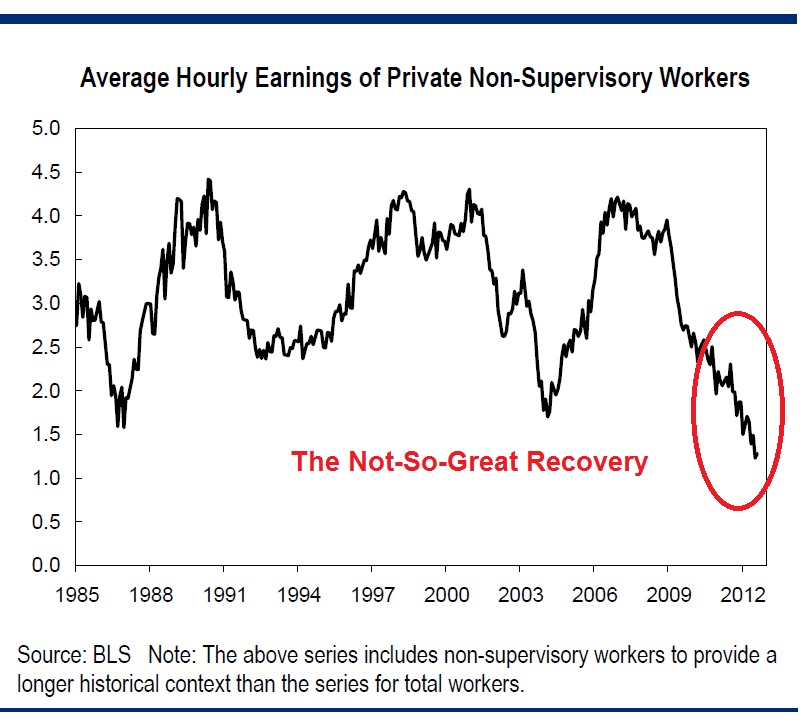
Average hourly earnings for American workers down under Obama
Average hourly earnings for workers way down under Obama

According to Forbes magazine: (H/T Gateway Pundit)

New income data from the Census Bureau reveal what a great job Barack Obama has done for the middle class as President. During his entire tenure in the oval office, median household income has declined by 7.3%.

In January, 2009, the month he entered office, median household income was $54,983. By June, 2012, it had spiraled down to $50,964. That’s a loss of $4,019 per family, the equivalent of losing a little less than one month’s income a year, every year. And on our current course that is only going to get worse not better…

[…]Three years into the Obama recovery, median family income had declined nearly 5% by June, 2012 as compared to June, 2009. That is nearly twice the decline of 2.6% that occurred during the recession from December, 2007 until June, 2009. As the Wall Street Journal summarized in its August 25-26 weekend edition, “For household income, in other words, the Obama recovery has been worse than the Bush recession.”

[…]Obama has failed the poor as well as the middle class. Last year, the Census Bureau reported more Americans in poverty than ever before in the more than 50 years that Census has been tracking poverty. Now The Huffington Post reports that the poverty rate is on track to rise to the highest level since 1965, before the War on Poverty began. A July 22 story by Hope Yen reports that when the new poverty rates are released in September, “even a 0.1 percentage point increase would put poverty at the highest level since 1965.”

Gateway Pundit adds:

Barack Obama is not just the food stamp president.
A record one in seven Americans is on food stamps today thanks to Barack Obama.

Barack Obama is also the poverty and pain president.
Under Obama, 6.4 million Americans are living below the poverty line and there is a record number of Americans living in deep poverty.

Meanwhile, Moody’s is threatening a credit downgrade:

Moody’s Investors Service said Tuesday that it would probably cut its triple-A rating on U.S. government debt by a notch unless congressional leaders can strike a budget deal in the coming months to bring down the deficit.

“If those negotiations lead to specific policies that produce a stabilization and then downward trend in the ratio of federal debt to GDP over the medium term, the rating will likely be affirmed,” Moody’s said in a press release Tuesday. “If those negotiations fail to produce such policies, however, Moody’s would expect to lower the rating, probably to Aa1.”

The threat comes after one of the other big three ratings firms, Standard & Poor’s, downgraded the U.S. last year following the brawl in Washington over the debt ceiling.

This would be the second credit downgrade – both occurred because of Obama’s Marxist policies of “spreading the wealth around” to punish job creators and their employees.

Are you better off now than you were four years ago?

CBO: Unemployment rises to 9.1% in 2013, health care spending doubles by 2022

Here are the raw numbers from the non-partisan Congressional Budget Office, as reported by CNS News:

The Congressional Budget Office (CBO) is projecting that if changes in federal taxing-and-spending policies already enacted and set to take effect at the beginning of next year do in fact take place, the unemployment rate will climb to 9.1 percent.

In a report released on Aug. 22, An Update to the Budget and Economic Outlook: Fiscal Years 2012 to 2022, CBO’s baseline projections show that by the fourth quarter of 2013 the national unemployment rate will be 9.1 percent.

[…]Widely referred to as the “fiscal cliff,” the expiration of the Bush tax cuts and over $1 trillion in automatic defense and discretionary cuts as a result of last year’s failed budget deal are set to take effect in January 2013.

[…]If no action is taken by Congress, current CBO projections show that unemployment will not return to pre-recession levels until 2017.

And more CBO: federal health care spending will exceed all discretionary spending by 2016:

Under current law, federal health care spending is on pace to exceed all discretionary spending by 2016, according to the Congressional Budget Office (CBO).

The change is due to large increases in Medicare and Medicaid spending and added spending under the Affordable Care Act (Obamacare) over the next decade, a feat the Tax Foundation calls a “truly unprecedented and scary” scenario.

The nonpartisan tax research group analyzed recent CBO projections of the budget for 2012 to 2022, finding that over the next decade Medicare spending will increase from $550 billion to $1.064 trillion, while Medicaid would more than double from $253 billion to $592 billion.

In addition, new exchanges and subsidies under Obamacare will force mandatory healthcare expenditures to grow from $25 billion to $181 billion in 2022.

“In total, healthcare entitlement spending is due to more than double, from $828 billion this year to $1.837 trillion in 2022,” according to the Tax Foundation.

“This means healthcare spending will overtake all discretionary spending in 2016 – Obama’s last year in office if reelected,” the group said.

And more CBO: taxes will shoot up by more than 30% between 2012 and 2014:

The amount of money the federal government takes out of the U.S. economy in taxes will increase by more than 30 percent between 2012 and 2014, according to the Budget and Economic Outlook published today by the CBO.

At the same time, according to CBO, the economy will remain sluggish, partly because of higher taxes.

“In particular, between 2012 and 2014, revenues in CBO’s baseline shoot up by more than 30 percent,” said CBO, “mostly because of the recent or scheduled expirations of tax provisions, such as those that lower income tax rates and limit the reach of the alternative minimum tax (AMT), and the imposition of new taxes, fees, and penalties that are scheduled to go into effect.”

The U.S. economy, CBO projects, will perform “below its potential” for another six years and unemployment will remain above 7 percent for another three.

And the GAO reports that the Obama administration has waived work requirements for welfare programs, which reduces revenues from employee income taxes and increases spending on welfare programs.

Now you might expect that the Democrats would have some bold plan to tackle unemployment, spending and high taxes. And they do!

Bold policy ideas at the Democrat National Convention

Take a look at this video on bold, innovative tax policy from the DNC convention:

That will fix unemployment for sure.

And they want to augment that tax policy with some reasonable pro-growth regulations:

If you don’t think that this is a good plan to solve our economic problems, then Democrats will say that you’re a racist homophobic Islamophobic sexist bigot.

Who pays the bill for handing out $2.2 trillion of entitlements per year?

This article by Nicholas Eberstadt is the most popular article on the Wall Street Journal right now. I found it through Doug Ross’ links.

First, a quick review of the entitlement situation:

What is monumentally new about the American state today is the vast empire of entitlement payments that it protects, manages and finances. Within living memory, the federal government has become an entitlements machine. As a day-to-day operation, it devotes more attention and resources to the public transfer of money, goods and services to individual citizens than to any other objective, spending more than for all other ends combined.

The growth of entitlement payments over the past half-century has been breathtaking. In 1960, U.S. government transfers to individuals totaled about $24 billion in current dollars, according to the Bureau of Economic Analysis. By 2010 that total was almost 100 times as large. Even after adjusting for inflation and population growth, entitlement transfers to individuals have grown 727% over the past half-century, rising at an average rate of about 4% a year.

In 2010 alone, government at all levels oversaw a transfer of over $2.2 trillion in money, goods and services. The burden of these entitlements came to slightly more than $7,200 for every person in America. Scaled against a notional family of four, the average entitlements burden for that year alone approached $29,000.

Government’s job used to be to handle responsibilities like roads and bridges or like defending us at home and to defending our national interests abroad. But now government seems to be more interested in redistributing money taken from job creating businesses and their workers to those don’t create jobs and those who don’t work. What happens when you punish people for trying to succeed and reward people who don’t even try?

This is the result of wealth redistribution:

The proud self-reliance that struck Alexis de Tocqueville in his visit to the U.S. in the early 1830s extended to personal finances. The American “individualism” about which he wrote did not exclude social cooperation—the young nation was a hotbed of civic associations and voluntary organizations. But in an environment bursting with opportunity, American men and women viewed themselves as accountable for their own situation through their own achievements—a novel outlook at that time, markedly different from the prevailing attitudes of the Old World (or at least the Continent).

The corollaries of this American ethos were, on the one hand, an affinity for personal enterprise and industry and, on the other, a horror of dependency and contempt for anything that smacked of a mendicant mentality. Although many Americans in earlier times were poor, even people in fairly desperate circumstances were known to refuse help or handouts as an affront to their dignity and independence. People who subsisted on public resources were known as “paupers,” and provision for them was a local undertaking. Neither beneficiaries nor recipients held the condition of pauperism in high regard.

Overcoming America’s historic cultural resistance to government entitlements has been a long and formidable endeavor. But as we know today, this resistance did not ultimately prove an insurmountable obstacle to establishing mass public entitlements and normalizing the entitlement lifestyle. The U.S. is now on the verge of a symbolic threshold: the point at which more than half of all American households receive and accept transfer benefits from the government. From cradle to grave, a treasure chest of government-supplied benefits is there for the taking for every American citizen—and exercising one’s legal rights to these many blandishments is now part of the American way of life.

As Americans opt to reward themselves ever more lavishly with entitlement benefits, the question of how to pay for these government transfers inescapably comes to the fore. Citizens have become ever more broad-minded about the propriety of tapping new sources of finance for supporting their appetite for more entitlements. The taker mentality has thus ineluctably gravitated toward taking from a pool of citizens who can offer no resistance to such schemes: the unborn descendants of today’s entitlement-seeking population.

We used to want to earn our own success. Now we want to live on the backs of children not yet born. Slavery is a horrible crime, no matter where it is practiced. Isn’t it a kind of slavery to live it up now and then pass the bill for it on to generations not even born yet? It strikes me as a kind of slavery – taking an unfair portion of the income of others so that we can live at a higher standard than what we can afford through our own choices and labor.