Tag Archives: Job Market

9 reasons why the economy is not moving “forward” under Barack Obama

From the American Enterprise Institute.

Here’s the summary of the list of 9 items:

  1. Unemployment rate
  2. Declining U.S. labor force (structural unemployment/government dependency)
  3. Labor force participation rate
  4. Unemployment/population ratio
  5. Average hourly earnings of workers
  6. GDP growth
  7. Economic competitiveness
  8. Federal debt crisis
  9. Risk of renewed recession

And here’s the detail of one that I haven’t mentioned much before on this blog:

5. Average hourly earnings were unchanged in the August jobs report, and are up just 1.7% over the past year. Not only does that match the slowest pace on record, but one you account for inflation, wages are flat to down.

The graph:
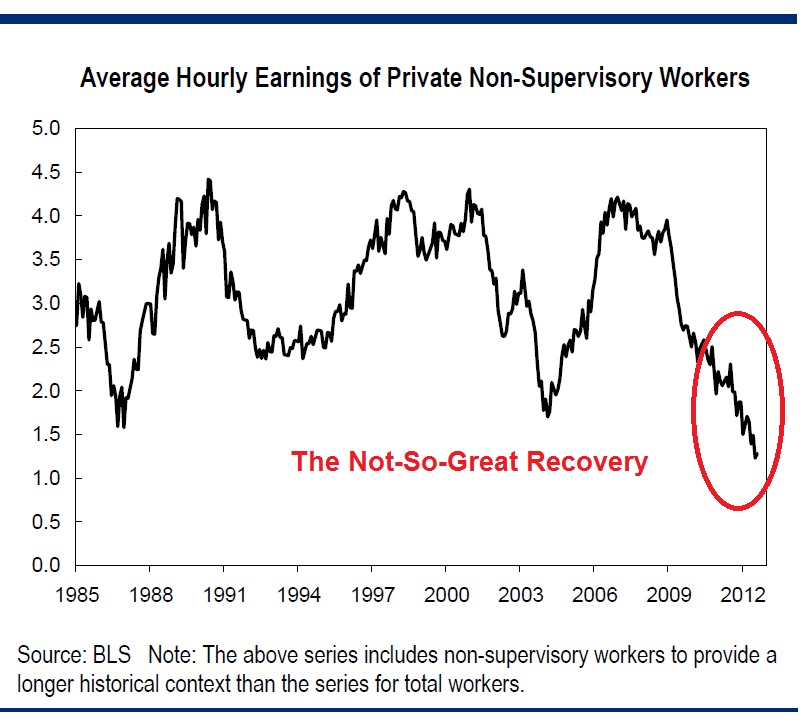
Average hourly earnings for American workers down under Obama
Average hourly earnings for workers way down under Obama

According to Forbes magazine: (H/T Gateway Pundit)

New income data from the Census Bureau reveal what a great job Barack Obama has done for the middle class as President. During his entire tenure in the oval office, median household income has declined by 7.3%.

In January, 2009, the month he entered office, median household income was $54,983. By June, 2012, it had spiraled down to $50,964. That’s a loss of $4,019 per family, the equivalent of losing a little less than one month’s income a year, every year. And on our current course that is only going to get worse not better…

[…]Three years into the Obama recovery, median family income had declined nearly 5% by June, 2012 as compared to June, 2009. That is nearly twice the decline of 2.6% that occurred during the recession from December, 2007 until June, 2009. As the Wall Street Journal summarized in its August 25-26 weekend edition, “For household income, in other words, the Obama recovery has been worse than the Bush recession.”

[…]Obama has failed the poor as well as the middle class. Last year, the Census Bureau reported more Americans in poverty than ever before in the more than 50 years that Census has been tracking poverty. Now The Huffington Post reports that the poverty rate is on track to rise to the highest level since 1965, before the War on Poverty began. A July 22 story by Hope Yen reports that when the new poverty rates are released in September, “even a 0.1 percentage point increase would put poverty at the highest level since 1965.”

Gateway Pundit adds:

Barack Obama is not just the food stamp president.
A record one in seven Americans is on food stamps today thanks to Barack Obama.

Barack Obama is also the poverty and pain president.
Under Obama, 6.4 million Americans are living below the poverty line and there is a record number of Americans living in deep poverty.

Meanwhile, Moody’s is threatening a credit downgrade:

Moody’s Investors Service said Tuesday that it would probably cut its triple-A rating on U.S. government debt by a notch unless congressional leaders can strike a budget deal in the coming months to bring down the deficit.

“If those negotiations lead to specific policies that produce a stabilization and then downward trend in the ratio of federal debt to GDP over the medium term, the rating will likely be affirmed,” Moody’s said in a press release Tuesday. “If those negotiations fail to produce such policies, however, Moody’s would expect to lower the rating, probably to Aa1.”

The threat comes after one of the other big three ratings firms, Standard & Poor’s, downgraded the U.S. last year following the brawl in Washington over the debt ceiling.

This would be the second credit downgrade – both occurred because of Obama’s Marxist policies of “spreading the wealth around” to punish job creators and their employees.

Are you better off now than you were four years ago?

Unemployed college graduates resort to unpaid internships

From the liberal New York Times, a story about how Obama’s young supporters are being forced into unpaid labor because there are no jobs.

Excerpt:

Although many internships provide valuable experience, some unpaid interns complain that they do menial work and learn little, raising questions about whether these positions violate federal rules governing such programs.

Yet interns say they often have no good alternatives. As Friday’s jobs report showed, job growth is weak, and the unemployment rate for 20- to 24-year-olds was 13.2 percent in April.

The Labor Department says that if employers do not want to pay their interns, the internships must resemble vocational education, the interns must work under close supervision, their work cannot be used as a substitute for regular employees and their work cannot be of immediate benefit to the employer.

But in practice, there is little to stop employers from exploiting interns. The Labor Department rarely cracks down on offenders, saying that it has limited resources and that unpaid interns are loath to file complaints for fear of jeopardizing any future job search.

No one keeps statistics on the number of college graduates taking unpaid internships, but there is widespread agreement that the number has significantly increased, not least because the jobless rate for college graduates age 24 and under has risen to 9.4 percent, the highest level since the government began keeping records in 1985. (Employment experts estimate that undergraduates work in more than one million internships a year, with Intern Bridge, a research firm, finding almost half unpaid.)

“A few years ago you hardly heard about college graduates taking unpaid internships,” said Ross Eisenbrey, a vice president at the Economic Policy Institute who has done several studies on interns. “But now I’ve even heard of people taking unpaid internships after graduating from Ivy League schools.”

Youth unemployment in America is about 20% for teens and college graduates. It’s the capitalists who provide those jobs – the same capitalists who the young have been taught to hate. The same capitalists now shifting their capital abroad because of Obama’s anti-business taxes, regulations, inflation and cronyism – which the young support. It’s anti-business socialism that causes outsourcing – if you tax and regulate and insult businesses here, they just shift their production somewhere else.

Recall what happened in 2008:

Strong support from young and minority voters propelled Barack Obama on the road to the White House, exit polls showed Tuesday.

Voters in the 18 to 24 age group broke 68 percent for Obama to 30 percent for John McCain, according to the exit polling. Those in the 25 to 29 age bracket went 69 percent to 29 percent in Obama’s favor.

The only age group where McCain prevailed was 65 and over, and that by just a 10-percentage-point margin, 54 percent to 44 percent, the exit polls showed.

Since the election, Obama has been piling up 5 trillion of debt for these poor ignorant fools to pay off. They will be working until they are in their 90s to pay off the retirement benefits and health care of their parents, but when it’s their turn to get Social Security and Medicare, the money will have run out. That’s what Obama offers young people. And surprisingly, they take it. What else can they do? All they know about the world are the slogans that their secular leftist teachers have taught them in school. America is evil. Tax the rich. Stop global warming. Chastity and marriage are sexist. These teachers are the ones who are relying on their little slaves to make them rich – not the corporations. The slaves rally believe in slavery, and they want to be slaves. They want to save the planet by voting for bigger government benefits for their unionized teachers.

Another looming debt crisis: law school students racking up $100,000+ in debt

Consider this scary article from the Competitive Enterprise Institute. (H/T Hans)

Excerpt: (links removed)

Federal financial aid policies haveencouraged law students to borrow increasing amounts to attend law school, despite the glut of lawyers (oddly, government policies encourage more people to go to law school, driving up law schooltuition, even as the Obama administration seeks to cut back on vocational education aimed at training the skilled blue-collar workers who are in desperately short supply in much of the country). The result, says law professor Brian Tamanaha, is a “Quickly Exploding Law Graduate Debt Disaster” in which most recent graduates of many law schools will never be able to pay off their staggering student loan debt. At the liberal Balkinization blog, Tamanaha notes that the average student has over $100,000 in debt just from law school at many schools…

[…]As one commenter noted earlier, federal financial aid and student loans have driven up law school tuition and student loan debt: “education loans . . . often have implicit government guarantees,” even those not explicitly backed by the government. As a result, “like the GSE’s, the supply of credit for education loans has continued to expand. So in a way colleges and universities, public and private have been in a bubble akin to the housing bubble. The benefits to the institutions are irresistible and so there is no way they will try to reign in costs and thus tuition. Not as long as students are willing and able to borrow.” When the bubble pops, taxpayers will be on the hook for countless billions of dollars (many graduates already are not repaying their student loans). “Why is college so expensive? A new study points to a disconcerting culprit: financial aid,” notes Paul Kix on page K1 of the March 25 Boston Globe. I and professors and education experts commented earlier on that study at Minding the Campus. Other studies also have concluded that increased federal financial aid, such as student loans, drives up college tuition, and you can find links to some of them here.

[…]When law school graduates are unable to pay off their student loans, lenders will come after their elderly parents who co-signed for the loans.  As the Washington Post notes, “Americans 60 and older still owe about $36 billion in student loans . . . Many have co-signed for loans with their children or grandchildren to help them afford ballooning tuition.”

According to the liberal New York Times, law schools do a woeful job of preparing students to practice law.

Excerpt:

The lesson today — the ins and outs of closing a deal — seems lifted from Corporate Lawyering 101.

“How do you get a merger done?” asks Scott B. Connolly, an attorney.

There is silence from three well-dressed people in their early 20s, sitting at a conference table in a downtown building here last month.

“What steps would you need to take to accomplish a merger?” Mr. Connolly prods.

After a pause, a participant gives it a shot: “You buy all the stock of one company. Is that what you need?”

“That’s a stock acquisition,” Mr. Connolly says. “The question is, when you close a merger, how does that deal get done?”

The answer — draft a certificate of merger and file it with the secretary of state — is part of a crash course in legal training. But the three people taking notes are not students. They are associates at a law firm called Drinker Biddle & Reath, hired to handle corporate transactions. And they have each spent three years and as much as $150,000 for a legal degree.

What they did not get, for all that time and money, was much practical training. Law schools have long emphasized the theoretical over the useful, with classes that are often overstuffed with antiquated distinctions, like the variety of property law in post-feudal England. Professors are rewarded for chin-stroking scholarship, like law review articles with titles like “A Future Foretold: Neo-Aristotelian Praise of Postmodern Legal Theory.”

So, for decades, clients have essentially underwritten the training of new lawyers, paying as much as $300 an hour for the time of associates learning on the job. But the downturn in the economy, and long-running efforts to rethink legal fees, have prompted more and more of those clients to send a simple message to law firms: Teach new hires on your own dime.

“The fundamental issue is that law schools are producing people who are not capable of being counselors,” says Jeffrey W. Carr, the general counsel of FMC Technologies, a Houston company that makes oil drilling equipment. “They are lawyers in the sense that they have law degrees, but they aren’t ready to be a provider of services.”

[…]Consider, for instance, Contracts, a first-year staple. It is one of many that originated in the Langdell era and endures today. In it, students will typically encounter such classics as Hadley v. Baxendale, an 1854 dispute about financial damages caused by the late delivery of a crankshaft to a British miller.

Here is what students will rarely encounter in Contracts: actual contracts, the sort that lawyers need to draft and file. Likewise, Criminal Procedure class is normally filled with case studies about common law crimes — like murder and theft — but hardly mentions plea bargaining, even though a vast majority of criminal cases are resolved by that method.

[…]“We should be teaching what is really going on in the legal system,” says Edward L. Rubin, a professor and former dean at the Vanderbilt Law School, “not what was going on in the 1870s, when much of the legal curriculum was put in place.”

Not only that, but the marketplace is saturated with lawyers already. When supply increases and demand decreases, prices fall. The new batch of lawyers are not going to be able to command the same salaries as the old batch.