
Tag Archives: Jay Richards

Is Obama right to say that technology destroys jobs?

From the Wall Street Journal, a rebuttal to the community organizer’s latest episode of economic illiteracy.

Excerpt:

Today, a couple of workers can manage an egg-laying operation of almost a million chickens laying 240,000,000 eggs a year. How can two people pick up those eggs or feed those chickens or keep them healthy with medication? They can’t. The hen house does the work—it’s really smart. The two workers keep an eye on a highly mechanized, computerized process that would have been unimaginable 50 years ago.

But should we call this progress? In a sense it sounds like a deal with the devil. Replace workers with machines in the name of lower costs. Profits rise. Repeat. It’s a wonder unemployment is only 9.1%. Shouldn’t the economy put people ahead of profits?

Well, it does. The savings from higher productivity don’t just go to the owners of the textile factory or the mega hen house who now have lower costs of doing business. Lower costs don’t always mean higher profits. Or not for long. Those lower costs lead to lower prices as businesses compete with each other to appeal to consumers.

The result is a higher standard of living for consumers. The average worker has to work fewer and fewer hours to earn enough money to buy a dozen eggs or a pair of shoes or a flat-screen TV or a new car that’s safer and gets better mileage than the cars of yesteryear. That higher standard of living comes from technology. It isn’t just the rich who get cheaper TVs and cars, plus the convenience of using an ATM at midnight.

Somehow, new jobs get created to replace the old ones. Despite losing millions of jobs to technology and to trade, even in a recession we have more total jobs than we did when the steel and auto and telephone and food industries had a lot more workers and a lot fewer machines.

Why do new jobs get created? When it gets cheaper to make food and clothing, there are more resources and people available to create new products that didn’t exist before. Fifty years ago, the computer industry was tiny. It was able to expand because we no longer had to have so many workers connecting telephone calls. So many job descriptions exist today that didn’t even exist 15 or 20 years ago. That’s only possible when technology makes workers more productive.

This is discussed more in Jay Richards’ book “Money, Greed and God“, which is an excellent little introduction to economics meant for Christians. The chapter you want is on “The Materialist Myth”, which is the idea that wealth is only ever shuffled around, and never created.
Jay Richards asks: what should Christians believe about global warming?

From Boundless.

Excerpt:

The big environmental issue nowadays is global warming. Anyone who watches or reads the news even occasionally has been told that humans are causing global warming through all the fossil fuels we’re burning. They’ve also been told that this warming process eventually will prove catastrophic if we don’t reverse course as soon as possible.

As thinking Christians and good stewards, how should we respond?

The short answer is, we should respond thoughtfully. Thoughtless stewards are rarely good stewards.

Notice that my brief summary of the global warming controversy bundled together several distinct claims. To think clearly about this issue, we have to tease apart this bundle of claims and consider each one. For each claim, there is a corresponding question we need to answer. And it’s only after answering these questions that we can be in a position to determine what, if anything, we ought to do about global warming.

Here are the four central questions:

  1. Is the earth warming?
  2. If the earth is warming, is human activity (like carbon dioxide emissions) causing it?
  3. If the earth is warming, and we’re causing it, is that bad overall?
  4. If the earth is warming, we’re causing it, and that’s bad, would any of the proposed “solutions” (e.g., the Kyoto Protocol, legislative restrictions on carbon dioxide emissions) make any difference?

If you like this article, you download a video of a lecture on this same topic, or listen to the audio from the lecture. The lecture was delivered at the University of California, Davis.

Intelligent Design conference in Oklahoma, March 25-26

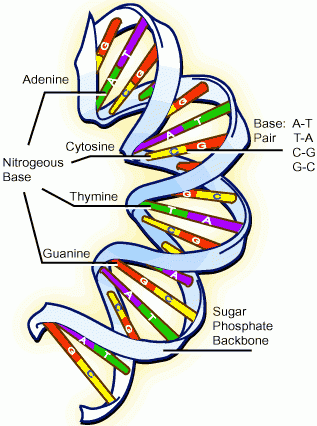
Structure of DNA
Structure of DNA

Information here at Evolution News. (H/T Apologetics 315)

Excerpt:

During the past decade, an increasing number of so-called “new atheists” have argued that human beings and the rest of nature are the products of chance and necessity rather than intelligent design. These “new atheists” typically base their ideas on Darwinian evolution, arguing that Darwin proved that nature is the product of a blind and unguided evolutionary process.

The message of the new atheists has spread far and wide. Just two years ago, thousands of students flocked to a lecture by leading new atheist Richard Dawkins at the University of Oklahoma. Dawkins famously contends that “Darwin made it possible to be an intellectually fulfilled atheist.” He received cheers and applause from the audience at OU.

The Darwinian view of nature has had a powerful impact on nearly every area of our culture. In public policy, it has encouraged the devaluation of human life. Among Christians, it has led some leading theologians and scientists to argue that God Himself doesn’t know how the history of life will turn out. And in science, Darwinian theory has encouraged the censorship of new scientific data as well as discrimination against scientists and students who think nature supplies evidence of intelligent design.

The good news is that the new atheists are wrong. Far from establishing a blind and purposeless universe, the findings of science increasingly provide powerful evidence that we live in a purpose-driven universe of incredible beauty and design.

On March 25-26 Oklahomans will have the chance to explore this evidence for themselves as four national experts come to Oklahoma to address the growing intersection between science and faith. Dr. Michael Behe, renowned biochemist and author of the books Darwin’s Black Box and The Edge of Evolution, will speak about the incredible design in the nanotechnology of the cell. Dr. Jay Richards, co-author of The Privileged Planet, will talk about how earth itself was intelligently designed for life and for scientific discovery. Dr. John West, author of Darwin Day in America and co-editor of The C.S. Lewis Readers’ Encyclopedia, will document the widespread impact of Darwin’s theory on society and faith. And lawyer Casey Luskin, co-author of Traipsing into Evolution: Intelligent Design and the Kitzmiller v. Dover Decision will outline positive steps you can take to stand for truth for you and your family.

Visit the event page here for more details.

If you don’t usually read Apologetics 315, you really need to check out the Friday round-up of all the week’s news.

Other conferences