Tag Archives: Intergenerational Theft

New study finds that many young people won’t purchase Obamacare plans

Dr. David Hogberg of the National Center for Public Policy Research explains how Obamacare affects young people.

Here’s the executive summary:

If the ObamaCare health insurance exchanges are to function properly, it is crucial that a substantial number of people ages 18-34 join them. This age group that is young and relatively healthy must purchase health insurance on the exchanges in order to “cross-subsidize” people who are older and sicker. Without the young and healthy, the exchanges will enter a “death spiral” where only the older and sicker participate and price of insurance premiums will increase precipitously.

This study finds that in 2014 many single people aged 18-34 who do not have children will have a substantial financial incentive to forego insurance on the exchanges and instead pay the individual mandate penalty of $95 or one percent of income. About 3.7 million of those ages 18-34 will be at least $500 better off if they forgo insurance and pay the penalty. More than 3 million will be $1,000 better off if they go the same route. This raises the likelihood that an insufficient number of young and healthy people will participate in the exchanges, thereby leading to a death spiral. 

The design of the plan is to tax younger, healthier people – especially men – in order to obtain the money to pay for heavy users of health care.

To compel the young and healthy to purchase insurance, the architects of ObamaCare included an individual mandate that requires individuals to either buy insurance or pay a penalty. The penalty, which increases over time, is whichever is greater: $95 or one percent of income in 2014, $325 or two percent of income in 2015, and $695 or 2.5 percent of income in 2016 and thereafter.

[…]The gender breakdown of these individuals presents another problem. Women have higher rates of health utilization than men, including more visits to primary-care physicians and greater use of diagnostic tests and emergency care. However, as Table 3 shows, roughly two-thirds of the individuals for whom insurance will cost at least $1,000 more than the fine are men.

Hard to see why any young man would have voted Democrat, and yet many did. Did they know that they were voting for a tax on themselves at a time when many of them are poorly educated by government-run schools, and can’t even find jobs? How can you pay a fine for not having health care when you don’t have a proper education or a proper job?

The net effect of the “community rating” and “guaranteed issue” provisions of Obamacare will be to raise health insurance premiums and force private companies to stop offering plans:

If the exchanges do not attract a sufficient number of people in the 18-34 age demographic, they will eventually enter an insurance “death spiral.” This occurs when the young and healthy drop out of the “insurance pool.” This leads to “adverse selection” in which insurance is only attractive to those who are generally older and sicker. If the insurance pool is comprised largely of people who are older and sicker, then insurance prices will rise to cover their costs. That rate increase causes even more young and healthy people drop their insurance, leaving the pools even older and sicker than before, and so on. Eventually, all but a few insurers will be forced to discontinue their business on the exchanges because they can no longer make a profit. Fewer insurers means less competition, resulting in even higher insurance premiums.

Community rating and guaranteed issue are catalysts for a death spiral. In its strictest form, community rating means that insurers must charge everyone the same premium, regardless of factors such as health status and age. Guaranteed issue means that an insurer must sell a policy to a consumer anytime.

Under ObamaCare, the exchanges use a modified version of both of these regulations. Its form of community rating doesn’t allow insurers to vary rates based on health status. It does allow, however, for modification of premiums if one smokes and to compensate for age (although in a more restricted manner than the market currently does). Regarding guaranteed issue, insurers must sell policies to all comers but (with a few exceptions) only during the annual open enrollment period from October to December.

Both of these rules give young and healthy people big incentives to forgo insurance coverage altogether. Community rating means young people have a reduced incentive to buy insurance since they will pay a premium that is above the market rate. Many who are currently purchasing insurance in the individual market, for example, will see a substantial premium increase if they switch to the exchange.

In a market without guaranteed issue, consumers run the risk of insurers not selling them policies when they get seriously ill. But that risk is largely gone under the exchanges. For instance, a young person who gets a serious illness in June only has to wait until October to sign up for insurance and then wait until January 1 of the next year to receive coverage. Combined, community rating and guaranteed issue give the young and healthy big incentives to forgo insurance until they are sick.

“Community rating” and “guaranteed issue” have actually already been tried at the state level. What happened then?

This:

The late Conrad Meier, then a senior fellow in health care policy for the Heartland Institute, examined what happened when these two regulations were instituted on the state level in his 2005 monograph “Destroying Insurance Markets.” In the early 1990s eight states — Kentucky, Maine, Massachusetts, New Hampshire, New Jersey, New York, Vermont and Washington — imposed community rating and guaranteed issue on their individual insurance markets. The result, according to Meier, was the above-described death spiral.

For example, in 1992 the New Jersey legislature adopted community rating and guaranteed issue rules for its individual insurance market with the passage of the “Individual Health Coverage Program.” The monthly premium for family coverage from Aetna rose from $769 in 1994 to $6,005 in 2005, a whopping increase of 683 percent! Other insurers saw similar increases.

Before the reforms began, there were about 28 insurers covering the New Jersey individual market. By 2007 there were only seven. According to the Census Bureau, the number of people in New Jersey’s individual market fell from about 998,000 in 1994 to 630,000 in 2005, a decline of 37 percent.

It’s pretty clear that Obamacare was designed to replicate this same effect that’s been observed in states at a national level, paving the way for single payer health care. What will Americans think when their healthcare is controlled by the kind of people who run USPS, Amtrak, the Bureau of Motor Vehicles and the IRS? 
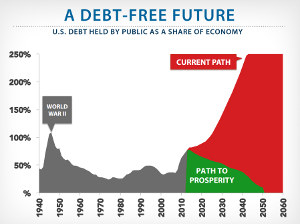
Let the grown-ups lead: Paul Ryan describes his proposal to balance the budget

Paul Ryan's Balanced Budget Proposal
Paul Ryan’s Balanced Budget Proposal

In the Wall Street Journal.

Excerpt:

America’s national debt is over $16 trillion. Yet Washington can’t figure out how to cut $85 billion—or just 2% of the federal budget—without resorting to arbitrary, across-the-board cuts. Clearly, the budget process is broken. In four of the past five years, the president has missed his budget deadline. Senate Democrats haven’t passed a budget in over 1,400 days. By refusing to tackle the drivers of the nation’s debt—or simply to write a budget—Washington lurches from crisis to crisis.

House Republicans have a plan to change course. On Tuesday, we’re introducing a budget that balances in 10 years—without raising taxes. How do we do it? We stop spending money the government doesn’t have. Historically, Americans have paid a little less than one-fifth of their income in taxes to the federal government each year. But the government has spent more.

So our budget matches spending with income. Under our proposal, the government spends no more than it collects in revenue—or 19.1% of gross domestic product each year. As a result, we’ll spend $4.6 trillion less over the next decade.

Our opponents will shout austerity, but let’s put this in perspective. On the current path, we’ll spend $46 trillion over the next 10 years. Under our proposal, we’ll spend $41 trillion. On the current path, spending will increase by 5% each year. Under our proposal, it will increase by 3.4%. Because the U.S. economy will grow faster than spending, the budget will balance by 2023, and debt held by the public will drop to just over half the size of the economy.

Yet the most important question isn’t how we balance the budget. It’s why. A budget is a means to an end, and the end isn’t a neat and tidy spreadsheet. It’s the well-being of all Americans. By giving families stability and protecting them from tax hikes, our budget will promote a healthier economy and help create jobs. Most important, our budget will reignite the American Dream, the idea that anyone can make it in this country.

The truth is, the nation’s debt is a sign of overreach. Government is trying to do too much, and when government does too much, it doesn’t do anything well. So a balanced budget is a reasonable goal, because it returns government to its proper limits and focus. By curbing government’s overreach, our budget will give families the space they need to thrive.

Since Obama was elected, he’s added over $5.5 trillion to the national debt. This is not sustainable. We cannot continue to pass on enormous levels of debt to our children so that 30-year-old students can have free condoms bought for them. It is immoral to spend trillions of dollars and then pass the bill to the next generation. Democrats like to talk about helping the children, but really they just want to force them to pay for their wasteful spending. It’s got to stop.

Who pays the bill for handing out $2.2 trillion of entitlements per year?

This article by Nicholas Eberstadt is the most popular article on the Wall Street Journal right now. I found it through Doug Ross’ links.

First, a quick review of the entitlement situation:

What is monumentally new about the American state today is the vast empire of entitlement payments that it protects, manages and finances. Within living memory, the federal government has become an entitlements machine. As a day-to-day operation, it devotes more attention and resources to the public transfer of money, goods and services to individual citizens than to any other objective, spending more than for all other ends combined.

The growth of entitlement payments over the past half-century has been breathtaking. In 1960, U.S. government transfers to individuals totaled about $24 billion in current dollars, according to the Bureau of Economic Analysis. By 2010 that total was almost 100 times as large. Even after adjusting for inflation and population growth, entitlement transfers to individuals have grown 727% over the past half-century, rising at an average rate of about 4% a year.

In 2010 alone, government at all levels oversaw a transfer of over $2.2 trillion in money, goods and services. The burden of these entitlements came to slightly more than $7,200 for every person in America. Scaled against a notional family of four, the average entitlements burden for that year alone approached $29,000.

Government’s job used to be to handle responsibilities like roads and bridges or like defending us at home and to defending our national interests abroad. But now government seems to be more interested in redistributing money taken from job creating businesses and their workers to those don’t create jobs and those who don’t work. What happens when you punish people for trying to succeed and reward people who don’t even try?

This is the result of wealth redistribution:

The proud self-reliance that struck Alexis de Tocqueville in his visit to the U.S. in the early 1830s extended to personal finances. The American “individualism” about which he wrote did not exclude social cooperation—the young nation was a hotbed of civic associations and voluntary organizations. But in an environment bursting with opportunity, American men and women viewed themselves as accountable for their own situation through their own achievements—a novel outlook at that time, markedly different from the prevailing attitudes of the Old World (or at least the Continent).

The corollaries of this American ethos were, on the one hand, an affinity for personal enterprise and industry and, on the other, a horror of dependency and contempt for anything that smacked of a mendicant mentality. Although many Americans in earlier times were poor, even people in fairly desperate circumstances were known to refuse help or handouts as an affront to their dignity and independence. People who subsisted on public resources were known as “paupers,” and provision for them was a local undertaking. Neither beneficiaries nor recipients held the condition of pauperism in high regard.

Overcoming America’s historic cultural resistance to government entitlements has been a long and formidable endeavor. But as we know today, this resistance did not ultimately prove an insurmountable obstacle to establishing mass public entitlements and normalizing the entitlement lifestyle. The U.S. is now on the verge of a symbolic threshold: the point at which more than half of all American households receive and accept transfer benefits from the government. From cradle to grave, a treasure chest of government-supplied benefits is there for the taking for every American citizen—and exercising one’s legal rights to these many blandishments is now part of the American way of life.

As Americans opt to reward themselves ever more lavishly with entitlement benefits, the question of how to pay for these government transfers inescapably comes to the fore. Citizens have become ever more broad-minded about the propriety of tapping new sources of finance for supporting their appetite for more entitlements. The taker mentality has thus ineluctably gravitated toward taking from a pool of citizens who can offer no resistance to such schemes: the unborn descendants of today’s entitlement-seeking population.

We used to want to earn our own success. Now we want to live on the backs of children not yet born. Slavery is a horrible crime, no matter where it is practiced. Isn’t it a kind of slavery to live it up now and then pass the bill for it on to generations not even born yet? It strikes me as a kind of slavery – taking an unfair portion of the income of others so that we can live at a higher standard than what we can afford through our own choices and labor.